


What Is an Intrinsically Safe Device? Energy and Heat Limits
What if an instrument’s safety comes from preventing ignition rather than containing an explosion? Understanding what an intrinsically safe device is starts with its core principle: limiting electrical energy and heat so they cannot ignite a hazardous atmosphere. Protection applies to the complete system, not just the device in isolation.
That distinction matters when selecting measurement equipment for areas where flammable gas or dust may be present. Intrinsic safety is one protection approach. Flameproof equipment differs because its enclosure is designed to contain an internal explosion.
This guide explains how energy and temperature limits work, how intrinsic safety differs from flameproof protection, and how hazardous-area classifications affect equipment suitability. It also covers intrinsically safe measurement products, including multifunction calibrators, to clarify where this equipment fits in Australian industrial testing.
Key Takeaways
- Identify whether the hazardous atmosphere involves gas, vapour or dust, then consider its zone classification when assessing equipment suitability.
- Look beyond a device’s label: intrinsic safety depends on the design of the complete electrical system, including its connected components and wiring.
- Distinguish protection methods by how they manage ignition risk: intrinsic safety limits available energy, while flameproof protection contains an internal explosion.
- For measurement work in hazardous areas, consider whether an intrinsically safe multifunction calibrator suits the task and the area’s requirements.
What is Intrinsically Safe Equipment?
Intrinsic safety is a hazardous-area protection method that limits electrical energy and heat to prevent ignition. It matters where flammable gases, vapours or dust could meet an electrical source.
Hazardous Areas and Combustible Materials
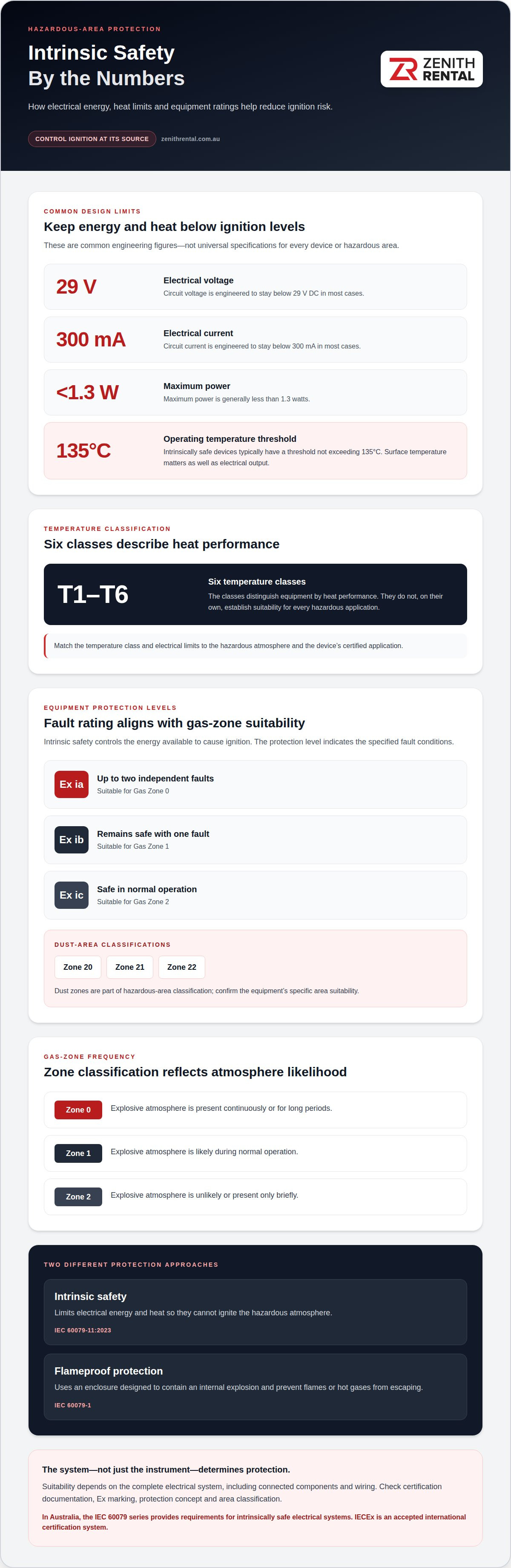
A hazardous area is a location where combustible material can mix with air and form an atmosphere that may ignite. Examples include industrial sites where flammable gases or vapours can escape, and places where combustible dust is present. In environments such as fuel forecourts—where platforms like Fuel360 help operators coordinate daily station management—maintaining strict control over electrical ignition sources is essential. Zone classifications describe how often an explosive atmosphere may occur. Zone 0 means it is present continuously or for long periods; Zone 1 means it is likely during normal operation. Zone 2 means it is unlikely or present only briefly. The classification helps determine which protection method and equipment rating are suitable.
Sparks, Overheating and Short Circuits
A spark, hot surface or short circuit can supply an ignition source where flammable gases, vapours or dust are present. A circuit fault can also release electrical energy or create heat, making equipment condition and system design relevant to hazardous-area safety. Intrinsic safety aims to keep energy and temperature low enough to prevent ignition, including under defined fault conditions. This matters when electrical instruments operate near combustible materials, where a small source of ignition can have serious consequences.
Intrinsic Safety as Hazardous-Area Protection
An intrinsically safe device is designed to prevent sparks or heat from reaching levels capable of ignition, including under specified fault conditions. Its protection depends on the complete system, including connected components and wiring, not on a device certificate alone. This approach is used in hazardous industrial environments because it controls ignition risk at its source. IECEx is an internationally recognised certification system accepted in Australia and many other countries, helping identify equipment assessed for explosive atmospheres.
Certification, Ratings and Area Classifications
To identify certified equipment, look for its certification documentation and Ex marking, including the protection concept and area suitability. In Australia, the IEC 60079 series provides requirements for intrinsically safe electrical systems, and IECEx is an accepted international certification system. Ex ia remains safe with up to two independent faults and suits Zone 0; Ex ib remains safe with one fault and suits Zone 1; Ex ic is safe in normal operation and suits Zone 2. For dust, corresponding hazardous-area classifications include Zones 20, 21 and 22. These ratings help match equipment to the area classification and the likelihood of an explosive atmosphere.
Energy and temperature limits
Intrinsic safety limits electrical energy and heat to reduce the chance that a circuit will ignite a potentially explosive atmosphere. The applicable limits depend on the equipment’s protection design and temperature classification.
Limiting Electrical and Thermal Energy
Electrical limits reduce the energy available to create a spark, while thermal limits restrict heat from reaching combustible material’s ignition temperature. In most cases, intrinsically safe equipment is engineered to keep circuit voltage below 29 V DC and current below 300 mA. Maximum power is generally less than 1.3 watts. These figures describe common design limits, not a universal specification for every device or hazardous area.
Heat matters as well as voltage and current. A circuit may avoid sparking yet still present an ignition risk if a surface becomes too hot. Intrinsically safe devices typically have an operating temperature threshold not exceeding 135°C. The applicable temperature class indicates the maximum surface temperature equipment can reach, helping match protection to the surrounding atmosphere.
Low-Energy Protection and Its Risks
Low-energy protection keeps electrical and thermal output below levels capable of igniting the materials present. What are the limits and risks of using intrinsically safe devices? Limits vary by protection design and temperature class. Unsuitable equipment, damage or circuit changes can undermine the intended protection, so a low-energy rating alone does not establish suitability for every hazardous environment.
Six classes define temperature levels for intrinsically safe electronics, ranging from T1 to T6. Temperature classes indicate equipment’s heat performance, but they do not by themselves establish suitability for every hazardous application. These classes help distinguish equipment by heat performance, but the right rating depends on the hazardous atmosphere and the device’s certified application. Consider both electrical output and surface temperature when interpreting a device’s protection marking.
What is the Difference Between Flameproof and Explosion Proof?
Intrinsic safety prevents ignition by limiting electrical energy entering a hazardous area. Flameproof and explosion-proof protection take a different approach: their enclosures contain an internal explosion and prevent flames or hot gases from escaping. This distinction affects equipment design, installation and suitability for an industrial location. Intrinsic safety controls the energy that could start ignition; enclosure-based protection contains an explosion.
Explosion-proof equipment uses a rugged enclosure designed to withstand pressure from an internal explosion without rupturing. Flameproof protection is a specific enclosure-based method addressed by IEC 60079-1. Intrinsic safety is addressed by IEC 60079-11:2023. These methods address ignition risk differently, so they aren’t interchangeable labels. A measurement instrument suitable for one protection concept may not suit another hazardous environment or installation.
Intrinsically safe products must be installed with a barrier that regulates electrical energy entering the hazardous area. A Zener barrier can divert excess energy, but it requires a dedicated, high-integrity grounding system to dissipate that energy safely. Isolators can also serve as associated safety components, but the selected barrier or isolator must match the equipment and system design. Certifying separate components alone does not establish that the complete arrangement is safe.
How do I select and install an intrinsically safe device and its associated barrier? Start with the hazardous-area classification and the device’s protection marking, then match the barrier’s electrical characteristics to the complete circuit. Installation should follow the system design and applicable IEC 60079 requirements, including any grounding needs for a Zener barrier. Document the components and wiring together, because changing one part can affect the system’s intrinsic-safety protection.
Intrinsic safety can sometimes replace explosion-proof equipment, but not in every situation. A low-energy instrument may suit an application when the complete system meets the area’s requirements; an enclosure-based approach may be appropriate elsewhere. Key considerations include area classification, equipment certification, circuit design and installation conditions. Assessing them together helps align the protection method with the task.
Intrinsically safe measurement products
Intrinsically safe measurement products bring measurement functions into hazardous areas while controlling ignition risk. For example, an intrinsically safe multifunction calibrator can support calibration work when the equipment and its complete circuit are suitable for the classified area. Its designation does not automatically make every connected instrument or lead suitable.
Start product selection with the measurement task. A calibrator used to test electrical signals has a different role from equipment that measures power quality or transformer oil breakdown voltage. For any instrument, check whether its certification covers the intended hazardous area and connection arrangement. A standard industrial instrument may perform the measurement, but performance alone does not establish intrinsic-safety suitability.
Consider the whole measurement arrangement: the instrument, leads, connected equipment and any associated barriers or isolators. Barriers regulate electrical energy entering the hazardous area, so an incorrect pairing can affect the system’s protection. Enclosures also matter, but intrinsic safety does not rely on an enclosure containing an explosion. The measurement setup must instead control available energy and thermal output, including under the conditions covered by its certification.
Temperature and voltage are useful details when reading product documentation. Temperature classes distinguish equipment by its maximum surface temperature, while electrical ratings describe relevant circuit limits. Read these values alongside the product’s protection marking and area classification, rather than treating them as proof on their own. A device suitable for one classified location may not suit another.
Match the instrument’s certified protection, measurement function and connected components to the job. An intrinsically safe multifunction calibrator is relevant when calibration work must be done in a hazardous area, provided the complete arrangement is suitable. Consider both measurement needs and the protection design; low voltage or a robust enclosure alone does not establish that an instrument is safe for the application.
Zenith Rental: Intrinsically safe multifunction calibrator hire
Zenith Rental offers intrinsically safe multifunction calibrator hire for measurement and calibration work in hazardous areas. It is an option when the task calls for a multifunction calibrator suited to the classified area and intended setup.
For other testing requirements, Zenith Rental also offers Test Equipment Rental, Electrical Test Equipment Calibrator hire, and power and energy testing equipment hire. Begin by identifying the measurement task and the area’s requirements, then ensure the complete connected system matches the intended protection approach.
For intrinsically safe multifunction calibrator hire, contact Zenith Rental to discuss your equipment requirements.
Plan the right equipment for your next task
Turn your understanding of what an intrinsically safe device is into a practical equipment decision: consider the measurement task, hazardous-area classification and complete setup. This gives your team a clearer basis for planning equipment needs alongside the work, rather than treating the instrument as an isolated choice.
Zenith Rental offers Test Equipment Rental, Electrical Test Equipment Calibrator hire, and Power and energy testing equipment hire. For calibration work in a hazardous area, an intrinsically safe multifunction calibrator may suit the task when its protection matches the intended application. Choose equipment based on the purpose of the test and the instrument needed to perform it.
Share your equipment requirements with Zenith Rental to discuss a suitable hire option. A considered selection can help your next testing task proceed with greater clarity and confidence.
Contact Zenith Rental for equipment advice
Frequently Asked Questions
Why is Intrinsic Safety Important?
Intrinsic safety helps reduce the chance that electrical equipment will ignite a flammable atmosphere in a hazardous area. For example, a measurement instrument used where combustible gas may be present needs protection suited to that location. Matching the equipment and full system to the area classification supports safer industrial work and helps avoid relying on an instrument’s appearance or ordinary operating condition alone.
How Does It Work?
Intrinsic safety works by controlling the electrical energy and heat available in an instrument and its connected circuit. The design considers components and wiring together, including conditions that may arise from faults. For example, a barrier can regulate energy entering the hazardous area from associated circuits. The equipment’s protection marking and classification indicate the environments for which its design has been assessed.
Why do I need safety barriers if the device itself is considered safe?
A barrier regulates electrical energy entering the hazardous area from connected circuits, so protection depends on more than the device’s design. A field instrument connected to unsuitable equipment or wiring may form a system that does not retain the intended protection. A Zener barrier also relies on a dedicated, high-integrity grounding system to dissipate excess energy safely.
What does intrinsically safe mean for an electrical device?
It means an electrical device is designed to limit ignition-capable electrical and thermal energy for its intended hazardous-area application. The phrase “what an intrinsically safe device is” describes a protection approach, not a guarantee that a device is suitable everywhere. Certification, protection marking, connected components and wiring all matter when using the instrument in a particular classified location.
How does intrinsic safety prevent ignition in hazardous areas?
Intrinsic safety reduces the energy available to create an ignition source, such as a circuit spark or heat from a component. For example, an intrinsically safe measurement setup uses equipment and associated components designed to control energy reaching the hazardous area. This approach addresses ignition at its source rather than relying on an enclosure to contain an explosion after ignition.
What is the difference between intrinsically safe and explosion-proof equipment?
Intrinsically safe equipment limits energy that could ignite an explosive atmosphere. Explosion-proof equipment uses an enclosure designed to contain an internal explosion and prevent flames or hot gases from escaping. These are distinct protection concepts, not interchangeable descriptions. The suitable approach depends on the hazardous-area classification, equipment protection marking, and the design and installation of the complete system.