


The Ultimate Electrical Commissioning Equipment List for Australian Industry 2026
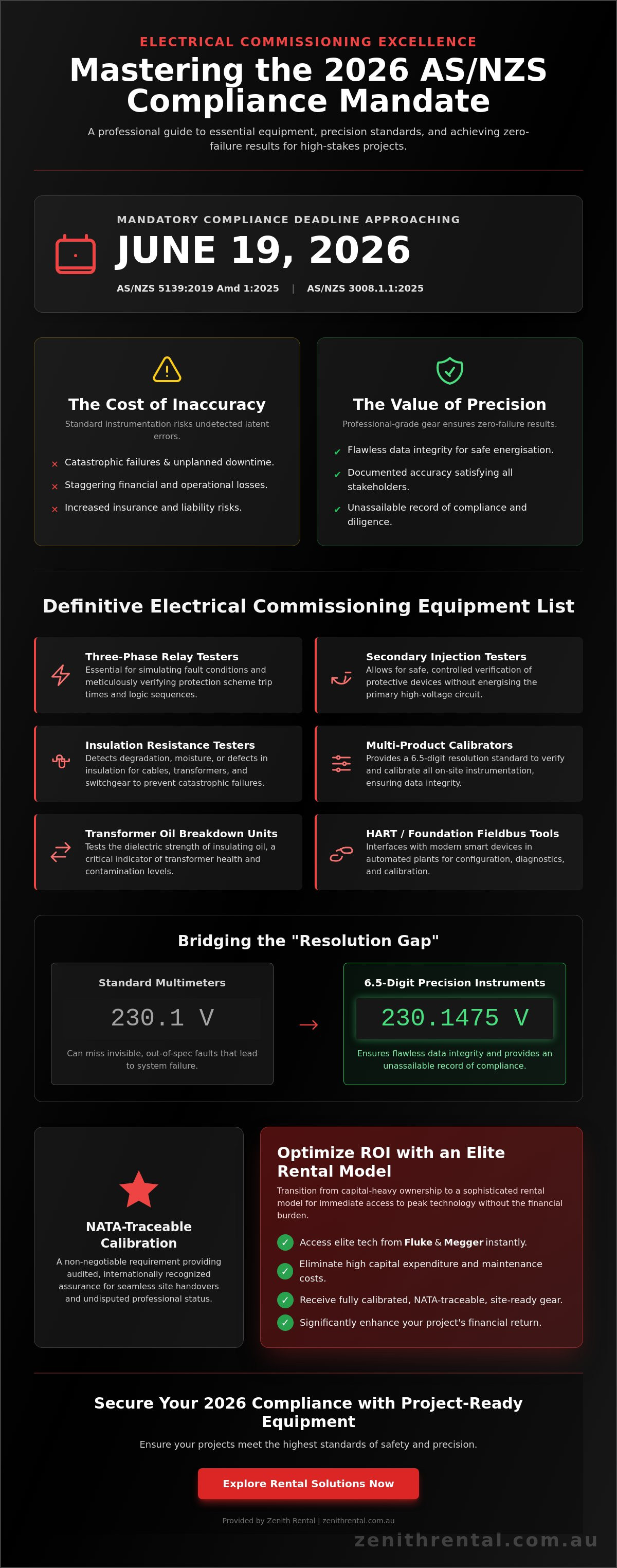
The success of your next major commissioning project won't be measured by the hours logged, but by the precision of the instruments used to validate them. In an era where the margin for error has effectively vanished, having a comprehensive electrical commissioning equipment list is no longer just a logistical requirement; it is a hallmark of professional excellence. You understand that maintaining a competitive edge in the Australian industry means staying perfectly aligned with evolving safety mandates. With compliance for AS/NZS 5139:2019 Amd 1:2025 and AS/NZS 3008.1.1:2025 becoming mandatory for all license holders on June 19, 2026, the pressure to deliver zero-failure results has never been more acute.
We've curated this guide to help you master these complexities with the poise of an industry leader. You'll learn how to secure a definitive selection of professional-grade tools from prestigious brands like Fluke and Megger, ensuring your project meets the rigorous demands of the 2026 standards. We will detail the essential testing assets required for flawless site audits, from high-performance insulation resistance testers to sophisticated three-phase relay testers. This overview provides a clear roadmap to achieving elite-tier results without the burden of high capital expenditure, positioning your firm at the absolute peak of technical reliability.
Key Takeaways
- Understand why standard instrumentation often falls short of the rigorous AS/NZS compliance mandates taking effect across Australia in 2026.
- Navigate our definitive electrical commissioning equipment list to identify the precise assets, from secondary injection testers to transformer oil breakdown units, required for high-stakes projects.
- Learn to bridge the "resolution gap" by utilizing 6.5-digit precision instruments and multi-product calibrators that ensure flawless data integrity on-site.
- Secure your site audit success by mastering the verification of NATA-traceable calibration and managing the environmental factors that impact sensitive gear performance.
- Enhance your project’s ROI by transitioning from capital-heavy ownership to a sophisticated rental model that provides immediate access to elite technology from Fluke and Megger.
Essential Instrumentation for Electrical Commissioning Compliance
Your commitment to excellence begins long before the first current flows through a new installation. In the sophisticated landscape of Australian industry, the Project commissioning process serves as the ultimate bridge between design intent and operational reality. It's a rigorous validation that ensures system longevity while safeguarding the lives of those who interact with high-voltage assets. Relying on a standard toolkit is a risk that seasoned professionals simply don't take. A truly professional electrical commissioning equipment list must account for the nuanced demands of the latest AS/NZS standards, where the margin for error has essentially vanished.
Precision defines your reputation. While maintenance testing focuses on ongoing health, a formal commissioning audit is a foundational event that demands a higher tier of instrumentation. In 2026, industrial power systems require 6.5-digit resolution and absolute signal integrity to identify the invisible faults that standard meters often miss. This distinction is critical; maintenance keeps the lights on, but commissioning proves the system is safe to energise in the first place.
The Cost of Inaccurate Commissioning
Latent installation errors are the silent predators of industrial projects. If left undetected, these faults can lead to catastrophic failures, unplanned downtime, and staggering financial losses. High-precision gear allows you to identify these issues early, ensuring that every connection and component operates within its design parameters. Utilizing elite assets, such as those found in our electrical commissioning equipment list, provides the documented accuracy required to satisfy stakeholders. This level of detail doesn't just ensure performance. It significantly reduces insurance and liability risks by providing an unassailable record of compliance and professional diligence.
Meeting Australian Regulatory Requirements
The regulatory landscape has shifted toward digital transparency and uncompromising safety. For all new installations, compliance with AS/NZS 3000:2018 remains the baseline, yet the integration of battery systems has introduced new complexities under AS/NZS 5139:2019. Documenting test results for switchboards and distribution boards is now a mandatory component of project handovers. In New South Wales, the transition to the BCNSW eCert portal as of July 1, 2026, highlights the move toward digital compliance where every data point is scrutinized. This is why NATA-traceable calibration is a non-negotiable requirement. It provides the assurance that your measurements are backed by an audited, internationally recognized standard, ensuring your site handovers are seamless. To further enhance your professional documentation, you can explore LabelWriter 5XL for durable, clear identification of all electrical components, ensuring your professional status remains undisputed.
Categorised Equipment List for Industrial Commissioning Projects
A masterfully curated electrical commissioning equipment list distinguishes a standard installation from a world-class infrastructure project. It's about selecting assets that mirror the sophistication of the systems they validate. When you approach the final phases of a project, the precision of your primary and secondary injection sets determines the reliability of the entire protection scheme. These aren't mere tools; they're the guardians of system integrity. Following the Australian/New Zealand Wiring Rules ensures that your methodology is sound, but only elite instrumentation can confirm that your execution is flawless.
Protection and Control System Tools
Validating relay logic requires the absolute control offered by three-phase relay testers. Secondary injection sets are essential for simulating fault conditions without energising the primary circuit, allowing for a meticulous verification of trip times and logic sequences. For modern plants, multi-function calibrators equipped with HART or Foundation Fieldbus communicators provide the seamless interface needed for digital instrumentation. In high-risk environments, choosing an intrinsically safe multifunction calibrator hire ensures that safety is never compromised while maintaining peak technical performance.
High Voltage and Insulation Testing
Ensuring the longevity of cables and windings demands more than a cursory check. A high-performance Hipot tester is vital for stress-testing insulation integrity before the system goes live. Move beyond basic megohmmeters by utilizing advanced insulation resistance testers that provide diagnostic data on polarization index and dielectric absorption ratios. For critical power transformers, a transformer oil breakdown voltage tester hire allows for the precise analysis of dielectric strength, ensuring that the insulating fluids are free from contaminants and ready for service.
Circuit Breaker and Contact Analysis
The mechanical health of your switchgear is just as critical as its electrical logic. Micro-milliohm meters are indispensable for measuring contact resistance, identifying potential hotspots before they become failures. When milliseconds matter, circuit breaker analyzers provide the high-resolution timing data required to verify opening and closing sequences. Accessing these elite assets through test equipment hire Australia allows you to maintain a lean operational profile while deploying the industry's most respected technology. For those seeking to elevate their next project, exploring the curated inventory at Zenith Rental offers a direct path to professional-grade reliability.
Precision Calibrators vs. General Multimeters: Why Accuracy is Paramount
The assumption that a standard handheld multimeter suffices for industrial validation is a misconception that can compromise an entire project's integrity. While a quality handheld is indispensable for basic troubleshooting, it lacks the resolution required for the rigorous demands of 2026 industrial power systems. The "Resolution Gap" is a technical reality; industrial commissioning often requires 6.5-digit precision to detect minute fluctuations in high-stakes environments. When you're managing an electrical commissioning equipment list, the inclusion of benchtop-grade calibrators ensures that your measurements are not just observations, but absolute certainties.
Efficiency on a complex site is born from the use of multi-product calibrators rather than a scattered collection of single-function tools. These sophisticated assets allow your team to validate multiple parameters from a single station, significantly reducing the time spent on repetitive setups. Elite brands like Fluke and Transmille have mastered this balance of versatility and precision. Their instruments provide the stability needed to confirm that every component of a distribution system operates within the tightest tolerances, ensuring your project meets the highest professional standards from the moment of energisation.
The Science of Calibration Traceability
Every measurement carries an "uncertainty budget," which is the calculated doubt inherent in any reading. Elite calibrators are engineered to minimize this budget, effectively eliminating the risk of "false pass" results. A false pass occurs when an instrument incorrectly indicates that a system is within specification, potentially leading to catastrophic failure later in the asset's lifecycle. Utilizing Fluke equipment provides the traceable accuracy required to satisfy stringent site audits. This level of validation is a cornerstone of professional service, ensuring that your data remains unassailable under the closest scrutiny.
Specialised Pressure and Gas Measurement
Modern commissioning often extends beyond purely electrical parameters into the realm of complex process loops. Integrating assets like Druck pressure pneumatic controllers is essential for verifying the instrumentation that governs industrial safety. Furthermore, the necessity of gas measurement instruments cannot be overstated for sites where hazardous atmospheres are a constant factor. Aligning your hardware with the National training standards for electrical commissioning ensures your technicians possess the competency to operate these multifunction calibrators effectively. This holistic approach to your electrical commissioning equipment list guarantees that every facet of the installation, from electrical logic to pneumatic response, is perfectly synchronised and safe for operation.
Ensuring Site Readiness: Calibration, NATA Traceability, and Logistics
The transition from planning to execution is where the most refined projects either excel or falter. While your electrical commissioning equipment list identifies the necessary hardware, site readiness defines the integrity of your results. True professional-grade commissioning begins with a meticulous verification process before a single lead is connected. You must ensure that every instrument arriving on-site is not only functional but perfectly aligned with the technical demands of the specific environment. This level of preparation eliminates the friction of technical delays, allowing your team to focus on the sophisticated task of system validation with absolute confidence.
Achieving this state of readiness requires a disciplined four-step approach. First, verify that all calibration certificates are current and specific to the assets being deployed. Second, assess the environmental conditions of your site; extreme Australian temperatures and humidity can influence the performance of sensitive high-resolution gear. Third, confirm the health of all secondary components, including battery life and accessory completeness, to avoid the frustration of missing probes or depleted power in remote locations. Finally, prioritize secure, climate-controlled logistics for high-value instrumentation. Protecting the physical integrity of these assets during transit is essential to maintaining their factory-standard precision.
The NATA Advantage in Australia
In the high-stakes environment of 2026 industrial projects, the distinction between "traceable" calibration and a NATA-endorsed certificate is fundamental. A NATA-accredited laboratory has been rigorously audited to the international ISO 17025 standard, providing a level of assurance that simple traceability cannot match. This distinction is critical for your project's legal standing and insurance compliance. Research indicates that businesses can save approximately 15% on annual maintenance costs by strategically distinguishing between these calibration tiers. For high-risk industries, NATA-certified instrumentation is the only choice that guarantees technical competence and validated procedures, ensuring your documented results remain unassailable during formal audits.
Logistics for National Projects
Managing the "dead time" between equipment delivery and site access is a logistical art form. Elite service providers understand that gear must be "site-hardened" and ready for immediate deployment upon arrival. Utilizing pre-configured testing kits tailored for specific site roles—such as protection testing or transformer analysis—minimizes setup time and reduces the risk of human error. This organized approach reflects a commitment to quality that mirrors the performance of the assets themselves. To ensure your next project is supported by this level of logistical excellence, you can explore our premium range of NATA-certified instrumentation. Selecting a partner that prioritizes these finer details allows you to maintain a seamless project flow, from the initial delivery to the final compliance handover.
Optimising Project ROI through Elite Equipment Rental
The financial architecture of a major industrial project is as critical as its technical execution. In 2026, the most successful firms are moving away from the heavy burden of capital expenditure (CAPEX) in favour of a more agile operational expenditure (OPEX) model. This shift toward "instrumentation-as-a-service" allows you to preserve capital for core business growth while ensuring your electrical commissioning equipment list remains at the cutting edge of technology. By opting for a sophisticated rental strategy, you align your costs directly with project milestones, transforming a traditional overhead into a precise, value-driven investment.
Ownership often masks a series of silent drains on your resources. Beyond the initial purchase, the hidden costs of storage, logistics, and mandatory maintenance can erode your margins. For instance, basic multimeter calibration in Sydney now starts at approximately $121, while oscilloscopes reach $181.50 as of May 2026. When you factor in the rapid pace of regulatory changes, such as the new AS/NZS 62368.1:2026 safety standards, the risk of technical obsolescence becomes a genuine liability. Rental eliminates these concerns entirely. You gain immediate access to the latest 2026 models, meticulously maintained and ready for deployment, without the long-term burden of asset depreciation.
Flexibility in High-Stakes Projects
Industrial sites are dynamic environments where requirements can change in an instant. The ability to scale your electrical commissioning equipment list to match specific project phases is a significant competitive advantage. Whether you need a sudden influx of secondary injection sets or a specialized transformer oil breakdown tester, rapid rental dispatch ensures your timeline remains intact. This flexibility is bolstered by expert technical support, helping you select the most refined assets for complex tasks. Reducing downtime through reliable, high-performance leasing isn't just efficient; it's a hallmark of professional project management.
The Zenith Partner Experience
Partnering with Zenith Rental provides more than just hardware; it offers a seamless integration of technical authority and premium service. We support the Australian industry with an impeccably maintained fleet of assets that reflect your own commitment to excellence. There is a profound peace of mind that comes from knowing every detail of your equipment needs has been considered by elite professionals. This sophisticated approach to technical hospitality ensures that your focus remains on the destination, while we handle the intricate logistics of your testing requirements. To elevate your next project with precision and prestige, Request a bespoke commissioning equipment quote today.
Elevating Your Professional Standards for 2026
The path to a zero-failure site audit is defined by technical precision and meticulous preparation. You've seen how a masterfully curated electrical commissioning equipment list transforms complex regulatory hurdles into a seamless validation of your professional expertise. By prioritizing NATA-traceable calibration and leveraging high-resolution instruments from elite brands like Fluke, Megger, and Transmille, you ensure your project stands as a testament to quality. Transitioning to an agile rental model doesn't just protect your capital; it provides immediate access to the most sophisticated technology available in the 2026 market.
Your reputation depends on the accuracy of every measurement taken on-site. We invite you to secure your elite commissioning equipment list from Zenith Rental today. With our Australia-wide national delivery and a commitment to impeccably maintained assets, including Druck and Megger hardware, we provide the peace of mind you deserve. Step onto your next project with the confidence that every technical detail has already been accounted for by a partner who values excellence as much as you do. Success is within your reach.
Frequently Asked Questions
What is the difference between a standard multimeter and a commissioning-grade calibrator?
A commissioning-grade calibrator provides the ability to source and simulate electrical signals with 6.5-digit precision, whereas a standard multimeter is primarily a measurement tool. In industrial environments, the calibrator eliminates the "Resolution Gap" by offering the stability required to validate complex instrumentation loops. This ensures your electrical commissioning equipment list includes the high-resolution assets necessary for verifying system logic rather than just basic continuity.
Why is NATA traceability required for electrical commissioning in Australia?
NATA traceability is essential because it provides an unassailable legal and technical standing for your project's data. A NATA-endorsed certificate ensures the laboratory has been audited to the international ISO 17025 standard, confirming the competency of the technician and the validity of the methods used. For high-risk Australian projects, this level of assurance is a non-negotiable requirement for satisfying insurance obligations and formal site handovers.
Can I rent a complete commissioning kit for a high-voltage substation?
You can absolutely secure a comprehensive, pre-configured commissioning kit for high-voltage substation projects through our specialized rental service. These kits typically include essential assets like three-phase relay testers, circuit breaker analyzers, and high-performance Hipot testers. Accessing a complete electrical commissioning equipment list through a single partner ensures all instruments are synchronized, calibrated, and ready for immediate deployment on complex utility-scale sites.
How often should commissioning equipment be calibrated?
Commissioning equipment typically requires professional calibration every 12 months to maintain its certified accuracy. However, for high-stakes industrial projects or those involving extreme environmental conditions, more frequent verification may be necessary. You should always consult the manufacturer's specifications and the specific quality plan of your project to ensure every instrument remains within its documented uncertainty budget throughout the commissioning phase.
What are the essential tools for transformer oil testing on site?
The essential tools for on-site transformer oil analysis include a transformer oil breakdown voltage tester and a digital transformer turns ratio meter. These instruments allow you to analyze the dielectric strength of the insulating fluid and verify the winding integrity in real-time. Using elite-tier gear from brands like Megger ensures that your fluid analysis meets the highest standards of accuracy required for critical power assets.
Is it better to hire or buy specialized test equipment for a six-month project?
Hiring specialized test equipment for a six-month project is generally the more cost-effective strategy for optimizing project ROI. This approach allows you to treat the cost as an operational expenditure (OPEX), avoiding the high capital outlay and long-term depreciation associated with ownership. Additionally, rental ensures you have access to the latest 2026 models without the hidden costs of storage or mandatory annual calibration.
Does Zenith Rental provide technical support for complex relay testers?
Zenith Rental provides sophisticated technical support to assist you in selecting and utilizing complex three-phase relay testers. Our team of elite professionals is deeply knowledgeable about the finer details of secondary injection testing and protection logic. This ensures you receive more than just hardware; you gain a partner focused on the seamless execution of your most challenging technical requirements.
What happens if rented equipment fails during a critical site audit?
Should a rented instrument encounter an issue during a critical site audit, our priority is to minimize your downtime through rapid replacement or technical intervention. Our assets are impeccably maintained to prevent such occurrences, yet we understand the high-stakes nature of industrial commissioning. We manage the logistics of providing a functional, calibrated alternative swiftly, ensuring your project timeline and professional reputation remain undisturbed.