


The Discerning Professional’s Guide to Thermal Camera Selection in 2026
A 2024 analysis of Australian grid reliability suggests that a single undetected electrical fault can cost an industrial facility upwards of A$45,000 per hour in unplanned downtime. You already know that in high-stakes environments, the difference between a routine maintenance check and a catastrophic failure lies in the absolute clarity of your data. Relying on an underpowered thermal camera is a risk your professional reputation simply cannot afford. We understand the frustration of navigating complex resolution and sensitivity specifications when your results must be beyond reproach. It's about more than just hardware; it's about the confidence that comes from using the pinnacle of diagnostic technology.
This guide empowers you to master the technical nuances of thermal imaging to select the elite equipment required for precision diagnostics. You'll learn how to identify the exact specifications for your specific application and understand the significant ROI of hiring premium, NATA-traceable gear rather than settling for less. We will explore the critical balance of detector resolution and thermal sensitivity to ensure your next inspection journey is seamless and your findings are pristine.
Key Takeaways
- Understand how modern thermography evolves from simple visual checks into sophisticated, non-destructive data acquisition for Australian industrial sites.
- Identify why a high-resolution thermal camera with superior NETD sensitivity is the non-negotiable benchmark for precision in high-stakes environments.
- Learn to map elite technical specifications and IP ratings to the specific, demanding requirements of your unique Australian industry sector.
- Evaluate the strategic financial advantages of hiring over purchasing to bypass the hidden costs of maintenance and the rapid cycle of technological obsolescence.
- Discover how Zenith’s elite fleet and seamless national logistics provide a sophisticated, reliable solution for your most critical diagnostic needs.
Understanding Thermal Imaging Technology for Industrial Applications
Thermography represents the pinnacle of non-destructive testing for the modern Australian enterprise. It's a sophisticated method for identifying thermal anomalies before they escalate into costly downtime. By 2026, the transition from simple visual checks to comprehensive infrared data acquisition has become the gold standard for elite asset management. Utilizing a high-performance thermal camera allows technicians to capture precise temperature data across complex systems, ensuring every component operates within its engineered parameters. This proactive approach forms the backbone of Tier 1 predictive maintenance programs, where reliability is non-negotiable. In the context of Australian safety and compliance, these tools are now mandatory for meeting the rigorous AS/NZS 3000:2018 standards during annual switchboard audits.
The Science of Infrared Radiation
At the heart of every professional-grade device lies the microbolometer, a sensitive detector that perceives infrared radiation and translates it into a detailed thermal map. Understanding thermography requires a nuanced grasp of how objects interact with heat. Energy is either emitted from the surface, reflected from other sources, or transmitted through the material itself. Discerning professionals focus on the emitted energy to gauge true thermal status. Emissivity is defined as the efficiency with which a surface emits thermal radiation compared to an ideal blackbody at the same temperature.
Why Visual Inspection Isn’t Enough
Visual assessments often mask the systemic vulnerabilities lurking beneath the surface. Electrical hotspots and mechanical friction generate heat long before smoke or physical deformation appears. A 2024 industry report noted that 85% of unexpected switchboard failures could've been prevented with quarterly infrared scans. Relying solely on the naked eye is a risk that modern leaders simply don't take. The precision of a modern thermal camera provides a level of clarity that traditional methods lack, identifying issues that are invisible to the most experienced inspectors.
Consider a 2025 audit at a major Perth manufacturing facility where a technician identified a loose busbar connection. While the component looked pristine under standard lighting, the thermal signature revealed a 45°C temperature rise above ambient levels. Addressing this connection during a scheduled break prevented a catastrophic failure that would've cost an estimated A$135,000 in lost production and emergency repairs. This level of insight provides the Zenith of preventative oversight, moving beyond guesswork to achieve absolute operational certainty. It's about providing a seamless experience where safety and performance are guaranteed through superior technology.
- Predictive Maintenance: Identifying wear in bearings and motors before seizure.
- Safety Compliance: Meeting insurance requirements for fire risk mitigation in high-voltage environments.
- Operational Efficiency: Reducing energy waste by identifying insulation voids in cold storage or HVAC systems.
Critical Specifications: How to Evaluate a Thermal Camera
High-stakes industrial environments demand more than just a basic heat map. Selecting a thermal camera requires a deep dive into the physics of the sensor and the specific requirements of your site. For the discerning professional in 2026, a resolution of 640x480 has become the non-negotiable benchmark for precision. This standard provides 307,200 unique measurement points, ensuring that even the smallest thermal anomalies are captured with absolute clarity, whether you're inspecting a high-voltage substation or a complex data centre.
Thermal Resolution vs. Visual Resolution
It's a common misconception that a high-megapixel visual camera translates to infrared performance. A 5MP visual sensor captures light, while a thermal sensor measures long-wave infrared radiation. In the IR world, pixel pitch determines how effectively a sensor can resolve detail at a distance. Higher resolution sensors eliminate the risk of "averaging," where the heat from a tiny, failing component is diluted by the cooler surrounding air, potentially masking a critical fault that could lead to a catastrophic failure.
Thermal Sensitivity (NETD) Explained
Sensitivity is measured in milliKelvin (mK), and in this metric, lower numbers represent elite performance. A lower Noise Equivalent Temperature Difference (NETD) rating means the sensor can distinguish between incredibly subtle temperature gradients. For building audits or moisture detection where thermal contrast is minimal, this is vital. A 30mK camera is significantly more precise than a 100mK model, allowing you to visualize thermal bridges that standard sensors simply wouldn't register.
Temperature Accuracy and Calibration
Accuracy in the elite tier of equipment typically sits at +/- 2% or 2°C. To maintain this standard in Australia, NATA-traceable calibration is essential for any professional reporting. This ensures your findings stand up to rigorous industrial scrutiny and insurance requirements. Utilizing a premium test equipment hire service guarantees your gear arrives in peak condition, fully calibrated and ready for the most demanding assignments.
Spatial resolution (IFOV) and Field of View (FOV) must match your specific environment. A wide FOV is ideal for scanning large HVAC installations at close range, while a narrow FOV is required for smelting applications where safety distances are mandatory. Whether you're inspecting a pristine corporate facility or a rugged mining site, the right specifications define the success of your journey. If you require the ultimate in diagnostic performance, securing an elite instrument ensures your operations remain at the pinnacle of safety and efficiency.
Choosing the Right Camera for Your Industry
Selecting the ideal thermal camera requires more than a simple comparison of specifications. It demands an understanding of how elite hardware integrates into the unique challenges of the Australian landscape. Whether you're operating in the humid tropics of Queensland or the dusty expanse of the Pilbara, your equipment must deliver a seamless performance that reflects your professional standing. Reliability is the cornerstone of the Zenith experience, ensuring every captured image serves as a definitive record of excellence.
Ruggedness remains a non-negotiable standard for site-based professionals. In 2026, an IP54 rating is considered the minimum requirement for protection against dust and moisture, while IP67-rated devices provide the ultimate security for those working in more extreme environments. Beyond physical durability, the sophistication of your software integration determines the value of your data. Premium analysis tools now allow for instantaneous, professional reporting that translates complex thermal gradients into actionable insights for your clients. Your choice of form factor also dictates efficiency:
- Handheld: Offers unmatched agility for rapid inspections and close-quarters diagnostics.
- Fixed-mount: Provides 24/7 monitoring for critical infrastructure, ensuring continuous peace of mind.
- Drone-mounted: Delivers a panoramic perspective of large-scale assets, reaching the pinnacle of site-wide oversight.
Electrical and Mechanical Maintenance
Precision is paramount when inspecting high-voltage switchboards or motor bearings. To capture accurate data from moving mechanical parts without the interference of motion blur, a high-speed frame rate of 60Hz is essential. This level of detail allows for the early detection of friction-induced heat before a failure occurs. For a truly comprehensive diagnostic suite, professionals are increasingly integrating thermal data with circuit breaker analyzer hire workflows. This holistic approach ensures that every component of the electrical system operates at its peak, mirroring the absolute reliability your clients expect.
Building Diagnostics and Energy Audits
In the realm of building science, the thermal camera serves as a tool for revealing the invisible. Detecting insulation voids, moisture ingress, or thermal bridging requires high thermal sensitivity, often measured at <30mK. When working in confined indoor spaces, a 42-degree wide-angle lens becomes a vital asset, allowing you to capture entire wall sections from a short distance. To achieve total structural clarity, many elite practitioners use thermal imaging alongside rotary laser levels. This combination enables precise structural mapping, ensuring that every energy audit or moisture survey is backed by undeniable, pinpoint accuracy.
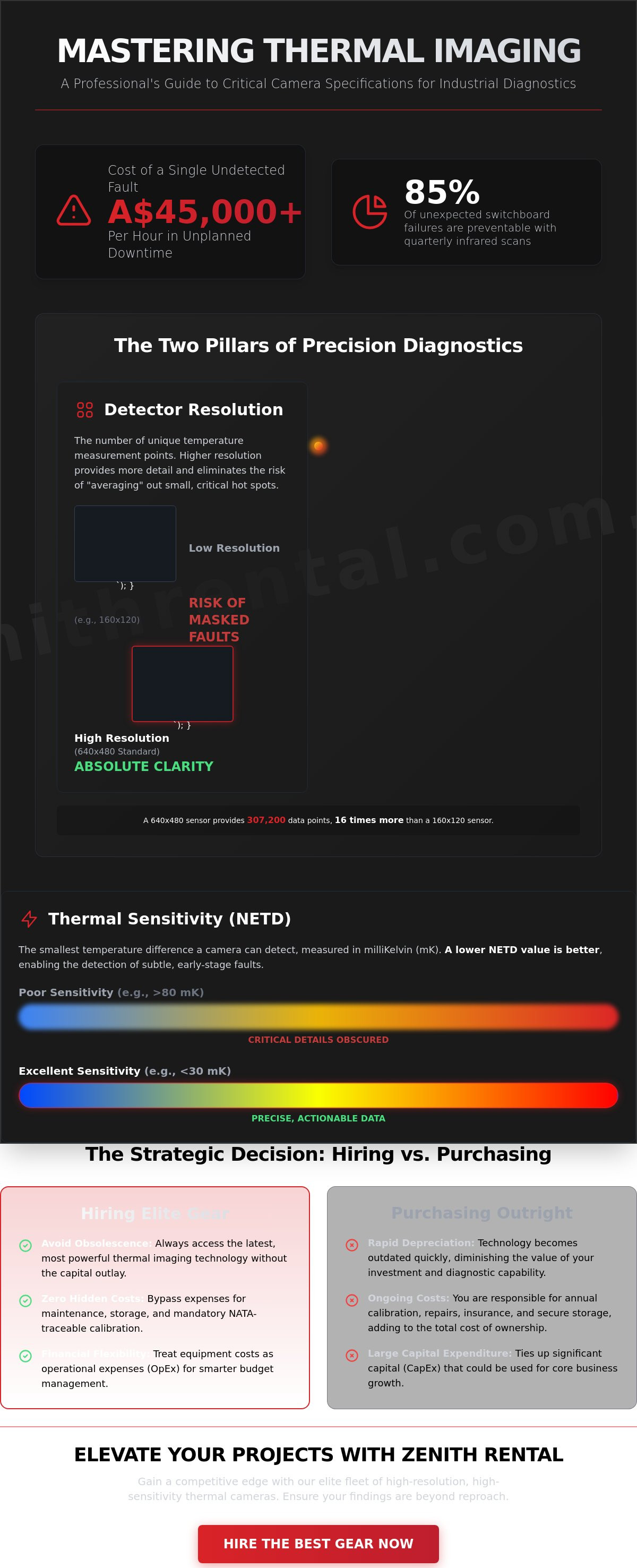
The Strategic Decision: Hiring vs. Purchasing Specialist Gear
Selecting a thermal camera in 2026 is a sophisticated choice that balances long-term value against immediate utility. While a flagship device feels like a permanent asset, the hidden burdens of ownership often erode that perceived worth. Annual calibration for high-end sensors in the Australian market typically ranges between A$750 and A$1,550 per unit. Beyond the invoice, the logistical friction of managing firmware updates and lithium-ion battery health can distract your specialists from core project delivery.
Technology cycles move at a relentless pace. A sensor that represents the pinnacle of performance today will likely be surpassed by a more efficient model within 18 to 24 months. By converting a heavy Capital Expenditure (CAPEX) into a flexible Operating Expense (OPEX), smart Australian firms preserve their cash flow for strategic expansion. This approach shifts the entire risk of technical obsolescence and depreciation from your balance sheet to our premium fleet, ensuring you always operate at the zenith of your industry.
Accessing the Latest Technology Without Depreciation
Elite thermography demands elite tools. Hiring grants immediate access to A$20,000+ FLIR or Fluke models for a fraction of the purchase price. You'll avoid the 25 percent first-year depreciation that plagues high-end electronics. This model allows you to select the precise thermal camera needed for a specific unique project, ensuring the tool matches the task perfectly. It's about achieving precision without the permanent price tag or the burden of managing an aging inventory.
Calibration and Compliance Assurance
Compliance is mandatory on Australian tier-one industrial sites. We take full responsibility for ensuring every instrument is site-ready and meets NATA-traceable standards. This eliminates the 14-day downtime your business would suffer during annual factory calibration cycles. Every Zenith Rental camera undergoes rigorous pre-hire verification to ensure absolute precision upon arrival. You receive a pristine, certified instrument that's ready for immediate deployment, allowing you to focus on the results of your project rather than the logistics of your gear.
Elevating Your Projects with Zenith Rental’s Elite Fleet
At Zenith Rental, we believe the tools you choose define the quality of your professional legacy. Our philosophy transcends basic equipment hire; we provide a gateway to precision through a curated fleet that meets the rigorous demands of 2026’s infrastructure standards. We understand that for the discerning professional, reliability isn't a luxury, it's a baseline. Every thermal camera in our inventory undergoes a rigorous 15-point calibration and performance check before it leaves our facility, ensuring it arrives at your site ready to perform at its peak.
Logistics in a country as vast as Australia require a master’s touch. Whether your project is situated in the heart of the Sydney CBD or a remote mining site in the Pilbara, our national delivery network operates with surgical precision. We've refined our supply chain to ensure that your project schedule remains uninterrupted. Our team provides expert technical support that goes beyond a simple user manual. We offer deep-tier insights to help you extract every bit of data from your sensors, turning raw heat maps into actionable intelligence for your clients.
We offer rental periods tailored to your specific timeline. A three-day energy audit requires the same level of excellence as a six-month infrastructure rollout. We provide the flexibility to scale your equipment needs without the burden of capital expenditure, allowing you to maintain a lean, agile operation while still utilizing the world's best technology.
Premium Brands: Fluke and FLIR
Our inventory features industry leaders like Fluke and FLIR, brands that have set the gold standard for thermography for decades. These instruments utilize high-end sensors that provide the thermal sensitivity required for legally defensible reporting. In 2026, regulatory compliance is non-negotiable. Using elite hardware ensures your findings stand up to the highest levels of scrutiny from insurers and government bodies. Our fleet also integrates seamlessly with other specialized tools, such as power quality analyzers, allowing for a holistic diagnostic approach to complex electrical systems.
Seamless Nationwide Support and Logistics
Zenith Rental adopts an elite concierge approach to test equipment hire. We don't just ship boxes; we deliver confidence. Every unit arrives in a custom, high-impact transit case, fully calibrated and with a fresh battery cycle. This meticulous attention to detail reflects our commitment to your success. If a project scope changes, our logistics team pivots instantly to provide the necessary support anywhere in Australia. Contact Zenith Rental today to secure your precision thermal camera and experience the pinnacle of professional equipment service.
Mastering the Future of Industrial Thermography
Navigating the complexities of the 2026 industrial landscape requires more than just standard tools; it demands a commitment to absolute precision. You've explored how critical specifications and industry-specific requirements define the performance of a high-tier thermal camera. By prioritizing strategic rental over capital expenditure, you gain immediate access to the world's most advanced imaging technology without the burden of depreciation or maintenance cycles. It's a choice that reflects both fiscal intelligence and a dedication to quality.
Zenith Rental curates an elite fleet featuring industry leaders like Fluke and FLIR, ensuring your projects benefit from unmatched clarity and diagnostic power. Every instrument arrives with NATA-traceable calibration, providing the rigorous documentation required for high-stakes Australian compliance and reporting. We handle the logistics with seamless nationwide delivery across Australia, allowing you to focus entirely on the success of your project. It's time to elevate your operational standards and experience the confidence that comes with professional-grade gear. Your journey toward technical excellence starts with the right partner.
Experience the Pinnacle of Precision: Explore Our Thermal Camera Fleet
Frequently Asked Questions
Is a higher resolution always better for a thermal camera?
Higher resolution is essential for professional applications because it provides more data points for precise temperature measurement. A 640 x 480 sensor captures 307,200 individual pixels, which is four times the detail of a standard 320 x 240 unit. This extra clarity ensures you don't miss small thermal anomalies in complex electrical circuits or distant mechanical components. It's the difference between seeing a vague heat signature and identifying a specific failing fuse.
Can a thermal camera see through walls or glass?
No, a thermal camera cannot see through solid walls or glass because these materials are opaque to long-wave infrared radiation. The camera detects surface temperatures rather than looking through objects. If you aim the device at a window, you'll see a thermal reflection of yourself. For internal inspections, you're actually seeing how heat conducts through the wall material, which reveals the studs or insulation behind the plaster.
How often should a professional thermal camera be calibrated?
Professional equipment requires calibration every 12 months to maintain a standard accuracy of ±2% or ±2°C. Over time, internal sensors can drift, leading to unreliable data that could compromise your site safety. Zenith Rental manages this rigorous schedule for you. Every unit in our fleet undergoes regular verification to ensure it meets factory specifications before it arrives at your project site in pristine condition.
What is the difference between a thermal imager and an infrared thermometer?
A thermal imager creates a visual map of thousands of temperature points simultaneously, while an infrared thermometer only measures a single spot. An entry-level imager with 160 x 120 resolution provides 19,200 data points in one frame. This technology is vital across many sectors, including automotive diagnostics where specialists like Topdon Norge AS utilize similar precision imaging to identify engine and electrical faults. This allows you to see the heat pattern of an entire motor, whereas a thermometer might miss a localized hot spot just millimetres away from your aim point.
What is NETD and why does it matter for my site inspection?
NETD stands for Noise Equivalent Temperature Difference and it measures the thermal sensitivity of the sensor. A lower NETD value, such as 30mK, means the camera can detect temperature differences as small as 0.03°C. This level of precision is vital for building envelope audits where you need to identify subtle moisture ingress. Using a high-sensitivity thermal camera ensures your reports are backed by the most granular data available in 2026.
Can I use a thermal camera for electrical inspections in Australia without a license?
You don't need a specific license to operate the hardware, but Australian Standard AS ISO 18436.7:2014 governs the qualification of thermography personnel. Most commercial insurance policies in Australia require a Category 1 or Category 2 certified professional to sign off on switchboard reports. Operating without these credentials can lead to rejected insurance claims if a fire occurs. It's a matter of professional integrity and risk management.
What software do I need to analyze thermal images after my hire?
Professional analysis requires radiometric software such as FLIR Tools or Testo IRSoft to process the raw data captured during your hire. These elite platforms allow you to adjust emissivity and reflected temperature settings long after you've left the site. Zenith Rental provides the necessary support to ensure you can generate sophisticated, branded reports for your clients. This seamless transition from field work to office analysis defines the modern professional experience.
Does Zenith Rental provide NATA-certified thermal cameras?
Zenith Rental provides high-performance equipment with calibration certificates traceable to national standards, ensuring absolute reliability for your inspections. While not every application requires a full NATA-endorsed report, our fleet meets the exacting demands of the Australian industrial sector. Every thermal camera we dispatch is treated as a critical instrument. We ensure your journey toward technical excellence is supported by the most accurate tools in the market today.