


The Professional’s Guide to Rotary Laser Levels: Precision for Australian Industry
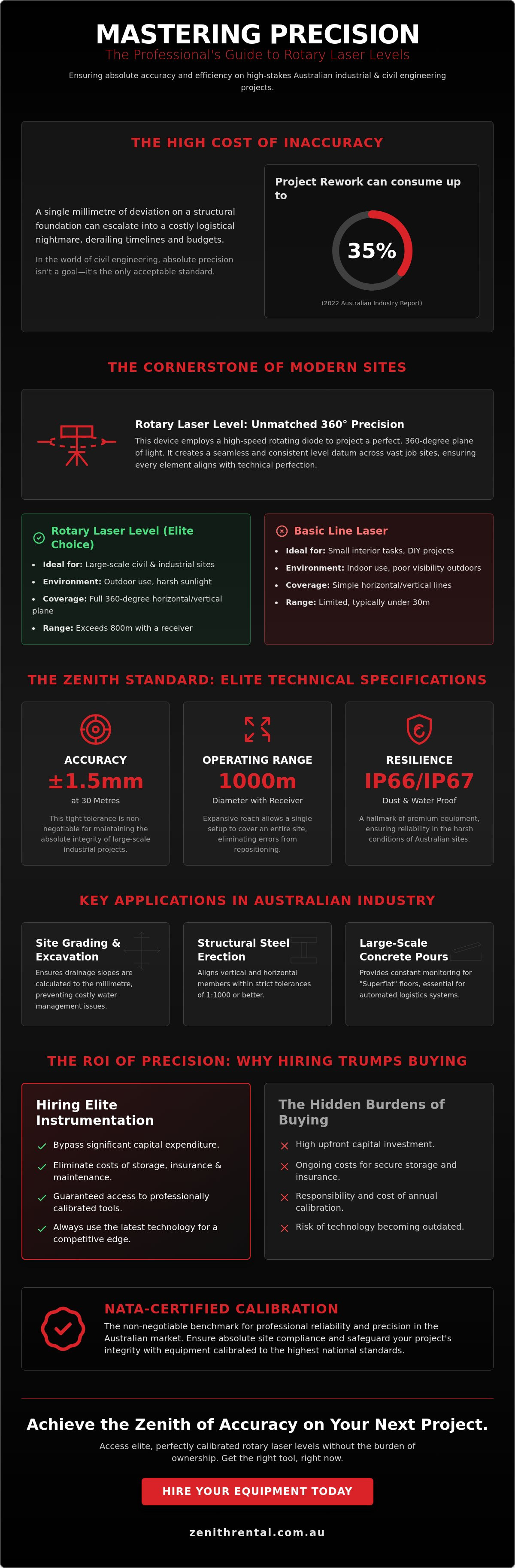
A single millimetre of deviation on a structural foundation can transform a prestigious development into a costly logistical nightmare. You understand that in the high-stakes world of Australian civil engineering, absolute precision is the only acceptable standard. The pressure to deliver pristine results while choosing between the visibility of green beams and the reliability of a high-performance rotary laser level often creates unnecessary friction on site. It's a challenge that demands more than just a basic tool; it requires a sophisticated understanding of elite measurement technology to avoid the rework that can consume up to 35 percent of project budgets according to 2022 industry reports.
We've crafted this guide to help you master the technical nuances of precision levelling and ensure your projects achieve the zenith of accuracy. You'll gain total confidence in your site measurements by understanding the critical importance of NATA-traceable calibration and the specific advantages of different beam frequencies. We'll explore how to select the unmatched tool for your specific industrial application, ensuring a seamless experience from the first setup to the final inspection.
Key Takeaways
- Master the technical nuances of the rotary laser level, the cornerstone of elite civil engineering that ensures pristine 360-degree accuracy across demanding Australian sites.
- Discover the critical technical thresholds required for industrial excellence, including the necessity of a 1000m operating diameter for maintaining rigorous site tolerances.
- Evaluate the superior ROI of hiring elite instrumentation, bypassing significant capital expenditure and the ongoing burdens of storage, insurance, and annual calibration.
- Ensure absolute site compliance by understanding NATA-certified calibration standards, the non-negotiable benchmark for professional reliability and precision in the Australian market.
- Secure your project’s success with professional field-verification techniques and heavy-duty mounting strategies designed to withstand the unique rigours of the Australian climate.
What is a Rotary Laser Level and Why is it Essential for Modern Sites?
Precision isn't a mere goal in the Australian industrial sector; it's the standard that separates elite projects from the rest. The rotary laser level stands as the definitive instrument for professionals who refuse to compromise on accuracy. Unlike standard levels, this device employs a high-speed rotating diode to project a 360-degree plane of light, creating a seamless datum across vast distances. This technology allows teams to maintain a consistent reference point across an entire site, ensuring that every measurement aligns with the project's "Zenith," or its highest point of technical perfection.
While basic line lasers serve well for small interior tasks, they often fail under the harsh glare of the Australian sun or across the expansive footprints of civil engineering works. A professional-grade rotary laser level offers a working diameter that can exceed 800 metres when paired with the correct technology. To truly grasp the complexity of these tools, one must ask what is a laser level? and how it has evolved from a simple manual tool into a sophisticated electronic beacon that guides multi-million dollar infrastructure builds. It's the difference between a project that simply functions and one that represents an unmatched standard of excellence.
The Core Components of an Industrial Laser
Every pristine measurement begins with the internal diode. This component emits a concentrated beam that a rapidly spinning head reflects into a flat, level plane. To ensure absolute reliability, professional units utilize electronic self-levelling mechanisms. These systems use internal sensors to automatically compensate for vibrations or minor tripod shifts; they provide a level of stability that old-fashioned pendulum systems can't match. Because the human eye can't always track a laser beam over a 300-metre distance in daylight, an elite laser receiver is essential. This handheld detector captures the signal with millimetre precision, making long-range outdoor alignment both effortless and accurate.
Key Applications in the Australian Industrial Landscape
The journey toward a perfect build starts beneath the surface. In site grading and excavation, these lasers ensure drainage slopes are calculated to the millimetre, preventing costly water management issues on large-scale developments. In structural steel applications, the "Zenith" of precision is reached when vertical and horizontal members align within strict tolerances of 1:1000 or better. For large-scale concrete pours, such as those required for high-tech warehouse flooring, the rotary laser level provides the constant monitoring needed to achieve the "Superflat" floor classifications essential for automated logistics systems. This level of detail transforms a standard construction site into a masterclass of industrial excellence.
Technical Specifications: Understanding Range, Accuracy, and Beam Type
Precision defines the elite professional. A high-tier rotary laser level offers an accuracy rating of +/- 1.5mm at 30 metres. This tight tolerance ensures that large-scale industrial projects maintain absolute integrity from the first pour to the final fit-out. When you're working on a pristine slab or a complex foundation, these millimetres represent the difference between a successful handover and a costly rectification. It's about achieving the pinnacle of site tolerance with every rotation.
Operating range is equally vital for the efficiency of your project. Industrial sites often span vast distances, requiring a diameter of 500m to 1000m. This expansive reach allows a single setup to cover the entire footprint, maintaining a seamless workflow across the site. Without this range, your team spends unnecessary time repositioning equipment, which introduces the risk of cumulative measurement errors. High-performance units ensure that your reference plane remains stable across the entire journey of the build.
Environmental resilience is a hallmark of premium equipment. Australian sites face harsh conditions, from the fine dust of the Pilbara to sudden tropical downpours in Queensland. IP66 or IP67 ratings are non-negotiable for maintaining reliability. An IP66 rating signifies the unit is dust-tight and protected against powerful water jets. IP67 goes a step further, allowing for temporary immersion in water. This level of protection ensures your equipment remains as reliable as your reputation, regardless of the weather.
Choosing between red and green beams is a matter of environment and efficiency. Red beams are the industry standard, offering exceptional battery life and reliability for most outdoor tasks using a receiver. Green beams provide unmatched visibility, appearing up to four times brighter to the human eye in high-ambient light conditions. While green diodes consume more power, the immediate visual clarity they provide in bright Australian sun can be a significant advantage for indoor fit-outs or short-range outdoor work. For those seeking the ultimate site setup, choosing premium equipment solutions ensures you have the right beam for every scenario.
Laser Classification and Safety Standards
Safety compliance is a core component of professional authority. Understanding the distinction between Class 2 and Class 3R lasers is essential for adhering to OSHA laser safety standards and local regulations. Class 2 lasers are generally safer for public spaces, while Class 3R lasers offer higher power but require stricter site controls. To maintain unmatched accuracy, elite levels feature "Out of Level" alerts that instantly notify the operator if the unit is bumped. In Australia, construction sites typically mandate the use of Class 2 lasers to ensure operator safety without compromising on-site performance.
Grade Capabilities: Single vs. Dual Grade
Sophisticated grading capabilities move your project beyond simple flat horizontal planes. A dual grade rotary laser level allows for precise slopes on both the X and Y axes, which is essential for complex drainage and roadwork. Digital grade entry provides a level of precision that manual dials can't match, allowing you to input exact percentages for flawless execution. For specialized infrastructure work like deep trenching or sewerage, you may need to utilize a pipe laser level to maintain a precise line and grade within the pipe itself. This level of detail ensures every component of the project reaches the zenith of quality.
The ROI of Precision: Why Hiring Trumps Buying for Elite Projects
Investing in a high-performance rotary laser level from industry leaders like Topcon or Spectra requires a substantial upfront commitment. A single dual-grade unit often commands a price tag exceeding A$4,500. For many Australian contractors, this capital is better deployed toward growth and site acquisition. Owning elite instrumentation brings a tail of secondary expenses that many firms overlook. Annual calibration cycles, secure climate-controlled storage, and specialized insurance premiums can add 15% to the total cost of ownership every year.
Zenith Rental serves as your strategic concierge in this space. We provide the exact tool required for the specific demands of your current project phase. You might need a basic horizontal laser for a residential slab today, yet require a high-precision grade laser for a specialized two-week civil drainage contract next month. Hiring ensures you aren't tethered to a generic tool that's merely adequate. You gain the freedom to match the instrument to the task with absolute surgical precision.
Accessing Best-in-Class Technology
Laser technology evolves at a rapid pace. A unit purchased three years ago lacks the advanced interference rejection and millimetre-accurate digital receivers found in today's elite models. Our test equipment hire service lets you access the latest features without the risk of asset depreciation. Using pristine, current-generation equipment on a professional site does more than ensure accuracy. It signals a commitment to quality that clients and stakeholders notice immediately. It's about the prestige of using the best tools available in the Australian market today.
Maintenance and Compliance Peace of Mind
Compliance is non-negotiable on modern Australian worksites. Every rotary laser level in our fleet undergoes rigorous verification and comes with a fresh calibration certificate before it reaches your hands. If a unit is dropped or sustains damage on-site, your project doesn't stall. We provide immediate replacement services to keep your timeline intact. You skip the three-week wait for specialized repair shops and the frustration of equipment downtime. We handle the technical complexities; you focus on the build. This seamless support structure turns a potential site crisis into a minor logistical footnote.
- Eliminate Depreciating Assets: Avoid the A$500 to A$800 annual hit on equipment value.
- Guaranteed Compliance: Every hire includes up-to-date calibration documentation for site audits.
- Zero Storage Burden: Free up warehouse space by returning tools the moment the job is done.
- Immediate Scalability: Access five units for a peak period as easily as you access one.
Calibration and Site Compliance: The Zenith Standard
Precision is the cornerstone of every elite project. Without a current calibration certificate, even the most sophisticated rotary laser level is a liability rather than an asset. In the Australian construction sector, accuracy isn't a suggestion; it's a contractual obligation. The National Association of Testing Authorities (NATA) serves as the backbone of these standards, ensuring that measurement traceability remains consistent across the continent. When you're working on a multi-million dollar infrastructure project in Sydney or a remote mining site in Western Australia, the margin for error is non-existent.
Environmental factors frequently challenge the integrity of high-end optics. Australia’s harsh climate, where site temperatures can swing by 20 degrees in a single afternoon, causes internal components to expand and contract. Transporting equipment over corrugated roads or through heavy traffic also introduces vibrations that can subtly shift a laser’s diode. Zenith Rental understands these pressures. We provide an unmatched experience by ensuring every instrument is calibrated and verified before it reaches your hands. This commitment to excellence guarantees that your team starts every day with absolute confidence in their data.
The Process of Professional Calibration
Our technical specialists perform a rigorous multi-point inspection on every unit. We verify both the horizontal and vertical planes against certified masters, ensuring the beam remains true across its entire operating range. This process involves adjusting electronic sensors to align perfectly with manufacturer tolerances, often exceeding the basic requirements found in standard rental fleets. Industrial-grade rotary laser levels require professional calibration at least once every six to twelve months to remain compliant with rigorous Australian Standards.
Site Documentation and Audit Trails
Modern project owners and government auditors demand an airtight audit trail for every piece of precision equipment used on-site. A single discrepancy in a foundation pour or a drainage slope can lead to remediation costs exceeding A$65,000, making valid paperwork your best defence against litigation. Zenith Rental simplifies this high-stakes compliance by providing pristine, digital-ready calibration records with every hire. This seamless integration of calibration and testing equipment hire into your workflow significantly mitigates project risk. By entrusting your equipment needs to an elite partner, you ensure that your project’s quality assurance remains beyond reproach from day one to completion.
Ensure your project meets the pinnacle of accuracy. Book your calibrated rotary laser level with Zenith Rental today.
Setting Up for Success: Best Practices for Rotary Laser Use
Achieving the ultimate finish on an Australian industrial site requires more than just high-end hardware; it demands a disciplined approach to deployment. Before you begin the day's work, perform a quick field calibration check. Even the most robust rotary laser level can experience slight shifts during transport over corrugated site tracks. A standard two-peg test confirms your datum remains absolute, ensuring that every measurement taken is a reflection of true precision.
Stability is the foundation of accuracy. Australian conditions are famously demanding, often presenting 40km/h gusts that can vibrate standard equipment. Always opt for a heavy-duty tripod with a wide footprint. Modern digital units feature sophisticated wind-sensitivity settings. These electronic filters distinguish between the rhythmic vibration of a nearby 20-tonne excavator and a genuine disturbance, allowing you to maintain a seamless workflow without constant resets.
Optimizing Your Site Workflow
Strategic placement of your equipment dictates the efficiency of the entire crew. Position your rotary laser level at a central, elevated point to ensure maximum coverage and minimize the risk of "shadowing" from stockpiles or machinery. This central hub approach allows large teams to operate multiple receivers off a single rotating beam simultaneously, which can improve site productivity by up to 25% compared to traditional manual levelling methods.
Safety and precision are inseparable. Before the first blade hits the soil, integrate your levelling tasks with service cable locators to map the subsurface environment. This comprehensive site preparation prevents costly utility strikes and ensures that your grade stakes are placed with total confidence. It's about creating a pristine environment where technical excellence can thrive without interruption.
Choosing Your Partner for Precision
Zenith Rental stands as the premier choice for Australian industry professionals who refuse to compromise on quality. We don't just provide tools; we offer an elite concierge-level experience tailored to the high-stakes world of industrial construction. Our fleet consists of the latest high-performance models, maintained to pristine standards and ready for immediate deployment to your most ambitious projects.
Our commitment to your success extends beyond the equipment itself. You gain access to expert technical support and a partnership built on absolute reliability. This is the Zenith experience: a seamless blend of professional authority and high-end service designed to elevate your project to the pinnacle of accuracy. Contact our team today to secure the elite instrumentation your next milestone demands.
Elevate Your Site Standards with Zenith Precision
Achieving the pinnacle of accuracy on a modern Australian worksite requires more than just standard gear; it demands a sophisticated approach to measurement. Selecting a high-performance rotary laser level ensures that your team maintains absolute precision across every hectare of development. By leveraging NATA-traceable calibration and elite-tier equipment from brands like Fluke and Megger, you eliminate the risk of costly rework and maintain strict site compliance. This strategic choice provides a seamless focus on project delivery while we handle the technical intricacies of maintenance and certification.
Our nationwide delivery network supports critical infrastructure projects across the country, ensuring pristine instruments arrive ready for immediate deployment. You'll experience a smooth transition from booking to site setup, backed by a fleet that represents the zenith of industry standards. Every detail is managed with the care of an elite concierge, allowing you to focus on the journey toward a successful project completion. We've optimized our fleet to ensure your success is never delayed by equipment availability or performance issues.
Discover the Zenith of precision; explore our elite range of rotary laser levels for hire today.
We look forward to supporting your next milestone with unmatched reliability and professional poise.
Frequently Asked Questions
Is a green beam rotary laser better than a red beam for outdoor use?
A green beam offers up to four times higher visibility to the human eye compared to red, but for professional Australian sites, the distinction often fades when using a digital receiver. While a green beam provides a crisp visual indoors, the intense Australian sun usually requires a dedicated detector for both colours. You'll find that red beams remain the industry standard for outdoor longevity due to lower power consumption and superior performance in extreme temperatures above 40 degrees Celsius.
How often should a rotary laser level be calibrated for industrial work?
You should calibrate your rotary laser level every six months to maintain the elite precision required for Australian civil engineering projects. While the ISO 17123-4 standard provides a framework for field testing, a professional laboratory service ensures your equipment meets the 1.5mm per 30-metre accuracy threshold. Always perform a manual check after any high-impact event or if the unit's been stored in a vehicle during a 35-degree summer day.
Can I use a rotary laser level for vertical alignment and plumbing?
Yes, you can use a dual-grade or vertical-capable rotary laser level to achieve flawless vertical alignment and plumbing on site. By placing the unit on its side or using its built-in 90-degree plumb spot, you can align wall tracks, steel columns, or fence lines with absolute confidence. This functionality transforms a standard levelling tool into a comprehensive layout solution, ensuring every vertical element meets the stringent requirements of the National Construction Code.
What is the difference between a self-levelling and a manual-levelling laser?
Self-levelling lasers use internal motors or pendulums to find true level automatically, whereas manual models require you to adjust spirit levels by hand. A self-levelling rotary laser level is the preferred choice for 95% of Australian professionals because it eliminates human error and saves approximately 15 minutes of setup time per day. These advanced units also include an out-of-level alert, which stops the beam if the device moves beyond its 5-degree compensation range.
What happens if the rotary laser level is bumped during operation?
If a professional-grade laser experiences a bump, the Height of Instrument alert or bump sensor will immediately stop the rotation to prevent inaccurate readings. This safety feature's vital on busy Australian construction sites where heavy machinery or foot traffic might disturb the tripod. You'll need to manually reset and re-verify your datum point to ensure the integrity of your levels remains uncompromised throughout the project.
Do I need a special license to operate a rotary laser level in Australia?
You don't need a specific high-risk work license to operate a Class 2 or Class 3R laser level in Australia. However, the Australian Standard AS IEC 60825.14:2014 dictates that operators must understand the safety requirements for the specific laser class used. Most tier-one contractors require a Safe Work Method Statement and a record of tool-box training to ensure all personnel on site are protected from direct eye exposure.
What is the maximum range of a professional-grade rotary laser?
A professional-grade rotary laser level typically offers a working diameter of 800 metres when paired with a high-performance digital receiver. This expansive range allows for seamless grading and levelling across large-scale industrial estates or agricultural developments without the need to relocate the tripod. For high-precision tasks, staying within a 300-metre radius ensures you maintain the tightest tolerances, often within 1.0mm of deviation across the entire span.
How do I protect the laser level from dust and water on a construction site?
Protect your equipment by selecting a model with an Ingress Protection rating of IP66 or higher, which guarantees resistance against heavy dust and high-pressure water jets. The harsh Australian environment demands this level of durability to prevent internal circuitry failure during sudden storms or on dusty excavation sites. After each use, wipe the glass housing with a soft microfibre cloth and store the unit in its padded, hard-shell case to maintain its pristine condition.