


Reducing project risk by assessing equipment failure likelihood
Reliable equipment alone won’t remove project risk; knowing how failure could affect the work is what makes planning effective. Reducing project risk with reliable equipment starts by assessing the likelihood of failure alongside its potential consequences for schedules, costs and rental plans.
Equipment breakdowns are only one concern. Delays, added costs when plans change and limited options for keeping work moving can compound the impact of a failure. Assess both how often equipment has an opportunity to fail and how likely it is to fail, then consider what is at stake if it does.
This article explains how to assess a project’s risk profile, estimate the likelihood of equipment failure and prioritise the risks that matter most. It also covers how contingency planning, practical safeguards and rental decisions can reduce disruption or limit its consequences, helping your team make informed decisions before work begins.
Key Takeaways
- Map equipment failures to potential schedule disruption, rental complications and project costs to identify where contingency planning matters most.
- Assess risks by considering what could happen, what it may trigger and how the outcome could affect project objectives.
- Distinguish how often equipment has an opportunity to fail from the chance it will fail on each opportunity, then weigh the consequences.
- Compare reliability measures in the context of the work, and consider suitable test equipment hire when measurement needs shape project risk.
Scheduling, cost, and equipment rental risks
Equipment failure can cause schedule slippage, rental extensions and added costs. A delay can occur even when the hire period matches the original plan.
Compare hiring and buying in light of duration, utilisation, upkeep and the consequences of downtime. Hiring may suit short-term specialist needs; purchasing may fit sustained use, but neither removes failure risk. Assess equipment fit, maintenance arrangements, response processes and warranty scope, including exclusions. Include rental extension terms in project planning, since a delayed milestone may increase costs.
Maintenance to Prevent Equipment Failure
Preventive maintenance means planned inspections, servicing and functional checks before equipment is needed. Follow manufacturer instructions, record faults and set suspect equipment aside for assessment. For a pressure controller, check its condition and operation before the test window. These steps reduce avoidable failure opportunities and help teams act before a defect threatens scheduled work.
Downtime and Backup Planning
Downtime planning defines how work will continue if critical equipment fails. Identify tasks that can be resequenced, nominate compatible backup equipment and decide who can authorise a switch. A contingency budget, alternative schedules and emergency responses address different consequences. If duplicate equipment is too costly, a team may accept some failure risk, but should set a clear trigger for action.
Pre-Project Reliability Checks
A pre-project checklist records equipment identity, intended task, operating conditions, inspection status, maintenance history, accessories, backup arrangements and escalation contacts. Confirm that the instrument suits the work, then assign an owner and due date to each outstanding concern. This creates a practical project-management baseline instead of relying on memory as deadlines approach.
Risks Across Project Environments
Risk extends beyond breakdowns. Heat, dust or moisture may affect equipment, while unsafe operation can put workers at risk. Shared instruments can create scheduling clashes across projects. Operational failures may interrupt a test sequence; strategic risks include missed commitments or lost opportunities. Map each cause to its effect, an owner and a response so teams can prioritise controls.
Assessing a project's current risk profile
A current risk profile shows how events could affect a project’s objectives. Risk management starts with identifying risks, then assessing likelihood and impact before selecting controls. In an electrical testing project, a delayed instrument, an unexpected fault or a disrupted supply could affect planned activities. Describe each risk by stating what may happen, what it could trigger and the resulting consequence.
Build the risk register from evidence, not assumptions. Interviews with technical staff can reveal equipment dependencies; brainstorming can uncover shared-resource conflicts. Checklists and cause-and-effect diagrams help identify overlooked failure causes, while assumption analysis tests whether plans depend on conditions that may change. Group risks by cause, then document potential effects, existing controls, owners and proposed actions.
Next, analyse and prioritise each entry. A risk matrix compares likelihood with impact, while scenario analysis explores how a disruption could unfold. Expert judgement adds context when records are incomplete. Rank risks against the organisation’s risk appetite and tolerance, not just their technical severity. Smaller projects may use high, medium and low categories; complex, high-stakes work may warrant more detailed qualitative and quantitative analysis.
Keep the register current as project conditions change. Reassess it regularly and after significant changes to scope, equipment, suppliers or the operating environment. For large-scale building work, include how extreme weather could affect supply chains and factories. Project monitoring can also occur on a larger scale between 3 and 6 months, with shorter reviews when conditions shift quickly. For complex builds requiring specialized oversight, advisory teams like hodgecmc.com assist owners in managing broader schedule, budget, and operational risks.
Give each high-priority risk an owner, response plan, resources and completion timeline. Monitor residual risk with a relevant indicator, then adjust controls if the indicator worsens. If current-transformer testing is central to the assessment, reviewing current-transformer test equipment can help align instrument requirements with the task.
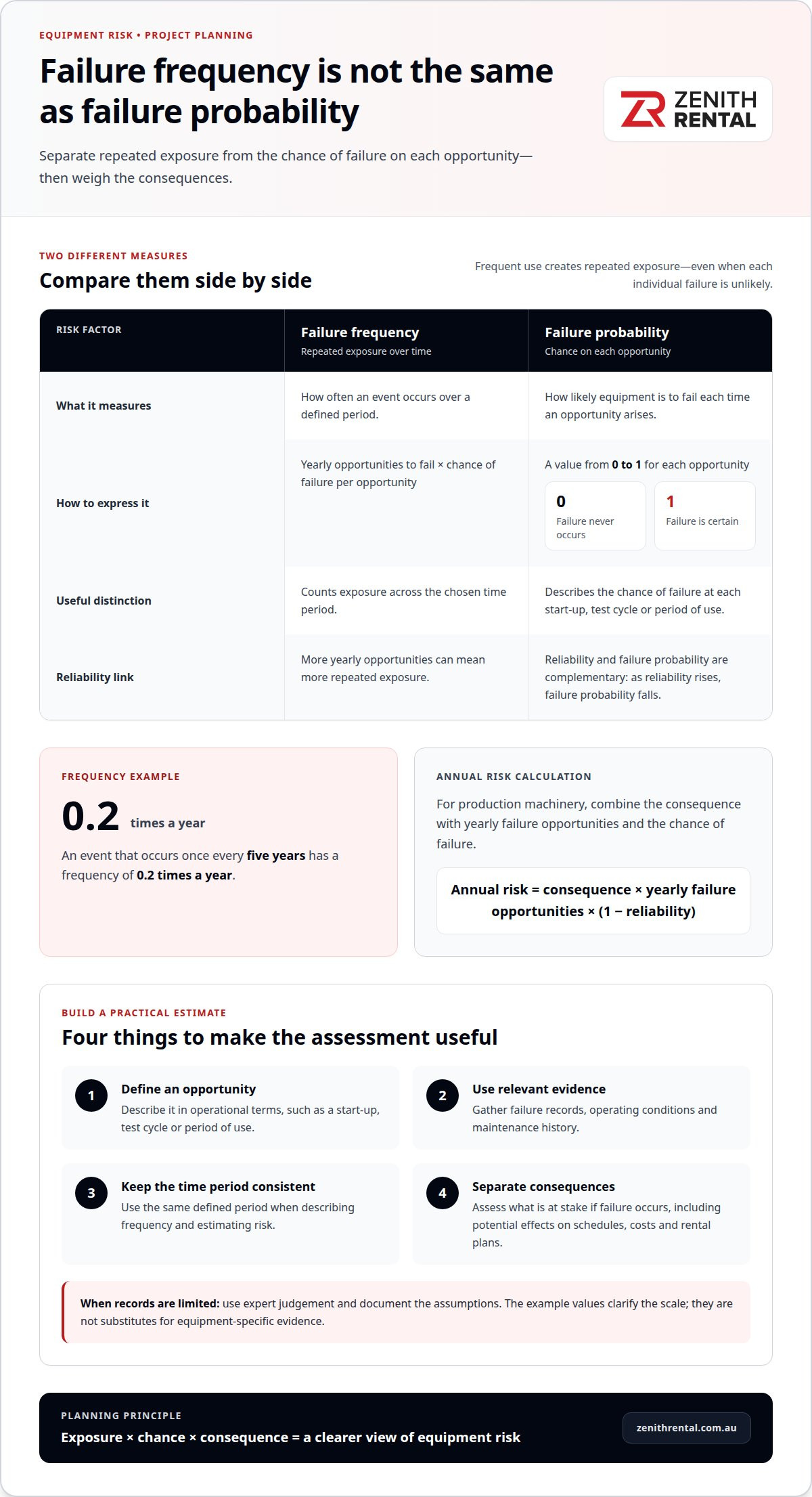
Frequency and probability of failure
Equipment risk depends on the failure event, its probability and the consequences. Separate how often equipment faces an opportunity to fail from the chance of failure on each opportunity. This distinction makes risk management more useful: frequent use creates repeated exposure, even when each individual failure is unlikely.
For production machinery, annual risk can be expressed as consequence multiplied by yearly failure opportunities and one minus reliability. The frequency of occurrence is the number of yearly opportunities to fail multiplied by the chance of failure. Reliability and failure probability are complementary measures in this calculation: as reliability rises, the chance of failure falls.
Use the time period consistently. An event that occurs once every five years has a frequency of 0.2 times a year. In the equation, the chance of failure is 1 when failure is certain each time an opportunity arises, and 0 when it never occurs. These values clarify the scale; they are not substitutes for equipment-specific evidence.
To develop a practical estimate, define an opportunity in operational terms, such as a start-up, test cycle or period of use. Gather relevant failure records, operating conditions and maintenance history. If records are limited, use expert judgement and document the assumptions. Assess consequences separately, including possible schedule interruptions, rework or effects on dependent activities.
Compare the likelihood and impact of each failure scenario. A low-probability event may still need attention if its consequences are severe. Conversely, teams may accept a low-impact risk when mitigation would cost more than its benefit. Use proactive measures that address both sides: reduce failure opportunities through maintenance, and limit consequences with workarounds or backup arrangements. Monitor whether actions change failure frequency or residual risk. Update estimates when equipment use, conditions or project plans change, so decisions reflect current exposure rather than outdated assumptions.
What equipment reliability metrics should project managers compare?
Compare measures that describe different aspects of equipment risk rather than treating reliability as a single score. Failure probability estimates the chance of failure at each opportunity; failure frequency accounts for how often those opportunities arise. A machine used repeatedly across a project may face greater exposure than one used briefly, even if both have the same per-use probability.
Pair likelihood measures with consequences. Consider how failure could affect the work sequence, dependent activities and project objectives. Annual risk combines consequence with the frequency of occurrence per year. Keep the period, operating conditions and definition of an opportunity consistent when comparing equipment, or the figures may represent different levels of exposure.
- Reliability: the likelihood that equipment performs as required, interpreted alongside its failure probability.
- Failure frequency: how often failures occur over the relevant operating period.
- Consequence: the effect a failure could have on schedule, cost exposure or dependent work.
- Residual risk: the remaining exposure after controls, tracked with a relevant key risk indicator.
Also compare downtime and maintainability. Reliability concerns whether failure occurs; maintainability concerns how readily repairs restore function. Record failure events, time out of service, repair actions and recurring causes. These measures distinguish equipment that rarely fails from equipment whose failures are resolved quickly. They also show whether maintenance reduces failure frequency, rather than merely limiting disruption after a fault.
Use like-for-like evidence: the same equipment type, task, operating conditions and measurement period. Review assumptions when records are sparse, and avoid ranking instruments by a single headline figure. A lower failure likelihood may not outweigh severe consequences, while effective workarounds can reduce impact without improving reliability. Reassess the indicators as project activities or conditions change.
For measurement tasks, explore test equipment rental options suited to the project’s requirements.
Zenith Rental: Multi-function calibrator with HART/Foundation Fieldbus communicator hire
Zenith Rental hires multi-function calibrators with HART/Foundation Fieldbus communicators for projects where these instruments suit the planned work. Matching equipment to the task helps align testing needs with the project schedule. Hiring also gives teams access to specialist equipment for a defined project period.
Before arranging equipment, identify the required measurements, project timing and consequences of disruption. This gives your team a clear basis for deciding whether a multi-function calibrator fits the work. Zenith Rental also offers test equipment rental, electrical test equipment calibrator hire, and power and energy testing equipment hire for relevant project needs.
If your equipment needs align with these options, contact Zenith Rental to discuss your project.
Make equipment planning part of the next project decision
Include equipment selection in the next scope or procurement review, while the team can still shape work sequences and resource plans. Match each instrument’s intended role to the project’s measurement activities, and keep the assumptions behind that choice visible as requirements evolve. This makes reducing project risk with reliable equipment an ongoing planning discipline, not a decision left until testing is about to begin.
Zenith Rental offers test equipment rental, electrical test equipment calibrator hire, and power and energy testing equipment hire for relevant project needs. The right option depends on the equipment your work requires.
Discuss equipment rental with Zenith Rental and take a considered next step for your project.
Frequently Asked Questions
What is risk mitigation?
Risk mitigation is the planned use of controls to reduce a risk’s likelihood, impact or both. For example, a project team could reduce measurement delays by scheduling equipment checks before a critical test. It could also limit the effect of a fault by preparing an alternative work sequence. The right response depends on the risk’s significance and the resources available.
What is the connection between risk and reliability?
Reliability influences the probability that equipment will perform as required, while risk also reflects how often failure opportunities arise and what a failure could affect. A fault during a non-critical task, for example, may have different consequences from one that interrupts a dependent test. Assess reliability alongside operating frequency and project impact to understand equipment-related exposure.
How does reliable equipment reduce project risk?
Reliable equipment can reduce the chance that instrument failure interrupts a planned task. This supports reducing project risk with reliable equipment when the instrument suits the measurement task and the project team has considered maintenance and fallback arrangements. Suitable test equipment, for example, can help a team complete a scheduled check while avoiding unnecessary equipment-related uncertainty.
How do equipment breakdowns affect project costs and timelines?
A breakdown can pause the affected task, delay dependent work and require repair or replacement arrangements. If hired equipment is needed longer than planned, the project may also face additional hire costs under its agreement. Teams can limit disruption by identifying milestones that depend on each instrument, documenting escalation steps and deciding how work will proceed during downtime.
What is the cost of reliable versus low-cost equipment in Australia?
There is no single cost comparison: total project exposure depends on equipment suitability, hire duration, delivery arrangements and the consequences of downtime. A lower upfront price alone does not show which option offers better value. Zenith Rental provides hire pricing after a quote request, with applicable charges set out in the Hire Schedule.