


Portable Appliance Testing: The Ultimate Guide to AS/NZS 3760 Compliance (2026)
A simple green "pass" tag on your electrical equipment is often the most deceptive element in a modern workplace if it lacks the rigorous diagnostic data mandated by the current AS/NZS 3760 standards. Achieving an elite level of safety through portable appliance testing requires more than just a cursory glance; it demands a seamless integration of technical precision and regulatory expertise. You likely feel that true operational excellence is built on a foundation of absolute reliability, yet the varying re-test frequencies across different Australian states can create unnecessary friction in your compliance journey.
This guide ensures you master these complexities to reach the zenith of electrical safety and regulatory compliance. We'll provide a clear, professional protocol for site-wide safety that meets the most stringent auditing standards. You'll discover how to distinguish between basic pass/fail results and the deep diagnostic data that protects your team's prestige. We'll also explore how to secure the industry's best diagnostic tools for your national fleet without the heavy capital expenditure typically associated with high-performance testing equipment.
Key Takeaways
- Understand why a rigorous visual inspection is the pinnacle of risk mitigation, accounting for nearly 90% of fault detection in industrial environments.
- Navigate the sophisticated AS/NZS 3760:2022 framework to ensure your personnel meet the elite standards required of a "Competent Person."
- Discover why basic pass/fail units fall short and how leakage current testing provides an unmatched level of protection for complex machinery.
- Master the professional step-by-step protocol for portable appliance testing to guarantee absolute reliability and regulatory compliance across your workplace.
- Learn how to transition from mere compliance to a prestigious safety culture using Zenith Rental’s concierge-level selection of precision instruments.
Understanding Portable Appliance Testing (PAT): The Zenith of Electrical Safety
Maintaining a pristine safety record requires more than just good intentions; it demands a rigorous commitment to Portable appliance testing (PAT). This systematic process involves the regular inspection and testing of electrical equipment to ensure it’s safe for use. It’s the primary defense against electric shock and fire hazards in professional settings. While some providers offer basic, non-diagnostic safety checks, the Zenith approach focuses on precision. We view safety as a luxury of certainty that allows you to focus on the journey of your project without the fear of mechanical failure.
In heavy-duty industrial environments, the stakes are significantly higher than in a standard office. Data from safety audits suggests that visual inspection alone accounts for nearly 90% of identified faults. A trained technician can spot a frayed cord or a compromised plug long before it causes a circuit failure. This proactive stance is essential for maintaining operational continuity on high-value industrial projects. When your timeline is tight and the equipment is elite, you can't afford the downtime caused by a preventable electrical fault.
The 2026 landscape for electrical safety emphasizes diagnostic depth. Modern portable appliance testing isn't just about a pass or fail sticker; it's about verifying the integrity of the earth bonding and insulation resistance to a granular level. This ensures that every piece of equipment in your fleet operates at its peak, providing a seamless experience for your team and your clients alike.
This commitment to technical excellence is a standard shared across industries; for instance, reputable event production companies Ontario rely on similar rigorous safety protocols to ensure their live and hybrid technical solutions remain flawless.
The Scope of Portable Appliances
In a professional Australian context, a portable appliance is defined as any equipment that is plugged into a socket-outlet. This definition covers a vast range of assets. We categorise these into hand-held tools, portable units like industrial vacuums, stationary equipment such as lathes, and transportable units like large compressors. The risk profile shifts dramatically between a low-risk office environment and a high-risk industrial worksite. On a construction site, the harsh conditions mean equipment is tested every 3 months, whereas a stationary office computer might only require a check every 5 years under AS/NZS 3760 standards.
Why Compliance is Non-Negotiable
Adhering to Australian WHS and OHS laws is a fundamental obligation for any business operating in 2026. Compliance isn't merely a box-ticking exercise; it’s a legal shield. If a workplace incident occurs, the legal ramifications of non-compliance are severe, often involving heavy fines or litigation. Accurate safety reporting is the cornerstone of a successful safety audit. This is why choosing the right instrumentation is critical. High-quality testing tools provide the data transparency needed to prove that your workplace meets the highest standards of electrical integrity. It’s about building a reputation for reliability and prestige in everything you do.
The Regulatory Framework: Navigating AS/NZS 3760 Standards
Excellence in workplace safety begins with a deep understanding of the AS/NZS 3760:2022 standard. This document serves as the definitive Australian benchmark for the in-service safety inspection and testing of electrical equipment. Adhering to these protocols ensures your organization meets its Australian electrical safety duties, protecting both your personnel and your professional reputation. The 2022 update refined several testing parameters to account for modern electronics, making it essential for businesses to align their safety programs with the most current data available.
The standard relies on the expertise of a "Competent Person." In the Australian regulatory context, this isn't necessarily a licensed electrician, but someone who possesses the necessary practical and theoretical knowledge, gained through training or experience, to perform portable appliance testing effectively. Organisations such as Axiom College offer the structured training required to meet these professional benchmarks. They must understand the nuances of the equipment, identify potential hazards, and possess the skill to operate testing instrumentation with absolute precision. Relying on verified competence is the hallmark of a sophisticated safety strategy.
Compliance isn't just about the physical test; it's about the integrity of your proof. You must maintain meticulous records for a minimum of seven years in most jurisdictions to satisfy potential audits. These logs should include test dates, detailed results, and the identity of the person conducting the inspection. Ensuring the validity of these results requires the regular calibration of your PAT tester. An uncalibrated device renders your results questionable, whereas a calibrated unit provides the certainty required for elite-level compliance.
Class I vs. Class II Appliances
Distinguishing between equipment classes is vital for accurate testing. Class I appliances rely on a protective earth for safety. You'll identify these by their three-pin plugs and metal enclosures. Testing involves measuring earth continuity and insulation resistance to ensure the protective path is intact. Class II appliances utilize double insulation, often marked by the "square within a square" symbol. These lack a protective earth and only require insulation resistance testing. Use this checklist for identification:
- Class I: Three-pin plug, metallic chassis, or the protective earth symbol (an 'E' or a circle with three lines).
- Class II: Two-pin plug, plastic casing, and the double-insulation symbol.
Testing Frequencies and Environment Risk
The environment dictates the pace of your safety journey. Construction sites and mining operations demand rigorous 3-month cycles due to high-impact usage and exposure to the elements. Commercial kitchens, classified as "harsh environments" due to moisture and heat, typically require 6-month intervals. In contrast, a low-risk corporate office might only see a 5-year cycle for stationary equipment like desktop computers. Industrial workshops fall into the 12-month category to account for mechanical wear and dust. Choosing premium testing equipment ensures these mandatory cycles remain a seamless part of your operational rhythm rather than a logistical burden.
Diagnostic vs. Pass/Fail: Selecting the Elite PAT Tester
In the pursuit of absolute compliance, a simple green light is rarely enough. While entry-level testers offer a basic pass or fail result, they lack the nuance required for complex industrial machinery or high-sensitivity medical electronics. Professional portable appliance testing demands diagnostic depth. High-end instruments from industry leaders like Megger and Fluke provide granular safety data that uncovers latent issues before they escalate into hazards. This level of detail is the hallmark of a sophisticated safety program that prioritizes precision over mere box-ticking.
Leakage current testing serves as a superior alternative to standard insulation resistance tests. It measures the actual current flowing to earth while the appliance is powered; this provides a realistic assessment of its health under real-world operating conditions. For large-scale asset management, the integration of Bluetooth connectivity and high-capacity data logging is non-negotiable. These features allow for the seamless transfer of results to cloud-based management systems. It ensures that every test record is pristine, accurate, and audit-ready at a moment's notice.
Advanced Features for Professionals
Elite technicians distinguish themselves through the precision of their tools. Standard 10A earth bond testing suffices for office gear, but 25A testing is vital for heavy-duty industrial equipment to ensure the integrity of protective earth paths. Safety isn't just about the appliance; it's about the entire circuit. This is why RCD (Residual Current Device) trip time testing is a critical safety differentiator. It ensures that safety switches disconnect power within the precise milliseconds required by AS/NZS 3760 standards. Integrated thermal printers and barcode scanners further refine the experience. They allow for immediate asset tracking and eliminate the risk of manual data entry errors during high-volume testing phases.
Rental as a Strategic Compliance Tool
Maintaining a fleet of elite testers represents a significant capital commitment and a constant management cycle. Choosing test equipment hire Australia allows businesses to access the latest NATA-certified technology without the burden of depreciation or the logistical headache of annual calibration management. Zenith provides a seamless service, delivering pristine, ready-to-use instruments to sites across the country. This strategic approach ensures your team always works with the pinnacle of diagnostic technology. It transforms a logistical necessity into a hallmark of professional excellence, reflecting a commitment to quality that aligns with the most discerning standards of Australian industry.
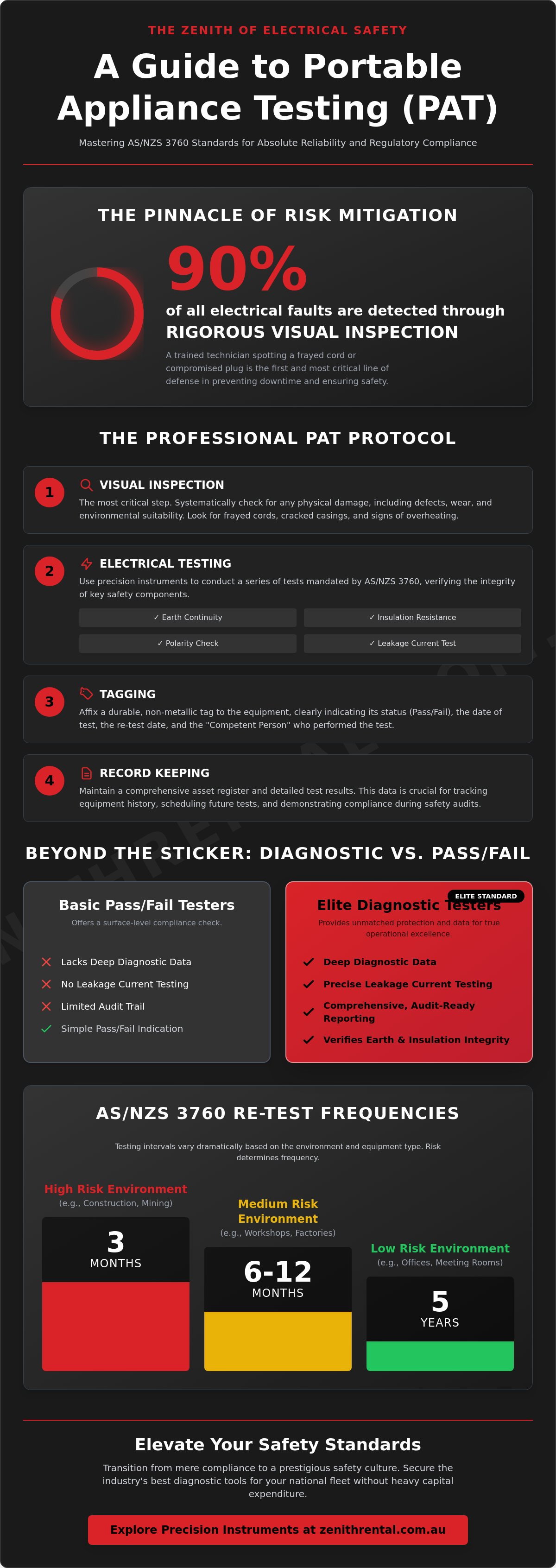
How to Conduct a Professional PAT Test: A Step-by-Step Protocol
Achieving the zenith of operational safety requires a disciplined, five-step methodology that leaves no room for error. This protocol ensures your equipment remains in pristine condition, reflecting the high standards of a sophisticated business environment. When performing portable appliance testing, technicians must follow a sequence that prioritises both electrical integrity and meticulous documentation.
- Step 1: Visual and Physical Inspection. Perform a rigorous assessment for damage, wear, and environmental stress. This is the most critical phase for identifying external vulnerabilities.
- Step 2: Earth Bond/Continuity Test. For Class I devices, you must ensure a low-resistance path to ground. This confirms that the protective earth connection is robust enough to handle a fault.
- Step 3: Insulation Resistance Test. Execute this test, or a Leakage Current test, to verify the dielectric integrity of the appliance. It ensures current doesn't escape through the casing.
- Step 4: Polarity Check. Conduct this on all detachable leads and extension cords. It's a vital step to verify that active and neutral wires aren't reversed, which could lead to live chassis components.
- Step 5: Functional Testing and Tagging. Finalise the process by powering the unit to confirm it operates correctly. Apply a durable tag and enter the data into a digital record system for a seamless audit trail.
Mastering the Visual Inspection
Visual inspection serves as the first line of defense against electrical hazards. Technicians must examine every millimetre of the cable for frayed cords, damaged plugs, or signs of moisture ingress. It's essential to verify that the equipment is suitable for its specific environment, such as ensuring high-performance tools have the correct IP ratings for outdoor use. Meticulous attention during this phase identifies up to 90% of potential faults before a single meter is connected.
RCD Trip Time Testing Procedures
Ensuring the reliability of Residual Current Devices (RCDs) requires more than just the "push button" test. While the button confirms the mechanical trigger works, a professional portable appliance testing regime uses calibrated instruments to measure the exact trip time. Testing must occur at both 0° and 180° phases to guarantee absolute safety assurance across the entire sine wave.
Under AS/NZS 3760, Type I RCDs must disconnect the power within 40 milliseconds, while Type II units must trip within 300 milliseconds. These precise measurements are non-negotiable for protecting your elite workforce from high-voltage incidents. Maintaining these standards reflects a commitment to excellence and unmatched reliability in every facet of your operations.
Maintain the integrity of your fleet and workshop with our premium equipment solutions tailored for the discerning Australian business.
Elevate Your Safety Standards with Zenith Rental’s Precision Instruments
Transitioning from basic compliance to a sophisticated safety culture requires more than just intent; it requires the right partnership. Zenith Rental acts as your elite concierge, curating a selection of technical instruments that reflect your commitment to excellence. We don't view safety as a chore. Instead, we see it as a vital component of a high-performing business. Our pristine fleet of testing equipment stands ready for your next safety audit, providing the reliability you expect from a premium service provider. By choosing professional equipment leasing, you access the Zenith of service, where every detail is managed with precision and care.
Adopting a proactive approach to safety signals to your stakeholders that quality is non-negotiable. In the 2026 regulatory environment, simply meeting the minimum requirements is no longer the benchmark for success. Elite organizations utilize high-end tools to ensure that every measurement is exact. This level of dedication transforms a routine check into a statement of professional authority. Zenith Rental provides the bridge between your safety goals and the technical reality of achieving them with absolute confidence.
Access the World’s Best Brands
Our inventory showcases the absolute leaders in the field: Fluke, Megger, and Seaward. These brands represent the global standard for portable appliance testing, known for their durability and accuracy. Choosing the right tool depends on your specific site risk profile, and our deeply knowledgeable team assists in making that selection. We understand that a construction site in Perth has different requirements than a corporate headquarters in Sydney. Our national coverage ensures that whether you're in Melbourne or Brisbane, our professional logistics team delivers a seamless experience. We prioritize efficiency so your team can focus on the task at hand without the burden of equipment maintenance or storage.
Your Partner in Precision
Total peace of mind comes from knowing your measurements are beyond reproach. Every instrument in our fleet undergoes rigorous NATA-traceable calibration before it reaches your hands. This commitment to accuracy ensures that your portable appliance testing data remains robust and reliable. We offer dedicated technical support to help your project reach its pinnacle of success, providing guidance that mirrors the high-end hospitality we're known for. Our goal is to minimize friction, making the booking and testing process as smooth as possible. We've accounted for every detail so you don't have to. Contact our specialists to secure your testing fleet today.
Secure Your Site with the Zenith of Electrical Safety
Achieving full compliance with AS/NZS 3760 standards requires more than a cursory glance; it demands a rigorous commitment to precision and technical excellence. By integrating professional portable appliance testing into your mandatory maintenance cycles, you're doing more than just meeting Australian regulatory requirements. You're protecting your workforce with the world's most reliable diagnostic technology. Zenith Rental provides immediate access to pristine, NATA-traceable equipment from industry leaders like Fluke and Megger, ensuring every measurement meets the highest national benchmarks. We offer seamless delivery to any site across Australia, complemented by expert technical support that reflects our signature elite concierge service. Don't settle for standard results when you can reach the pinnacle of site safety and operational reliability. Discover our elite range of PAT testers and secure your site compliance today. We're here to ensure your next safety audit is handled with absolute confidence and professional grace.
Frequently Asked Questions
What is the Australian Standard for portable appliance testing?
The primary Australian Standard for portable appliance testing is AS/NZS 3760:2022. This essential regulation provides a rigorous framework for the safety inspection and testing of electrical equipment to ensure every device meets elite safety benchmarks. By adhering to these standards, businesses maintain a pristine environment where technical reliability and guest safety remain the top priority.
How often do I need to PAT test my electrical equipment in Australia?
Testing intervals vary from 3 months to 5 years based on your specific workplace environment and the potential risk level of the equipment. For example, high-risk construction sites require testing every 3 months, while a standard office setting typically demands a 12 or 24 month cycle. Zenith Rental prioritizes this seamless adherence to safety, ensuring our premium equipment always operates at the pinnacle of compliance.
Can any employee perform PAT testing, or do they need specific qualifications?
A "Competent Person" who possesses the necessary training and skills can perform portable appliance testing. While you don't always need to be a licensed electrician, you must have the technical knowledge and experience to operate a Portable Appliance Tester correctly. This ensures every inspection reflects a high-end commitment to safety and professional precision, mirroring the elite service standards we uphold.
What is the difference between a Class I and a Class II electrical appliance?
Class I appliances rely on a protective earth connection for safety, whereas Class II appliances utilize double insulation for protection. You'll identify Class II items by their distinct "square within a square" symbol, which indicates they don't require an earth wire. Understanding these technical nuances is essential for maintaining a sophisticated fleet of equipment that delivers unmatched reliability for every discerning user.
Is a visual inspection alone enough to be compliant with AS/NZS 3760?
A visual inspection is not enough to achieve full compliance with the AS/NZS 3760 standard. While visual checks can identify up to 90 percent of visible defects, electrical testing with a calibrated PAT device is mandatory to detect hidden internal faults. This comprehensive approach ensures your equipment remains in pristine condition, providing a seamless experience for both staff and high-value clients.
What happens if an appliance fails a PAT test in a commercial workplace?
If an appliance fails a test, you must immediately withdraw it from service and attach a "Danger: Do Not Use" tag. The equipment should remain isolated until a qualified technician repairs it or it's permanently decommissioned. Managing these details with precision protects your reputation for excellence and ensures that only elite, safe equipment remains in your active inventory.
Do new electrical appliances need to be tested before their first use?
New electrical appliances don't require formal testing before their first use, but they must be visually inspected and tagged as "New to Service." This tag records the date the item entered the workplace and identifies when its first formal test is due. Implementing this logical process ensures your safety records remain impeccable from the very first moment an asset joins your premium collection.
How long do I need to keep the records of my electrical safety tests?
You should keep records of your electrical safety tests for at least 7 years to satisfy regulatory requirements and demonstrate due diligence. Safe Work Australia recommends maintaining a detailed register that includes test dates, results, and the technician’s credentials. This organized approach to documentation reflects a professional commitment to the highest standards of safety and elite service management.