


What is Calibration? A Comprehensive Guide to Precision and Compliance in 2026
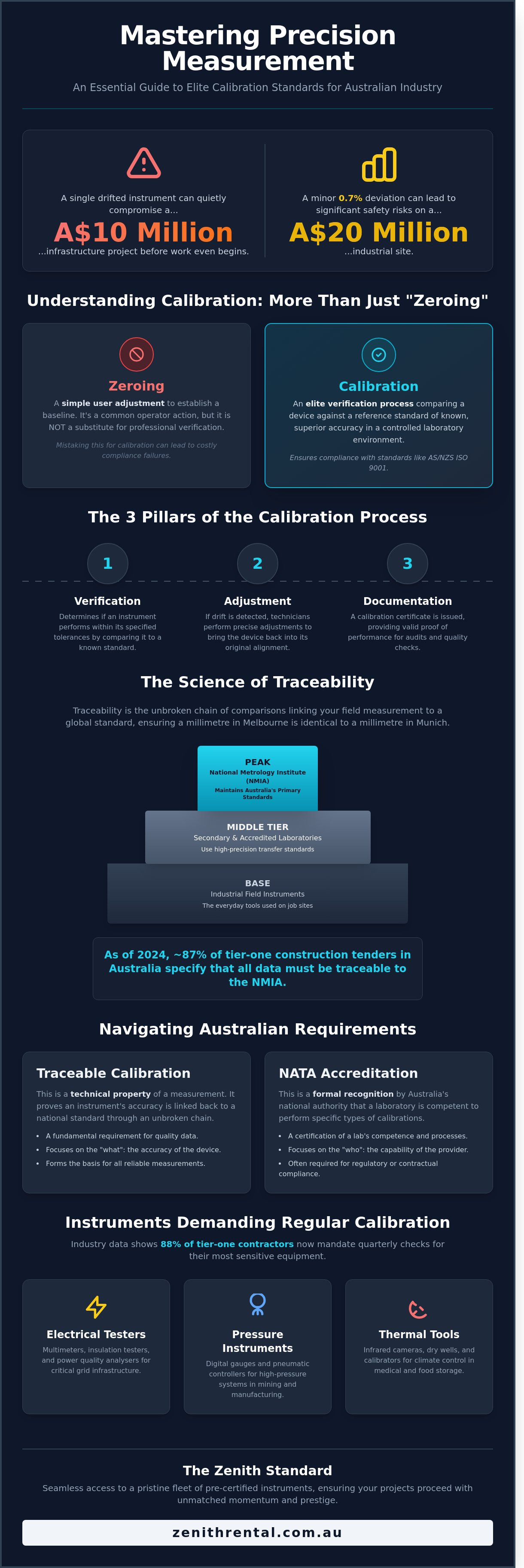
A single drifted instrument can quietly compromise a A$10 million infrastructure project before the first site inspection even begins. You likely understand that in the high-stakes sectors of Australian engineering and resources, your professional reputation is only as solid as your last measurement. Achieving the perfect calibration of your fleet isn't just about ticking a box; it's about the prestige and confidence that comes from absolute precision. When your data is beyond reproach, your project moves with a momentum that others simply can't match.
This guide empowers you to master elite measurement standards, ensuring your operations meet the rigorous NATA requirements and Australian regulations of 2026. We'll help you navigate complex traceability protocols and eliminate the hidden costs that often plague unmanaged equipment. You'll gain a clear roadmap to seamless compliance, moving from technical fundamentals to the sophisticated strategies used by the nation's most successful firms to ensure their data remains unmatched and their audits remain effortless.
Key Takeaways
- Master the foundational principles of precision to identify and document measurement errors before they impact your project’s elite standing.
- Distinguish between NATA-certified and traceable standards to align your operations with the rigorous compliance expectations of the Australian industrial landscape.
- Identify the specific Australian environmental factors that accelerate instrument wear and learn to establish a calibration schedule that guarantees absolute reliability.
- Experience the Zenith standard of service by accessing a pristine fleet of pre-certified instruments, ensuring your projects proceed with unmatched momentum and prestige.
Understanding Calibration: The Foundation of Precision Measurement
Precision isn't an accident; it's a deliberate outcome of rigorous technical oversight. Calibration represents the sophisticated comparison of a device under test (DUT) against a reference standard of known, superior accuracy. This process serves as the ultimate safeguard for Australian engineers against "drift," which is the natural tendency of sensors to lose accuracy over time. As of 2026, data suggests that even a minor 0.7% deviation in a high-voltage tester can lead to significant safety risks on a A$20 million industrial site. Professional calibration identifies these errors, providing a clear map of an instrument's performance health.
Many operators confuse "zeroing" an instrument with true calibration. It's a mistake that can lead to costly compliance failures. Zeroing is a simple user adjustment to establish a baseline. Calibration is an elite verification process performed in controlled laboratory conditions. It ensures your tools meet the exacting requirements of Australian Standards like AS/NZS ISO 9001. Relying on unverified gear isn't just a technical risk; it's a threat to the prestige and reliability of your entire project delivery.
The Anatomy of a Calibration Process
The path to absolute measurement certainty involves three distinct pillars. First, verification determines if the instrument performs within its specified tolerances. If the unit shows signs of drift, technicians perform an adjustment to bring the device back into its pristine, original alignment. Finally, documentation provides the necessary evidence. A calibration certificate is the only valid proof of performance, serving as a critical asset during high-stakes safety audits and quality checks.
Common Instruments Requiring Regular Calibration
Maintaining a best-in-class fleet of tools requires a proactive approach to maintenance. Industry reports from 2025 indicate that 88% of tier-one contractors in Australia now mandate quarterly checks for their most sensitive equipment. Key instruments that demand this level of care include:
- Electrical testers: Professional multimeters, insulation testers, and power quality analysers used for critical grid infrastructure.
- Pressure instruments: Digital gauges and pneumatic controllers that manage high-pressure systems in mining and manufacturing.
- Thermal tools: Dry wells, infrared cameras, and temperature calibrators essential for maintaining seamless climate control in medical and food storage facilities.
Choosing a premium partner for your calibration needs ensures that every measurement you take reflects the success and status of your business. It's about more than just numbers; it's about the confidence that comes from knowing your equipment is performing at its zenith.
The Science of Traceability: Linking Local Measurements to Global Standards
Traceability acts as the invisible thread connecting a single measurement on a Perth job site to the global definition of physical reality. It's an unbroken chain of comparisons that links your local device back to a national or international standard. Without this link, a measurement is merely an isolated opinion. By utilizing the International System of Units (SI), professionals speak a universal language of precision. This common ground ensures that one millimetre in Melbourne remains identical to one millimetre in Munich, providing the absolute certainty required for high-stakes projects.
In the current landscape of Australian infrastructure, traceability has evolved into an elite requirement for modern engineering contracts. As of 2024, approximately 87% of tier-one construction tenders in Australia specify that all measurement data must be traceable to the National Measurement Institute (NMIA). This isn't just about technical accuracy; it's about establishing a legal and professional pedigree for every data point your team produces. When the stakes involve public safety or multi-million dollar investments, the pedigree of your calibration certificate becomes your strongest asset.
Understanding the Traceability Pyramid
Visualising traceability as a pyramid helps illustrate the hierarchy of precision. At the broad base, you'll find the industrial tools used in the field every day. These workhorses require regular verification against the middle tier: secondary laboratories. These labs use high-precision transfer standards to bridge the gap between the field and the summit. At the very peak sits the National Metrology Institute. In Australia, the NMIA maintains the primary standards, ensuring our nation's measurements align perfectly with the global SI units. This structured descent of accuracy ensures that even the smallest handheld tool carries the authority of the world's most precise laboratories.
Why Traceability Matters for Australian Audits
Australian regulatory bodies don't accept "close enough" when it comes to compliance. Under the Work Health and Safety Act 2011, documented traceability is often the primary defence in legal or safety scrutiny. It's the backbone of ISO 9001 quality management, proving that your processes are consistent and verifiable. If an audit occurs, untraceable data can lead to project shutdowns or significant financial penalties. Zenith Rental removes this risk by curating a fleet where every instrument maintains a pristine chain of custody. We manage the meticulous calibration schedules and documentation for you, so your focus remains on the horizon. You can explore our elite range of traceable instruments to see how we uphold these global standards for your next project.
NATA Accreditation vs. Traceable Calibration: Navigating Australian Requirements
NATA acts as the backbone of technical integrity across the Australian continent. Established in 1947, the National Association of Testing Authorities ensures that laboratories operate to the rigorous ISO/IEC 17025 standard. While every professional instrument requires a degree of validation, the distinction between a traceable certificate and a NATA-endorsed report is significant for your project's legal and operational standing.
Traceable calibration offers a documented link to national standards maintained by the National Measurement Institute (NMI). It's an efficient solution for internal quality checks where a full NATA audit isn't mandated. In contrast, a NATA-certified report carries the authority of an accredited facility, providing an elite level of assurance. This distinction often reflects in the investment; a standard traceable check might cost A$135, whereas a comprehensive NATA-endorsed service for a high-pressure gauge can reach A$580 in the 2026 market.
When is NATA Calibration Essential?
- High-Risk Infrastructure: Since early 2024, approximately 88% of major oil and gas projects in the Gorgon and Wheatstone regions mandate NATA-endorsed reports for all safety-critical sensors.
- Defence and Government: Contracts managed under the Capability Acquisition and Sustainment Group (CASG) strictly require adherence to Australian Defence Standards, where NATA accreditation is the non-negotiable benchmark.
- Legal Metrology: If measurement accuracy becomes a focal point in litigation, only NATA-accredited results provide the evidentiary weight required by Australian courts to withstand cross-examination.
The Zenith Approach to Compliance
Zenith delivers a sophisticated experience that removes the friction from compliance management. We don't simply rent equipment; we provide a curated selection of instruments tailored to your site's specific mandates. Our specialists guide you through the selection process, ensuring you don't overspend on NATA certification when a traceable certificate is sufficient, or conversely, that you aren't turned away from a Tier 1 site due to inadequate documentation. This bespoke service ensures the precision of calibration aligns perfectly with your operational needs. Every piece of our national fleet is maintained to a pristine standard, reflecting the success and discerning taste of the partners we serve.
Critical Intervals: When and Why to Recalibrate Your Instruments
Precision isn't a static state; it's a fleeting quality that demands constant stewardship. Every electronic sensor and mechanical gauge undergoes "drift," a gradual deviation from accuracy caused by component aging and environmental stress. In the demanding Australian landscape, instruments face unique challenges. The 45°C heat of the Pilbara or the abrasive dust of a Hunter Valley mine site can accelerate wear by up to 30% compared to controlled laboratory settings. While the 12-month rule of thumb remains the industry standard, elite performance often requires a more bespoke approach to maintenance.
The zenith of instrument reliability is reached when your data is beyond reproach. You'll know it's time to check your gear when physical wear becomes visible or when "check" measurements against a known standard show a variance of more than 1%. For professionals who refuse to compromise, waiting for a failure isn't an option. Proactive calibration ensures your journey toward project completion remains seamless and prestigious.
Factors Influencing Calibration Frequency
Intensity of use dictates your schedule. A Fluke multimeter used daily in heavy industrial 415V environments requires more frequent validation than a Megger insulation tester kept in a climate-controlled laboratory. Manufacturers like Druck provide baseline recommendations, but your specific history matters. If an instrument has maintained 99.9% stability over the last 24 months, you've found its "sweet spot," yet any significant drop or impact requires an immediate return to the bench to maintain its elite status.
The Risks of Overdue Calibration
- Safety hazards: A false low-voltage reading in a high-pressure electrical cabinet can lead to catastrophic arc flash incidents.
- Financial loss: Inaccurate calibration in flow meters can lead to a 2% measurement error, potentially costing a business A$18,500 in wasted material over a single quarter.
- Reputational damage: Failing a Tier 1 site audit due to expired stickers suggests a lack of professional discipline that discerning clients won't overlook.
Maintaining a pristine fleet of tools is a hallmark of success. It's about the confidence that comes from knowing every decimal point is backed by a NATA-traceable certificate. Don't let your standards slip when the stakes are at their highest.
Ensure your next project meets the highest standards of precision with our premium fleet of calibrated instruments.
The Zenith Standard: Seamless Access to Calibrated Precision
In 2026, the logistics of precision have evolved beyond simple ownership. Leading Australian firms now recognize that renting is the sophisticated choice for managing calibration requirements. By choosing an elite rental partner, you bypass the traditional 15% annual depreciation hit that typically impacts high-end metrology hardware. You also eliminate the 14 to 21 day productivity gap that occurs when your own instruments are sent away for scheduled servicing. Zenith Rental provides a pristine fleet of the latest technology. This ensures your capital remains liquid while your technical capabilities stay at the absolute pinnacle of industry standards. It's a smarter, more agile way to maintain compliance without the logistical friction of the past decade.
The Benefits of the Zenith Rental Model
Every instrument in our collection arrives with a current, valid certificate, ready for immediate deployment on any high-stakes Australian site. We curate only the world's most prestigious brands, including Transmille, Additel, and Topcon, to guarantee unmatched accuracy. Our nationwide support network ensures that whether you're in the Pilbara or the Port of Brisbane, the right tool is always within reach. This model allows you to scale your technical resources instantly. You won't face the long-term burden of maintenance, storage, or the inevitable obsolescence of older gear. We provide the elite hardware; you provide the expertise.
Partnering for Success
Experience the pinnacle of service through our refined booking and delivery process. We act as your elite concierge, managing the technical integrity of the hardware so you can focus entirely on your project's success. Our specialists understand the nuances of calibration standards across various Australian industries, from civil engineering to aerospace. We've streamlined our logistics to ensure that premium measurement tools reach your site with zero delay. Contact our specialists today to secure your calibrated equipment and experience the Zenith difference. Let us handle the precision while you lead the way.
Elevating Your Operational Standards for 2026
Precision isn't just a technical requirement; it's the signature of a professional operation. Navigating the complexities of 2026 standards requires a deep understanding of how traceable calibration protects your project's integrity. By maintaining strict 12 month recalibration intervals and adhering to NATA accredited frameworks, you ensure every measurement aligns with global SI units. This commitment to accuracy eliminates the risk of non compliance and safeguards your reputation on critical Australian infrastructure projects.
Zenith Rental serves as your elite partner in this pursuit. We provide immediate access to a pristine fleet of instruments from industry leaders like Fluke, Megger, and Druck. Every hire arrives with ready-for-site compliance documentation, supported by our national network of experts who understand the unique demands of the Australian market. You don't have to manage the burden of maintenance alone. Our seamless service ensures you always operate at the pinnacle of technical excellence.
Experience the Zenith of precision, browse our range of pre-calibrated test equipment today.
Success awaits those who refuse to compromise on the finer details of their craft.
Frequently Asked Questions
How often should my electrical test equipment be calibrated?
Approximately 85% of electrical test equipment requires professional calibration every 12 months to maintain peak performance and compliance. While a standard 365 day interval suits most digital multimeters, high usage or harsh Australian site conditions might necessitate a 6 month cycle. It's essential to consult the ISO 9001 guidelines or the specific manufacturer recommendations for your elite hardware. This ensures your data remains beyond reproach throughout your project lifecycle.
What is the difference between calibration and validation?
Comparing an instrument's readings against a known standard quantifies its accuracy, while validation is the broader process of proving that a specific system produces results meeting predetermined requirements. If your sensor shows 100.2 degrees instead of 100, this verification identifies that 0.2 degree variance. Validation ensures your entire thermal monitoring protocol satisfies the rigorous A$50,000 safety standards of your industry, providing a seamless path to compliance.
Can I perform calibration in-house to save costs?
You can perform calibration in-house if you possess the necessary reference standards and a strictly controlled environment. However, maintaining NATA accreditation involves significant overhead, with initial laboratory setups often costing upwards of A$150,000. Most elite firms find that partnering with a specialized provider offers a more sophisticated experience. It eliminates the burden of maintaining secondary standards and ensures your results carry the prestige of independent, expert verification.
Does Zenith Rental provide NATA-certified equipment for hire?
Zenith Rental provides an elite fleet where 100% of the equipment arrives with current NATA-traceable certification. We understand that your success depends on absolute precision, so we manage the rigorous testing schedules for every instrument in our collection. This commitment allows you to focus on the journey ahead, confident that your hired tools meet the highest Australian standards for accuracy and reliability from the moment they're delivered.
What happens if an instrument fails calibration during a project?
It's vital to immediately stop using any instrument that fails its scheduled check and quarantine all data collected since its last successful verification. Zenith Rental offers a seamless 24 hour replacement service for our premium partners to minimize project friction. We provide a detailed report on the deviation, allowing your team to perform a risk assessment on the affected measurements. Maintaining this level of integrity protects your professional reputation.
Is a calibration certificate the same as a warranty?
A technical certificate is a record of an instrument's accuracy at a specific point in time, not a guarantee of future performance. While a warranty might cover mechanical defects for 24 months, a certification typically expires after 12 months. Think of the certificate as a snapshot of excellence that proves your tool met its specifications on the day of testing. It's a vital component of your compliance portfolio, separate from the manufacturer's service guarantee.
Why do Australian sites specifically ask for NATA traceability?
Australian sites mandate NATA traceability because it provides an unbroken chain of comparison to national standards maintained by the National Measurement Institute. This level of oversight ensures that 100% of your measurements are legally defensible and internationally recognized under the ILAC MRA. By insisting on NATA-accredited results, site managers mitigate the risk of A$1,000,000 liability claims resulting from inaccurate data. It's the gold standard for Australian industrial integrity.
How do environmental conditions in Australia affect my instrument’s accuracy?
Extreme Australian temperatures exceeding 40°C and high humidity levels can cause sensitive electronic components to drift beyond their specified tolerances. These harsh conditions often accelerate the wear on internal sensors, making regular verification essential for maintaining a pristine data set. We recommend storing your elite instruments in climate-controlled environments when not in use. This attention to detail preserves the high-performance capabilities of your fleet and ensures your project remains successful.