


Multi-Product Calibrator Hire Guide for Australia
Could a calibrator with more functions still be the wrong hire? Yes. If its documented capabilities don’t match the measurements and calibration tasks your project requires, it may not be suitable. A successful multi-product calibrator hire starts with the test scope, then checks the functions, ranges and performance needed to complete it.
It’s understandable to want one instrument to cover as much as possible, particularly for occasional projects where long-term ownership may not make sense. But counting functions alone won’t tell you whether a calibrator is right for the job. Zenith Rental provides test and measurement equipment hire across Australia, including Fluke and Transmille multi-product calibrators for defined project requirements.
This guide explains how to compare your test scope with an instrument’s documented capabilities, what information to prepare for a hire enquiry, and how hiring can provide access to specialist instrumentation without a long-term purchase. It also covers why you should identify the required measurements, ranges and project conditions before selecting a calibrator. With those details clear, you can assess whether a hired instrument suits the work ahead.
Key Takeaways
- Start with the test procedure and the instrument being tested, then identify the calibration tasks the project requires.
- Build a specification checklist covering functions, test points, ranges, tolerances and connection details before selecting equipment.
- For multi-product calibrator hire, assess documented capabilities against the full workflow rather than choosing by function count alone.
- Compare a multi-product calibrator with task-specific instruments by considering the required measurements, range and practical workflow.
- Prepare clear project requirements to help align Zenith Rental’s Australian test equipment hire with your defined scope.
What is a multi-product calibrator, and what work can it support?
A multi-product calibrator is a reference instrument used to check or adjust other instruments across more than one calibration function. The instrument being checked is the device under test. Depending on its design, the calibrator supplies a known signal, measures a signal, or does both. Comparing the device’s response with the reference helps determine whether its readings or outputs fall within the required tolerance.
Calibration establishes how an instrument’s performance compares with a reference. It is more than checking whether the instrument switches on. For background on the broader process, see What is Calibration? The functions, ranges and accuracy of a multi-product calibrator vary by instrument, so use its documentation and the test procedure to guide your selection.
How does a multi-product calibrator differ from a single-function calibrator?
A single-function calibrator is designed for a particular calibration task. A multi-product instrument combines multiple functions in one unit, which may reduce the number of separate instruments needed and simplify some workflows. That convenience doesn’t guarantee that it will cover every task. Its documented functions, ranges and performance determine whether it suits the application.
Which calibration tasks may involve a multi-product calibrator?
Electrical and instrumentation work may involve multi-product calibrators, but the relevant capabilities depend on the task and the instrument. Voltage, current, resistance and frequency are examples of functions to verify against model documentation, not features to assume. Before arranging multi-product calibrator hire, define the test points and required accuracy, then compare them with the instrument’s specifications.
For each device under test, identify what the procedure asks you to apply or measure, the values involved and the acceptable tolerance. Check that the calibrator’s connection method and operating workflow also suit the setup. This keeps the selection grounded in the work rather than the number of functions on a product page. Zenith Rental provides multi-product calibrator hire as part of its test and measurement equipment hire across Australia, supporting defined project requirements with specialist instrumentation.
Which calibrator specifications should match your project?
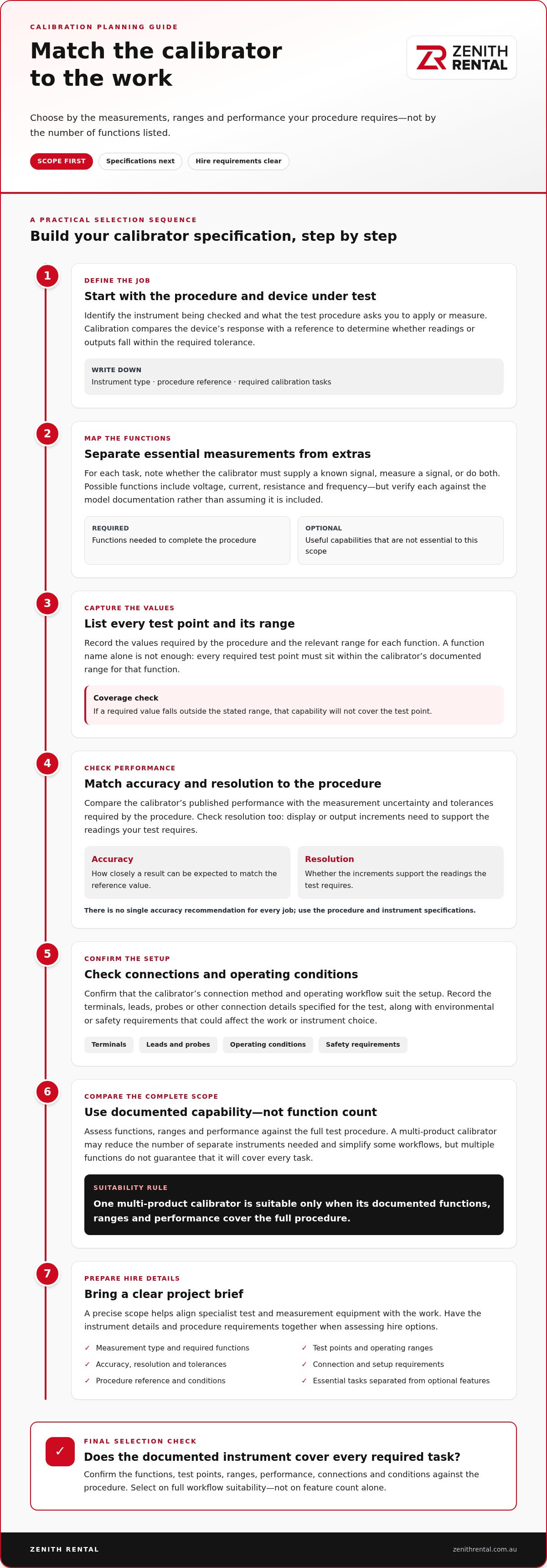
Start with the test procedure and the instrument under test, then build a specification checklist around the work. This helps separate essential requirements from useful extras, so a long feature list doesn’t distract from whether the calibrator can perform each required task.
Record the following for each instrument and procedure:
- Required functions: the signals to generate or measure, separating essential tasks from optional capabilities.
- Test points and ranges: every value the procedure requires, including the relevant range for each function.
- Accuracy and resolution: the performance needed to assess results against the procedure’s tolerances.
- Connections and setup: terminals, leads, probes or other connection details specified for the test.
- Operating conditions: environmental or safety requirements that could affect the planned work or instrument choice.
For broader background on how calibration services support measurement quality and traceability, see the US National Institute of Standards and Technology’s NIST Calibration Services. Apply the governing procedure and relevant Australian requirements to your project.
How do ranges and accuracy affect calibrator suitability?
Check that every required test point sits within the calibrator’s documented range for the function being used. A function name alone isn’t enough: if a required value falls outside the stated range, that capability won’t cover the test point.
Accuracy describes how closely a result can be expected to match the reference value. Compare the calibrator’s published performance with the measurement uncertainty and tolerances required by your procedure. There’s no single accuracy recommendation for every job; the procedure and instrument specifications should determine the threshold. Check resolution as well, since the display or output increments need to support the readings your test requires.
What should you record about the instrument under test?
Capture the instrument’s measurement type, operating range, required test points, connection requirements and acceptance tolerances. Include the procedure reference and any relevant operating conditions, such as the environment where testing will take place. If temperature calibration is in scope, the temperature calibrator buying guide offers additional context.
These details provide a clear basis for multi-product calibrator hire. Zenith Rental aligns test and measurement equipment hire with defined project requirements across Australia. A precise scope helps identify suitable instrumentation without selecting by feature count alone. Review multi-product calibrator hire options against your test requirements.
Is one multi-product calibrator enough for every calibration job?
No. One multi-product calibrator is suitable only when its documented functions, ranges and performance cover the full test procedure. Multiple functions don’t guarantee universal compatibility, and they don’t automatically make an instrument more accurate than a task-specific alternative.
Compare options against the work, not the product category alone:
- Function: Does the instrument support each required calibration task?
- Range and performance: Are the test points covered, and does the documented accuracy meet the procedure’s requirements?
- Workflow: Do the connections, setup and sequence suit the way the job will be carried out?
For example, if a procedure requires several functions that one calibrator supports across the necessary ranges, a single unit may cover the planned sequence. If a test point, connection or performance requirement falls outside its documented capabilities, you may need a separate task-specific instrument. The full procedure determines the right fit.
When can a multi-product calibrator simplify the workflow?
A multi-product calibrator may simplify equipment planning when one documented instrument covers the required functions and test points. The team can plan a defined sequence around that unit, potentially reducing instrument changes or the number of separate devices to set up. These benefits depend on the procedure, connections and operating conditions. They aren’t guaranteed by a multi-function label.
When might a task-specific instrument be the better fit?
Consider another instrument if the job requires a function or range the calibrator doesn’t document, or if the procedure’s uncertainty requirements call for different performance. A task-specific device may also suit a procedure with particular connection or operating requirements. The aim is to meet the method, not to favour one instrument type by default.
Brand can provide useful context, but it doesn’t prove that an instrument suits a particular test. Zenith Rental’s equipment hire includes Fluke and Transmille multi-product calibrators alongside specialist test and measurement equipment. For broader background on Fluke, read the Fluke equipment overview, then assess any instrument against your job requirements. A sound multi-product calibrator hire decision comes down to documented fit, with complementary equipment included where the procedure calls for it.
How to prepare for multi-product calibrator hire
A clear scope makes it easier to match hired equipment to the job and plan a smooth test sequence. Work from the procedure outward: identify what you need to test, what the method requires and how the equipment will be used on site. This gives your hire enquiry practical detail instead of relying on a broad description of the application.
What information should you have ready before arranging hire?
Prepare a concise project brief with the details that determine instrument suitability and hire planning:
- Application and instrument under test: describe the work and list the equipment to be calibrated, including relevant instrument details.
- Procedure and test points: note the procedure reference, required functions and each test point.
- Ranges, accuracy and tolerances: record the expected values and the performance your procedure requires.
- Connections and conditions: outline connection requirements, the test environment and any operating constraints.
- Project schedule and workflow: provide expected hire dates, how the instrument will be used and any supporting equipment or accessories the setup may require.
Separate essential requirements from preferences. For example, identify which functions the procedure depends on and which would simply be convenient. If temperature calibration is part of the scope, consult the test equipment hire guide for Australia for broader considerations when planning equipment hire.
How can you plan a reliable on-site workflow?
Before the project begins, compare the selected equipment documentation with the procedure, including its functions, ranges, accuracy and stated connection requirements. Map the test sequence so the team knows which instruments and connections are needed at each step. Then consider practical site arrangements, including access to the test location, safe handling, available workspace and any supporting equipment required by the procedure.
Operating conditions matter too. Temperature, location and other environmental constraints may affect the planned setup, so include them in the project brief rather than treating them as afterthoughts. Clear planning helps identify gaps before work starts and keeps the hired equipment aligned with the intended task.
For multi-product calibrator hire, bring your procedure, instrument details and project dates together as one scope. Discuss your calibrator hire requirements with Zenith Rental to connect your defined project needs with test and measurement equipment hire across Australia.
Multi-product calibrator hire from Zenith Rental: align equipment with the job
The right calibrator is the one that fits the documented procedure, not necessarily the one with the longest feature list. Before arranging hire, match the project’s required functions, test points, ranges and accuracy to the equipment documentation. This fit-first approach keeps the selection anchored to the work and helps you plan for any additional instruments the procedure calls for.
Zenith Rental provides test and measurement equipment hire nationally across Australia, including Fluke and Transmille multi-product calibrators alongside other specialist instrumentation. Its equipment supports electrical, industrial and power testing work.
What makes a project-ready hire enquiry?
A useful enquiry gives a clear picture of the task and its practical conditions. Bring together the calibration procedure, details of the instrument under test and the required test points. Include the functions, ranges and accuracy specified by the procedure, as well as connection requirements, operating conditions and any supporting equipment that may be needed.
Expected hire dates and the planned workflow also help define the project. For example, note whether testing will take place at a fixed bench or across an on-site sequence, and describe any environmental constraints that affect setup. The more clearly you outline the work, the more precisely the equipment discussion can focus on the job. Suitability depends on the relevant instrument documentation, not assumptions based on brand or category.
Explore calibrator hire for your project
A capable instrument is one whose documented functions and performance align with the task. Review its specifications against the procedure, including range and accuracy, then consider how it will fit into the testing sequence. If a requirement falls outside the calibrator’s documented capabilities, plan for complementary equipment rather than treating multi-function capability as universal coverage.
Zenith Rental’s specialist equipment hire service supports defined project requirements with test and measurement instruments across Australia. Whether your scope calls for a multi-product calibrator or a combination of specialist equipment, a clear brief gives the selection a sound technical starting point. Prepare your procedure, instrument details, test points and expected timing, then explore multi-product calibrator hire with Zenith Rental.
Make your next calibration project easier to plan
The strongest equipment choice begins with the procedure, not the number of functions on a calibrator. Match required tasks, test points, ranges and accuracy to the instrument’s documentation, then decide whether one unit can support the full workflow or whether complementary equipment is needed.
Preparing the instrument details, connection requirements, operating conditions and project timing gives your hire enquiry a clear technical foundation. This helps keep multi-product calibrator hire aligned with the work you need to complete, without assuming that one instrument suits every application.
Zenith Rental provides test and measurement equipment hire nationally across Australia, with Fluke and Transmille multi-product calibrators in its hire inventory. Review the equipment options in light of your project scope to plan a well-matched setup: Explore multi-product calibrator hire with Zenith Rental.
A clear brief and a fit-first approach make calibration work easier to plan.
Frequently Asked Questions
What is a multi-product calibrator?
A multi-product calibrator is a reference instrument that supports multiple calibration functions. Depending on its design, it supplies or measures signals so a technician can compare an instrument under test with a reference. “Multi-product” doesn’t mean every unit performs every type of calibration. Its functions, ranges and accuracy depend on the instrument, so consult the documentation and test procedure before selecting one for a job.
What can a multi-product calibrator calibrate?
A multi-product calibrator can support calibration tasks that match its documented functions and performance. Depending on the instrument, examples may include work involving voltage, current, resistance or frequency, but those capabilities shouldn’t be assumed across all calibrators. First identify the instruments you need to test and the procedure’s required test points. Then compare those requirements with the calibrator’s specifications to determine whether it suits the task.
Is a multi-product calibrator suitable for every calibration task?
No. Suitability depends on whether the calibrator’s documented functions, ranges, accuracy and connections cover the full test procedure. A task-specific instrument or additional equipment may be needed if a required test point or performance requirement falls outside those specifications. Multiple functions can be convenient, but they don’t guarantee universal compatibility or greater accuracy. Use the procedure and instrument documentation as the basis for your selection.
How do I choose the right multi-product calibrator for hire?
Start with the calibration procedure and the instrument under test, rather than choosing by feature count. List the required functions, test points, operating ranges, tolerances, accuracy and connection details. Compare each requirement with the calibrator’s documented specifications, and note any environmental or workflow constraints. For multi-product calibrator hire, this fit-first approach helps establish whether one instrument covers the job or complementary equipment is needed.
Can I hire a Fluke or Transmille multi-product calibrator in Australia?
Yes. Zenith Rental provides test and measurement equipment hire nationally across Australia, and its hire inventory includes Fluke and Transmille multi-product calibrators. The brand name alone doesn’t establish suitability for a particular application. Match the instrument’s documented functions, ranges and accuracy to your test procedure and required points to keep your selection grounded in the project’s technical requirements.
What information should I provide when arranging calibrator hire?
Share the application, instrument-under-test details and the procedure you’ll follow. Include required functions, test points, ranges, tolerances, accuracy and connection requirements, along with relevant environmental conditions. Expected hire dates and a brief outline of the workflow can also help define the project. A clear scope gives the equipment discussion a practical starting point and helps align the hire with the planned work.
How do calibrator range and accuracy affect the choice?
Every required test point must fall within the calibrator’s documented range for the function being used. Accuracy must also be appropriate for the procedure’s tolerances and measurement uncertainty requirements. Check the specifications for each relevant function rather than relying on a general accuracy figure or product label. Resolution may matter too, since the available increments need to support the readings required by your test method.