


Temperature Calibrator Buying Guide: Precision Solutions for Australian Industry
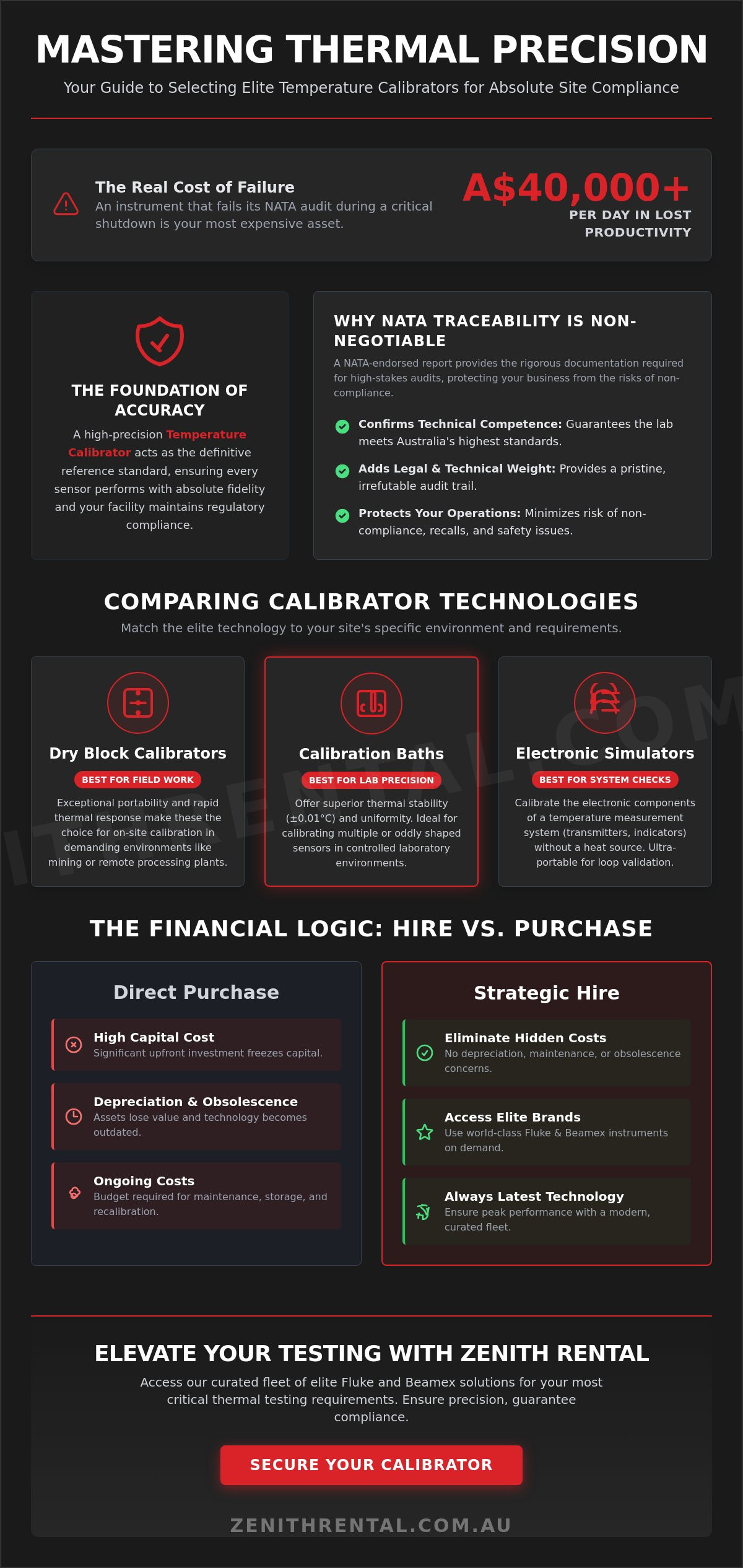
The most expensive instrument in your facility isn't the one you bought; it's the one that failed its NATA audit during a critical shutdown. You recognize that securing a high-tier temperature calibrator is less about the tool itself and more about the absolute certainty it provides your team. It's the difference between a project that flows with effortless precision and one mired in the complexities of measurement drift that, according to 2022 industry benchmarks, can cost an Australian plant upwards of A$40,000 per day in lost productivity.
We understand that the high capital cost of elite instruments often creates a barrier to accessing the best technology. This guide helps you master thermal complexities and select the elite instruments required for absolute site compliance. You'll discover how to leverage world-class brands like Fluke and Beamex to reach the pinnacle of technical performance. We'll examine the specific criteria for selecting hardware that guarantees a seamless journey from initial testing to final certification.
Key Takeaways
- Understand how a high-precision temperature calibrator acts as the definitive reference standard to ensure your facility maintains absolute Australian regulatory compliance.
- Navigate the nuances between dry blocks, calibration baths, and simulators to select the elite technology perfectly suited to your site's physical environment.
- Master the financial logic of accessing world-class instrumentation through a strategic hire model, eliminating the hidden costs of depreciation and equipment obsolescence.
- Identify the essential technical specifications and temperature ranges required to match your most demanding industrial processes with surgical precision.
- Discover how Zenith’s curated fleet of Fluke and Beamex solutions provides a seamless, prestige experience for your most critical thermal testing requirements.
Understanding Temperature Calibrators: The Foundation of Thermal Accuracy
A temperature calibrator serves as the definitive reference standard, ensuring that every industrial sensor performs with absolute fidelity. In the demanding landscapes of the Australian industrial sector, from the resource-rich Pilbara to sophisticated pharmaceutical labs in Melbourne, thermal stability is not just a technical preference; it's a regulatory mandate. Achieving the "Zenith" of modern industrial maintenance requires a commitment to precision that transcends basic checks. It's about establishing an elite reference source that guarantees every degree of measurement is beyond reproach. High-performing sectors such as aerospace, food production, and medical research rely on these tools to maintain pristine quality standards and operational safety. When accuracy is paramount, the calibrator becomes the silent partner in your success, providing the confidence needed to make critical operational decisions.
The process of ensuring accuracy begins with a deep appreciation for the principles of calibration, which link local measurements to international standards. This connection is essential for Australian businesses looking to compete on a global stage. Without a reliable reference, even the most advanced sensors can drift, leading to costly waste or safety compromises. By investing in elite-tier equipment, technicians ensure that their thermal environments are controlled with unmatched sophistication. This focus on the finer details separates industry leaders from the rest of the market.
The Anatomy of a High-End Calibrator
Elite instruments feature internal reference sensors designed to minimize measurement uncertainty to the lowest possible levels. These components work in harmony with high-resolution displays that allow discerning technicians to view minute fluctuations that standard equipment might miss. Temperature stability is the ability to maintain a set point within ±0.01°C over time. This level of control ensures that the thermal environment remains consistent, providing a seamless experience during the verification process. The build quality of these devices reflects a sense of prestige, designed for professionals who value reliability as much as performance.
Why NATA Traceability is Non-Negotiable
In Australia, the National Association of Testing Authorities (NATA) sets the benchmark for technical competence and reliability. While a standard factory certificate offers a basic level of assurance, a NATA-endorsed report provides the rigorous documentation required for high-stakes audits and international trade. This distinction is vital for maintaining a pristine audit trail that remains beyond reproach during regulatory inspections. It's the difference between a simple logistics exercise and a professional commitment to excellence.
- NATA accreditation confirms a laboratory's technical competence to perform specific calibration tasks.
- Endorsed reports provide legal and technical weight to your quality assurance data.
- Maintaining NATA-traceable records protects your business from the risks of non-compliance and potential product recalls.
Choosing a NATA-traceable temperature calibrator ensures that your site's measurement journey is supported by the highest levels of Australian authority. It's a choice that reflects a brand's dedication to quality, safety, and the ultimate pursuit of precision.
Comparing Technologies: Dry Blocks, Calibration Baths, and Electronic Simulators
Selecting the right temperature calibrator isn't just about technical specifications; it's about matching the tool to the specific rigours of your environment. In the Australian industrial landscape, where sites range from pristine urban laboratories to remote Pilbara mining operations, the physical setting dictates the technology. Professionals must balance the need for laboratory-grade accuracy with the rugged portability required for demanding field work. The evolution of multifunction units has transformed how Australian technicians approach these tasks, allowing for a more streamlined and efficient workflow.
Dry Block Calibrators: The Field Professional’s Choice
Dry wells dominate on-site calibration due to their exceptional portability and rapid thermal response. These units use a metallic internal block to transfer heat, making them ideal for the fast-paced requirements of mining sites, power plants, and large-scale HVAC systems. While air gaps between the sensor and the block can introduce minor thermal gradients, using precision-machined inserts helps mitigate these effects. They remain the elite choice for technicians who need to move quickly between multiple points without the mess of liquid media. For projects requiring the highest standards of reliability, choosing a premium equipment partner ensures your operations remain at the peak of performance.
Liquid Calibration Baths: The Pinnacle of Uniformity
For those who demand unmatched stability, liquid baths represent the zenith of thermal reference technology. By using stirred media like oil, water, or salt, these baths achieve a level of thermal uniformity that dry blocks simply cannot replicate. Understanding the importance of temperature calibration is vital when working in sensitive pharmaceutical or food production environments. These sectors require the absolute stability of a laboratory bath to meet strict ISO 9001 standards. Whether you're managing a local facility or a national laboratory, the stirred liquid ensures the entire sensor is immersed in a perfectly consistent environment.
Electronic Process Calibrators: Simulating the Signal
Electronic simulators provide a different kind of precision. They don't generate physical heat; instead, they simulate the electrical signals produced by RTDs and thermocouples. This allows technicians to calibrate the loop and verify the readout's accuracy without waiting for a physical heat source to stabilize. Modern multifunction units often include HART or Foundation Fieldbus communication, making them versatile assets for complex control systems. Electronic simulators test the readout, while heat sources test the entire sensor assembly. This distinction is crucial for identifying whether a fault lies in the sensor itself or the connected instrumentation. The result is a seamless, sophisticated approach to system maintenance that reflects the success of a well-managed operation.
Strategic Hire vs. Purchase: Navigating Equipment Lifecycle Costs
Choosing between capital acquisition and strategic hire defines the long-term efficiency of your operational budget. A high-specification temperature calibrator represents a significant investment, with premium multi-function models often exceeding A$12,000 in initial costs. For many Australian firms, the financial logic of hire is undeniable. It transforms a heavy capital expenditure into a manageable operating expense, allowing you to access elite instrumentation without tying up vital cash flow. This approach ensures your balance sheet remains lean while your technical capabilities remain at the absolute pinnacle of the industry.
The "Zenith" advantage centers on a commitment to excellence that goes beyond mere availability. We provide a seamless experience where the burden of asset management disappears. You don't just receive a tool; you receive a pristine, expertly maintained solution delivered exactly when your project demands it. This just-in-time delivery model mirrors the high-performance requirements of Australia’s most demanding sectors, from LNG processing to pharmaceutical manufacturing.
The Real Cost of Equipment Ownership
Owning a precision instrument involves a trail of hidden expenses that quickly erode the perceived value of a purchase. Annual NATA recertification for a single temperature calibrator typically costs between A$850 and A$1,300, excluding the logistical headaches of transit and the resulting downtime. When a device is in the lab, it isn't earning revenue. Furthermore, high-precision electronics face a steep depreciation curve. A unit that met every standard three years ago may lack the digital integration or accuracy levels required for modern compliance. For a deeper look at managing these variables, explore The Definitive Guide to Test Equipment Hire in Australia: Precision at the Zenith. Industry leaders frequently consult educational content on temperature calibration to understand how rapidly sensor technology evolves, making the risk of technical obsolescence a genuine threat to fixed-asset owners.
Operational Flexibility for National Projects
Australian industry operates across vast distances and intense timelines. Whether you're managing a shutdown in the Pilbara or a maintenance cycle in the Hunter Valley, you need the ability to scale your fleet instantly. Relying on a fixed internal inventory often leads to "equipment bottlenecks" during peak periods or expensive assets sitting idle during lulls. Hiring allows you to customize your fleet to match the intensity of the project. You can deploy specialized calibrators to remote sites with total confidence in their performance. We eliminate downtime by providing immediate access to a calibrated, ready-to-work fleet. This flexibility allows you to align hire durations with specific maintenance windows, ensuring you only pay for the precision you use. It's a sophisticated strategy that prioritizes results over the burdens of ownership.
Selection Criteria: Matching Calibrator Specs to Industrial Requirements
Selecting the ultimate temperature calibrator requires a discerning eye for detail. It's not merely about acquiring a tool; it's about investing in a standard of excellence that secures your facility's reputation. Site managers must first evaluate the temperature range with absolute precision. For instance, a petrochemical plant in Gladstone might require a range from -40°C for cryogenic storage up to 660°C for turbine exhaust. If the instrument doesn't comfortably exceed these extremes, you risk compromising the integrity of your data and the safety of your journey toward operational perfection.
Immersion depth is another non-negotiable factor for the elite professional. To eliminate stem conduction errors, industrial standards often dictate an immersion depth of 15 times the diameter of the probe. A shallow well results in thermal leakage, which can introduce errors as high as 2.0°C in high-temperature applications. Your choice should offer the physical capacity to meet these rigorous mechanical requirements. The user interface also demands scrutiny. In high-pressure environments, a seamless, intuitive touchscreen ensures your team operates with peak efficiency and confidence.
Accuracy, Stability, and Uniformity
The "Big Three" of thermal specifications define the uncertainty budget of your calibration process. Accuracy tells you how close the display is to the true temperature, but stability and uniformity ensure that performance remains consistent over time and across the entire calibration zone. Australian conditions present unique challenges. Ambient temperatures in remote mining sites often reach 45°C, which can cause drift in lesser instruments. Selecting a temperature calibrator with superior thermoregulation ensures your results remain pristine regardless of the external climate.
Compatibility with Sensors and Protocols
An elite calibrator must be versatile. It should support a comprehensive suite of thermocouples, including types K, J, T, R, and S, without requiring external adapters. For modern facilities, HART or Fieldbus integration is essential for managing smart transmitters. This connectivity allows for a seamless flow of data directly into your compliance reporting software. By automating these logs, you achieve a level of precision that manual entry cannot match. This integration transforms a routine check into a streamlined, high-performance experience that reaches the zenith of technical compliance.
Elevate Your Testing with Zenith Rental’s Elite Calibration Fleet
Zenith Rental provides more than just equipment; we offer a curated gateway to the world’s most prestigious instrumentation. Our commitment to excellence ensures that every professional has access to the pinnacle of measurement technology without the burden of long-term asset management. We understand that for discerning technical professionals in Australia, the quality of a temperature calibrator is a direct reflection of their own commitment to precision. Every instrument in our inventory undergoes a rigorous verification process. We ensure it arrives in pristine, ready-to-work condition, allowing you to focus entirely on the task at hand. This is the Zenith standard: absolute reliability delivered with the sophistication of a high-end concierge service.
The Elite Fleet: Our Featured Calibrators
Our selection represents the gold standard of the industry, featuring brands that have defined the limits of accuracy for decades. We maintain a fleet that serves the diverse needs of Australian mining, oil and gas, and pharmaceutical sectors. Our featured solutions include:
- Fluke 724 and 754: These instruments are the versatile workhorses of the field. The Fluke 754, in particular, stands out for its ability to document calibrations while communicating with HART smart transmitters. It's the preferred choice for professionals who demand efficiency and ruggedness in a single package.
- Beamex MC6 Series: This is the ultimate multifunction communicator and calibrator. It offers a seamless user experience with a full touch screen and multiple operational modes. It’s designed for those who refuse to compromise on capability, providing a high-accuracy reference for even the most complex site environments.
- Druck Solutions: When your project requires integrated testing of both pressure and temperature, Druck provides the refined engineering necessary for high-stakes environments. Their systems are known for stability and long-term performance in the most demanding Australian climates.
Your Partner in Precision
We've designed our rental experience to minimize friction and maximize your productivity. With national support and logistics tailored specifically for the Australian market, we provide rapid deployment to major hubs and remote sites alike. Our team offers expert technical guidance to ensure you select the perfect reference for your specific application. We don't just ship a box; we provide a comprehensive support structure that mirrors the high performance of the tools we supply. Whether you're managing a short-term shutdown or a large-scale commissioning project, our service scales to meet your ambitions. Experience the pinnacle of service and reliability. Contact Zenith Rental today to secure the elite instrumentation your next project deserves.
Achieve the Pinnacle of Calibration Excellence
Selecting the right instrumentation isn't just a technical requirement; it's a commitment to operational integrity. Whether your facility demands the high-speed performance of dry block technology or the immersion precision of calibration baths, your choice defines the reliability of every measurement. By prioritizing NATA-traceable standards and assessing the strategic advantages of rental models, you ensure your project maintains its competitive edge without the burden of depreciating assets.
Zenith Rental provides an elite concierge experience for Australian industry professionals who refuse to compromise. We offer immediate access to a pristine fleet of Fluke and Beamex instruments, ensuring your team works with the world's finest technology. Our Australia-wide national delivery guarantees that your next temperature calibrator arrives exactly when and where it's needed, fully certified and ready for high-stakes testing. We've mastered the finer details of equipment logistics so you can focus on achieving perfect results. Experience a seamless partnership that elevates your technical capabilities to the highest standard.
Explore our elite range of temperature calibrators for your next project
We look forward to supporting your journey toward unmatched thermal accuracy.
Frequently Asked Questions
What is the difference between a dry block and a temperature bath?
Dry blocks use a calibrated metal insert to provide heat, making them the elite choice for speed and portability in the field. Temperature baths utilize a stirred liquid medium to achieve 0.01°C stability and superior uniformity for oddly shaped sensors. While a dry block reaches its set point in 15 minutes, a bath offers the pristine accuracy required for laboratory-grade primary standards.
How often should a temperature calibrator be recertified in Australia?
Australian industry standards typically mandate a 12 month recertification interval for any temperature calibrator to remain compliant with ISO 9001 quality systems. High precision units used in critical pharmaceutical or aerospace sectors often require 6 month checks to mitigate drift. Regular calibration maintains the integrity of your results and ensures your instrument performs at its zenith.
Can a process calibrator simulate both RTDs and thermocouples?
Yes, a modern process calibrator seamlessly simulates both RTDs and thermocouples by sourcing and measuring electrical signals. These sophisticated instruments handle common RTD types like Pt100 and Pt1000 alongside Type K, J, and T thermocouples. This versatility allows technicians to verify the entire signal chain from the sensor tip to the control room display with one device.
What immersion depth is required for accurate temperature calibration?
Accurate results require an immersion depth of at least 15 times the diameter of the sensor you're testing. If you're calibrating a 6mm probe, you must submerge it 90mm to eliminate stem conduction errors. Following this 15:1 ratio ensures the sensing element reaches true thermal equilibrium, providing a seamless measurement experience without environmental interference.
Is NATA certification required for all industrial temperature testing?
NATA certification isn't legally mandatory for every application, but it's essential for 100% of laboratories complying with ISO/IEC 17025 standards. Many Australian government contracts and tier one mining projects specify NATA accredited results to guarantee national traceability. It provides a pristine audit trail that non accredited certificates can't match in high stakes environments.
How does ambient temperature affect the accuracy of a field dry block?
Ambient temperature shifts can impact accuracy by up to 0.02°C for every degree of deviation from the factory reference point. Most elite field units operate optimally between 18°C and 28°C. If you're working in a 40°C Pilbara environment, the internal cooling system must work harder, which may increase the total uncertainty of your calibration journey.
What are the advantages of a multifunction calibrator with HART communication?
HART enabled calibrators allow you to communicate directly with smart transmitters to perform digital adjustments and diagnostics. This integration eliminates the need for a separate handheld communicator, streamlining your workflow by 30% or more. Technicians can view device configuration and perform loop tests through a single, sophisticated interface that ensures absolute reliability.
Can I rent a temperature calibrator for a short term national project?
You can rent a temperature calibrator for durations as short as 24 hours to support projects across Australia. Zenith Rental provides an elite fleet of pristine, NATA calibrated instruments delivered directly to your site with unmatched efficiency. This flexible model allows you to access the latest technology for a specific journey without the long term commitment of ownership.