


Instrumentation Calibrator Hire: A Practical Selection Guide
The most familiar calibrator may be the wrong hire. For instrumentation calibrator hire, the right choice depends on the signals you need to source or measure, the required range and accuracy, and the test procedure, not the brand name alone. It’s worth confirming that a unit suits the job before arranging a hire.
This guide explains how to match a calibrator to your application and prepare a clear hire enquiry. You’ll learn what to check about signal types and specifications, and how to confirm the specific instrument’s calibration status, supplied documentation and accessories before dispatch.
Zenith Rental offers calibrator hire across Australia, with listed categories including multi-product calibrators and multifunction calibrators with HART/Foundation Fieldbus communicators. The following sections cover what to establish about your task, what details to share when discussing equipment suitability, and how to check the hire arrangements against your project schedule.
Key Takeaways
- Start with the measurement task, then identify the signals and ranges your procedure requires.
- For instrumentation calibrator hire, compare source and measurement functions with the instrument specifications rather than relying on a multifunction label.
- Use a checklist to assess accuracy, communications, accessories and hire logistics before selecting an option.
- Before confirming an enquiry, check the specific instrument’s calibration status and the documentation supplied for your project.
- Share your application, signal requirements and schedule with Zenith Rental to discuss suitable calibrator hire options across Australia.
Instrumentation Calibrator Hire: Start with the Measurement Task
An instrumentation calibrator sources, measures or simulates signals so you can check an instrument’s response against a defined test procedure. The right instrumentation calibrator hire depends on what you’re testing, the signal type and the required measurement range. Start with the job, not the product label. For an introduction to the underlying concept, see What is Calibration?
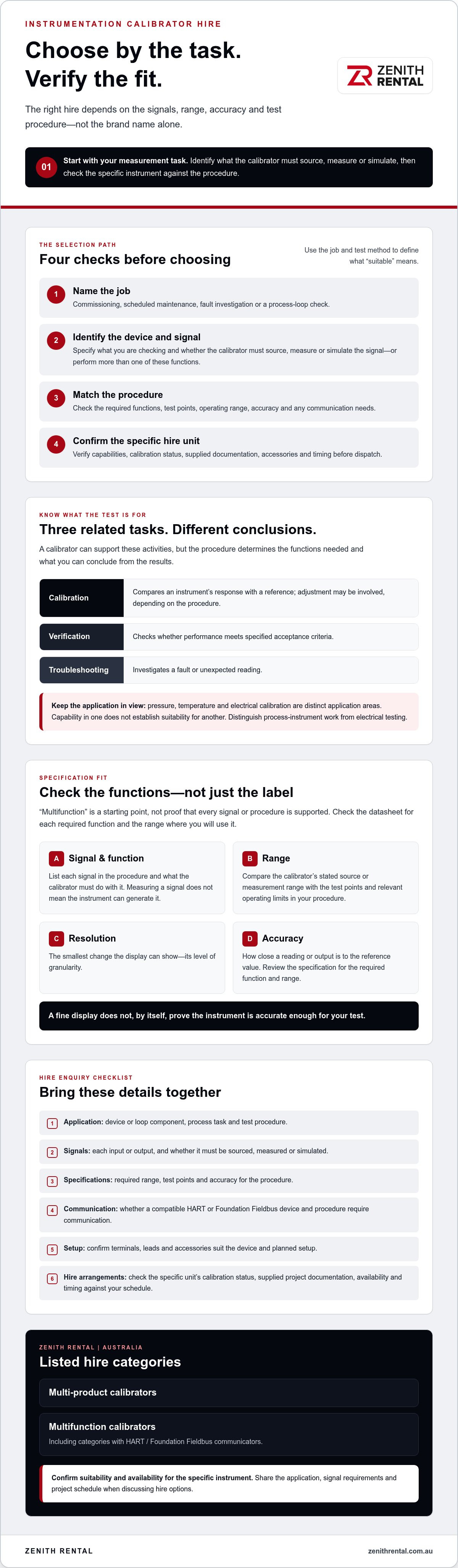
Calibration, verification and troubleshooting are related, but they aren’t interchangeable. Calibration compares an instrument’s response with a reference and may involve adjustment, depending on the procedure. Verification checks whether its performance meets specified acceptance criteria. Troubleshooting investigates a fault or unexpected reading. A calibrator can support these activities, but the test method determines the functions you need and the conclusions you can draw from the results.
Which instrumentation work calls for a calibrator?
Calibrators may be used during commissioning, scheduled maintenance, fault investigation or process-loop checks. For example, a loop check may involve confirming the signal path between a field device and the control system. A fault investigation may require measuring or simulating a particular input. In either case, use the job’s test procedure to identify the required functions, range and accuracy.
Distinguish process-instrument work from electrical testing. A process task may involve checking a pressure, temperature or other process signal, while an electrical test may call for different equipment and methods. Similar terminology doesn’t mean one instrument suits both. Match the hire to the application and procedure rather than assuming a general-purpose calibrator will cover every test.
What signals and devices must the hire support?
Before requesting equipment, write down the device under test and each signal you need to source or measure. Note whether the procedure requires an input, an output or both, along with the expected operating range. Pressure, temperature and electrical calibration are distinct application areas. A capability in one doesn’t establish suitability for another.
- Device: What instrument or loop component will you check?
- Signal: What must the calibrator source, measure or simulate?
- Range: What minimum and maximum values does the procedure specify?
- Communication: Does the task require communication with a compatible HART or Foundation Fieldbus device?
HART or Foundation Fieldbus communication matters only when the device and procedure require it. Zenith Rental lists multifunction calibrators with these communicators among its hire categories. Confirm the specific unit’s capabilities and availability before proceeding. Once the task, signal and range are clear, you can discuss suitability more precisely.
Match Calibrator Functions to Signals, Range and Accuracy
A “multifunction” label is a starting point, not proof that a calibrator supports every signal or test procedure. Before comparing hire options, translate the project method into specific capabilities. Check the instrument datasheet for each required function and confirm that it applies across the range you’ll use. Don’t assume a broad product category covers every requirement.
Check signal compatibility and required functions
List every electrical or process signal in the test procedure, then note what the calibrator must do with each one. Does it need to source a signal, measure an input, simulate a transmitter response or communicate with a compatible device? These functions aren’t interchangeable. An instrument that measures a signal may not be able to generate it.
Check connections, leads and accessories, too. Confirm that the specified terminals and leads suit the device under test and your planned setup. If the procedure involves a compatible HART or Foundation Fieldbus device, verify that communication is required and supported by the specific instrument being considered.
Understand range, resolution and accuracy
Range describes the values a calibrator can source or measure. Compare its stated range with the test points in your procedure, including any relevant operating limits. A calibrator may suit a general application category but still be unsuitable if a required test point falls outside its capabilities.
Resolution is the smallest change the display can show, or its level of granularity. Accuracy describes how close a reading or output is to the reference value. A fine display doesn’t, by itself, show that the instrument is accurate enough for your test. Review the specifications for the required function and range. Ask your technical lead to confirm the procedure’s acceptance tolerances and any uncertainty considerations.
Use the governing procedure to determine suitability and acceptance criteria. Confirm the calibration status and required documentation for your project with the rental provider, then check that the records supplied for the specific hire instrument meet your organisation’s process.
For instrumentation calibrator hire, prepare a concise comparison of signal, function, test range, required accuracy, connections and communication needs. Check each item against the datasheet and procedure before selecting an option. If you’re assessing hire categories, Zenith Rental’s calibrator hire options can be a starting point. Confirm the exact specifications and availability of any candidate instrument before proceeding.
Compare Instrumentation Calibrator Hire Options with a Clear Checklist
A structured comparison helps separate technical fit from convenience. For each candidate, record the application, supported signals, required range and accuracy, communication functions, and accessories needed for your procedure. Then check the hire period, dispatch timing and support arrangements with the supplier. Treat these as details to confirm, not assumptions.
| Check | What to confirm |
|---|---|
| Application | Does the instrument suit the test procedure and device under test? |
| Signals and functions | Can it source, measure or simulate each required signal? |
| Range and accuracy | Do the specifications cover the test points and procedure criteria? |
| Communications | Are HART or Foundation Fieldbus functions needed and supported? |
| Accessories | Are compatible leads, connectors and other essential items included? |
| Hire arrangements | Can the hire period, dispatch timing and support arrangements meet project needs? |
Ask for the current specifications and calibration documentation for the specific proposed instrument. Check its calibration status and whether the supplied records meet your project requirements. Before committing, confirm that the records, accessories and hire arrangements have all been assessed against your procedure.
When does a multifunction calibrator make sense?
A multifunction calibrator may suit a job requiring several signal types, provided it supports each one across the required range and meets the procedure’s criteria. One instrument can reduce equipment changes during a varied task, but the label alone doesn’t confirm coverage. Compare every required function with the specific unit’s specifications. Zenith Rental lists multifunction calibrators, including options with HART/Foundation Fieldbus communicators. Confirm exact specifications and availability.
When should a task-specific calibrator be considered?
A dedicated calibrator may be a better fit when the procedure is narrowly defined and calls for a particular application or function. Compare the actual requirements rather than choosing by brand or broad category. For temperature-specific selection considerations, see the temperature calibrator buying guide. For wider rental planning, the test equipment hire guide covers broader considerations.
Use this checklist to make your instrumentation calibrator hire enquiry precise: share the application and test requirements, then ask the supplier to confirm the proposed instrument’s specifications, documentation, accessories and logistics before you commit.
Prepare for Calibrator Hire: Documentation, Accessories and Timing
A well-prepared enquiry helps the rental provider assess the application and gives your team a chance to confirm important details before dispatch. For instrumentation calibrator hire, organise the requirements so the proposed unit, its records and its accessories can be checked against the project.
What information should a hire enquiry include?
Describe the job and device under test, then outline the relevant procedure, signals and ranges. Be specific about whether the calibrator needs to source, measure or simulate a signal. If the task involves a compatible device, state whether HART or Foundation Fieldbus communication is required.
- Define the task. Describe the application and device you need to test.
- List the signals. Include the required signal types, functions and expected ranges.
- Confirm specifications. Ask whether the proposed instrument meets the procedure’s requirements, including applicable accuracy criteria.
- Check documentation and accessories. Confirm the calibration status and ask what records, leads, adapters, manuals and other required items accompany that specific instrument.
- Arrange timing. State your required hire dates and delivery arrangements, then confirm dispatch timing and any support arrangements directly with the provider.
Sharing these details early gives the provider a clearer basis for discussing equipment suitability. If your procedure requires traceability records or a particular certificate, specify that requirement and confirm what documentation is supplied with the proposed unit. Don’t assume a document or accessory is included until it has been confirmed.
What should be checked before the instrument arrives?
Before dispatch, reconfirm the exact instrument specifications and current availability with the rental provider. Check that the calibration records meet your project requirements and that the accessory list covers the planned setup. A missing lead or adapter can delay work even when the calibrator itself is suitable.
Plan the handover at your end, too. Make sure the receiving technician knows which instrument is arriving, understands the setup needed for the procedure and can follow the relevant safety procedures. If delivery timing is critical, confirm the arrangements rather than relying on an assumed timeframe.
Zenith Rental hires test and measurement equipment nationally across Australia, including multi-product and multifunction calibrators. Share your application, signals, required ranges and schedule to discuss a suitable hire category, then verify the specific unit’s details before proceeding. Discuss your calibrator hire requirements.
Arrange Instrumentation Calibrator Hire with Zenith Rental
A confident hire request starts with a clear description of the job. Identify the task, match the required signals and functions, check that the instrument’s specifications align with the procedure, and verify the documentation and accessories you’ll need. These checks help you discuss suitable options without assuming a particular unit is available or meets every requirement.
How Zenith Rental can support a focused enquiry
Zenith Rental serves customers nationally across Australia and lists multi-product and multifunction calibrators among its hire categories, including multifunction calibrators with HART/Foundation Fieldbus communicators. Fluke, Megger and Transmille are among the equipment brands it lists. These categories and brands can help frame an enquiry, but they don’t confirm a specific unit’s functions or current availability.
Share the application and test procedure so the proposed equipment can be considered against the job. A precise description helps clarify whether you need to source, measure or simulate signals, and whether communication functions are relevant. Confirm the exact specifications of the proposed instrument before proceeding.
Move from requirements to a hire request
Include the practical details that will help shape your instrumentation calibrator hire enquiry:
- Task and device: Describe the work and the instrument or system being checked.
- Signals and range: List the signals to source or measure and the required operating range.
- Accuracy and procedure: Share the accuracy criteria and relevant test method.
- Communications: State whether the task requires HART or Foundation Fieldbus communication.
- Timing and inclusions: Give your required hire dates and confirm the specifications, calibration status and documentation, accessories, availability and dispatch arrangements for the specific unit.
Before confirming a hire, compare the provider’s response with your project requirements. If a specification, document, accessory or timing detail remains unclear, ask for confirmation rather than relying on assumptions. Zenith Rental’s hire range includes electrical and industrial test equipment, with calibrator options to discuss based on your stated application.
Ready to outline your task, signals and project schedule? Discuss your instrumentation calibrator hire requirements with Zenith Rental and request suitable options for your application.
Make Your Next Calibrator Hire Enquiry with Confidence
A successful instrumentation calibrator hire starts with the measurement task, then checks that the proposed instrument supports the required signals, range and accuracy. Compare its specifications with your test procedure, and confirm the calibration documentation, communication capability and accessories you’ll need before arranging the hire.
Zenith Rental serves customers nationally across Australia and lists multi-product and multifunction calibrators among its hire categories, including multifunction calibrators with HART/Foundation Fieldbus communicators. These categories can help frame your enquiry, but confirm the specific instrument’s specifications, documentation and availability for your project.
Share your application, required signals, test range, accuracy criteria and project timing to clarify what you need. Discuss your instrumentation calibrator hire requirements with Zenith Rental and request options for your job. With the key details confirmed, you can move ahead with a clear, well-prepared hire request.
Frequently Asked Questions
Is a multifunction calibrator suitable for every instrumentation job?
Not automatically. A multifunction calibrator is suitable only if its supported signals, ranges and accuracy meet the job’s procedure. The label alone doesn’t confirm compatibility with every device or test. Before arranging instrumentation calibrator hire, compare the proposed unit’s specifications with the test method and acceptance criteria. Ask the project lead or rental provider to clarify any technical requirements that remain unclear.
Can I hire a calibrator with HART or Foundation Fieldbus communication?
Yes, if the job requires communication with a compatible field instrument and the specific calibrator supports the required protocol. Confirm the device and communication requirements first, then ask the rental provider about the proposed unit’s capabilities. Zenith Rental lists multifunction calibrator hire with HART/Foundation Fieldbus communicator capability. Confirm the specific instrument’s current specifications and availability for your required hire period before proceeding.
How much does instrumentation calibrator hire cost?
The hire charge depends on the instrument, hire period, required accessories and delivery arrangements, so request a quote based on your project rather than relying on a general price range. Share the application, required specifications and hire dates with the rental provider. Ask them to confirm which accessories and documentation are included, along with relevant logistics, so the proposed option reflects your requirements.
What should I check before hiring an instrumentation calibrator?
Confirm the required signals, range, accuracy, functions and communication protocols against your test procedure. Ask for the current specifications and calibration documentation for the specific unit, and check which leads and accessories are included. Confirm hire dates and delivery arrangements, too. The procedure and responsible technical authority should determine whether the proposed instrument is suitable, not its general category or multifunction label alone.
How do I choose between a multifunction and task-specific calibrator?
Start with the job, not the product label. A multifunction instrument may suit work involving several supported signal types, while a task-specific option may align more closely with a narrowly defined procedure. Compare the required functions, ranges, accuracy and accessories with the test requirements. Before deciding, ask the rental provider to confirm that the specific proposed hire instrument matches your application.
Does a hired calibrator come with a calibration certificate?
Don’t assume a certificate or any particular record is included, or that every instrument has the same calibration status. Ask the rental provider what documentation accompanies the specific unit and whether it meets your project’s quality requirements. Confirm any traceability or acceptance criteria with the responsible technical lead before booking. Once received, retain the records required by your procedure and project documentation process.
How far in advance should I arrange instrumentation calibrator hire?
There’s no universal lead time to rely on, because timing depends on the instrument, current availability, required hire dates and delivery arrangements. Contact the provider as soon as your project schedule is known. Share the specifications and dates you need, then confirm availability, dispatch timing and return arrangements before finalising the hire. This helps you assess whether the proposed arrangements fit your schedule.