


Wind Turbine Generator Testing Tools: 2026 Practical Guide
The turbine’s size isn’t the best starting point for choosing test equipment. The measurement task is. The right wind turbine generator testing tools depend on what you need to assess, the instrument’s capability and conditions at the test point, including access constraints that can affect setup and readings.
There isn’t one universal kit for every test. This guide explains how to match test objectives with instrument categories, plan a safe, repeatable measurement workflow and decide whether hiring calibrated equipment suits a defined project or specialist need. It also covers where power quality analysers, insulation resistance testers, relay testers, circuit breaker analysers and micro-milliohm meters may fit into an electrical testing plan. Zenith Rental hires calibrated electrical, industrial and power testing equipment to clients across Australia, offering access to specific instruments without ongoing ownership.
Key Takeaways
- Match wind turbine generator testing tools to the measurement objective, whether commissioning, scheduled maintenance, fault diagnosis or performance investigation.
- Compare an instrument’s capability and connection method with the test procedure and required measurement, rather than choosing by turbine size alone.
- Before testing, define the question and plan for site access, turbine operating state, isolation arrangements and authorised procedures.
- Consider equipment hire for defined projects or specialist measurement needs. Weigh utilisation and project duration against the responsibilities of equipment ownership.
- Record the test setup and results consistently to support clear interpretation and repeatable follow-up measurements.
What do wind turbine generator testing tools measure?
Wind turbine generator testing tools are instruments used to inspect, measure or help diagnose a generator and its associated electrical systems. An instrument captures a particular measurement. A test procedure defines why, where and how to take it, including the required setup and safety controls. The tool is one part of a complete test, not a substitute for a procedure.
Choose equipment according to the question, turbine design and applicable site procedure. Commissioning checks establish a baseline and assess equipment after installation or work. Scheduled maintenance looks for changes over time. Fault diagnosis focuses on a specific abnormal condition, while a performance investigation examines behaviour under defined operating conditions. The same turbine may require different measurements for each purpose.
Which generator and electrical-system measurements matter?
Start by identifying the measurement objective. Voltage describes electrical potential, while current measures the flow of electricity. Resistance indicates opposition to that flow, and continuity checks whether an electrical path is complete. Power quality measurements examine how the electrical supply behaves, including variations that may affect connected equipment.
Depending on the investigation, measurement points may include the generator and connected equipment such as cables, switchgear or transformer connections. A power quality analyser, insulation resistance tester or micro-milliohm meter may suit a particular task, but none is a universal choice. Not every test applies to every turbine configuration. Match the instrument’s capability and connection method to the intended measurement and approved procedure.
How do test scope and operating conditions change tool choice?
Some inspections are performed offline, with equipment in the state required by the test procedure. Other measurements may be taken while the turbine is operating, but only where the procedure and site arrangements permit. Operating state affects what can be measured, where connections can be made and what access is available.
Plan around access to the measurement point, environmental conditions, isolation arrangements and the available test window. These factors can determine the instrument, leads and connection approach needed for a reliable result. Follow authorised site procedures. Having an instrument on hand does not mean you have permission to access or test equipment.
IEC 61400 international testing standards are a family of standards covering wind turbine topics, not one universal test instruction. Identify the relevant part for the project and verify its applicability before treating any provision as a requirement. A clearly defined scope keeps the measurement, instrument and procedure aligned.
How do wind turbine generator testing tools support key electrical tests?
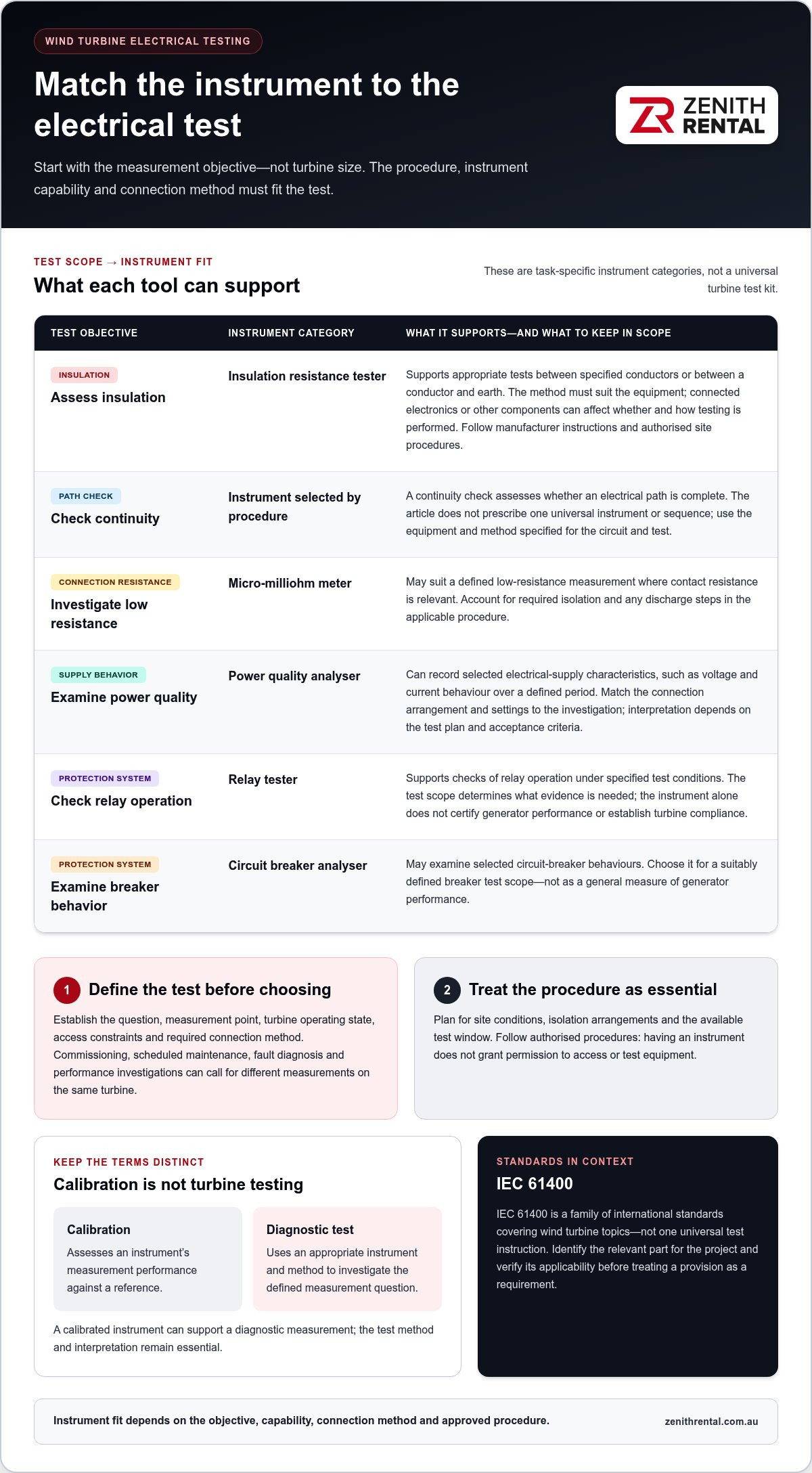
Choose an instrument based on the test objective, not a generic turbine checklist. A measurement is useful only when its method and instrument suit the test objective. Consider the instrument’s capability, how it connects to the circuit and the procedure governing the measurement. A tool category that suits one test scope may be unsuitable for another.
What tools can support insulation, continuity and resistance checks?
An insulation resistance tester is used for appropriate insulation-resistance tests, helping assess insulation between specified conductors or between a conductor and earth. The test method must suit the equipment being examined. Connected electronics or other components may affect whether and how a test can be performed. Follow the relevant manufacturer instructions and authorised site procedure.
Continuity checks assess whether an electrical path is complete. Low-resistance measurements can help investigate connections where contact resistance is relevant. A micro-milliohm meter may suit a suitably defined low-resistance measurement. Before testing, account for the required isolation and any discharge steps in the applicable procedure. There isn’t one sequence that applies to every turbine or circuit.
When might power-quality or protection testing be relevant?
A power quality analyser can support investigations into selected characteristics of the electrical supply, such as voltage and current behaviour over a defined period. Match the connection arrangement and measurement settings to the question being asked. The instrument records selected characteristics; interpretation still depends on the test plan and acceptance criteria.
Relay testers and circuit breaker analysers are used for protection-system test scopes. A relay tester can support checks of relay operation under specified test conditions, while a circuit breaker analyser may examine selected breaker behaviours. These instruments don’t, by themselves, certify generator performance or establish turbine compliance. The test scope determines what evidence is needed.
Calibration and diagnostic testing are different activities. Calibration assesses an instrument’s measurement performance against a reference; it doesn’t calibrate the turbine. A calibrated instrument can support a diagnostic measurement, but the test method and interpretation remain essential. Zenith Rental hires calibrated electrical, industrial and power testing equipment, including power quality analysers and insulation resistance testers. For a defined project, calibrated test equipment hire provides access to measurement equipment suited to the scope.
Certification references also need to be applied in context. The U.S. Department of Energy’s wind turbine certification guidelines discuss U.S. certification testing, including generator standards. They’re a useful reference for understanding a certification framework, but don’t establish Australian project requirements. Confirm the applicable standards and procedures for the specific work.
How should you compare wind turbine generator testing tools?
Compare instruments against the test plan, not just their labels. The table below helps align a test objective with an instrument category and practical considerations. It isn’t a substitute for the approved procedure or engineering judgement, and it doesn’t imply that every test applies to every turbine.
| Test objective | Instrument category | Measurement consideration | Project context |
|---|---|---|---|
| Assess insulation resistance | Insulation resistance tester | Check the procedure’s required range, connection method and test conditions. | Maintenance or fault investigation, where the defined scope calls for this test. |
| Investigate continuity or a low-resistance connection | Continuity tester or micro-milliohm meter | Match the instrument and leads to the measurement method and connection points. | Electrical connection assessment or targeted diagnosis. |
| Examine selected supply characteristics | Power quality analyser | Confirm the required measurement functions, connection arrangement and recording needs. | Performance investigation or investigation of an electrical supply concern. |
| Test protection-system components | Relay tester or circuit breaker analyser | Align the test setup and instrument capability with the specified protection test. | Commissioning, maintenance or fault work within the defined protection-system scope. |
Use the comparison to shortlist instrument categories, then assess each option against the actual requirements. A tool’s name alone doesn’t establish its capability for a particular turbine or test.
Which instrument specifications should the test plan match?
Start with the values expected in the measurement. Check that the instrument’s range and resolution suit those values, then compare its stated accuracy or uncertainty with the procedure’s requirements. Review the necessary leads, accessories and interfaces as part of the setup. Connection needs and the operating environment can affect whether an otherwise suitable instrument works for the planned test.
How do calibration records and documentation affect confidence?
Current, traceable calibration documentation can help establish an instrument’s measurement status and support confidence in recorded results. It doesn’t guarantee that a field measurement is correct. Setup, connections, operating conditions and technique still matter. Keep relevant instrument details with the test record, including the method and conditions, so results can be interpreted in context.
For a defined project, calibrated hire equipment can align access to instruments with the test scope and duration. Zenith Rental hires calibrated electrical, industrial and power testing equipment, including power quality analysers, insulation resistance testers, relay testers, circuit breaker analysers and micro-milliohm meters. Compare the required capability and documentation with the project procedure before selecting an instrument category.
What should you plan before testing a wind turbine generator?
A repeatable field test starts before the instrument reaches the measurement point. Define the question, agree on test conditions and organise records first. This keeps the procedure, access arrangements and selected equipment aligned, while making results easier to interpret later.
- 1. Define the test scope. Identify the turbine and generator, the reason for testing, the measurement points and the decision the results will inform. For a fault investigation, frame a specific question instead of giving a broad instruction to “check the generator”.
- 2. Confirm the site conditions. Coordinate access and the required turbine operating state with the responsible site team. Establish the available test window and note environmental or operational conditions that could influence readings or limit access.
- 3. Set the procedure and isolation arrangements. Follow the authorised site and manufacturer procedures for the specific equipment and task. Confirm required isolation arrangements and other controls with responsible personnel. Don’t assume a sequence or safe approach that may not apply to the turbine or measurement.
- 4. Match and inspect the instruments. Check that each instrument suits the planned measurement. Before use, review its identity, physical condition and configuration, along with relevant calibration documentation. Confirm that leads, probes and other accessories suit the planned connection and environment.
- 5. Prepare the record. Decide how readings will be captured and labelled before testing begins. Include measurement points, units, instrument identification, time and operating context so each result remains meaningful beyond the immediate test.
- 6. Measure and review. Take readings in accordance with the authorised procedure. Record results as you obtain them, note any departure from the plan and preserve the data for review. Before drawing conclusions, consider whether the recorded conditions and setup support the intended comparison.
Good records add essential context. A voltage reading without its measurement point or operating state may be difficult to interpret, while a documented setup supports clearer comparisons during later maintenance or diagnosis. Keep data secure in line with the project’s arrangements. Flag anomalies or procedural deviations for appropriate review rather than treating them as confirmed faults.
For a defined project, align the test scope with the equipment required. Arrange calibrated test equipment hire from Zenith Rental for electrical, industrial and power measurement needs.
When does hiring wind turbine generator testing tools make sense?
Equipment hire can suit a project when a specialist instrument is needed for a defined period but would see limited use between jobs. Ownership may make more sense when a team uses the same equipment regularly and can manage its calibration, storage, maintenance and lifecycle. The decision depends on utilisation, project duration and measurement requirements, not simply the purchase-versus-hire cost.
Is equipment hire suitable for a defined testing project?
For commissioning, a maintenance window or a targeted investigation, hiring can provide access to calibrated instruments without adding equipment to a permanent inventory. It can also help a team meet a specialist measurement need without taking on long-term lifecycle management. Hire still needs planning: allow time for instrument familiarisation, align equipment access with the project schedule, and plan how the instrument and accessories fit the site procedure. For a broader overview of project-based equipment access, see this test equipment hire guide.
Ownership offers continuity and ready access for recurring work, but the organisation must manage calibration records, upkeep, storage and eventual replacement. Consider expected frequency of use alongside those responsibilities. A tool needed for one defined test may be better treated as a project resource; a regularly used instrument may warrant a longer-term approach.
How can a project team plan equipment access with confidence?
Build equipment requirements from the measurement plan. Specify the test objective, instrument category and required capability, then identify the accessories, leads, interfaces and documentation needed for the setup. Include the required operating conditions and any familiarisation or coordination time so equipment is part of a prepared workflow, not a last-minute variable.
Calibration documentation supports confidence in an instrument’s measurement status, while accuracy and uncertainty requirements come from the test method and the decision the result will inform. Calibration alone doesn’t guarantee a correct field result; connection, setup and technique still matter. The calibration accuracy guide offers further context for considering these factors.
Zenith Rental provides calibrated electrical, industrial and power testing equipment for hire to clients across Australia. For a defined project or specialist measurement requirement, explore electrical test equipment hire and plan equipment access around the test scope.
Plan your next turbine test with confidence
Reliable results begin with a clear test objective. Match wind turbine generator testing tools to the measurement required, the instrument’s capability and the approved procedure, rather than assuming one set of tools suits every turbine. Site access, operating conditions and connection requirements also shape a safe, repeatable measurement plan.
Before testing, define the scope, check instrument condition and calibration documentation, and record readings with enough context to interpret them. For a defined project or specialist measurement need, equipment hire can be a practical alternative to owning and managing instruments between uses.
Zenith Rental provides calibrated electrical, industrial and power testing equipment for hire across Australia. Explore test equipment hire for your project and plan your next measurement task with care. A well-matched instrument and a considered workflow are a strong foundation for clearer results.
Frequently Asked Questions
What tools are used to test a wind turbine generator?
The tools depend on the test objective and turbine configuration. Wind turbine generator testing tools may include insulation resistance testers for appropriate insulation checks, micro-milliohm meters for defined low-resistance measurements, and power quality analysers for investigating selected supply characteristics. Relay testers and circuit breaker analysers relate to protection-system test scopes. No single instrument covers every task, so match capability, connections and accessories to the approved procedure.
How do you test a wind turbine generator?
Start by defining the asset, the measurement question and the decision the result will inform. Identify measurement points, required operating state and site access arrangements, then select instruments that suit the test procedure. Follow authorised site and manufacturer instructions for isolation and testing. Record readings with units, instrument details, measurement points and operating context. The method varies with the equipment and task, so a generic sequence shouldn’t replace the applicable procedure.
Which instrument measures wind turbine generator insulation resistance?
An insulation resistance tester is the instrument category used for appropriate insulation-resistance tests. The test plan should identify the relevant conductors or points, the required instrument capability and the permitted connection method. Account for connected equipment and follow manufacturer instructions and authorised site procedures, including any applicable isolation or discharge steps. The test isn’t suitable for every circuit or configuration, so don’t apply it as a universal check.
Can a power quality analyser test a wind turbine generator?
A power quality analyser can measure selected electrical supply characteristics as part of a defined investigation, provided its capability and connection arrangement suit the measurement. It may help examine voltage and current behaviour under specified operating conditions. It doesn’t, by itself, test every generator function or certify performance or compliance. Interpret readings against the test plan and relevant criteria, with the turbine state and measurement setup documented.
How often should wind turbine generators be tested?
There isn’t one testing interval that applies to every generator or measurement. Set frequency through the relevant maintenance plan, manufacturer guidance, asset condition, operating history and project requirements. A scheduled inspection interval shouldn’t automatically be treated as the interval for every electrical test. Fault symptoms, completed work or a specific performance investigation may prompt additional testing, using the applicable procedure and authorised site arrangements.
Do wind turbine testing instruments need calibration?
Instruments should have calibration status appropriate to the measurement and project requirements. Relevant calibration documentation helps establish the instrument’s measurement status and supports confidence in recorded results. Calibration isn’t proof that a particular field reading is correct: connections, setup, operating conditions and technique also influence results. Record instrument identification and relevant calibration details alongside measurements so results can be reviewed in context.
Is it better to hire or buy wind turbine generator testing tools?
Hiring may suit a defined project or specialist measurement need when equipment will be used occasionally. Ownership may suit recurring work, provided the organisation can manage calibration, storage, maintenance and lifecycle needs. Consider utilisation, project duration, familiarisation and coordination before deciding. Zenith Rental provides calibrated electrical, industrial and power testing equipment for hire across Australia, offering a practical option for project-based measurement requirements.