


What is HART Communication Protocol? The Industrial Standard Explained (2026)
Over 50 million devices worldwide currently utilize a hybrid language that many technicians only partially understand. To truly master your facility's efficiency, you must look beyond the surface of what is HART communication protocol and appreciate it as the essential bridge between reliable analog infrastructure and high-speed digital diagnostics. This standard remains the cornerstone of industrial intelligence, even as we move into the era of HART 7.10 and Ethernet-APL integration.
It's common to feel a sense of friction when troubleshooting "smart" instruments that refuse to yield their data, or when you're uncertain if your current calibrators can handle the latest protocol enhancements. You likely recognize that while the 4-20mA signal provides the foundation, the real value lies in the digital data layered on top. This guide promises to elevate your technical expertise, moving you from basic connectivity to a sophisticated command of device diagnostics and calibration requirements.
We'll explore the intricate hybrid signal architecture that allows for simultaneous analog and digital transmission. You'll gain the clarity needed to select elite-tier calibration equipment and understand how the latest updates, such as WirelessHART and HART-IP, are reshaping the Australian industrial landscape. By the end of this article, you'll possess the knowledge to transform routine maintenance into a high-performance strategic advantage.
Key Takeaways
- Master the sophisticated hybrid architecture that defines what is HART communication protocol, allowing digital data to ride seamlessly on a traditional 4-20mA analog loop.
- Unlock deep diagnostic insights by accessing secondary variables such as device health and temperature to preemptively address maintenance requirements.
- Streamline your operational workflow by understanding how Bell 202 Frequency Shift Keying ensures data integrity without interrupting process signals.
- Ensure absolute precision in the field by selecting the correct HART-compatible multi-function calibrators for digital zero and span adjustments.
- Prepare for the next generation of industrial excellence by integrating WirelessHART and high-speed HART-IP into your facility's digital backbone.
Defining the HART Protocol: The Hybrid Industrial Standard
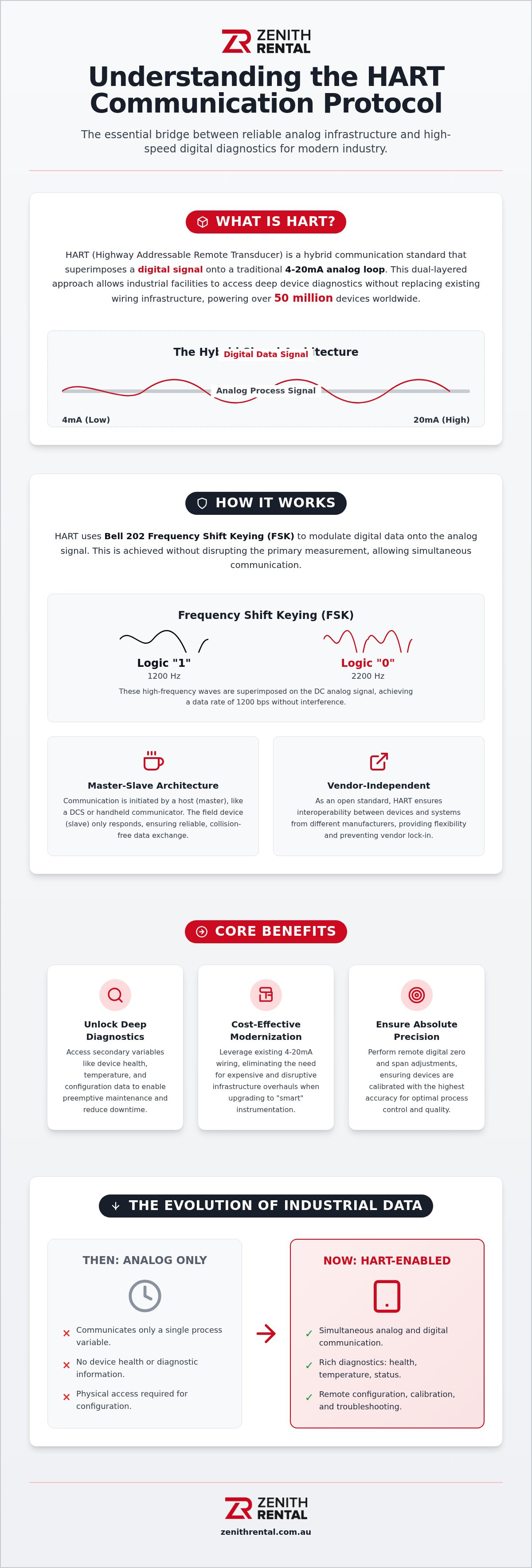
To grasp the essence of modern process automation, one must first ask: what is HART communication protocol? At its core, HART (Highway Addressable Remote Transducer) represents a masterstroke of engineering that bridges the gap between legacy reliability and future-facing intelligence. It operates as a sophisticated hybrid standard, seamlessly superimposing a digital signal onto the traditional 4-20mA analog loop. This dual-layered approach allows industrial facilities across Australia to maintain their existing wiring infrastructure while unlocking a wealth of device data that was previously inaccessible. It's a refined solution for those who value both stability and innovation.
The HART Communication Protocol remains the most widely utilized standard in 2026 because it offers a "best of both worlds" value proposition. It provides the instantaneous, real-time response of analog control alongside the deep diagnostic capabilities of digital systems. For plants seeking to modernize without the staggering capital expenditure of a total system overhaul, HART is the premier choice for achieving operational excellence. It's an efficient way to extract maximum value from existing assets while preparing for the digital demands of tomorrow.
The Evolution of Industrial Communication
The journey of industrial connectivity has shifted from simple, pure analog loops to highly intelligent digital integration. In the past, a 4-20mA signal could only communicate a single variable. Today, the HART standard has transformed these assets into vocal components of the industrial ecosystem. This transition from simple measurement to complex device management ensures that every asset performs at its peak. It allows for a more precise approach to maintenance, where data layers provide the necessary context for success. By preserving the existing wiring layers, HART has turned every instrument into a smart device without the need for disruptive infrastructure changes.
Key Characteristics of the HART Standard
Reliability is the hallmark of the HART protocol, particularly within the demanding environments of the Australian resources and manufacturing sectors. Its simultaneous communication capability means that control signals and diagnostic data travel together without interference. This vendor-independent standard promotes absolute interoperability. It ensures that elite-tier instrumentation from brands like Fluke or Megger integrates perfectly into your workflow. By utilizing specialized multi-function calibrators with integrated HART communicators, technicians can verify protocol integrity with total confidence. Accessing this level of precision doesn't require a permanent investment in hardware. Partnering with a refined service provider for your testing requirements creates a sense of security, knowing that every detail of the process is optimized for high performance.
How HART Communication Works: The Technical Foundation
The physical layer of this protocol is a testament to industrial ingenuity. It utilizes the Bell 202 standard to modulate digital information onto the existing current loop. To truly appreciate what is HART communication protocol, one must look at the elegance of Frequency Shift Keying (FSK). This technique allows for a 1200 bps data rate, where a 1200 Hz frequency represents a logic "1" and a 2200 Hz frequency represents a logic "0". Because these high-frequency sine waves are superimposed on the DC signal, they don't disturb the primary 4-20mA measurement. It's a seamless integration of two distinct data streams.
For those seeking a deeper dive into the signal processing involved, Texas Instruments' guide to HART provides an exhaustive breakdown of the OSI model application. The communication follows a strict master-slave architecture. A host system, such as a distributed control system (DCS) or a handheld communicator, initiates every exchange. The field device simply listens and responds. This structured approach ensures absolute reliability, preventing data collisions that could compromise critical industrial processes. It's a refined method that prioritizes signal integrity above all else.
Frequency Shift Keying (FSK) Explained
One of the most refined aspects of FSK is that the average value of the AC signal is zero. This technical detail is vital. It means the digital data "rides" on the analog signal without adding any DC offset to the 4-20mA loop. Your control system continues to see the precise process variable while simultaneously receiving digital status updates. This dual-channel capability remains robust even over long cable runs typical of expansive Australian industrial sites, provided the loop impedance remains within the required 230 to 1100 ohm range. It's an efficient way to maintain accuracy without sacrificing the depth of your data.
Point-to-Point vs. Multi-drop Configurations
Most installations utilize the point-to-point configuration. In this mode, the 4-20mA signal communicates the primary variable while the digital layer provides secondary data. However, for applications requiring higher device density, the multi-drop configuration allows multiple instruments to share a single pair of wires. In multi-drop mode, the analog current is typically fixed at 4mA, and all process information is transmitted digitally. This setup is ideal for remote monitoring where wiring costs are a primary concern. Securing a high-performance multi-function calibrator through a premium hire service ensures your team can interface with either configuration with absolute precision and ease.
Critical Benefits of HART in Modern Industrial Environments
Beyond the technical modulation, understanding what is HART communication protocol requires an appreciation for the actionable intelligence it provides. While the 4-20mA loop delivers the primary process variable, the digital layer simultaneously transmits secondary variables such as sensor temperature, internal pressure, or device health. This multi-variable capability is a hallmark of elite-tier instrumentation. It eliminates the need for redundant sensors, reducing both installation costs and complexity for Australian industrial projects. By accessing these hidden data layers, facilities transform from reactive cost centers into proactive, data-driven environments.
Safety remains a paramount concern, particularly in hazardous environments common across the Australian resource sector. HART enables remote device verification, allowing technicians to interrogate field devices from the safety of a non-hazardous marshalling panel or control room. This capability minimizes the time personnel spend in high-risk zones, aligning with the highest standards of operational safety. It's a refined approach that prioritizes workforce well-being without sacrificing the precision of your measurements. When paired with an intrinsically safe multifunction calibrator hire, your team can maintain these standards with absolute confidence.
Advanced Diagnostics and Predictive Maintenance
The true value of this protocol lies in its ability to predict failure before it occurs. Technicians can monitor valve signatures and sensor drift remotely, identifying performance degradation that a simple analog signal would never reveal. This data facilitates the extraction of "as-found" and "as-left" reports, which are essential for regulatory compliance and quality assurance. By feeding this digital intelligence into asset management systems, plants can shift toward predictive maintenance schedules. This strategic move drastically reduces operational downtime, ensuring that every asset performs at its peak throughout its lifecycle.
Interoperability and the Universal Command Set
The FieldComm Group maintains the rigorous standards that ensure every HART-enabled device speaks a common language. This interoperability is managed through three distinct command levels. Universal commands are understood by all devices, while Common Practice commands handle functions shared by many instruments. Device Specific commands allow manufacturers to offer unique, high-value features. This structure is supported by Device Description (DD) files, which act as a digital driver for your host system. It ensures that whether you're using a legacy DCS or a modern handheld communicator, the integration remains seamless and the data remains reliable. This level of consistency is what separates standard operations from a truly refined industrial ecosystem.
Calibrating HART-Enabled Devices: Tools and Techniques
Moving from technical theory to field application requires a shift in focus toward the specialized instruments that make interaction possible. Understanding what is HART communication protocol is only half the battle. The real work begins when a technician must interface with a device to perform a NATA-traceable calibration. Standard analog calibrators simply lack the digital "voice" needed to communicate with smart transmitters. You need a tool that can simultaneously source or measure the 4-20mA signal while interrogating the digital data layer to adjust zero and span parameters with absolute precision.
The Role of Multi-function HART Calibrators
Modern field service demands efficiency and accuracy. While standalone handheld terminals were once the standard, elite technicians now prefer integrated multi-function calibrators. These refined assets, such as the gold-standard models from Fluke and Transmille, combine a high-accuracy pressure or electrical calibrator with a full-featured HART communicator. Utilizing a single device reduces the logistical burden and minimizes potential points of failure during critical testing. For those managing large-scale Australian industrial projects, accessing this level of technology through a premier test and measurement equipment hire service ensures you always have the latest device description (DD) files at your fingertips without the ongoing costs of ownership.
The 250-Ohm Loop Resistance Requirement
A common point of friction during commissioning is the failure of the digital signal to "connect" with the host. This usually stems from a lack of sufficient loop resistance. The HART protocol requires a minimum loop resistance of 250 ohms to ensure the digital FSK signal has sufficient impedance to be detected by the host communicator. If your current loop is too "clean," the digital sine waves are essentially absorbed by the power supply, leaving the communicator unable to see the device. Setting up a successful calibration loop follows a meticulous sequence:
- Ensure the loop power supply is stable and providing at least 24V DC.
- Verify the total loop resistance; if it's below 250 ohms, temporarily insert a 250-ohm resistor in series.
- Connect your multi-function calibrator in parallel with the device or across the resistor.
- Initiate the polling sequence to identify the device's unique address and tag.
Troubleshooting often reveals that simple power supply issues or incorrect wiring are the culprits behind communication failures. Reliability in these moments is non-negotiable. To maintain the highest standards of accuracy and minimize downtime, you can secure professional calibrator hire that arrives fully tested and ready for immediate deployment on your site.
The Future of HART: WirelessHART and Digital Integration
The trajectory of industrial automation in 2026 is defined by a seamless transition from physical wires to intelligent, self-healing networks. Understanding what is HART communication protocol today requires an appreciation of its evolution into WirelessHART and HART-IP. While the foundational 4-20mA loop remains a steadfast companion in many Australian facilities, the protocol has expanded to meet the high-speed demands of Industry 4.0. This evolution ensures that your legacy investments continue to provide value while integrating with the most advanced Ethernet-APL backbones. It's a sophisticated bridge between the reliability of the past and the speed of the future.
WirelessHART and Mesh Networking
WirelessHART, governed by the IEC 62591 standard, utilizes mesh networking to create incredibly resilient communication paths. In the expansive environments of Australian mining or processing plants, where cabling costs can be prohibitive, these self-organizing networks offer a refined alternative. They automatically route data around obstacles, ensuring that critical diagnostics reach the host system without interruption. This mesh architecture provides a sense of security, knowing that the network can adapt to physical changes on-site. Conducting a successful site survey or maintaining these systems requires specialized tools. Securing an intrinsically safe multifunction calibrator hire allows your team to verify signal integrity in hazardous zones with absolute confidence and safety.
The shift toward HART-IP represents a quantum leap in data performance. To put this in perspective, transferring a 1 MB file over traditional 4-20mA HART communication takes approximately 2 hours and 25 minutes. With HART-IP over Ethernet-APL, that same file is transferred in just one second. This speed facilitates the convergence of IT and OT, allowing for real-time asset management on a global scale. It's an efficient solution for modern professionals who require immediate visibility into their operations without the friction of slow data rates.
Securing High-Precision Equipment for Your Project
Selecting the right partner for your protocol testing is essential for project success. For short-term commissioning or periodic maintenance, hiring specialized instrumentation is often the most prudent choice. It provides your team with immediate access to the Fluke or Megger tools that define the industry's gold standard. This approach eliminates capital expenditure while ensuring that every measurement is backed by NATA-traceable precision. The HART protocol has proven its enduring value by acting as a bridge between eras. With the right equipment and a focus on the finer details, your facility is perfectly positioned to lead the next generation of industrial excellence across Australia.
Elevating Your Industrial Intelligence with HART
Mastering the intricacies of what is HART communication protocol empowers you to unlock the full potential of your facility's assets. By bridging the gap between reliable 4-20mA signals and rich digital diagnostics, you've gained the clarity needed to reduce downtime and improve operational safety. Whether you're configuring legacy instruments or deploying the latest WirelessHART mesh networks, the protocol remains the cornerstone of industrial excellence in 2026.
Achieving this level of precision requires more than just knowledge; it demands elite-tier instrumentation. We provide national coverage across Australia, ensuring your critical projects have access to gold-standard tools from brands like Fluke and Megger. Every unit in our fleet arrives with NATA traceable calibration, backed by expert technical support to minimize friction on-site. With flexible short and long-term leasing options, you can maintain the highest standards of accuracy without unnecessary capital expenditure.
Explore our elite range of HART-compatible calibrators and test equipment today. Step into a future of absolute reliability and technical mastery.
Frequently Asked Questions
Is HART communication protocol still relevant in 2026?
HART remains the global industrial standard in 2026, with over 50 million enabled devices currently in operation. The recent release of HART Protocol Specification 7.10 in August 2026 demonstrates its ongoing evolution. It's the most practical way for Australian plants to access digital intelligence using existing 4-20mA wiring. This hybrid capability ensures it stays relevant even as facilities transition toward high-speed Ethernet-APL and HART-IP integration.
Can I use a standard multimeter to read HART digital data?
A standard multimeter cannot decode the digital packets layered onto the loop. While it accurately measures the 4-20mA analog current, it lacks the Frequency Shift Keying (FSK) modem required to interpret digital data. To access diagnostics or secondary variables, you need a specialized multi-function calibrator with an integrated HART communicator. These refined instruments distinguish between the DC current and the high-frequency AC sine waves that carry the digital information.
What is the maximum distance for a HART communication loop?
The maximum distance typically reaches 3,000 metres for a single shielded twisted pair cable, or 1,500 metres if multiple twisted pairs are bundled. These distances depend heavily on cable capacitance and loop resistance. To maintain signal integrity over long Australian industrial runs, you must ensure the total loop resistance remains between 230 and 1,100 ohms. Exceeding these limits can cause the digital signal to attenuate, leading to communication dropouts.
Do I need a special power supply for HART-enabled devices?
You don't require a specialized power supply, as most devices operate on a standard 24V DC loop. However, the power supply must be clean and free from excessive ripple or noise that could interfere with the 1200 Hz and 2200 Hz FSK frequencies. Some high-end multi-function calibrators available for hire include a built-in 24V loop power supply with an internal 250-ohm resistor, specifically designed to facilitate stable HART communication during field testing.
What is the difference between HART and Foundation Fieldbus?
The primary distinction lies in the signal architecture. HART is a hybrid protocol that preserves the 4-20mA analog signal, whereas Foundation Fieldbus is a purely digital, multi-drop network. While Foundation Fieldbus offers faster data rates and advanced control-in-the-field capabilities, it requires entirely different wiring and host systems. Many Australian operators prefer HART because it allows for incremental digital upgrades without the significant capital expenditure of a full infrastructure replacement.
How do I update the Device Description (DD) files on my calibrator?
Updating DD files typically involves connecting your communicator to the manufacturer's management software via a PC. These files are essential drivers that allow your host system to understand specific field device parameters. When you secure a multi-function calibrator hire from a premium provider, the instrument arrives pre-loaded with the latest DD library. This ensures you can interface with the newest smart instruments across your site without the friction of manual software management.
Is WirelessHART secure for critical industrial applications?
WirelessHART is exceptionally secure, employing robust AES-128 encryption and frequency hopping to protect sensitive industrial data. It utilizes a self-organizing mesh network where each device acts as a router, ensuring multiple paths for data delivery. This redundancy, combined with strict device authentication, makes it a reliable choice for remote monitoring on Australian sites. It's designed to coexist with other wireless networks without interference, maintaining a high standard of signal integrity.
What happens to the analog signal if the digital HART communication fails?
The 4-20mA analog signal remains completely unaffected if the digital layer fails. This is a core benefit of what is HART communication protocol; the digital data is superimposed on the analog current without changing its DC value. If the FSK modem or communicator loses connection, your control system continues to receive the primary process variable. This inherent redundancy provides a sense of security, ensuring that process control is never compromised by digital communication issues.