


What is a Micro Milliohm Meter? A Professional Guide to Precision Resistance Testing
A single milliohm of resistance is often the only thing standing between a flawlessly operating power system and a catastrophic equipment failure. You already know that in high-stakes Australian industrial projects, "close enough" is never an acceptable standard for electrical integrity. Whether you're verifying the bond of a massive busbar or testing the contact resistance of critical switchgear, precision is the ultimate hallmark of professional excellence. This guide provides the technical clarity you require by answering the fundamental question: what is a micro milliohm meter?
It's common to feel frustrated by the confusion surrounding Kelvin sensing or the prohibitive costs of maintaining a NATA-calibrated fleet. We're here to simplify that process for you. You'll discover the sophisticated mechanics of 4-wire measurement, learn to distinguish between micro and milliohm resolutions, and identify the most efficient ways to access elite instrumentation. This overview ensures your testing remains uncompromisingly accurate while your operations stay smooth, safe, and cost-effective. By the end of this guide, you'll have the confidence to select the perfect instrument for your most demanding applications.
Key Takeaways
- Master the fundamental definition of what is a micro milliohm meter and understand why these specialized instruments are indispensable for detecting minute resistance levels that standard multimeters overlook.
- Explore the technical nuances of 4-wire Kelvin sensing to eliminate lead resistance errors, ensuring your measurements reflect the true integrity of your electrical assets.
- Identify critical applications for precision testing within high-voltage circuit breakers and industrial busbars to protect your infrastructure from the risks of excessive thermal stress.
- Gain the engineering insight required to choose between milliohm and micro-ohm resolutions, perfectly aligning your equipment with the most stringent project specifications.
- Discover the strategic advantages of hiring elite, NATA-calibrated instrumentation to maintain absolute compliance and peak performance without the burden of significant capital expenditure.
Understanding the Micro-Milliohm Meter: Definitions and Core Purpose
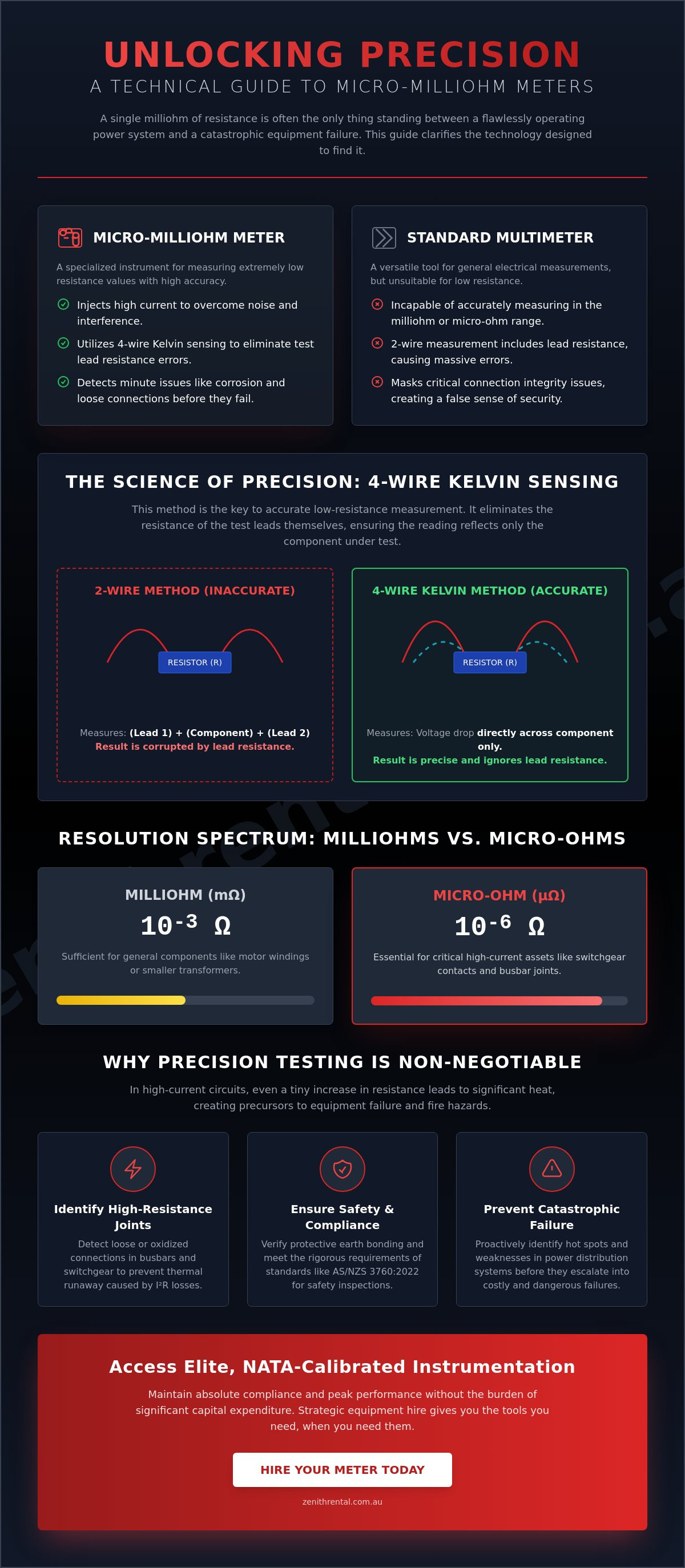
Precision is the invisible foundation of electrical safety. When engineers ask what is a micro milliohm meter, they are looking for more than a simple definition; they are seeking a tool that can reveal the truth about an electrical connection. At its heart, this instrument is a specialized low-resistance ohmmeter designed to measure values that fall far below the capabilities of a standard digital multimeter. While a typical handheld device excels at measuring kilohms (kΩ), it remains physically incapable of detecting the minute resistance levels found in high-current industrial assets. The micro-milliohm meter achieves this by injecting a controlled, high-current signal into the test object, allowing it to isolate the actual resistance of the joint or material from any external interference.
Standard multimeters often introduce noise through their own test leads. In many cases, the leads themselves have a higher resistance than the component you're trying to measure. This makes accurate low-resistance testing impossible without specialized circuitry. By using high-current injection, these elite meters can identify connection integrity issues, such as corrosion or loose mechanical fixings, that would otherwise remain hidden until a failure occurs. It's a sophisticated approach to maintenance that prioritizes reliability and performance. Ultimately, knowing what is a micro milliohm meter allows you to move beyond guesswork and achieve absolute certainty.
The Measurement Spectrum: Milli vs. Micro
Understanding the distinction between these two ranges is vital for any professional project. The milliohm range (10^-3) is generally sufficient for testing industrial components like motor windings or smaller transformers. However, when your work involves critical electrical bonds or massive switchgear, you must move into the micro-ohm range (10^-6). This level of sensitivity is where the most refined insights are found. For NATA-certified reporting, you must balance resolution with accuracy. Resolution refers to the smallest increment the meter can display, while accuracy reflects the instrument's proximity to the absolute true value. Both are essential for maintaining the highest standards of engineering integrity.
Why Precision Resistance Testing is Non-Negotiable
In high-current circuits, even a tiny increase in resistance can lead to significant heat generation. These hot spots are the precursors to equipment failure and fire hazards. By utilizing a micro-milliohm meter, you can detect these thermal risks before they escalate. Ensuring the integrity of protective earth bonding is also a critical safety requirement. If the resistance of an earth bond is too high, protective devices might not trip during a fault, creating a dangerous environment. Adherence to Australian standards and safety audits requires this level of rigour. Key reasons to prioritize this testing include:
- Identifying high-resistance joints: Detecting loose or oxidized connections in busbars and switchgear.
- Ensuring safety compliance: Meeting the requirements of AS/NZS 3760:2022 for in-service safety inspections.
- Preventing catastrophic failure: Avoiding the $I^2R$ losses that lead to thermal runaway in power distribution systems.
Regular safety audits and compliance checks depend on the precise data that only these specialized instruments can provide, protecting both your assets and your personnel. It's about more than just utility; it's about the peace of mind that comes from knowing every connection is at its peak performance level.
The Science of Precision: 4-Wire Kelvin Sensing Explained
Precision is not merely a goal; it's a requirement for those who manage Australia's most critical infrastructure. When you ask what is a micro milliohm meter, you're essentially inquiring about the mastery of low-resistance physics. Standard ohmmeters often fail because they cannot distinguish between the resistance of the component and the resistance of the test leads themselves. This 2-wire limitation can introduce errors that are hundreds of times larger than the value being measured, a risk no professional can afford to take in high-current environments. Understanding what is a micro milliohm meter involves recognizing that the instrument is designed to bypass these physical limitations through a more sophisticated measurement architecture.
The 4-wire Kelvin sensing method resolves the lead resistance problem by separating the current injection from the voltage measurement. Two leads provide a constant, high-precision current, while two high-impedance probes measure the resulting voltage drop across the component. Because the voltage probes draw virtually no current, the resistance of those leads becomes irrelevant to the final calculation. This isolation allows for the impeccable accuracy required for NATA-traceable reporting, ensuring that your data reflects the true state of the asset rather than the limitations of your equipment.
Overcoming Lead Resistance and Thermal EMF
Beyond lead resistance, environmental factors like Thermal Electromotive Force (EMF) can haunt precision readings. These micro-voltages occur whenever dissimilar metals meet at different temperatures, a common occurrence in field testing on Australian mine sites or substations. Modern Digital Low Resistance Ohmmeter (DLRO) technology in 2026 has evolved significantly to combat this phenomenon. By utilizing bi-directional current, the meter takes readings in both polarities and automatically averages them. This process cancels out the DC offset caused by thermal EMF, providing a refined, stable result even in challenging outdoor conditions where temperature gradients are high.
The Importance of Test Current Selection
Selecting the appropriate current is vital for maintaining the integrity of your test sample. While 10A serves as the standard for many industrial components, specialized tasks require a more robust approach. High-voltage circuit breaker testing often necessitates 100A or more to ensure the current breaks through surface oxidation on the contacts, providing a true reading of the metallic path. However, the professional must remain vigilant about the following factors:
- 10A Standard: Ideal for motor windings, small transformers, and general bonding where heat sensitivity is a concern.
- 100A+ Injection: Necessary for high-voltage switchgear and large busbar joints to ensure measurement stability.
- Thermal Management: Higher currents generate heat, which can temporarily increase the resistance of the sample. Modern units now include AI-integrated monitoring to predict and manage these thermal fluctuations.
When your project demands such specific parameters, selecting high-performance test assets from a curated fleet ensures you have the exact current range and resolution required for the task at hand. This strategic approach allows you to maintain the highest standards of safety and compliance without the logistical burden of maintaining specialized hardware year-round.
Critical Industrial Applications Across the Australian Landscape
The rugged Australian landscape demands equipment that matches its intensity. From the remote mining hubs of the Pilbara to the sophisticated power grids of our coastal cities, the stakes for electrical integrity remain incredibly high. Understanding what is a micro milliohm meter becomes essential when you realize it's the primary tool used to prevent catastrophic failures in these high-value environments. In these settings, precision isn't just a technical requirement; it's a safeguard for both multi-million dollar assets and human life.
Evaluating contact resistance in high-voltage circuit breakers and switchgear is perhaps the most prestigious application for these instruments. A deviation of only a few micro-ohms can indicate pitted contacts or mechanical misalignment that would lead to overheating under load. Similarly, testing the integrity of busbar joints in industrial power distribution is a non-negotiable part of commissioning. These joints carry thousands of amperes, and even a slight increase in resistance can cause immense thermal stress, leading to system-wide blackouts or fire hazards. By using a specialized meter, technicians ensure that every connection meets the original engineering specifications.
In the mining and telecommunications sectors, verifying lightning protection system bonds is a critical survival requirement. Australia's intense storm seasons pose a constant threat to remote infrastructure. A micro-milliohm meter confirms that lightning protection paths are truly low-resistance, ensuring that a strike is safely dissipated into the earth rather than causing an explosion or equipment loss. This level of verification provides the peace of mind that comes from knowing your site's most vulnerable points are fully protected.
Power Generation and Distribution
Renewable energy is rapidly transforming the Australian grid, and with this shift comes the need for impeccable grounding. Substation grounding in solar and wind farms requires low-resistance pathways to ensure safety during fault conditions. Technicians also rely on transformer winding resistance testing to identify internal short circuits or loose connections. These periodic contact resistance audits are the backbone of grid reliability, allowing providers to maintain a seamless flow of power to homes and businesses across the continent.
Manufacturing and Heavy Industry
Precision resistance testing is equally vital in the manufacturing sector. Quality control for transformers and large motors often involves micro-ohm verification to ensure every unit leaving the factory floor is at peak performance. Welding quality assessment is another refined application; a poor weld will show higher resistance than a perfect one, allowing for non-destructive integrity checks. As battery storage grows, testing battery strings for UPS systems and electric vehicle fleets ensures each cell contributes correctly to the total power output. Every cable splice and high-current connector must be verified to maintain the efficiency and safety of these modern power systems.
When you consider what is a micro milliohm meter in the context of these diverse industries, it's clear that the instrument is more than a tool. It's a partner in achieving the highest possible standard of industrial service and quality.
Choosing Your Resolution: Milliohms vs. Micro-Ohms
Selecting the appropriate resolution is a defining moment in any high-precision project. If you're refining your understanding of what is a micro milliohm meter, you must consider the specific tolerances of the asset under test. While milliohm resolution is often perfectly adequate for standard motor windings or smaller transformers, micro-ohm sensitivity is the non-negotiable standard for high-voltage contact resistance and critical busbar joints. Choosing the wrong resolution doesn't just lead to inaccurate data; it compromises the engineering integrity of the entire system. It's the difference between a successful audit and a missed fault that could lead to a costly outage.
Environmental conditions significantly influence your choice of hardware. Field testing in remote Australian locations requires rugged, portable units with exceptional battery life and high-contrast displays for readability under the harsh sun. Conversely, a controlled laboratory environment allows for the use of high-current benchtop testers that prioritize absolute stability and higher injection currents. Modern professionals also demand seamless reporting. Today's elite instruments feature integrated data logging with USB or Bluetooth connectivity, allowing you to transfer impeccable records directly to your client's asset management software without the risk of manual transcription errors.
Selection Framework for Asset Managers
Asset managers must balance technical requirements with logistical realities to ensure a smooth operation. The following criteria are essential for a successful deployment:
- Expected Resistance: Align the meter's range with the asset's design specifications to ensure you aren't testing at the very edge of the instrument's capability.
- Required Test Current: Verify if your project requires 10A for general bonding or 100A+ to meet international standards for circuit breaker testing.
- Field Readiness: Consider the weight and portability for remote site work, especially for FIFO operations where every kilogram and battery hour is critical.
Top Tier Brands to Consider
The market offers several distinguished manufacturers, each catering to specific professional needs. Megger remains the industry benchmark for Digital Low Resistance Ohmmeters (DLRO), known for their rugged construction and impeccable field performance. Fluke is frequently chosen for its user-friendly interfaces and multi-function reliability, making it a versatile choice for diverse maintenance teams. For those requiring laboratory-grade calibration tasks, Transmille offers elite precision that meets the most demanding scientific standards. Each of these brands represents a commitment to quality and success in the field.
To ensure your project benefits from these high-performance standards, you can hire a micro milliohm meter from our curated selection of industry-leading brands. This approach guarantees access to the latest technology and current NATA-traceable calibration for every critical measurement, providing the reliability your prestigious projects deserve.
Accessing Elite Instrumentation: The Case for Strategic Equipment Hire
Success in high-precision electrical testing hinges on the quality of the assets you deploy. Understanding what is a micro milliohm meter is only the first step; the second is ensuring you have access to a calibrated unit that performs to elite standards. For many Australian firms, the financial logic of strategic hiring far outweighs the burdens of ownership. When you choose to hire, you bypass the significant capital outlay required to purchase high-end instrumentation that may only be necessary for specific project phases. This approach allows your capital to remain fluid, directed toward growth rather than being tied up in depreciating hardware.
Ownership carries hidden complexities that often disrupt operational efficiency. Beyond the initial purchase, you must manage ongoing maintenance, secure storage, and the inevitable reality of technological obsolescence. In a field where 2026 technology offers AI-integrated monitoring and superior data logging, owning a five-year-old meter can put your team at a disadvantage. By opting for a hire model, you ensure that every technician arrives on-site with the latest, most refined tools available. This commitment to modern hardware reflects a standard of excellence that discerning clients notice and value.
Compliance is perhaps the most compelling reason to consider a professional hire partner. Every critical measurement must be backed by a current NATA-traceable calibration certificate to satisfy Australian safety audits and engineering standards. Maintaining these certifications across a private fleet is a logistical hurdle that requires constant vigilance. When you engage a specialist provider, that burden disappears. You receive an instrument that is ready for immediate, high-stakes deployment, accompanied by the documentation required to prove the integrity of your results.
Precision at the Zenith of Industry
Zenith Rental provides nationwide access to a curated selection of premium, calibrated instruments designed for the most demanding environments. We understand that your time is a luxury, which is why our logistics and technical support are designed to be seamless and reliable. By integrating our service into your broader test equipment rental strategy, you gain a partner dedicated to your project's success. Whether you're working in a remote mining hub or an urban substation, our team ensures the right tool reaches you exactly when it's needed, allowing you to focus on the finer details of your engineering tasks.
Next Steps for Your Project
Every project has unique requirements, and selecting the correct resolution is vital for a successful outcome. We invite you to consult with our specialists to match a meter to your specific resistance tolerances and current injection needs. You can begin by reviewing our comprehensive fluke and Megger inventory, which represents the peak of industry reliability. Whether you require a short-term solution for a single audit or a long-term arrangement for a major infrastructure build, requesting a quote is the first step toward securing the precision your work demands. Let us help you maintain the highest possible standard of service and quality.
Elevating Your Engineering Standards
Achieving absolute precision in resistance testing is the hallmark of a true industry professional. Throughout this guide, we've explored the technical nuances of 4-wire sensing and the specific applications that make these instruments indispensable across Australia's industrial landscape. By now, you possess a clear understanding of what is a micro milliohm meter and how it serves as a guardian of system integrity. Whether you're verifying a critical busbar joint or commissioning high-voltage switchgear, your commitment to accuracy ensures the long-term success of every asset you touch.
Maintaining an elite fleet doesn't have to be a logistical burden. We provide seamless access to the world's most prestigious brands, including Megger and Fluke, all backed by current NATA traceable calibration. With our nationwide Australian delivery and expert technical support, your team can focus on delivering impeccable results without the hidden costs of ownership. Explore our range of precision Micro Milliohm Meters for hire today and experience the peace of mind that comes from partnering with a specialist who values quality as much as you do. Your next project deserves nothing less than the highest standard of excellence.
Frequently Asked Questions
Can I use a standard multimeter to measure milliohms?
Standard multimeters are physically incapable of providing the precision required for milliohm measurements. Because these devices use a 2-wire system, they include the resistance of their own leads in the final result. This creates an unacceptable error margin when you're testing low-resistance assets. For professional integrity, you need a specialized instrument that isolates the test subject from the measurement circuitry, ensuring your data is untainted by the hardware itself.
What is the main difference between a milliohmmeter and a micro-ohmmeter?
The primary distinction lies in the level of resolution each instrument provides. A milliohmmeter measures down to the thousandth of an ohm, while a micro-ohmmeter reaches the millionth of an ohm. When asking what is a micro milliohm meter, it's helpful to view it as a high-resolution tool capable of detecting the finest deviations in electrical bonds. High-voltage switchgear often requires the micro-ohm sensitivity that a standard milliohmmeter simply cannot offer.
Why is 4-wire measurement necessary for low resistance testing?
4-wire measurement, or Kelvin sensing, is essential because it completely removes lead resistance from your calculations. By using two leads for current injection and two separate probes for voltage measurement, the meter ensures that the voltage drop is only measured across the component under test. This architecture is the only way to achieve the absolute reliability required for NATA-traceable reporting in demanding industrial environments across Australia.
What test current should I use for a circuit breaker contact resistance test?
For circuit breaker contact resistance, you should typically use a test current of 100A or higher. This high current is necessary to break through any surface oxidation or film on the contacts, which might otherwise cause a falsely high resistance reading. While 10A is common for smaller components, the 100A injection ensures the measurement reflects the true metallic contact area under actual operating conditions.
How often do micro-milliohm meters need calibration?
Most professional organizations require an annual calibration to maintain the instrument's accuracy and compliance. In high-stakes Australian industries, such as mining or power distribution, having a current NATA-traceable certificate is a non-negotiable requirement for safety audits. Regular calibration ensures that the fine sensors within your meter haven't drifted, preserving the success and reliability of your testing programs and protecting your critical infrastructure.
Is NATA certification required for industrial resistance testing in Australia?
NATA-traceable certification is almost always required for industrial resistance testing to ensure compliance with Australian standards like AS/NZS 3760:2022. While the standard focuses on safety, site-specific engineering specifications usually mandate that all test equipment must have a valid, traceable calibration. This provides a legal and professional safety net, proving that your measurements meet the highest possible industry benchmarks and can withstand the scrutiny of any audit.
What factors can interfere with accurate low-resistance readings?
Several environmental factors can compromise your data, including thermal EMF and poor contact cleanliness. Thermal EMF occurs when dissimilar metals at different temperatures create small voltages that skew your results. Additionally, grease, dust, or oxidation on the test point can add artificial resistance. Modern meters often use bi-directional current to cancel out these errors, ensuring your readings remain stable and impeccable even in harsh field conditions.
Can I hire a micro-milliohm meter for a single-day project?
Yes, strategic equipment hire allows you to access elite instrumentation for any duration, including single-day requirements. This flexibility is ideal for specific maintenance shutdowns or periodic audits where purchasing a high-value asset isn't a financially logical move. It ensures you have the latest technology and a fresh calibration certificate for every project, regardless of the scale or timeframe, maintaining your status as a high-tier partner.