


Volt-Ampere Characteristic Tester Hire: A Practical Guide
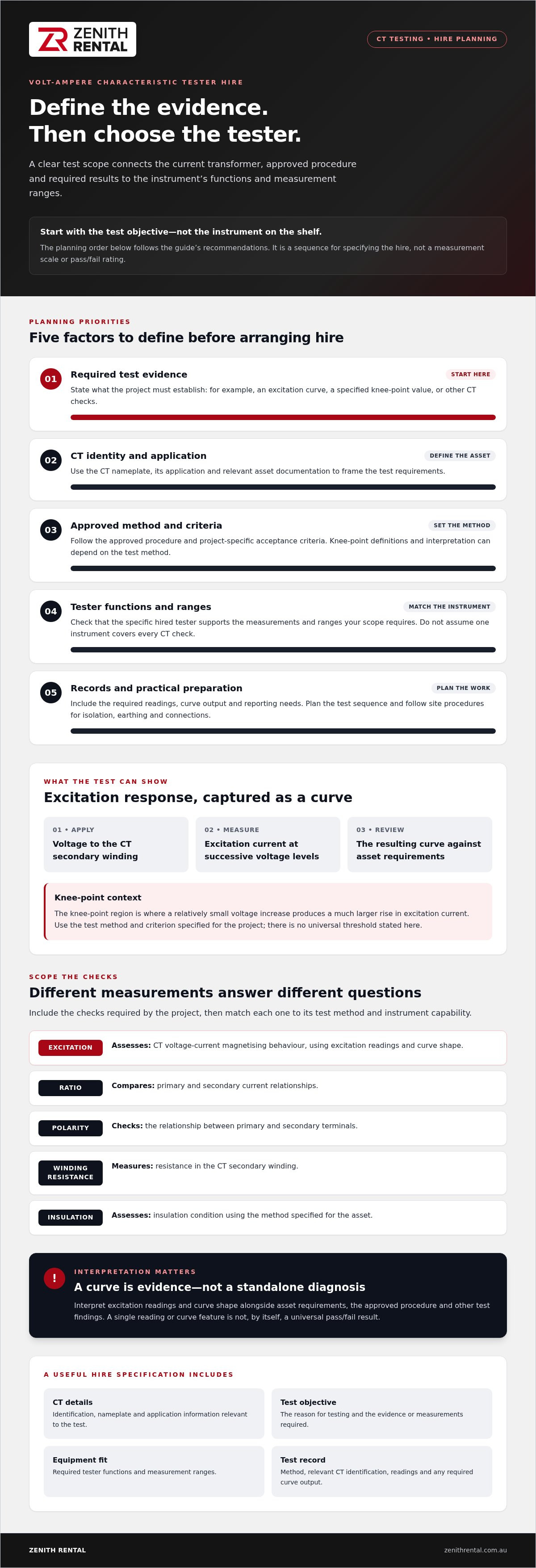
What should you check before arranging volt-ampere characteristic tester hire? Start with the evidence your current transformer (CT) test must produce, not the instrument on the shelf. Choosing equipment before defining the test scope can leave important measurements unsupported and put project timing at risk.
To select a suitable tester, consider the CT, test procedure and intended application. Depending on the instrument and requirements, CT assessment may cover the excitation curve, ratio, polarity, winding resistance or burden. The functions and measurement ranges of the specific hired tester matter, so define the required evidence before arranging equipment.
This guide explains what a volt-ampere characteristic tester can help assess, which CT and test details to include in a hire specification, and how to prepare the transformer, team and site. Zenith Rental provides Australian electrical testing teams with access to specialised equipment for defined projects, without requiring a purchase. A clear scope and practical preparations can help you use the equipment effectively and reduce avoidable delays.
Key Takeaways
- Define the test evidence you need, then identify the tester capabilities required to produce it.
- Use the CT nameplate, application and approved procedure to specify a suitable volt-ampere characteristic tester hire.
- Use excitation-current readings and curve shape as part of an assessment, not as a standalone diagnosis.
- Plan the test sequence and follow approved site procedures for isolation, earthing and connections.
- When arranging hire through Zenith Rental, outline the CT details, test objectives, hire duration and reporting needs.
What does a volt-ampere characteristic tester reveal about a current transformer?
A volt-ampere characteristic tester assesses a current transformer’s excitation behaviour. It applies voltage to the secondary winding and measures the resulting excitation current. These readings form a curve that helps engineers assess how the CT responds as voltage rises. Unlike a general-purpose meter that measures voltage or current at a point in time, this specialist instrument captures the CT’s excitation response as part of a defined test.
A current transformer converts high primary current into a lower, proportional secondary current for measurement or protection equipment. Its characteristics matter because a change from intended performance may affect signals used by metering systems or protection relays. Excitation testing can provide useful evidence during commissioning, planned maintenance or an investigation. Interpret the results alongside the asset requirements and other test findings.
What is a current transformer excitation characteristic?
During an excitation test, the instrument records the current needed to magnetise the CT core at successive applied-voltage levels. Plotting these values produces the excitation curve, whose shape shows how the core responds as voltage increases. The curve can highlight behaviour that warrants closer assessment, but it does not diagnose a fault on its own.
The knee-point voltage describes the region where a relatively small increase in voltage produces a much larger rise in excitation current. Its precise definition and interpretation depend on the test method and asset requirements. Use the criterion specified for the test rather than assuming there is one universal threshold.
When might a CT volt-ampere test be required?
An excitation test may form part of commissioning to establish a performance record, maintenance to check condition, troubleshooting after an unexpected protection or metering result, or verification following work on the CT. In each case, the approved procedure and asset requirements determine the evidence needed. An excitation curve may be one part of a broader assessment.
Before arranging volt-ampere characteristic tester hire, define the CT, the reason for testing and the required results. This scope helps match the equipment to the task instead of assuming every tester supports every measurement. Include the test sequence and reporting requirements in your planning so the instrument can be selected around the evidence the project needs.
Which CT measurements and test results should the hire support?
Start with the test objective, then match the required evidence to the instrument’s supported functions and measurement ranges. A volt-ampere characteristic tester may provide excitation data, while other CT checks may require separate functions or equipment. Don’t assume one tester performs every check listed in a project specification.
For an excitation test, the instrument applies voltage to the CT secondary and records excitation current at successive points. The resulting curve shows how current changes as voltage rises. Review the curve and recorded values against the asset documentation and approved procedure. A single reading or curve feature is not, by itself, a diagnosis or a universal pass/fail result.
How do excitation curves and knee-point readings inform assessment?
The curve shows the CT core’s magnetising behaviour under the test conditions. A knee-point reading identifies a defined point on that curve, but the method for determining it can vary. The IEEE Guide for Field Testing of Relaying Current Transformers provides field-testing context. Apply the method and acceptance criteria specified for your project rather than relying on an assumed threshold.
For a useful test record, capture the method, relevant CT identification, readings and any required curve output. Compare the results with specified criteria and relevant baseline information where available. If the required output includes a particular curve or knee-point value, state that clearly in the test scope.
Which additional CT checks belong in the test scope?
Other measurements may be required, but each answers a different question and may need a different instrument capability:
- Ratio: compares primary and secondary current relationships.
- Polarity: checks the relationship between primary and secondary terminals.
- Winding resistance: measures resistance in the CT secondary winding.
- Insulation: assesses insulation condition using the method specified for the asset.
A CT excitation test examines the transformer’s voltage-current magnetising behaviour; it is not, on its own, a complete CT assessment. Include the checks required by the project scope and match each to the test method and instrument capability. The IEEE guide can help frame field-test considerations, while asset documentation and approved procedures determine applicable limits and acceptance criteria.
For volt-ampere characteristic tester hire, provide the CT details and required results so the equipment can be matched to the task. Explore CT tester hire through Zenith Rental as you finalise the scope.
How to Choose a Volt-Ampere Characteristic Tester
Start with the evidence the project requires, not a preferred brand or a feature list. A useful hire specification connects the CT’s nameplate and application to the approved test procedure, required results and site conditions. This helps identify the instrument functions and ranges needed for the task.
What CT and project details should shape the hire specification?
Gather the CT identification and nameplate details, including its ratio, burden and accuracy class where available. Add the CT’s application, relevant asset records, test procedure, required measurements and reporting format. Note access and connection constraints that could affect setup. Missing information can slow equipment selection or leave the team resolving basic scope questions after the hire is arranged.
How should you compare tester capabilities for the task?
Compare the required outputs with the specific instrument’s supported functions and measurement ranges. The IEEE Standard Requirements for Instrument Transformers may be relevant where project documentation refers to it. Use the asset requirements and approved procedure to guide your specification, and avoid assuming one tester performs every CT check.
| Test objective | CT and project information | Required output | Capability to verify |
|---|---|---|---|
| Excitation characteristic | Nameplate details, application and specified method | Excitation readings and curve, plus any specified knee-point result | That the tester supports the required test method and relevant range |
| Ratio or polarity | CT ratio, terminal details and procedure | Ratio result or polarity indication | Whether those checks are supported, or require separate equipment |
| Winding resistance or insulation | Test limits and asset procedure | Recorded measurements in the required format | Whether the hire instrument supports the check or another instrument is needed |
| Test record and workflow | Reporting needs, test sequence and team experience | Results that can be retained and reviewed as required | Interface, reporting options and operating steps for the hired unit |
Project duration matters too. Define the testing window and expected sequence so the hire period accounts for setup, testing and recording, not just the time needed to take readings. If the team is unfamiliar with the instrument, allow time to review its operating instructions and planned workflow before site work begins. Functions, ranges, interfaces and accessories vary by instrument, so include the requirements in the hire specification.
For volt-ampere characteristic tester hire, share the CT details, required evidence, project duration and reporting needs with Zenith Rental’s CT tester hire team.
How should you prepare for a CT characteristic test?
Prepare before the instrument arrives. Confirm the evidence the project requires, organise the CT records and assign clear responsibilities to the test team. These steps help the team use the hire period efficiently and keep the work aligned with site requirements.
What should the team confirm before equipment arrives?
Check the asset identity against the CT nameplate and available drawings. Confirm the approved test procedure, scope and acceptance criteria, then prepare the relevant test forms or record templates. Make sure everyone involved understands their role and can access the information needed to follow the planned sequence.
Coordinate safe access and isolation with the site team. Isolation, earthing and test connections must follow authorised site procedures and the approved test method; this guide does not replace them. Resolving access or documentation gaps before setup can prevent avoidable delays.
A practical preparation sequence is:
- Confirm the CT identification, test objective, method and required results.
- Gather nameplate details, drawings, asset records and reporting templates.
- Arrange access and the required isolation under site rules and authorised procedures.
- Set up the hired instrument according to its operating instructions and the approved test sequence.
- Record the test conditions, readings and observations, then retain the results with the project documentation.
How can the team support reliable test records?
For each test, record the asset identification, relevant environmental context, connection arrangement, instrument settings and observations. Retain raw readings and any curve outputs, not just a summary or conclusion. Clear records help reviewers understand how the result was obtained and compare it with applicable requirements.
Note limitations, unexpected behaviour or anomalies alongside the results. Don’t treat an isolated reading as a final diagnosis. Interpret it within the approved procedure and the broader asset evidence. Organise the file so the test team and project reviewers can trace each result to the correct CT.
With the scope, documentation and site arrangements prepared, specify volt-ampere characteristic tester hire around the actual task. Include the CT details, test objectives, planned hire duration and reporting needs in your enquiry. Arrange CT tester hire with Zenith Rental for your project.
Hire a volt-ampere characteristic tester through Zenith Rental
Once you’ve defined the CT test scope and required evidence, match the project brief to suitable equipment. Zenith Rental provides volt-ampere characteristic tester hire for current transformers, giving Australian electrical teams access to specialist test equipment for a defined project without requiring a purchase.
A focused enquiry keeps the equipment discussion centred on the task. Include the CT details and test procedure, then describe the results your team needs to capture. This helps align the hire requirement with the intended test instead of assuming every tester supports the same functions, ranges or reporting options.
What information makes a hire enquiry more useful?
Share the details that connect the CT to the planned work. If some information is incomplete, provide what you have so the equipment discussion can be based on the project brief.
- CT identification: nameplate details, ratio, application and relevant asset information.
- Test objective: the reason for testing and the approved procedure or standard referenced by the project.
- Required measurements: excitation characteristic data and any other CT checks specified for the task.
- Hire period: the planned duration, including the expected testing window.
- Site considerations: relevant access, connection or scheduling constraints.
- Reporting needs: the records, readings, curve outputs or other evidence the project requires, without assuming a particular file format.
These details make the equipment discussion more precise and bring practical considerations, such as the test sequence and reporting expectations, into view before the equipment is selected.
What happens after you define the project requirements?
With the CT information and objectives clear, Zenith Rental can discuss the equipment hire in relation to your project scope. The instrument’s functions and measurement ranges are specific to the unit, so the discussion focuses on matching the required evidence to the relevant capabilities. This grounds the hire decision in the test procedure rather than brand preference alone.
Zenith Rental is an Australian-owned and operated specialist serving customers nationally, with access to specialised test and measurement equipment for electrical testing projects. If your team is preparing a CT characteristic test, bring the asset details, test objectives, planned hire period and reporting needs together for a focused equipment-hire discussion.
Discuss your CT tester hire requirement with Zenith Rental.
Set your CT test up for success
A well-specified hire begins with the evidence your project needs. Use the CT nameplate, application and approved procedure to define the test scope, then match it to the tester’s supported functions and measurement ranges. Preparing site arrangements, documentation and reporting requirements in advance can help the team use the equipment effectively.
For a defined project, volt-ampere characteristic tester hire provides access to specialist equipment without requiring a purchase. Zenith Rental provides CT characteristic tester hire and specialises in electrical and industrial test-equipment hire across Australia.
Share your CT details, test objectives, planned hire period and reporting needs to start a focused equipment discussion. Discuss your CT tester hire requirements with Zenith Rental and prepare for a well-documented test.
Frequently Asked Questions
What is a volt-ampere characteristic tester used for?
A volt-ampere characteristic tester assesses a current transformer’s excitation behaviour by applying voltage to its secondary and measuring the resulting excitation current. The readings can be plotted as a curve and reviewed against the CT documentation and test procedure. Because instrument functions and outputs vary, define the required evidence first. For volt-ampere characteristic tester hire, match the test objective to the specific unit’s supported functions and ranges.
Can a volt-ampere characteristic tester test every type of current transformer?
Don’t assume one instrument or procedure suits every current transformer. The appropriate test depends on the CT’s design, application and required evidence, as well as the tester’s functions and measurement ranges. Review the CT documentation and approved procedure, then use those details to specify the hire. Check that the selected instrument’s capabilities align with the intended test before relying on it for the task.
How does a CT excitation test identify the knee point?
An excitation test records the current needed to magnetise the CT as voltage is applied to its secondary, producing data that can be plotted as a characteristic curve. The knee point is identified according to the definition and method specified for the test, not a universal value. Compare the recorded result with CT documentation and project criteria. Don’t treat one reading on its own as a definitive diagnosis.
What information should I provide when enquiring about tester hire?
Provide the CT identification and application, planned test procedure, required measurements and intended hire period. Include relevant project constraints and describe the records or outputs the team needs, such as readings or a curve. These details help frame the equipment discussion around the test scope. Lead with the CT characteristics and testing objectives, as a model name alone may not explain the evidence required.
Is a volt-ampere characteristic test enough to assess a current transformer?
Not necessarily. An excitation characteristic test assesses a specific aspect of CT behaviour, while the project may call for separate checks such as ratio, polarity, winding resistance or insulation. The approved scope and applicable procedures determine which measurements are needed. Treat excitation results as one part of the available evidence, not as a complete condition assessment or proof that the CT is suitable for every application.
What should I check before using a hired CT tester?
Check that the specific instrument’s functions and measurement ranges align with the CT requirements and approved procedure. Read the supplied operating instructions, review relevant asset documentation and prepare the test-record process. Confirm which accessories and documentation apply to the hired unit instead of assuming they are standard across all configurations. Only authorised personnel should carry out the work, following approved site procedures for isolation, earthing and connections.