


Understanding Power Quality Measurements: A Comprehensive Guide to Industrial Precision
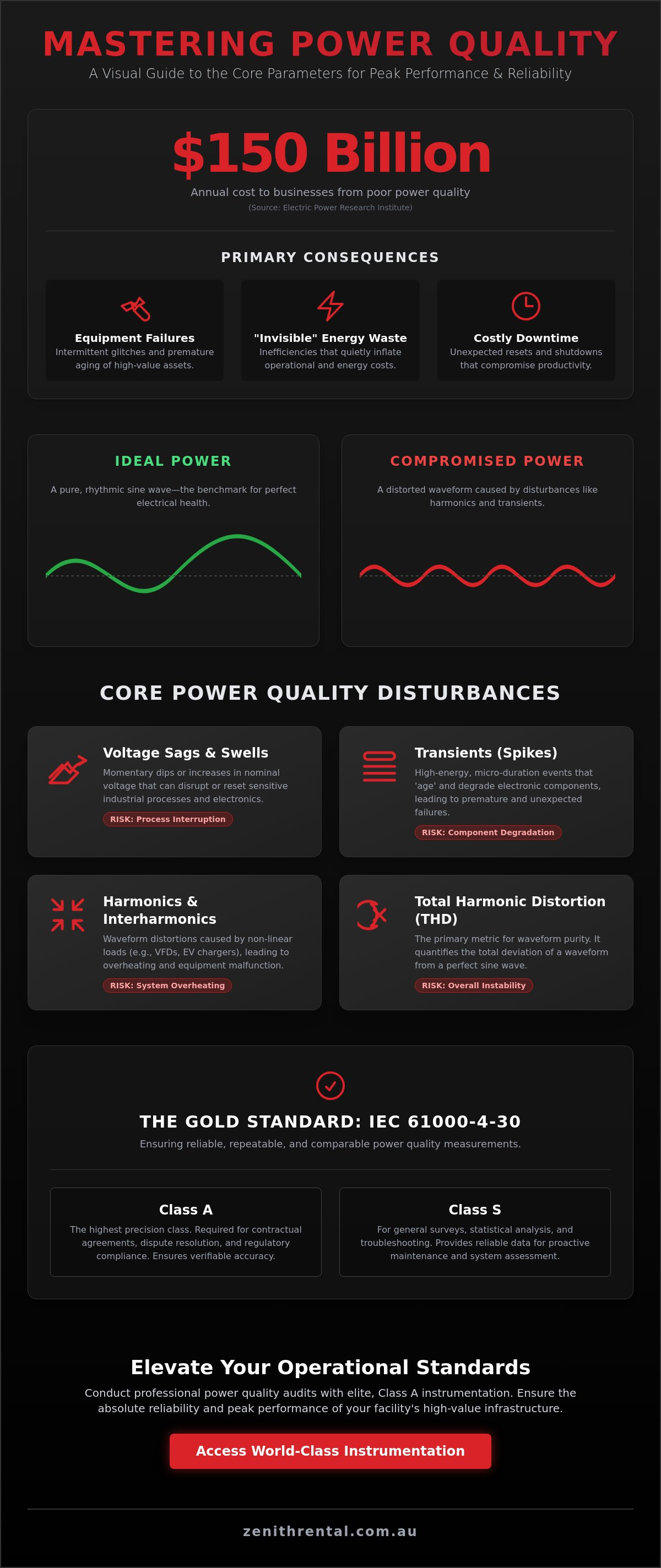
Did you know that poor power quality costs businesses more than $150 billion annually according to the Electric Power Research Institute? For a discerning operator, these hidden inefficiencies often surface as frustrating equipment failures or rising energy costs that compromise your facility's excellence. Achieving absolute reliability requires a sophisticated approach to understanding power quality measurements, ensuring your high-value infrastructure operates at its absolute peak.
It's common to feel a sense of friction when navigating the technical nuances of the IEC 61000-4-30:2025 standards or the updated 2026 National Electrical Code. You seek the confidence that only precise, professional data can provide. This guide empowers you to master complex electrical parameters and provides a clear framework for identifying disturbances. We'll examine how to select the correct accuracy class for your specific application, helping you minimize downtime through a seamless process of proactive monitoring and elite technical insight.
Key Takeaways
- Recognise power quality as a silent partner that preserves the prestige and smooth operation of your high-performance environment.
- Identify the core electrical parameters necessary for maintaining impeccable system stability and long-term asset health.
- Master the nuances of the IEC 61000-4-30 standard for a more profound understanding power quality measurements and regulatory compliance.
- Learn to conduct a methodical power quality audit that functions as a sophisticated diagnostic tool rather than a simple data exercise.
- Access world-class instrumentation through elite rental partners to ensure your measurements meet the highest possible industry standards.
Defining Power Quality in a High-Performance Environment
True operational excellence begins where the visible ends. For the discerning facility manager, Defining Power Quality is less about simple connectivity and more about the precision of the invisible force driving your success. It's the silent partner in your facility's prestige, ensuring that every sensitive component performs with the grace it was designed for. While utility-grade power might suffice for basic lighting, high-tier industrial environments demand precision-grade power. This level of stability is defined by the perfect waveform, a pure, rhythmic sine wave that serves as the ultimate benchmark for electrical health.
Achieving this standard isn't a matter of chance. It requires a sophisticated commitment to understanding power quality measurements, transforming raw electrical data into a strategic asset. When you view power as a premium resource rather than a mere utility, you align your infrastructure with the highest standards of reliability and success. This proactive stance separates elite operations from those that merely react to failure.
This commitment to excellence often extends beyond the electrical panel. A truly elite facility also considers its physical environment; integrating high-end acoustic panels or room dividers from Chicsense can ensure your workspace reflects the same level of sophistication and precision as your technical systems.
The Consequences of Compromised Power
Compromised power doesn't always announce itself with a total blackout. Often, it's a subtle, corrosive influence that degrades high-value assets over time. Poor power quality leads to "invisible" energy waste, where inefficiencies quietly inflate operational costs without a clear signature. Beyond the financial impact, intermittent equipment glitches or unexpected resets reflect poorly on facility management standards. It creates a sense of friction in an environment that should be seamless. Protecting your investment in advanced instrumentation requires a keen eye for these hidden disturbances before they escalate into costly downtime.
The Evolution of Power Quality in the Modern Grid
The electrical landscape is undergoing a profound transformation. The integration of renewable energy sources like solar and wind introduces new layers of volatility to the grid, demanding more rigorous monitoring. Simultaneously, the proliferation of electric vehicle charging infrastructure creates unique harmonic challenges that can disrupt sensitive local networks. We've seen a decisive shift from simple linear loads to sophisticated non-linear systems in modern industrial settings. The release of the IEC 61000-4-30:2025 standard reflects this evolution, providing updated methods to handle rapid voltage changes in a grid that is more complex than ever. Staying ahead of these trends isn't just a technical requirement; it's a hallmark of a brand that values absolute reliability.
The Core Parameters of Power Quality Analysis
Every facility possesses a unique electrical signature. This complex tapestry of currents and voltages defines the health and longevity of your infrastructure. Mastering this signature requires a deep dive into the primary indicators of stability. Achieving impeccable system control starts with understanding power quality measurements, allowing you to transform technical noise into actionable intelligence. Total Harmonic Distortion (THD) serves as the primary metric for waveform purity, quantifying the degree to which your power deviates from the ideal sine wave.
When you monitor these parameters, you aren't just logging data; you're curating an environment of absolute reliability. Each metric provides a window into how your equipment interacts with the supply. By identifying the specific "fingerprint" of your facility's power, you can anticipate failures before they occur, preserving the prestige of your operations and the integrity of your high-value assets.
Voltage Sags, Swells, and Transients
Precision equipment relies on a steady, predictable stream of energy. Voltage sags, also known as dips, and swells represent momentary deviations from the nominal voltage that can disrupt delicate industrial processes. While these fluctuations are often brief, transients are far more aggressive. These high-energy, micro-duration events "age" electronics prematurely, leading to the early failure of sophisticated components. These disturbances pose specific risks to circuit breaker analyzers and sensitive relays, which require absolute stability to function as intended. Utilizing the IEEE Recommended Practice for Monitoring Electric Power Quality ensures your detection methods align with global benchmarks for precision.
Harmonics and Interharmonics
The rise of non-linear loads has introduced new layers of complexity to modern networks. Variable Frequency Drives (VFDs) and LED lighting, while energy-efficient, generate harmonic distortion that ripples through your system. These harmonics lead to excessive overheating in transformers and neutral conductors, quietly eroding the lifespan of your core infrastructure. In complex, multi-source power systems, monitoring interharmonics becomes essential. These non-integer multiples of the fundamental frequency can cause erratic behavior in sensitive controls, making sophisticated Power Quality Measurement hire a prudent step for any facility seeking to maintain a superior operational standard.
Flicker and Frequency Variations
Visual instability can be more than a minor nuisance. Flicker, the perception of light fluctuation caused by voltage changes, often signals underlying issues with large load switching or rapid duty cycles. Frequency stability is even more critical for the modern industrialist. For synchronized processes, even a minor deviation can lead to timing errors and mechanical stress. These frequency shifts often link back to grid-level instabilities, requiring constant vigilance to ensure your internal network remains insulated from external volatility and maintains its high-performance status.
Navigating Standards: IEC 61000-4-30 and Accuracy Classes
Precision is nothing without consistency. In the sophisticated landscape of industrial power, having a common language for measurement isn't just a convenience; it's a necessity. The IEC 61000-4-30:2025 standard stands as the international gold standard, defining the exact methods required to capture power quality parameters with absolute certainty. For the discerning professional, adhering to this standard ensures that data remains irrefutable, especially when dealing with the high-stakes environment of Australian industrial compliance and contractual obligations.
Standardisation provides the foundation for trust. When a facility experiences a dispute with a utility provider or a failure of high-value infrastructure, the integrity of the recorded data becomes the focal point. True mastery in understanding power quality measurements relies on using instruments that follow these rigorous methodologies. Class A measurement, as defined by the IEC, is the only choice for those who refuse to compromise on accuracy. It demands precise time-stamping, often synchronised via GPS, and incredibly low levels of uncertainty to ensure that measurements taken at different locations yield identical, comparable results.
Class A vs. Class S: Choosing Your Level of Precision
The distinction between accuracy classes is fundamental to your monitoring strategy. Class A instrumentation is designed for critical applications where the stakes are highest. It's the required standard for billing verification, legal dispute resolution, and monitoring critical infrastructure where even a minor error is unacceptable. In contrast, Class S (Survey) devices are suitable for general statistical analysis and non-critical troubleshooting where absolute precision isn't the primary driver. At Zenith, we maintain a standard of excellence by providing Class A instrumentation for all high-stakes projects, ensuring your data carries the weight of professional authority.
The Role of NATA Calibration in Compliance
Data is only as reliable as the tool that captures it. NATA-certified calibration serves as the ultimate proof of measurement integrity, providing a documented trail of accuracy that stands up to the most rigorous scrutiny. This level of certification is essential for audit readiness, particularly during site safety or energy efficiency reviews. Utilising professional calibration and testing equipment hire ensures that your facility remains compliant with Australian standards. Calibrated tools don't just provide numbers; they provide the peace of mind that your facility management meets the highest possible industry benchmarks.
Strategic Implementation: Conducting a Professional Power Quality Audit
Transitioning from theoretical knowledge to operational mastery requires a disciplined approach. A professional power quality audit isn't merely a data-logging exercise; it's a sophisticated diagnostic process that reveals the hidden rhythms of your infrastructure. By applying a methodical framework, you transform raw electrical signals into a strategic roadmap for longevity and performance. This process demands the use of high-performance power and energy testing equipment to ensure that every nuance of the electrical environment is captured with absolute fidelity.
Capturing a mere snapshot of your facility's health is often insufficient for the discerning operator. True excellence in understanding power quality measurements involves a commitment to temporal depth. While a single day of data might show a peaceful system, it's the long-term monitoring that uncovers the intermittent disturbances that compromise your high-value assets. This commitment to detail ensures that your facility management remains at the peak of industry standards, providing a sense of security that only comprehensive data can offer.
Step-by-Step Audit Framework
A successful audit begins with a clearly defined scope. You must identify critical loads and the points of common coupling (PCC) where disturbances are most likely to enter or exit your system. Once the perimeter is set, the equipment setup must be handled with professional care, ensuring current transformers (CTs) and voltage leads are connected safely and accurately. We recommend a data collection period of at least one full business cycle, typically seven days, to capture the full spectrum of load variations and external grid influences. Finally, the analysis phase moves beyond raw numbers, distilling complex waveforms into actionable insights and executive-level reports that reflect your commitment to quality.
Interpreting the Results for Operational Success
The true value of an audit lies in the interpretation of the data. By identifying recurring patterns in harmonic distortion or transient events, you can pinpoint the exact moment your infrastructure faces stress. Correlating these power disturbances with specific equipment malfunctions allows you to move from reactive repairs to proactive management. When it's time to present these findings to stakeholders, the clarity of your data serves as the ultimate justification for infrastructure upgrades or mitigation strategies. For those ready to elevate their facility's reliability, exploring Power Quality Measurement hire provides immediate access to the elite tools required for this level of precision.
Elevating Operational Standards with Zenith Rental’s Elite Instrumentation
Achieving the peak of industrial performance requires more than just technical knowledge; it requires the right instruments. Zenith Rental serves as the premier partner for those who demand absolute reliability in their electrical infrastructure. We curate a selection of world-class brands, including Fluke and Megger, ensuring you have access to the same precision used by the world's leading engineers. Mastery in understanding power quality measurements is made effortless when you're equipped with the industry's most refined tools, allowing you to focus on strategic success rather than logistical hurdles.
Owning high-value assets often brings a burden of maintenance and the risk of rapid obsolescence. By choosing our premium rental model, you bypass the capital expenditure while maintaining access to the latest technological advancements. It's a sophisticated way to manage your facility's needs without sacrificing the quality of your data. This approach ensures your testing protocols remain agile, adapting to the evolving requirements of the modern grid with ease and prestige.
The Zenith Advantage: Access to the Peak of Technology
We provide immediate access to the latest Class A analyzers, the very gold standard required for compliance with IEC 61000-4-30. Every instrument in our fleet is impeccably maintained and arrives with freshly verified calibration, ensuring NATA-traceable accuracy for every project. Our experts understand the nuances of Australian power systems, providing the technical support necessary for truly understanding power quality measurements and transforming complex readings into actionable intelligence. This isn't just a utility service; it's a superior user experience designed to uphold your professional reputation.
Seamless Integration into Your Project Workflow
Our national reach ensures rapid deployment of critical testing tools across Australia. Whether you're in Sydney, Melbourne, or a remote industrial hub, we minimize friction in your procurement process. Flexible hire terms align perfectly with your project milestones or maintenance shutdowns, providing the right tool at the exact moment it's needed. There's a distinct status associated with using industry-leading instrumentation on-site. It signals to stakeholders and regulators that your facility management operates at the highest possible standard. When you're ready to secure your infrastructure's future, our Power Quality Measurement hire services provide the elite foundation your project deserves.
Secure Your Infrastructure’s Future with Precision
Mastering the invisible rhythms of your electrical network is the hallmark of an elite operator. By aligning your facility with the IEC 61000-4-30:2025 standards and committing to rigorous Class A monitoring, you insulate your high-value assets from the corrosive effects of poor power. True proficiency in understanding power quality measurements transforms technical data into a strategic shield. It's a commitment to quality that ensures your infrastructure operates with the grace and reliability it was designed for, preserving the prestige of your professional environment.
Zenith Rental provides the foundation for this excellence through a curated fleet of top-tier brands like Fluke, Megger, and Druck. Every critical instrument arrives with NATA-traceable calibration, providing the ultimate proof of measurement integrity for your next audit. Our nationwide Australian support and rapid deployment ensure that the peak of technology is always within reach. Explore our elite range of Power Quality Analyzers for hire today. Elevating your operational standards to a position of absolute reliability has never been more seamless.
Frequently Asked Questions
What is the primary difference between power quality and power reliability?
Power reliability refers to the continuity of your supply, focusing on whether the lights stay on and how often interruptions occur. Power quality, however, concerns the purity and stability of the voltage and current while the power is flowing. Even if your supply is perfectly reliable, poor quality can still cause sophisticated equipment to malfunction or age prematurely.
How long should a power quality survey typically last for accurate results?
A professional survey should typically last for at least seven days to capture a full business cycle. This duration ensures you record load variations across different shifts, peak periods, and weekend cycles. This depth of data is essential for understanding power quality measurements and identifying intermittent disturbances that a shorter snapshot would likely miss.
Why is IEC 61000-4-30 Class A considered the gold standard for measurement?
Class A defines the exact mathematical methods and time-synchronisation requirements an instrument must use to ensure irrefutable results. This standard ensures that two different Class A meters measuring the same point will produce identical data. This level of precision is vital for legal compliance, billing disputes, and monitoring critical industrial infrastructure where absolute certainty is required.
Can harmonics cause damage to my electrical motors and transformers?
Harmonics cause significant thermal stress by increasing eddy current losses and creating a skin effect in conductors. This excessive heat quietly degrades the insulation within your motors and transformers over time. Left unmonitored, these distortions lead to premature equipment failure and unexpected downtime, compromising the prestige and efficiency of your facility.
What are the most common causes of voltage sags in an industrial environment?
Voltage sags often stem from the sudden starting of large motors or the switching of heavy loads within your own facility. External events, such as faults on the utility grid or lightning strikes on nearby lines, also create these momentary dips. These fluctuations can be particularly disruptive to sensitive electronic controllers and high-performance automation systems.
Is it better to hire or purchase a high-end power quality analyzer?
Hiring is often the preferred choice for discerning professionals who value access to the latest technology without the burden of ownership. Renting ensures you always use a freshly calibrated, impeccably maintained Class A instrument. It eliminates the ongoing costs of NATA certification and the risk of hardware obsolescence, allowing you to focus on results rather than maintenance.
How does NATA calibration affect the validity of my power quality report?
NATA calibration provides the documented traceability required to prove your measurements are accurate and comply with Australian standards. A report backed by NATA-certified tools carries the professional authority needed for insurance claims, safety audits, and contractual disputes. It transforms raw data into a legally defensible asset that reflects your commitment to excellence.
What is the impact of solar inverters on local power quality?
Solar inverters can introduce high-frequency harmonics and cause local voltage swells as they inject power back into the grid. These effects can disrupt the balance of your internal network if not properly managed. Monitoring these variables is a critical component of understanding power quality measurements in modern facilities that rely on a blend of renewable and grid power.