


Transformer Oil Testing Standards in Australia: The 2026 Compliance Guide
Could a single misinterpreted moisture reading jeopardize the integrity of a multi-million dollar high-voltage asset? For professionals managing the nation's energy infrastructure, the margin for error has never been slimmer. You likely recognize that aligning with local AS 60296:2017 requirements while tracking international IEC 60422:2024 updates feels like a complex balancing act. Mastering the transformer oil testing standards Australia mandates is no longer just a checkbox for safety; it's a hallmark of operational excellence and asset longevity.
We agree that maintaining grid resilience requires an uncompromising commitment to precision. This guide provides a definitive roadmap for 2026 compliance, ensuring your high-voltage assets meet every rigorous performance standard with absolute reliability. We'll explore the mandatory physical tests required for NATA-traceable results and reveal how to access elite-tier diagnostic technology, such as a Transformer Oil Breakdown Voltage Tester hire, to protect your prestigious investments without the burden of significant capital expenditure.
Key Takeaways
- Define the critical synergy between AS/NZS 1767 and international IEC 60296 standards to ensure your high-voltage assets remain at the peak of performance.
- Navigate the rigorous transformer oil testing standards Australia requires for 2026 compliance by identifying which diagnostic tests are mandatory for site safety.
- Secure absolute reliability in your reporting by understanding the necessity of NATA-traceable results during high-stakes regulatory audits.
- Discover how premium equipment rental allows your team to deploy the latest Transformer Oil Breakdown Voltage Testers without the burden of capital expenditure.
- Master the art of predictive maintenance by interpreting subtle chemical signals that indicate the health and longevity of your critical power infrastructure.
The Critical Role of Transformer Oil Testing in Australian Industry
Modern high-voltage transformers are the silent sentinels of the Australian economy. They power our prestigious manufacturing hubs and the sprawling urban centers that define our success. Within these massive steel casings, insulating oil performs a delicate, multi-faceted ballet. It serves as a superior coolant, a robust dielectric barrier, and a vital diagnostic messenger. Understanding The Critical Role of Transformer Oil Testing is the first step in protecting these high-value assets from the unforgiving thermal stresses of the Australian climate.
As we move through 2026, the industry has moved beyond the outdated model of reactive maintenance. The current priority is proactive, condition-based monitoring. Chemical contamination and oxidation aren't just technical nuisances; they're direct threats to your asset's longevity. Adhering to the transformer oil testing standards Australia mandates ensures that every decision you make is backed by empirical data rather than guesswork. This strategic shift represents a high-return investment. It transforms a routine maintenance task into a sophisticated advantage that avoids the prestige-damaging impact of unplanned outages.
Understanding the Risks of Non-Compliance
Neglecting your oil's health carries heavy consequences under Australian workplace health and safety laws. A catastrophic failure doesn't just halt production. It creates significant legal and safety liabilities for your organization. Moisture and oxidation relentlessly erode the dielectric strength of insulating liquids, leading to internal arcing and irreversible winding damage. Standardized testing prevents these untimely failures, ensuring that critical infrastructure remains operational and safe. It's about maintaining a standard of excellence that reflects your commitment to absolute reliability.
The 2026 Regulatory Landscape for Power Utilities
The current energy climate demands more than just occasional checks. Regulatory bodies and insurance providers now require rigorous adherence to specific testing intervals and verifiable data. Safety audits in 2026 focus heavily on your ability to produce NATA-traceable results. Best practice is no longer a vague goal; it's a documented reality. Insurance firms increasingly view compliance with transformer oil testing standards Australia as a prerequisite for coverage. They value the security that comes from precise, high-end diagnostic testing. Utilizing professional solutions like a Transformer Oil Breakdown Voltage Tester hire ensures your data meets these exacting standards every time.
Primary Australian Standards for Insulating Liquids: AS/NZS 1767 and Beyond
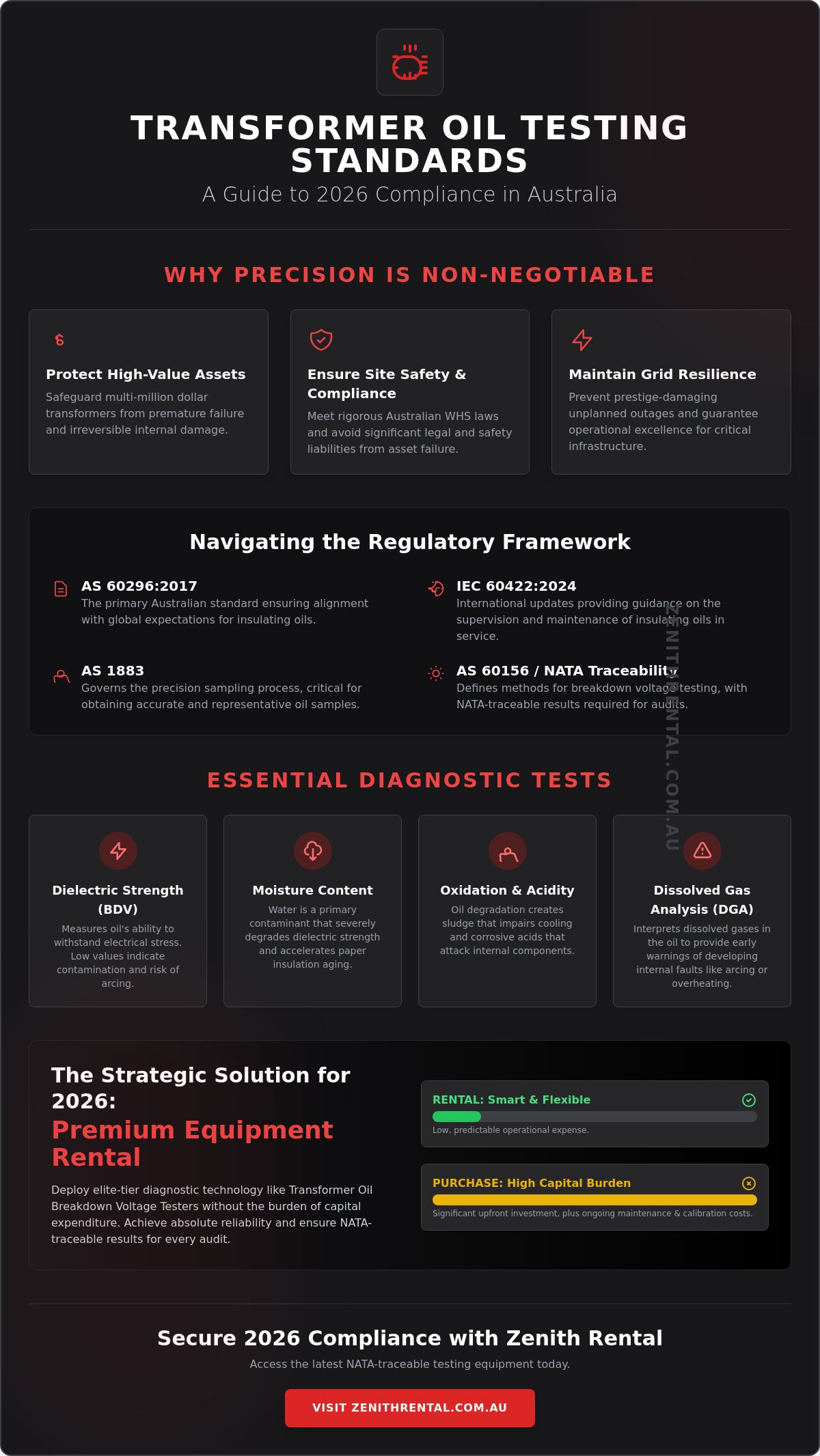
The framework of transformer oil testing standards Australia relies on a clear hierarchy of local and international benchmarks. While AS/NZS 1767 long served as the definitive foundation, the industry has largely transitioned toward AS 60296:2017 to ensure alignment with global expectations. This shift ensures that Australian engineers speak the same technical language as their international peers. Success in the field requires more than just understanding the oil's chemistry. It demands absolute precision in the sampling process, governed by AS 1883, and strict adherence to protocols like AS 60156 for determining dielectric breakdown voltage at power frequency.
Maintaining a prestigious asset fleet requires a deep familiarity with these evolving regulations. As we progress through 2026, the focus has expanded to include the unique performance characteristics of both traditional mineral oils and modern alternatives. Every test performed is a testament to a facility's commitment to reliability and safety. Following the correct standardisation prevents the costly misinterpretation of data that could lead to catastrophic equipment failure.
AS/NZS 1767: Classification and Specifications
AS/NZS 1767 categorises mineral oils based on their refining process and intended thermal application. It sets uncompromising thresholds for viscosity, flash point, and pour point. These parameters dictate how effectively the oil circulates to suppress heat within the transformer core. In 2026, these standards have evolved to address the rising use of natural and synthetic esters, which offer superior fire safety. Achieving these specific benchmarks requires high-performance instrumentation. Professionals often choose a transformer oil breakdown voltage tester hire to ensure their results meet these updated requirements with absolute accuracy.
International Standard Harmonisation
International harmonisation is a functional reality for modern Australian utilities. You'll often find yourself cross-referencing ISO or ASTM methods during complex diagnostics to maintain a superior image of technical competence. For instance, IEC 60814 remains the gold standard for moisture analysis in oil-impregnated paper. It provides the granular detail needed to assess the true age of your transformer's internal insulation. Similarly, IEC 60247 outlines the limits for acidity and interfacial tension. These metrics are critical Essential Diagnostic Tests Required for Site Compliance, as they signal the onset of sludge formation. Adhering to this global logic ensures your assets remain in peak condition.
Essential Diagnostic Tests Required for Site Compliance
Achieving the highest possible standard of asset care requires a suite of sophisticated diagnostic procedures. Each test serves as a critical data point, painting a comprehensive picture of your transformer’s internal health. While the general framework of transformer oil testing standards Australia sets the expectation, the execution of these specific tests determines the safety and longevity of your power infrastructure. We focus on four pillars of diagnostics: dielectric strength, dissolved gas patterns, moisture levels, and chemical stability.
Precision in these areas is non-negotiable. A slight oversight in moisture measurement or a misinterpreted gas ratio can lead to a miscalculated risk assessment. By adhering to rigorous testing protocols, you ensure that every high-voltage asset operates at its peak potential, mirroring the high performance expected in elite industrial environments. This commitment to detail transforms routine compliance into a strategic advantage for your facility.
Dielectric Strength and AS 60156 Protocols
The dielectric breakdown voltage test is your first line of defense. It measures the oil's ability to withstand electrical stress at power frequency. Under AS 60156, the protocol is exacting. Technicians must maintain a specific electrode configuration, typically a 2.5mm gap, and follow strict stirring requirements to ensure the sample remains representative. A 'pass' result varies depending on the voltage class of your equipment; higher voltage assets naturally demand more robust dielectric performance. To ensure your on-site results meet these rigorous benchmarks, many elite service professionals rely on a Transformer Oil Breakdown Voltage Tester hire to access factory-calibrated, high-precision instrumentation.
The Science of Dissolved Gas Analysis (DGA)
If dielectric testing measures the oil's current state, DGA predicts its future. Dissolved Gas Analysis acts as the 'blood test' of the transformer, identifying hidden thermal and electrical faults before they escalate into catastrophic failures. By monitoring gases like Hydrogen, Methane, and Acetylene through gas chromatography, we can pinpoint specific internal issues. Experts utilize the Duval Triangle and Rogers Ratio methods to interpret these gas patterns with exquisite precision. This level of insight allows for surgical maintenance interventions, preserving the prestige and performance of your high-voltage network.
Moisture and Acidity: The Silent Killers
Trace amounts of water are enough to compromise the safety of high-voltage systems. Using the Karl Fischer titration method, we measure moisture content in parts per million. There is a direct, destructive correlation between oil acidity and the degradation of solid paper insulation. As the oil oxidizes, it produces acids that weaken the cellulose fibers of the windings; this is an irreversible process that marks the beginning of asset depreciation. According to the Primary Australian Standards for Insulating Liquids, maintaining neutralisation values within strict limits is essential for long-term reliability. Monitoring interfacial tension (IFT) further provides an early warning for sludge formation, allowing you to act before cooling ducts become obstructed.
Achieving NATA-Traceable Results in On-Site Testing
NATA traceability represents the pinnacle of measurement confidence in the Australian industrial sector. It provides an unbroken chain of comparisons back to national standards, ensuring your data is beyond reproach during a safety or performance audit. In the context of transformer oil testing standards Australia, achieving this level of precision on-site transforms a routine maintenance task into a sophisticated internal diagnostic program. You don't need to rely on external "black box" services when you have access to the same elite-tier instrumentation they use. This shift toward internal mastery reflects a commitment to absolute reliability and operational prestige.
The accuracy of your diagnostic hardware is the foundation of your compliance strategy. A high-quality oil sample is worthless if the instrument used to measure it lacks recent, verifiable calibration. Drift in measurement tools can lead to false positives that trigger unnecessary maintenance or, more dangerously, false negatives that mask a brewing catastrophic failure. Utilizing professional test equipment hire Australia services ensures your team always works with factory-calibrated assets that meet the most exacting industrial requirements. Always verify calibration certificates before you begin any site testing program to maintain your facility's reputation for excellence.
The Importance of Calibrated Instrumentation
Precision calibration is what separates a world-class diagnostic from a simple guess. Portable oil breakdown testers and DGA monitors require regular adjustment to account for environmental wear and electronic drift. Even a minor deviation in voltage ramp rates can skew breakdown results by a significant margin. By choosing a high-end rental solution, you bypass the logistical burden of maintaining NATA-calibrated hardware yourself. This ensures that every test you perform is a true reflection of the asset's health, providing the peace of mind that comes with surgical measurement accuracy.
Sampling Integrity and AS 1883 Compliance
Sampling is a delicate art that requires impeccable organization. AS 1883 mandates specific procedures to ensure the oil extracted from the transformer remains a true representation of the bulk liquid. This includes thorough flushing of valves to remove stagnant oil and the use of specialized glass syringes for Dissolved Gas Analysis to prevent the ingress of atmospheric gases. Environmental factors like high humidity, airborne dust, or direct sunlight can compromise a sample in seconds. Microscopic contaminants or trace moisture from the air can lower a breakdown voltage reading by as much as 30 percent, leading to incorrect diagnostic conclusions. Personnel must be meticulously trained to create a controlled, clean testing environment even in the most challenging field conditions.
Maintaining this level of detail ensures your results are both accurate and defensible. When your team uses precision-engineered tools, the entire process feels seamless and efficient. If you're looking to elevate your on-site capabilities, consider a Transformer Oil Breakdown Voltage Tester hire to ensure your next compliance audit is met with absolute confidence.
Strategic Equipment Solutions: Why Rental is the Premium Choice for 2026
Maintaining an impeccable record of asset health requires more than just technical expertise; it necessitates access to the finest diagnostic tools on the market. As 2026 unfolds, the sheer sophistication of the transformer oil testing standards Australia enforces has shifted the strategic focus from equipment ownership to high-performance rental solutions. This transition isn't merely about capital preservation. It's about ensuring your maintenance team operates at the peak of industry standards with the agility and confidence that only the latest technology can provide.
The logistical burden of purchasing, storing, and maintaining a fleet of sensitive instruments often detracts from the primary goal of asset reliability. By opting for a premium rental model, you ensure that every project utilizes project-ready, factory-calibrated kits designed for immediate on-site execution. This approach guarantees that your data is accurate, your compliance is unquestioned, and your reputation for excellence remains untarnished. Whether you're managing a single metropolitan substation or a sprawling network of remote industrial sites, national equipment delivery ensures you have the right tools exactly when they're needed.
Accessing Elite Technology from Megger and Fluke
Precision is the hallmark of a successful testing program. Utilizing industry-standard instrumentation from brands like Megger and Fluke provides a level of repeatability that entry-level hardware simply cannot match. Modern oil breakdown testers now feature automated testing sequences that align perfectly with the updated protocols of transformer oil testing standards Australia mandates. These features significantly reduce the margin of error in critical safety measurements, allowing your technicians to focus on interpreting results rather than managing the hardware. High-precision tools don't just provide data; they provide the peace of mind that your high-voltage assets are protected by the best technology available.
The Economic Logic of the Zenith Rental Model
The true cost of ownership extends far beyond the initial purchase price. Annual NATA-traceable calibrations, specialized storage requirements, and the constant threat of technological obsolescence create hidden drains on your operational budget. The Zenith rental model eliminates these complexities. It offers a scalable solution that allows you to source multiple units for large-scale substation audits across Australia without the long-term liability of a bloated asset register. You gain the flexibility to deploy the most advanced hardware for specific projects, backed by expert support that ensures a seamless transition from technical requirement to on-site success. To elevate your next maintenance cycle, Explore our range of transformer oil breakdown voltage testers for hire and experience the ease of a truly professional diagnostic partnership.
Securing Excellence in High-Voltage Infrastructure
Mastering the transformer oil testing standards Australia enforces is the hallmark of a world-class facility. By prioritizing precise diagnostics such as Dissolved Gas Analysis and Dielectric Breakdown Voltage, you transform routine maintenance into a sophisticated shield for your most prestigious assets. We've explored how NATA-traceable data and the correct application of AS 60296:2017 ensure your site remains at the peak of industry compliance. This proactive commitment doesn't just prevent failure; it safeguards the long-term value and performance of your energy network.
Zenith provides the seamless support you need to achieve these exacting results. Our fleet includes critical assets with NATA-traceable calibration, ready for nationwide delivery to any Australian industrial site. You'll benefit from the expert technical support of our specialized instrumentation team, ensuring every measurement is executed with absolute confidence. It's time to move beyond the logistical burden of ownership and embrace the agility of elite rental solutions. Secure Your Compliance with Our Elite Transformer Test Equipment Hire and lead your team toward a future of uncompromising reliability.
Frequently Asked Questions
What is the primary Australian Standard for transformer oil testing?
The primary benchmark is AS 60296:2017, which provides the specifications for unused mineral insulating oils in electrical equipment. This standard replaced the older AS 1767.1 to align more closely with global expectations. For in-service maintenance and supervision, technicians look toward the guidance provided in AS 60422 to ensure their assets remain in peak operational condition and meet the latest safety requirements.
How often should transformer oil be tested according to AS/NZS 1767?
Testing frequency is typically determined by the voltage class and the critical nature of the asset rather than a single fixed interval. Most high-voltage power transformers require an annual diagnostic to monitor for moisture and dissolved gases. However, for extremely critical infrastructure or aging units, a more frequent schedule of six-monthly checks might be adopted to maintain the highest possible standard of reliability and performance.
Why is NATA calibration required for transformer oil breakdown testers?
NATA calibration ensures that your test results are traceable to national standards, providing an essential layer of legal and technical security. Without this level of verification, breakdown voltage readings can drift, leading to inaccurate assessments of an asset's safety. Adhering to transformer oil testing standards Australia mandates requires using instruments, such as those found through a Transformer Oil Breakdown Voltage Tester hire, that have been rigorously validated to guarantee absolute data integrity.
Can I perform Dissolved Gas Analysis (DGA) on-site?
Yes, modern portable DGA monitors allow for high-precision gas chromatography to be performed directly at the substation. This provides immediate insights into potential thermal or electrical faults without the delays of laboratory transit. Many elite maintenance teams choose to integrate this capability into their workflow by utilizing test and measurement equipment hire to access the latest diagnostic technology for their critical site audits.
What are the acceptable limits for moisture in transformer oil?
Acceptable moisture limits vary based on the operating voltage of the transformer, with higher voltage units requiring much drier oil. For transformers operating above 170 kV, moisture levels should typically remain below 20 ppm to ensure dielectric safety. In-service oil for lower voltage assets may allow for slightly higher thresholds, but maintaining the lowest possible moisture content is always the preferred strategy for maximizing asset longevity and prestige.
How does AS 1883 affect the way I collect oil samples?
AS 1883 mandates strict protocols for sample collection to prevent external contamination from air, dust, or moisture. It requires the use of specialized glass syringes for DGA and specific flushing techniques for valves to ensure the sample is a true representation of the bulk oil. Following these meticulous steps is the only way to ensure your transformer oil testing standards Australia compliance remains beyond reproach during a high-stakes audit.
What is the difference between IEC 60156 and AS 60156?
AS 60156 is the Australian adoption of the international IEC 60156 standard, meaning the technical requirements for determining dielectric breakdown voltage are virtually identical. This harmonisation allows Australian engineers to utilize global best practices while remaining compliant with local regulatory frameworks. Both standards focus on the precise ramp rate of voltage and the specific geometry of the electrodes used during the testing process.
What happens if a transformer oil sample fails the dielectric strength test?
A failed dielectric strength test necessitates immediate action, starting with a re-test of a fresh sample to rule out sampling error. If the failure is confirmed, the oil must be processed through dehydration and filtration to restore its insulating properties. In cases of severe degradation or chemical instability, a full oil replacement may be the only way to safeguard the asset and restore its status as a reliable component of the grid.