


Transformer Oil Breakdown Voltage Tester Hire: The 2026 Professional Guide
Could a microscopic impurity in your insulating fluid be the silent architect of a multi-million dollar power outage? For high-voltage professionals across Australia, the margin for error has never been thinner. You recognize that maintaining the dielectric integrity of your assets isn't just a routine maintenance task; it's a critical safeguard for your organization’s reputation and operational continuity. Choosing a premium transformer oil breakdown voltage tester hire allows you to access world-class diagnostic precision without the significant capital burden of purchasing specialized high-voltage equipment for periodic use.
This 2026 professional guide details how elite-tier testing solutions ensure your infrastructure remains in peak condition while meeting complex IEC and ASTM regulatory requirements. We'll examine the technical advantages of utilizing calibrated Megger instrumentation and how seamless nationwide logistics support your projects from remote sites to metropolitan hubs. You'll discover the strategic benefits of partnering with an Australian-owned specialist to verify oil strength with absolute confidence. By the end of this article, you'll have a clear roadmap for achieving total compliance and long-term asset health through sophisticated instrumentation and refined service standards.
Key Takeaways
- Understand how monitoring dielectric strength prevents catastrophic asset failure caused by moisture and particulate contamination in insulating fluids.
- Master the nuances between IEC 60156 and ASTM D1816 standards to ensure your testing protocols align with global industry requirements.
- Learn how to select the optimal transformer oil breakdown voltage tester hire based on specific voltage ranges and field-portability needs for your site.
- Implement precise sampling and bottle preparation techniques to eliminate false readings and maintain absolute data integrity during the diagnostic process.
- Leverage high-performance, calibrated assets and nationwide logistics to achieve seamless regulatory compliance across all Australian industrial operations.
The Critical Role of Dielectric Strength in Transformer Maintenance
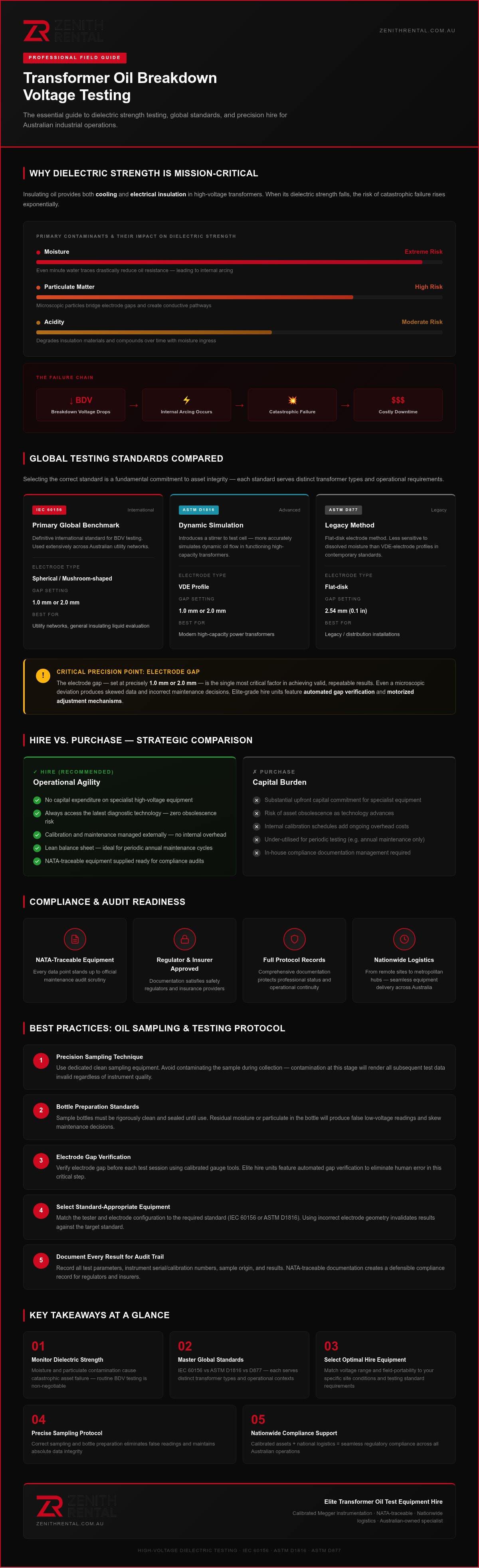
Insulating oil serves as the lifeblood of high-voltage transformers, providing both essential cooling and vital electrical insulation. Its effectiveness is measured by its dielectric strength, or its ability to withstand electrical stress without failing. Breakdown voltage is the specific voltage at which an electrical spark occurs between two electrodes immersed in the oil. When this threshold drops, the risk of internal arcing and catastrophic failure increases exponentially. Contaminants such as moisture, acidity, and particulate matter are the primary culprits in degrading this strength. Even minute quantities of water can drastically reduce the oil's resistance, leading to costly downtime and significant safety hazards within industrial power grids. Protecting these assets requires a commitment to precision that only the highest quality instrumentation can provide.
Why Hire is the Strategic Choice for 2026
Securing a transformer oil breakdown voltage tester hire represents a sophisticated shift toward operational agility for Australian industrial leaders. Rather than committing substantial capital to specialized high-voltage instruments that might only see use during annual maintenance cycles, elite teams opt for a flexible rental model. This approach ensures you always have access to the latest diagnostic technology without the looming threat of asset obsolescence. It also removes the burden of managing internal calibration schedules and maintenance overheads. By outsourcing the equipment logistics, your engineers can focus entirely on the technical execution of the project. Efficiency is the hallmark of modern asset management, and hiring provides a seamless path to achieving it while maintaining a lean balance sheet.
Ensuring Site Compliance and Audit Readiness
The regulatory landscape in Australia demands rigorous verification of asset health, making the quality of your test data paramount. Utilizing NATA-traceable equipment for your testing ensures that every data point collected stands up to the scrutiny of official maintenance audits. Professional partners provide the comprehensive documentation essential for satisfying both safety regulators and insurance providers who require proof of verified dielectric testing protocols. By choosing a high-tier transformer oil breakdown voltage tester hire, you guarantee that your compliance records are beyond reproach. This level of detail doesn't just protect the physical machinery; it protects the organization's professional status and its unwavering commitment to excellence. Reliability in testing translates directly to reliability in power delivery, a standard that discerning clients never compromise on.
Navigating Global Standards: IEC 60156 vs. ASTM D1816
The selection of a testing standard isn't merely a technicality; it's a fundamental commitment to the highest levels of asset integrity. IEC 60156 remains the definitive international benchmark for breakdown voltage (BDV) testing, utilized extensively across Australian utility networks. This standard provides a rigorous framework for evaluating the dielectric strength of insulating liquids. However, modern power transformers often demand the specific nuances of ASTM D1816. This specialized standard introduces a stirrer to the test cell, more accurately simulating the dynamic conditions and oil flow within a functioning high-capacity transformer. For those maintaining legacy installations or specific distribution units, the ASTM D877 flat-disk electrode method might still be relevant, though it's typically less sensitive to dissolved moisture than the VDE-electrode profiles found in more contemporary standards.
Standard-Specific Electrode Configurations
Precision begins with the geometry of the interface. IEC 60156 typically employs spherical or mushroom-shaped electrodes, whereas ASTM D1816 utilizes the specific VDE profile. The gap between these electrodes, often set at precisely 1.0mm or 2.0mm, is the single most critical factor in achieving a valid and repeatable result. Even a microscopic deviation can lead to skewed data and incorrect maintenance decisions. Elite instrumentation provided through a transformer oil breakdown voltage tester hire simplifies this complexity for your site teams. These advanced units often feature automated gap verification and motorized adjustment mechanisms, ensuring that every electrical discharge occurs under strictly controlled, standard-compliant conditions.
Automated Testing and Data Integrity
The era of manual voltage ramping and visual monitoring has been superseded by sophisticated digital control. Modern testers utilize microprocessor-driven sequences that adhere strictly to pre-programmed standard profiles, removing the variability of human intervention. This transition ensures that the rate of voltage rise is perfectly consistent across every test run, whether you are performing a single check or a series of six breaks. For professionals managing high-stakes national projects, the ability to generate instantaneous on-board printouts or export encrypted digital data for seamless reporting is invaluable. It creates an unassailable audit trail that satisfies even the most discerning regulatory bodies. Ensuring your team has access to these high-performance assets is effortless when you partner with an Australian instrumentation specialist who understands the demands of the modern power industry.
Selecting the Right Transformer Oil Tester for Your Project
Selecting the perfect instrumentation is a nuanced decision that balances technical necessity with operational ease. For Australian site managers, the primary consideration often revolves around the required voltage ceiling. A 60kV unit may suffice for standard distribution assets, yet transmission-level transformers or those utilizing high-purity synthetic esters typically demand the 80kV or 100kV capabilities of more robust systems. Opting for a high-tier transformer oil breakdown voltage tester hire ensures you have the headroom necessary to capture accurate data across your entire asset portfolio. In the demanding environments of remote Australian sites, battery longevity and physical ruggedness are non-negotiable. You need an instrument that performs as flawlessly in the dust of a mining site as it does in a climate-controlled laboratory. User-friendly interfaces are equally vital, as they allow your team to execute precise sequences during high-pressure maintenance windows without the risk of operational errors.
Laboratory-Grade Accuracy in a Portable Format
Modern engineering has successfully condensed laboratory precision into field-ready enclosures. Elite testers now feature internal electromagnetic shielding and sophisticated safety interlocks, allowing for high-voltage operations in close proximity to other sensitive equipment. One of the most significant advancements is the integration of automatic temperature measurement. Because oil viscosity and dielectric strength are temperature-dependent, these units normalize results instantly, providing a consistent baseline for your records. This level of sophistication, once reserved for permanent labs, is now available in lightweight designs that don't compromise on dielectric stability or user safety. It's this fusion of portability and power that allows site engineers to maintain the highest standards of accuracy regardless of their location.
Key Features for High-Performance Testing
The finer details of an instrument's performance can significantly impact the quality of your oil sample. Rapid switch-off times, often under 10ms, are essential to prevent the carbonization of the oil during the breakdown arc. This preserves the integrity of the sample for subsequent tests in the sequence, ensuring that the average breakdown value isn't unfairly skewed by burnt particulates. Transparent test chambers allow technicians to visually observe the arc, providing a qualitative check alongside the quantitative data. Additionally, intuitive navigation ensures that technical teams can operate the equipment with confidence. Securing a transformer oil breakdown voltage tester hire through a specialist like Zenith Rental guarantees access to these premium features, ensuring your team can focus on excellence rather than troubleshooting equipment.
Operational Excellence: Best Practices for Oil Sampling and Testing
Precision testing starts long before the voltage ramp begins. The integrity of your diagnostic data hinges entirely on the purity of the specimen. A single speck of dust or a microscopic droplet of moisture introduced during collection can trigger a false low reading, potentially leading to unnecessary and expensive maintenance interventions. Professional teams prioritize a pristine environment for sampling, recognizing that even the most advanced transformer oil breakdown voltage tester hire is only as effective as the sample it analyzes. Understanding the nuances of fluid behavior under different environmental conditions is what separates a routine check from a sophisticated asset health assessment.
The Sampling Protocol
Before drawing the oil, engineers must flush the sampling valve thoroughly to remove stagnant fluid and accumulated debris that often settles in the valve body. Using the 'bottom-up' filling method is essential; by allowing the oil to rise slowly from the base of a clean, amber glass bottle, you prevent the entrapment of air bubbles that could distort the breakdown arc. Once filled, the sample must be sealed immediately with a poly-lined cap and shielded from direct sunlight or extreme temperature fluctuations during transport. This disciplined approach ensures the sample remains a true representation of the transformer's internal condition when it reaches the test cell.
Executing the Breakdown Test
Upon arriving at the test station, the oil requires a period of rest. Allowing the sample to settle and de-gas ensures that any entrained air, which naturally lowers dielectric resistance, has escaped. Standards such as IEC 60156 and ASTM D1816 dictate specific stir-times and stand-times that your team must follow with absolute discipline. High-performance testers automate these sequences, yet the technician's role in monitoring the process remains vital. Averaging a series of six breakdowns is the industry standard for ensuring statistical validity, providing a reliable measure of the oil's actual performance rather than a one-off anomaly. This rigorous process provides the clarity needed to decide whether a targeted oil filtration or a complete fluid replacement is the most prudent course of action.
The relationship between temperature and dielectric strength is a critical factor often overlooked in basic field guides. Oil dielectric strength varies inversely with temperature when moisture is present; therefore, recording the exact oil temperature during the test is non-negotiable for accurate normalization. If your results indicate a decline in dielectric strength, it's often a signal to investigate deeper for acidity or sludge formation. To ensure your team has the sophisticated tools required for these critical decisions, you can secure high-precision instrumentation from an Australian partner dedicated to industrial excellence.
The Zenith Advantage: Elite Hire for National Industrial Projects
Zenith Rental isn't just a supplier; we're a high-tier partner for your most ambitious industrial goals. Since 2010, our Australian-owned team has curated a fleet of high-precision instrumentation that meets the exacting standards of the national power grid. Choosing a transformer oil breakdown voltage tester hire through Zenith provides more than just an instrument. It grants you access to a legacy of excellence and technical mastery. Our logistics network ensures that whether your project is in a metropolitan hub or a remote outback substation, the required assets arrive calibrated and ready for immediate deployment. Efficiency and reliability are the cornerstones of our service, mirroring the high performance of the assets we provide.
Managing complex maintenance schedules requires a holistic view of asset health. We empower your team to integrate oil dielectric checks with a full suite of diagnostics through our comprehensive test and measurement equipment hire services. This integrated approach allows for a more refined understanding of transformer performance, ensuring that every component of your high-voltage system operates at its peak. By centralizing your instrumentation needs with a specialist who understands the Australian landscape, you minimize friction and maximize operational uptime.
Uncompromising Quality and Support
Every asset in our inventory undergoes a rigorous verification process before it leaves our facility. We understand that in the field, there's no room for equipment failure or data ambiguity. Our commitment to quality means providing NATA-traceable accuracy that satisfies the most stringent Australian regulatory requirements. Beyond the hardware, our clients benefit from elite technical support. If your field team encounters a complex application or needs guidance on a specific testing standard, our knowledgeable professionals are only a phone call away. We offer flexible hire terms that align perfectly with your project timelines, providing the agility needed to manage both short-term outages and long-term infrastructure upgrades with ease.
Partnering for Success in 2026
Industry leaders across Australia trust Zenith for their critical power infrastructure because we prioritize the qualitative nature of their time. We've mastered the art of luxury service within a technical framework, ensuring the transition from initial quote to site delivery is entirely seamless. This focus on the finer details allows you to maintain site compliance and verify oil dielectric strength with absolute confidence. As we look toward the future of the Australian energy sector, the need for reliable, high-performance testing has never been greater. Contact the elite team at Zenith today to secure your next precision transformer oil breakdown voltage tester hire and experience the peace of mind that comes with a truly premium partnership.
Elevating Your Asset Management Strategy for 2026
Maintaining the dielectric integrity of your high-voltage infrastructure is a sophisticated endeavor that demands the finest instrumentation. By prioritizing rigorous sampling protocols and adhering to global testing standards, you'll ensure your industrial assets remain resilient against the risks of contamination and electrical stress. It's a strategic move that allows your organization to bypass the complexities of equipment ownership while maintaining absolute site compliance through a premium transformer oil breakdown voltage tester hire.
Zenith Rental supports your success with NATA traceable calibration on all assets and seamless nationwide express delivery to even the most remote Australian sites. Our commitment to your operational excellence is backed by 24/7 expert technical support, ensuring your team has the guidance required for any field application. We've mastered the art of technical service so you can focus on the success of your project.
Secure Your High-Precision Transformer Oil Tester Today and experience the peak of professional service. Your pursuit of excellence deserves a partner who values precision as much as you do.
Frequently Asked Questions
How often should transformer oil be tested for breakdown voltage?
Testing frequency depends on the criticality of the asset and its specific operating environment. While annual testing is a standard benchmark for most industrial transformers, high-load or aging units may require biannual checks. Regular monitoring allows you to identify degradation trends before they lead to failure. By utilizing a transformer oil breakdown voltage tester hire for these cycles, you maintain a rigorous maintenance schedule that satisfies both insurance requirements and internal safety protocols.
Can I use an 80kV tester for all types of transformer oil?
An 80kV tester is suitable for the vast majority of mineral-based insulating oils found in Australian distribution and transmission networks. Standard mineral oil typically exhibits breakdown values between 30kV and 60kV. However, for ultra-high voltage assets or those utilizing specialized synthetic esters, a 100kV unit might be necessary to capture the full dielectric profile. Selecting the correct voltage ceiling ensures your data remains accurate and provides the necessary headroom for high-performance fluids.
What is the difference between ASTM D1816 and ASTM D877?
The primary distinction lies in the electrode geometry and the presence of a stirrer. ASTM D1816 utilizes VDE-shaped electrodes and an internal stirrer to simulate oil flow, making it significantly more sensitive to dissolved moisture and particulates. Conversely, ASTM D877 uses flat-disk electrodes without stirring. While D877 is common for older distribution transformers, D1816 is generally preferred for modern power transformers where precision and moisture detection are paramount to your operational success.
Is a NATA calibration certificate required for rental oil testers?
Yes, a NATA-traceable calibration certificate is vital for maintaining professional audit readiness and regulatory compliance. It serves as verified proof that the instrument's readings are accurate and reliable against national standards. Zenith Rental ensures that every transformer oil breakdown voltage tester hire arrives with the necessary documentation to satisfy safety audits and insurance mandates. This commitment to precision protects your organization's reputation and ensures that your maintenance records are beyond any technical reproach.
How does moisture content affect the breakdown voltage of insulating oil?
Moisture is one of the most detrimental contaminants, as it drastically reduces the oil's ability to resist electrical stress. Because water is conductive, even a few parts per million can create a path for an electrical arc, leading to a lower breakdown voltage. High moisture levels often indicate a seal failure or breathing issues. Regular testing helps you detect these ingress points early, allowing for proactive drying or filtration before internal arcing causes permanent damage.
What happens if my oil sample fails the breakdown voltage test?
A failed test indicates that the oil's dielectric strength has fallen below the safe operating threshold defined by your specific standard. This result typically triggers a secondary investigation, such as dissolved gas analysis or acidity testing. Depending on the severity, you may need to perform on-site oil filtration to remove moisture and particulates. In cases of significant chemical degradation or carbonization, a complete oil change is necessary to restore the transformer's insulating properties and ensure reliability.
Are portable oil testers as accurate as laboratory-based units?
Modern portable testers are engineered to deliver laboratory-grade precision in a field-ready format. These units utilize the same microprocessor-controlled voltage ramping and high-speed switch-off sequences found in permanent lab installations. High-tier brands incorporate internal shielding and temperature normalization to ensure field results are directly comparable to laboratory data. This allows your team to make critical maintenance decisions on-site with absolute confidence, minimizing the delays associated with transporting samples to external facilities for analysis.
How do I ensure my oil sample isn't contaminated during the testing process?
Maintaining a pristine sampling chain is the only way to prevent false readings. You must use clean, amber glass bottles and flush the sampling valve thoroughly before collection to remove stagnant debris. Rinsing the test cell with the sample oil itself before the final fill also helps eliminate residual contaminants from previous tests. By strictly following these protocols and minimizing the sample's exposure to humid air or dust, you protect the integrity of your diagnostic data.