


The Professional’s Guide to Battery Load Testing: Ensuring Power Integrity in 2026
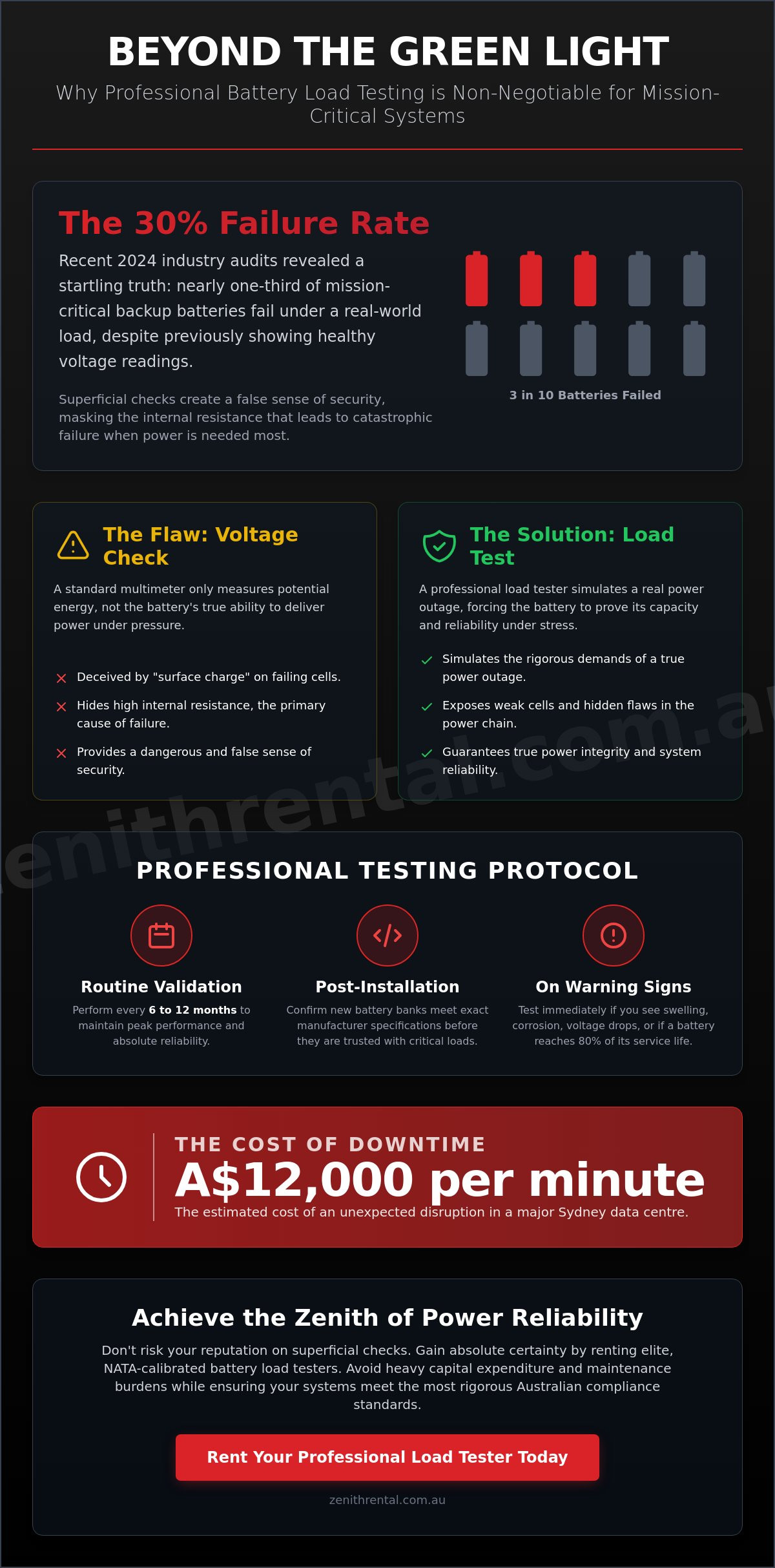
What if the green light on your uninterruptible power supply is actually a false promise of security? Recent 2024 industry audits revealed that 30% of backup batteries in Australian mission-critical facilities failed during discharge, despite showing healthy voltage readings just moments prior. Relying on superficial checks is a risk your reputation cannot afford. To achieve absolute certainty, you must deploy a professional battery load tester that subjects your cells to the rigorous demands of a true power outage.
You already know that the difference between a seamless transition and a catastrophic blackout lies in the finer details of your maintenance protocol. We'll show you how to master the art of industrial testing to ensure your power systems reach their zenith of performance and reliability. This guide provides a clear path to elite-tier compliance and safety, offering you the same sophisticated instrumentation used by the country's top engineers without the burden of a heavy capital expenditure. We'll explore the transition from simple voltage checks to repeatable, high-capacity protocols that guarantee your power integrity in 2026.
Key Takeaways
- Understand why a standard multimeter is insufficient for critical systems and how simulating real-world stress ensures your power integrity remains pristine.
- Master the nuances of discharge testing to accurately interpret CCA and Ah ratings, providing a sophisticated view of your battery’s true functional health.
- Identify the essential features of a high-performance battery load tester to ensure your data logging meets the most rigorous Australian compliance standards.
- Follow a refined, step-by-step protocol for preparation and safety, ensuring every test is conducted with the precision and care your infrastructure deserves.
- Discover the strategic advantage of renting elite, NATA-calibrated instruments to maintain a seamless, high-status operation without the burdens of maintenance.
The Critical Role of Battery Load Testers in Power Reliability
True power integrity represents the pinnacle of operational excellence. For professionals managing high-stakes environments, a battery load tester serves as much more than a mere diagnostic tool; it is a precision instrument designed to simulate the rigorous demands of real-world stress. While a standard multimeter measures potential energy, it fails to account for the battery's ability to deliver current under pressure. Achieving the Zenith of maintenance requires a shift from reactive repairs to a philosophy of proactive system validation.
The consequences of power failure in Australia are immense. In 2024, an unexpected disruption in a major Sydney data centre can cost upwards of A$12,000 per minute in lost productivity and reputational damage. For Australian hospitals, the stakes are even higher, as power reliability directly impacts life-sustaining equipment. Relying on superficial measurements is a risk that elite facilities cannot afford. Understanding how batteries work at a chemical level reveals why a deep, simulated load is the only way to guarantee a seamless transition during a blackout.
Load Testing vs. Voltage Testing
A standard voltmeter often detects a "surface charge," which is a deceptive layer of voltage that remains even on a failing cell. This mask hides high internal resistance, the primary culprit behind power delivery failure. A professional battery load tester pulls a specific current from the battery, exposing these weak links within a series-connected string. This process ensures that every component in your power chain performs with the same prestige and reliability as the day it was commissioned. By identifying these hidden flaws, you prevent a single failing cell from compromising your entire backup system.
When to Perform a Professional Load Test
Precision scheduling is the hallmark of sophisticated facility management. Industrial UPS systems require routine validation every 6 to 12 months to maintain peak performance and absolute reliability. Post-installation testing is equally vital. It confirms that new battery banks meet the manufacturer's exact specifications before they are trusted with critical loads. Beyond scheduled checks, you should watch for specific warning signs that demand immediate attention:
- Visible swelling or casing deformation in individual cells.
- Signs of terminal corrosion or electrolyte leakage.
- Unexpected voltage drops of 5 percent or more during routine monitoring.
- Batteries that have reached 80 percent of their expected service life.
By adhering to these rigorous standards, you ensure that your power infrastructure remains in a pristine state, ready to perform when the journey becomes demanding. This commitment to detail transforms a simple utility into a robust asset, mirroring the high performance expected in world-class Australian industries.
Understanding the Science: How Different Testers Evaluate Health
Evaluating a battery's health requires more than a simple voltage check; it demands a rigorous assessment of its internal chemistry under stress. A high-quality battery load tester converts stored chemical energy into measurable electrical data, revealing the true state of the power cell. This process mirrors the demands of elite operations where failure isn't an option. Professionals monitor terminal voltage, current flow, and temperature rise to identify weaknesses before they cause a system collapse. Data from 2024 indicates that 32% of industrial power failures stem from neglected battery maintenance. Understanding battery reliability and testing ensures your infrastructure maintains its pristine performance. While Cold Cranking Amps (CCA) measure the immediate surge required for ignition, Amp-Hour (Ah) ratings define the long-term endurance critical for backup systems. Temperature plays a pivotal role. A battery operating at 0°C may lose up to 40% of its effective capacity compared to its 25°C rating.
- Terminal Voltage: The primary indicator of charge state under load.
- Current Flow: Measures the battery's ability to deliver sustained power.
- Temperature Rise: High heat during a test often signals internal resistance or plate degradation.
Carbon Pile Load Testing: The Traditional Heavyweight
Carbon pile testers represent the traditional, high-current approach to evaluation. These units apply a variable load to the battery, simulating the intense draw of heavy machinery or large lead-acid arrays. It's a robust method that generates significant heat, requiring technicians to follow strict safety protocols to manage high-amperage discharge. While the "big heat" method provides a definitive look at a battery's stamina, it's a demanding process that requires expert handling to ensure an elite level of safety. These testers remain the gold standard for high-capacity applications where a battery load tester must prove its mettle against extreme physical demands.
Digital Conductance Testing: The Modern Precision Approach
The modern professional often turns to digital conductance testing for a seamless diagnostic experience. This method sends a specific frequency signal through the battery to measure plate surface area without the heat or risk of traditional banks. It's a precise, non-invasive technique that offers unmatched speed for routine health checks. Digital accuracy has improved by 15% since 2022, allowing for a sophisticated analysis of battery health without depleting the charge. For those seeking the pinnacle of power management, choosing the right premium testing equipment ensures every journey remains uninterrupted. This approach balances technical depth with the efficiency required for high-stakes business environments.
Choosing the Right Instrument for Your Project
Selecting the ideal battery load tester requires a meticulous alignment between the instrument's capacity and your infrastructure's specific demands. You must ensure the unit handles the exact kilowatt (kW) or Amp-hour (Ah) rating of your battery bank without compromise. A mismatch here leads to inaccurate data or equipment fatigue. Professional-grade testers in 2026 must support diverse chemistries, including the rapid discharge profiles of LiFePO4 and the stability requirements of AGM cells. It's about choosing a partner for your power systems that reflects your commitment to quality.
Precision is the hallmark of elite service. Modern compliance frameworks demand detailed data logging for trend analysis and historical reporting. By adhering to IEEE recommended practices, technicians can transform raw discharge numbers into actionable insights. This foresight prevents unexpected downtime in critical systems. You aren't just measuring voltage; you're securing the future of your operations.
For field technicians operating across remote Australian regions, from the Pilbara to the Bowen Basin, portability is a non-negotiable luxury. Carrying heavy, cumbersome gear across vast distances is inefficient. We prioritise sleek, ruggedised designs that offer unmatched performance in the harshest environments. The goal is a seamless transition from the workshop to the most isolated site, maintaining the same level of professional authority regardless of the location.
Fixed Load Banks for Substation Testing
Large-scale substation validation requires constant-current discharge units that provide deep-cycle validation. Multi-channel testers are essential for monitoring individual cell voltages simultaneously, ensuring no single cell jeopardises the entire bank's integrity. For massive projects, leveraging test equipment hire Australia allows access to the latest high-capacity banks. This strategy provides the prestige of world-class technology with the flexibility that high-stakes projects demand.
Handheld Analysers for Rapid Site Audits
Handheld units from premier brands like Fluke or Megger represent the "elite concierge" of diagnostic tools. These devices offer seamless Bluetooth and cloud connectivity, allowing for instant report generation while you're still on-site. They provide facility managers with immediate clarity on battery health through a polished, professional interface. It's about more than just a reading; it's about the confidence that comes from using the world's finest battery load tester technology to ensure absolute reliability.
Step-by-Step: Performing a Professional Battery Load Test
Precision is the hallmark of professional power management. When you're responsible for high-value assets, a superficial check isn't enough. You require a definitive assessment of a battery's internal health. Utilizing a professional battery load tester allows you to simulate real-world cranking demands, ensuring that every journey begins with absolute confidence.
Before you begin, verify that the battery is at a full state of charge. A surface charge can be deceptive; the resting voltage should ideally read 12.6V or higher for a standard lead-acid unit. If the battery was recently charged, turn on the headlamps for 30 seconds to dissipate any surface tension before taking your baseline reading.
Safety remains the foundation of every technical procedure. Lead-acid batteries emit volatile hydrogen gas during discharge cycles. You must conduct your testing in a space with a ventilation rate of at least 5 air changes per hour. Don your PPE, specifically acid-resistant gloves and wrap-around eye protection, to guard against accidental electrolyte spray or terminal sparking.
Terminal integrity determines the success of your data collection. Pristine contact points are essential for a seamless flow of current. Use a stainless steel wire brush to remove any microscopic oxidation from the posts. When connecting your battery load tester, attach the positive red clamp first, followed by the negative black clamp. Ensure the "bite" of the teeth is firm and direct to prevent arcing, which can pit the lead and skew your resistance readings.
The 15-second rule is the industry standard for execution. Apply a load equal to 50% of the battery's Cold Cranking Amps (CCA) rating. Maintain this load for exactly 15 seconds while monitoring the voltage drop. This brief, intense stress test reveals the true character of the battery's chemistry without causing the thermal runaway associated with prolonged discharge.
Interpreting the Results
The 80% capacity rule is your primary benchmark for success. At an ambient temperature of 21°C, a healthy 12V battery shouldn't drop below 9.6V during the 15-second load. If the voltage stays above this threshold, the unit is fit for service. A rapid plunge below 6V often indicates a dead cell, whereas a slow, steady decline that stays just below the limit suggests the battery simply requires a deep saturation charge. For those maintaining elite standards, document every metric to ensure NATA-traceable compliance during your next safety audit.
Common Mistakes to Avoid
Testing a cold battery is a frequent error that leads to false failures. Chemical reactions within the cells slow down significantly when temperatures drop below 10°C, providing a pessimistic view of the battery's actual health. Always aim for a controlled environment to ensure your data is representative.
Ignoring terminal resistance can also compromise your journey. Even a 0.05-ohm variance caused by a loose clamp can result in a significant voltage drop that doesn't reflect the battery's internal state. Finally, avoid the temptation of over-testing. Repeatedly applying a load within a 60-minute window can cause permanent plate degradation and shorten the component's lifespan.
Secure the reliability of your fleet by using the elite testing equipment available through Zenith Rental.
The Zenith Advantage: Why Rental is the Elite Choice
Strategic asset management defines the modern electrical professional. In 2026, the rapid evolution of power storage means a battery load tester purchased today may lack the precision required for next-generation solid-state or high-density lithium arrays within 18 to 24 months. By choosing the Zenith Rental model, you bypass the 20 percent annual depreciation typical of high-end diagnostic hardware. You trade the burden of maintenance and storage for immediate access to the industry's most advanced fleet. This agility allows your firm to scale effortlessly, whether you're managing a routine facility audit or a massive, one-off data center commissioning project. Positioning your business as a premium partner starts with the tools you bring to the site; using the latest tech signals a commitment to excellence that ownership simply cannot match.
NATA Traceability and Compliance
Precision is the hallmark of professional integrity. In Australia, compliance with rigorous industrial standards like AS/NZS 3000 requires more than just a functional tool; it demands documented, verifiable accuracy. Every battery load tester in our collection undergoes strict NATA-accredited calibration to ensure absolute reliability. We provide pristine, project-ready equipment accompanied by comprehensive calibration records. This level of detail satisfies the most stringent insurance and safety audits. It gives you and your clients total confidence in every measurement recorded, ensuring your reputation for quality remains untarnished.
Seamless Logistics for National Projects
Time is your most precious resource. Our national delivery network ensures that critical testing equipment arrives at your site exactly when needed, across every Australian state and territory. You aren't just renting a tool; you're engaging an elite concierge service. Our experts provide high-level technical guidance to help you select the ideal instrument for your specific application. This seamless integration of logistics and expertise allows you to focus on the journey of your project while we handle the technical complexities. It's a partnership designed for those who value quality without sacrificing a personal touch.
Experience the pinnacle of power integrity and elevate your service standards. Contact Zenith Rental today to secure the elite instrumentation your business deserves and lead the market with confidence.
Secure the Zenith of Power Performance
Success in critical infrastructure depends on the precision of your diagnostic tools. As Australia moves toward the heightened energy demands of 2026, maintaining absolute power reliability requires a sophisticated approach to battery maintenance. Utilizing a high-performance battery load tester ensures every cell in your array meets the rigorous standards of modern industry. You've now mastered the science of evaluating health and the methodology required for professional results.
Zenith Rental provides the elite bridge between technical necessity and operational excellence. Our fleet offers NATA-certified calibration on all instruments, ensuring your data remains beyond reproach. We facilitate your project's success with seamless nationwide delivery across Australia and provide direct access to premium support from industry-leading technical experts. It's a partnership designed for those who refuse to compromise on quality or reliability.
Explore our elite range of calibrated battery load testers for your next project
We look forward to supporting your journey toward flawless power integrity.
Frequently Asked Questions
How often should industrial batteries undergo a full load test?
Industrial batteries require a full discharge test every 12 to 24 months to comply with Australian Standard AS 2676.2. If your power system exceeds 5 years of service, annual testing becomes essential to detect the 20% capacity drop that typically precedes a total failure. This rigorous schedule ensures your critical infrastructure maintains its elite performance standards and absolute reliability.
What is the difference between a battery tester and a battery analyser?
A battery tester applies a physical resistive load to simulate real-world demands; conversely, an analyser uses electronic signals to measure internal resistance or conductance. Testers provide the most definitive proof of health by forcing the battery to perform under actual stress. Analysers offer a swift, non-invasive health check that complements the deeper insights of a comprehensive discharge assessment.
Can I load test a battery that is not fully charged?
You shouldn't load test a battery unless it has reached a 100% state of charge and a stabilized open-circuit voltage. Testing a partially discharged unit yields inaccurate data and risks dropping the voltage below the critical 1.75V per cell threshold prematurely. For a pristine audit trail, ensure your power bank has completed a full float charge cycle for at least 24 hours.
Is it safe to perform a load test on a Lithium-Ion (LiFePO4) battery?
It's safe to load test Lithium-Ion (LiFePO4) batteries provided you use a specialized battery load tester configured for lithium discharge curves. Standard lead-acid testers may trigger the Battery Management System to shut down if they don't account for the flat discharge profile of lithium cells. Professional-grade equipment ensures the test remains within the manufacturer's 1C or 2C discharge limits.
What safety precautions are necessary during a high-current discharge test?
High-current discharge tests require Category III 1000V rated insulated tools and flame-retardant PPE to mitigate arc flash risks. You must ensure the testing zone has a ventilation rate of at least 4 air changes per hour to prevent hydrogen gas accumulation. Secure all terminal connections to a torque of 12.4 Newton-meters to avoid resistive heating or catastrophic sparking during the test.
Why should I choose a NATA-calibrated tester for my site audit?
Choosing a NATA-calibrated tester ensures your data meets the strict ISO 17025 standards required for Australian site audits and insurance compliance. Calibration certificates provide the definitive proof of accuracy that elite facilities demand for their risk management portfolios. It transforms a simple measurement into a verified document that stands up to the most rigorous regulatory scrutiny and professional standards.
How do I determine the correct load to apply during a test?
Determine the correct load by referencing the manufacturer’s 1-hour, 3-hour, or 8-hour discharge tables found in the technical datasheet. Most professionals apply a load equal to 50% of the Cold Cranking Amps for 15 seconds or use the specific C-rate defined by AS 2676 standards. This precise calculation ensures the test reflects the actual backup requirements of your specific installation and journey.
What happens if a battery fails the load test but still shows 12 volts?
A battery showing 12.6 volts can still fail a load test if high internal resistance prevents it from delivering sustained current. This phenomenon, often called a surface charge, hides the fact that the battery's active plate material has depleted by more than 20%. Only a dedicated battery load tester can expose these hidden weaknesses, ensuring your power integrity remains at the zenith of performance.