


The Honeywell BW Ultra Checklist: Ensuring Elite Safety in Confined Spaces
What if the difference between a seamless site entry and a critical safety breach was hidden within a single, unverified sensor configuration? You likely recognize that in high-stakes Australian industrial environments, the Honeywell BW Ultra represents the pinnacle of multi-gas detection. However, managing its sophisticated 5-gas array and ensuring absolute compliance with AS/NZS 60079.29.1 standards often presents a complex logistical challenge for even the most seasoned safety managers. It's a delicate balance between maintaining pristine technical accuracy and managing the high capital costs associated with elite safety fleets.
At Zenith, we believe safety equipment should provide total peace of mind, not a procurement headache. This guide promises to help you master the deployment, sensor configuration, and rigorous compliance requirements of the Honeywell BW Ultra through our definitive professional checklist. You'll gain total confidence in your sensor accuracy while discovering a refined, cost-effective strategy to access elite technology without the burden of high capital expenditure. We provide a comprehensive pre-entry protocol and a roadmap to achieving the zenith of workplace safety in every confined space journey.
Key Takeaways
- Discover how the Honeywell BW Ultra leverages advanced 1-Series sensor technology to provide rapid response times and unmatched precision in complex confined spaces.
- Master a five-step pre-operational protocol to ensure your instrument casing, pump, and battery health remain in pristine condition for every shift.
- Understand how to customise your detection capabilities by selecting the optimal fifth sensor to mitigate specific toxic gas risks unique to your environment.
- Align your safety protocols with essential Australian compliance standards, including AS/NZS 60079.10.1 and Safe Work Australia codes, for total site peace of mind.
- Learn why renting represents the pinnacle of procurement strategy, offering access to elite detection technology without the burden of depreciation or capital expenditure.
Understanding the Honeywell BW Ultra: The New Standard in Portable Gas Detection
The Honeywell BW Ultra represents the absolute pinnacle of site safety. It isn't just a tool; it's a premium 5-gas portable detector engineered specifically for the rigours of confined space entry. While standard devices often compromise on visibility or sensor speed, the "Ultra" designation signifies a commitment to elite environmental protection and unmatched durability in the harshest Australian conditions. Whether you're managing complex maintenance in the oil and gas sector or overseeing critical water treatment infrastructure, this device provides the ultimate peace of mind.
Understanding the evolution of portable gas detection is essential for any safety professional. The Honeywell BW Ultra sets a new benchmark by incorporating the 1-Series sensor, a technological leap that ensures your team remains protected by the fastest response times available. For professionals in the oil and gas sector, this device is a non-negotiable asset for ensuring the safety of personnel during high-stakes shutdowns. In heavy industrial maintenance, where environmental conditions can degrade equipment rapidly, the ruggedised exterior ensures it remains operational under extreme stress. This reliability is why it has become the preferred choice for elite teams across the country.
Key Features of the Pristine BW Ultra Design
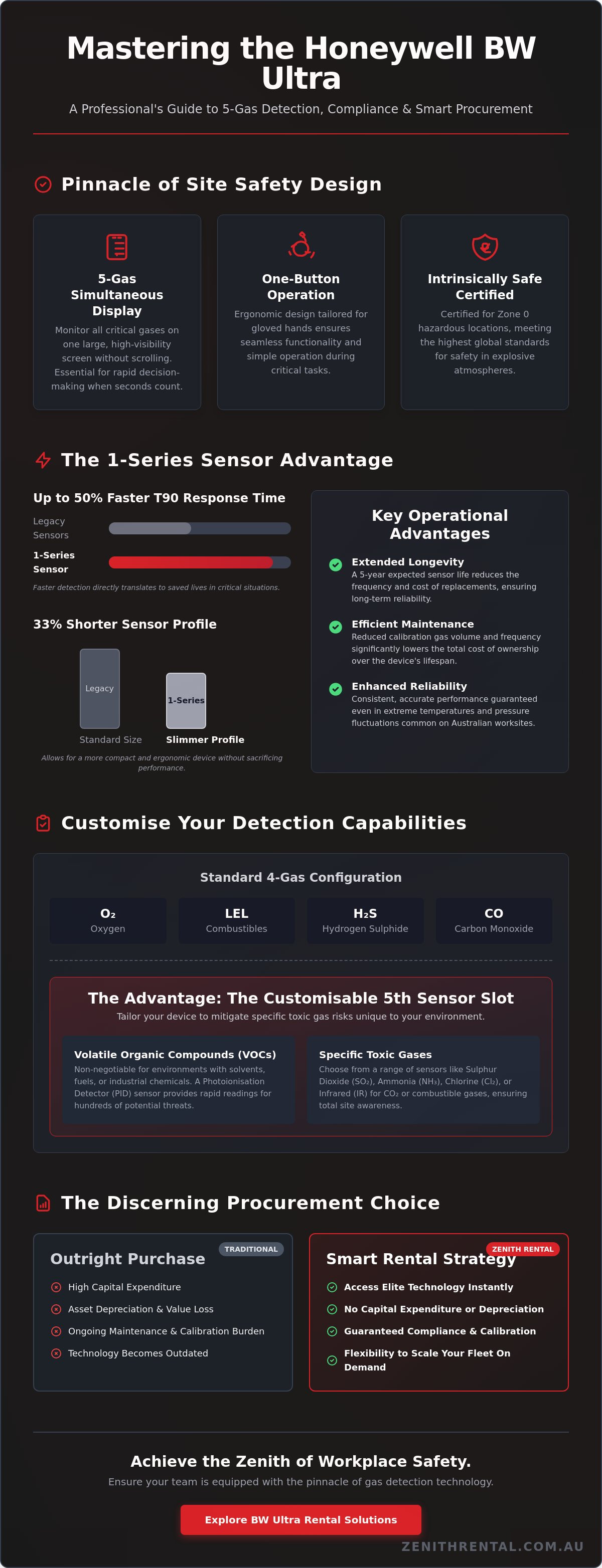
The pristine design of the BW Ultra prioritises clarity and ease of use. A large, high-visibility display allows operators to monitor five gases simultaneously without scrolling through menus; this is critical when seconds count. The ergonomic "one-button" operation is specifically tailored for gloved hands, ensuring seamless functionality during heavy industrial maintenance. With its intrinsically safe certification for Zone 0 hazardous locations, the device meets the highest global standards for explosive atmosphere safety. It provides a sophisticated user experience that mirrors the high performance required in modern industrial settings.
The 1-Series Sensor Advantage
The 1-Series sensor technology is a radical departure from traditional gas detection components. These sensors are 33% shorter than the industry standard, allowing for a slimmer device profile without sacrificing performance. The primary benefit for Australian worksites is the reduced T90 response time. The 1-Series detects hazards up to 50% faster than legacy sensors. This speed directly translates to saved lives. Beyond immediate safety, these sensors offer several operational advantages:
- Extended Longevity: A 5-year expected sensor life reduces the need for frequent replacements.
- Efficient Maintenance: Reduced calibration frequency lowers the total cost of ownership.
- Enhanced Reliability: Consistent performance even in extreme temperatures and pressure fluctuations.
By choosing a device with such advanced specifications, you're not just renting equipment; you're investing in a seamless safety journey that prioritises the well-being of every worker on site.
Sensor Selection Checklist: Customising Your Detection Capabilities
Achieving the pinnacle of safety in high-stakes environments requires more than just a standard device; it demands a bespoke approach to atmospheric monitoring. The Honeywell BW Ultra provides this elite flexibility through its five-sensor design, allowing you to move beyond basic detection into a realm of absolute site awareness. While the standard 4-gas configuration addresses the primary threats of Oxygen (O2), Lower Explosive Limits (LEL), Hydrogen Sulphide (H2S), and Carbon Monoxide (CO), the true advantage lies in the customisable fifth slot.
Selecting the correct fifth sensor is a decision that defines the success of your safety protocol. For those managing volatile organic compounds (VOCs), a Photoionisation Detector (PID) sensor is non-negotiable. These sensors utilise a 10.6 eV lamp to ionise gases, providing rapid readings for chemicals that standard sensors might miss. When monitoring combustible gases, you must choose between Infrared (IR) and Catalytic Bead technology. IR sensors are a premium choice for environments with low oxygen or potential "poisoning" agents like silicones, which can degrade a catalytic bead's performance by 40% after a single exposure. This level of technical foresight ensures your journey into confined spaces is as secure as it is efficient.
Common 5-Gas Configurations for Australian Industry
Australian worksites demand configurations that reflect local environmental challenges and strict regulatory standards. For standard confined space entry, most elite operators combine the base four gases with Sulphur Dioxide (SO2) to meet the Australian Compliance Checklist for wastewater and heavy industrial applications. In environmental monitoring sectors, adding a Carbon Dioxide (CO2) or Chlorine (Cl2) sensor ensures the array is perfectly tuned to the specific chemical profile of the site. Refining and chemical processing facilities often opt for specialised sensors that target Ammonia (NH3) or Hydrogen Cyanide (HCN) to provide an unmatched layer of protection for their workforce.
Sensor Health and Cross-Sensitivity Verification
Maintaining a pristine fleet of Honeywell BW Ultra units involves rigorous attention to sensor health. Sensor "poisoning" is a silent threat where contaminants coat the sensor element, leading to false negatives. You can detect this early by performing daily bump tests; a response time lag of more than 15% usually indicates the need for professional service. Managing cross-sensitivity is equally vital, particularly between CO and H2S. High concentrations of one can occasionally trigger the other, so using filtered sensors is a mark of a sophisticated safety setup. Always verify your equipment against this health checklist:
- Confirm all sensors are within their 2-year or 3-year expected lifespan.
- Check the PID lamp for clouding or residue every 30 days.
- Verify that the IR sensor is calibrated for the specific hydrocarbon present on-site.
- Ensure the pump filter is replaced if flow rates drop below 0.25 L/min.
For those who require the most reliable equipment without the burden of long-term maintenance, choosing to rent a premium gas detector ensures you always have access to the latest, perfectly calibrated sensor technology. This seamless approach allows you to focus on the project at hand, confident that every detail of your atmospheric monitoring is handled with expert precision.
Pre-Operational Checklist: Five Steps to Seamless Site Deployment
The journey to absolute site safety begins long before the first descent. Ensuring your Honeywell BW Ultra remains in peak condition is a mark of professional excellence and a commitment to your team's wellbeing. To maintain the highest standards of reliability, follow these Five Steps to Seamless Site Deployment during every pre-shift routine.
- Step 1: Physical Inspection. Examine the pristine instrument casing for any signs of impact or wear. A compromised seal can affect the device's IP66/68 rating, which is vital for the demanding conditions found in Australian utility and mining sectors.
- Step 2: Battery Health Check. Confirm the lithium-polymer battery is fully charged. The Honeywell BW Ultra is designed to support an 18-hour shift at 20°C, providing the endurance required for extended operations without the need for mid-shift recharging.
- Step 3: The Bump Test. This is the non-negotiable standard for safety. A bump test verifies that the sensors and alarms respond correctly to a known concentration of gas, ensuring the unit is ready to perform when it matters most.
- Step 4: Fresh Air Calibration. Zero the sensors in a known fresh-air environment. This establishes a clean baseline, preventing false readings that could lead to unnecessary site evacuations or, conversely, a failure to detect rising hazards.
- Step 5: Datalogging Confirmation. Verify that the device is recording data. Elite-level safety management relies on post-incident analysis, and the BW Ultra stores up to 45 days of data at 15-second intervals, providing a comprehensive history for reporting and compliance.
Executing a Flawless Bump Test
A bump test provides the ultimate peace of mind. While a calibration checks for accuracy, the bump test confirms the sensors are functional and the paths are clear. We recommend using the IntelliDoX system for automated verification. This sophisticated dock streamlines record-keeping by automatically storing test results for over 5,000 events. If a unit fails a bump test, pull it from service immediately. At Zenith, we believe that reliability is the pinnacle of luxury service; there is no room for compromise when it comes to equipment performance.
Managing Internal Pump Integrity
The Honeywell BW Ultra features a high-performance internal pump capable of drawing samples from distances up to 23 metres. Before deployment, check the pump for blockages or moisture ingress that could impede airflow. Always use genuine sampling hoses and hydrophobic filters to protect the internal components from debris. Perform a pump stall test by briefly blocking the inlet; the device should trigger a pump alarm within 2 seconds. This simple check confirms a perfectly sealed system, ensuring your remote monitoring is as accurate as a direct reading.
Australian Compliance Checklist: Navigating Safety Standards
Compliance in Australian heavy industry is a commitment to elite operational standards. The Honeywell BW Ultra serves as a cornerstone of this commitment, engineered to exceed the rigorous demands of Safe Work Australia’s Confined Spaces Code of Practice. In environments where explosive gases represent a constant threat, maintaining the pinnacle of safety is non-negotiable. This device ensures your site remains a sanctuary of precision and reliability.
AS/NZS Standards and Gas Detection
The Honeywell BW Ultra is meticulously designed to align with AS/NZS 60079.10.1. This standard governs the classification of areas where explosive gas atmospheres may occur. By utilizing a device that meets these intrinsically safe (Ex) standards, you ensure your equipment is a seamless fit for Zone 0, 1, and 2 environments. Under Australian law, specifically within the 2022 updates to work health and safety regulations, periodic professional calibration is a strict requirement. Zenith Rental provides NATA-accredited calibration certificates with every unit, ensuring your site audits are supported by traceable, pristine data. This level of precision is vital when gas detection acts as the "gatekeeper" for your Permit to Work systems. A permit is only as reliable as the sensor that validates it.
- Intrinsically Safe: Certified to global and Australian Ex standards for hazardous zones.
- NATA Traceability: Essential for meeting the evidentiary requirements of state-based safety regulators.
- Permit Integration: High-precision readings provide the "all-clear" for high-risk entry tasks.
Ensuring Audit Readiness with Datalogging
Safety audits and incident investigations demand absolute transparency. The BW Ultra features a dedicated "Black Box" logging system that records a 45-day history of gas levels at 1-second intervals. This isn't mere record-keeping; it's a sophisticated layer of liability protection. You can effortlessly access these internal logs via Fleet Manager II or the Honeywell Safety Suite to generate comprehensive reports. These documents prove your team followed every safety protocol to the letter, providing a rhythmic flow of data that mirrors the efficiency of your operations. In high-risk industrial sectors, having an immutable digital trail is the ultimate mark of a professional operation. It transforms a standard safety check into a data-driven assurance of excellence.
The "Black Box" functionality is particularly valuable during multi-shift projects where handovers must be documented with total clarity. It ensures that every peak, alarm, and sensor status is captured with microscopic detail. When an auditor requests proof of compliance, you don't just provide a verbal assurance; you present a polished, professional report that reflects the status of your elite workforce.
Procurement Strategy: Why Renting the BW Ultra is the Discerning Choice
Selecting the right procurement model is as critical as the safety specifications of the device itself. High-performance instruments like the Honeywell BW Ultra represent a significant investment in both capital and ongoing technical oversight. For Australian project managers, the decision to rent rather than purchase is often the hallmark of a sophisticated operational strategy. This shift from capital expenditure to a flexible operational model preserves your cash flow while ensuring your team never works with outdated or weary equipment.
Renting allows your business to access the pinnacle of gas detection technology without the inevitable burden of asset depreciation. In the fast-moving world of industrial safety, hardware that is "top-of-the-line" today can be superseded within a few years. By partnering with a specialist provider, you bypass the risks of ownership and ensure your fleet always reflects the latest advancements in sensor accuracy and battery efficiency. It's a seamless way to maintain an elite safety profile on every site.
The Economic Case for Specialist Hire
The total cost of ownership for a 5-gas detector involves much more than the initial invoice. You must account for the recurring costs of sensor replacements, which typically occur every two to three years, and the mandatory six-month calibration cycles required by Australian safety protocols. A single PID sensor replacement can often exceed A$500, excluding the labour and downtime involved in the repair. Renting eliminates these hidden drains on your budget. You pay for the equipment only when it's generating value on a project, which directly maximises your ROI.
- Dynamic Scaling: Expand your fleet for a 48-hour emergency shutdown or a multi-month infrastructure build without long-term storage liabilities.
- Zero Maintenance Burden: Avoid the logistical headache of tracking calibration certificates and sensor health.
- Pristine Technology: Ensure every Honeywell BW Ultra on your site is a late-model unit in peak physical condition.
Zenith Rental: Your Elite Concierge for Test Equipment
Zenith Rental functions as your dedicated partner in technical excellence. We don't just supply tools; we provide a bespoke service designed to meet the rigorous demands of the Australian resources and construction sectors. Every instrument in our fleet arrives project-ready, pre-calibrated, and fully charged. We understand that compliance is non-negotiable. That's why we ensure all equipment is NATA traceable and meets the specific requirements of AS 2865:2009 for confined space entry.
Our commitment to reliability means you can focus on the journey and the successful completion of your project, knowing the technical details are handled by experts. We pride ourselves on a seamless delivery process that mirrors the high performance of the instruments we provide. Experience the Zenith difference—hire the Honeywell BW Ultra for your next project and secure the ultimate safety solution for your team today.
Master the Pinnacle of Site Protection
Achieving absolute safety in confined spaces requires more than just equipment; it demands a commitment to the highest technical standards. By implementing the Honeywell BW Ultra, your team gains access to an elite five-gas detection system that meets rigorous Australian compliance requirements. You've seen how precise sensor selection and a disciplined five-step pre-operational checklist eliminate the margins for error that often compromise site integrity. Choosing a rental model ensures your fleet remains at the zenith of performance without the burden of long-term maintenance cycles.
Zenith Rental provides an unmatched service experience that includes NATA traceable calibration with every unit. Our Australia-wide express delivery ensures your project stays on schedule, while our expert technical support team handles your most complex configurations. It's a seamless path to operational excellence that prioritizes both your timeline and your team's wellbeing. Secure your future projects with a partner that understands the nuances of high-stakes safety.
Secure your Honeywell BW Ultra rental today for absolute site safety
We look forward to supporting your next successful deployment across Australia.
Frequently Asked Questions
How often does the Honeywell BW Ultra require a bump test?
You should perform a bump test on the Honeywell BW Ultra before every shift or daily to ensure the sensors respond correctly to gas. This essential check verifies that the alarms function perfectly and the device is ready for the day's challenges. Following Australian Standard AS/NZS 60079.29.2:2016 is the best way to maintain a pristine safety record on your site.
The process is quick and seamless, taking less than 60 seconds when using an automated docking station. Regular testing provides the peace of mind that your elite safety equipment is performing at its zenith. It's a small step that guarantees absolute reliability for every team member entering a confined space.
Can the BW Ultra detect five gases simultaneously?
The Honeywell BW Ultra is specifically engineered to monitor up to five atmospheric hazards at once, providing an unmatched level of protection. This sophisticated device tracks the standard four gases plus a fifth sensor of your choice, such as a PID or IR sensor. It's the ultimate tool for complex Australian industrial environments where multiple threats may exist.
This five-gas capability ensures you have a comprehensive view of your surroundings without needing multiple instruments. The high-resolution display presents all five readings clearly, allowing for rapid decision-making. It's a refined solution for professionals who demand the highest standards of safety and efficiency.
What is the battery life of the Honeywell BW Ultra during continuous pumping?
You can expect 18 hours of continuous battery life at 20 degrees Celsius while the internal pump is active. This impressive duration ensures your journey remains uninterrupted even during the most demanding double shifts. If you're working in harsher Australian conditions near 0 degrees, the runtime typically adjusts to 14 hours.
The device uses a high-performance lithium polymer battery designed for longevity and reliability. Charging is a simple, professional process that returns the unit to full power quickly. This consistent performance reflects the elite quality of the instrument and its ability to support your most critical operations.
Is the Honeywell BW Ultra intrinsically safe for use in Australia?
The unit carries full IECEx certification, which confirms it's intrinsically safe for use in hazardous zones across Australia. This global standard ensures the electronics won't ignite a flammable atmosphere, providing a secure experience for all operators. It's a mandatory requirement for professionals working in oil, gas, and chemical sectors.
By meeting these rigorous safety specifications, the device maintains its status as a premium partner for high-risk tasks. Every unit is built to withstand the tough conditions of Australian worksites while keeping the user's safety as the top priority. You can trust this sophisticated technology to perform when the stakes are at their highest.
What is the difference between a bump test and a full calibration?
A bump test is a brief functional check to ensure the sensors react to gas, while a full calibration adjusts the sensor accuracy to a known standard. You should calibrate the instrument every 180 days to meet manufacturer recommendations and maintain its elite performance. While the bump test offers daily reassurance, calibration is the deep refinement that keeps the device at its pinnacle.
Calibration involves more precise equipment and takes longer to complete than a standard bump test. Both procedures are vital for a seamless safety program and ensure your data remains accurate for compliance purposes. Keeping a detailed log of these events is a hallmark of a professional and well-organized safety team.
How do I download the datalogging information from the BW Ultra?
Downloading your data is a seamless process using the Honeywell Safety Suite software or the Fleet Manager II system. You simply connect the instrument to your computer via an IR Link or place it in an IntelliDoX docking station. The unit stores 45 days of data at 15-second intervals, providing a clear and detailed history of every journey.
This organized approach to data management allows you to generate professional reports for safety audits or incident investigations. The software is intuitive and designed to minimize friction, making it easy to track trends and sensor health. It's a sophisticated way to manage your fleet and ensure you're always operating at the highest standard.
Can I use the BW Ultra for VOC detection with a PID sensor?
You can equip the device with a Photoionisation Detector (PID) sensor to monitor for Volatile Organic Compounds (VOCs). This elite feature allows you to detect over 100 different toxic gases that standard sensors might overlook. It's a powerful addition for environmental monitoring, hazmat response, and specialized industrial cleaning tasks.
The PID sensor provides rapid, accurate readings for chemicals like benzene or toluene, which are common in many Australian workplaces. Choosing this configuration transforms the unit into a versatile and sophisticated tool for advanced gas detection. It's a best-in-class choice for those who value a comprehensive safety experience.
What happens if the internal pump on the BW Ultra stalls?
If the internal pump encounters a blockage or stall, the device immediately triggers a distinct audible and visual alarm. The motor stops automatically to protect the unit's sophisticated internal components from damage. You'll see a clear "Pump Alarm" notification on the screen, prompting you to check the probe, hose, or filter for obstructions.
Once you clear the blockage, you can restart the pump with a simple button press to resume your work. This rapid response ensures that your equipment remains in pristine condition and that you're never sampling air incorrectly. It's a refined safety feature that highlights the instrument's focus on absolute reliability and user protection.