


Test Equipment for Data Center Commissioning: A Practical Checklist
What if an instrument produces a reading but not the evidence needed for acceptance? In data centre commissioning, choosing test equipment for data center commissioning means more than matching an instrument to a task. Its specifications, calibration documentation and recorded results must also meet project requirements, or testing may need to be repeated.
Equipment planning can affect the schedule, particularly when specialist instruments are needed for defined testing windows. Teams need to confirm what each activity requires, whether a proposed instrument is suitable and what records to retain for review.
This checklist connects commissioning activities with relevant instrument categories and evidence to prepare. It also shows how to check instrument suitability and calibration records before testing, and how to plan equipment hire around milestones and site readiness. Use it to coordinate requirements with a rental provider and prepare for acceptance reviews with a clear, documented testing plan.
Key Takeaways
- Build your equipment list from the project scope, test procedures and acceptance criteria, not from a generic commissioning kit.
- Match each specified electrical test to a suitable instrument and identify the records needed for review.
- Before testing, check the instrument’s range, accuracy, functions, accessories and environmental limits against the task requirements.
- Use this checklist to organise test equipment for data center commissioning around project milestones, site readiness and planned testing windows.
- For equipment hire enquiries, provide the required tests, specifications, quantities, dates and documentation needs, then confirm instrument suitability and availability with the rental provider.
What test equipment does data center commissioning actually require?
Start with the project, not a generic kit. Commissioning is the staged verification that installed systems and their interactions meet the project scope, design intent and acceptance criteria. Commissioning test equipment refers to the instruments used to check specified system performance and record results for review. The Project commissioning overview describes the broader process of systematically checking, inspecting and testing operational components.
For a data centre, equipment requirements depend on the electrical systems in scope, the approved test procedures and the specifications each system must meet. A project that requires insulation resistance checks, protective-device tests, power quality measurements or current transformer checks needs instruments suited to those tasks. Select test equipment for data center commissioning against the stated test and evidence requirements, not simply because an instrument is common on similar projects.
Keep equipment selection separate from commissioning responsibility. A rental provider may supply instruments, but authorised project personnel remain responsible for conducting tests, following approved methods and assessing results. Check instrument specifications and documentation with the provider, then have the appropriate project representative approve the instrument’s use.
Which commissioning stages shape the equipment list?
Installation checks, functional testing and integrated testing may require different instruments and records. An installation check may verify a component or connection. Functional testing may confirm that equipment responds as intended. Integrated testing examines how systems operate together under defined conditions. These are examples, not universal stage names or a prescribed sequence.
Use the project commissioning plan to map each stage to its activities, equipment and required evidence. Terminology varies between projects, so follow the approved documents rather than assuming another facility’s stage labels or test sequence applies.
Which project documents should teams review first?
Before requesting equipment, review the project specifications, drawings, test procedures, commissioning plan and acceptance criteria. These documents clarify what must be tested, the method to follow, the expected measurement range and the records needed for acceptance review. Where applicable, check approved equipment schedules and relevant system information as well.
Identify who can approve the test method, instrument ranges and test records. Confirm referenced standards against the project scope, and ask the commissioning team to verify their current edition and applicability. This reduces the risk of selecting an instrument based on an assumption and gives a rental provider the details needed to discuss specifications, availability and documentation for the planned test window.
Match data centre commissioning tests to the right electrical instruments
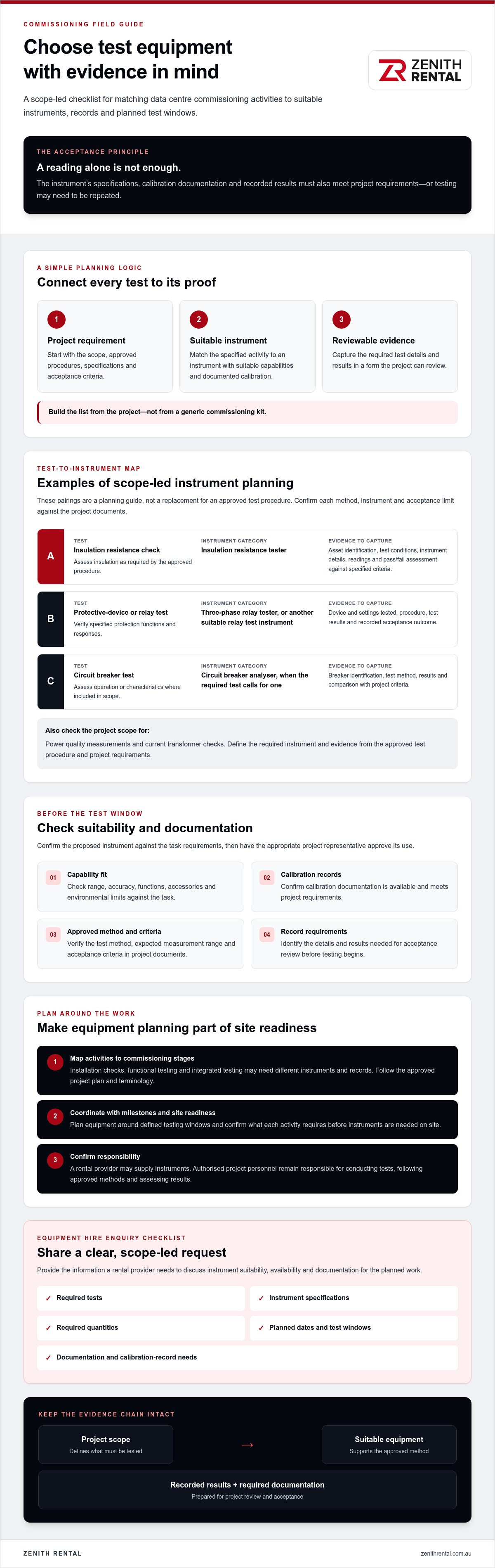
A useful equipment checklist connects each specified test to its purpose, instrument category and evidence. The pairings below are a planning guide, not a replacement for an approved test procedure. The commissioning team must confirm the method and acceptance limits for each system. This approach supports commissioning as a quality control process for building systems, with results recorded in a form the project can review.
| Project-defined test | Purpose | Instrument category to consider | Evidence to capture |
|---|---|---|---|
| Insulation resistance check | Assess insulation as required by the approved procedure. | Insulation resistance tester | Asset identification, test conditions, instrument details, readings and pass/fail assessment against the specified criteria. |
| Protective-device or relay test | Verify the specified protection functions and responses. | Three-phase relay tester or other suitable relay test instrument | Device and settings tested, procedure, test results and recorded acceptance outcome. |
| Circuit breaker test | Assess breaker operation or characteristics where included in scope. | Circuit breaker analyser, when the required test calls for one | Breaker identification, test method, results and comparison with project criteria. |
| Power quality measurement | Record electrical supply characteristics required by the project. | Power quality analyser | Measurement points, relevant operating conditions, recorded data and review outcome. |
| Current transformer check | Verify specified current transformer characteristics. | Current transformer tester | Transformer identification, test configuration, readings and acceptance assessment. |
What instruments support electrical verification?
Use an insulation resistance tester only for checks covered by the approved procedure. Relay testers support relevant protection tests. Include a circuit breaker analyser only when the scope specifies breaker testing that calls for one. Power quality analysers and current transformer testers are also conditional, not automatic inclusions. For each test, check that the instrument’s measurement range, accuracy, resolution, channels and functions suit the approved method and acceptance limits.
How should teams distinguish instrument capabilities?
Compare the documented test requirements with the specific instrument model, including its functions, limits, leads and accessories. A familiar brand name alone does not establish suitability. Confirm model specifications and required accessories before arranging hire, and ask the rental provider what documentation accompanies the instrument. The commissioning team should approve the instrument selection and evidence format.
For a defined commissioning window, a scope-led enquiry can help clarify which specialist instruments may be suitable and available. Share the test activities and required specifications when discussing electrical test equipment hire.
How to assess test equipment suitability and evidence before commissioning
Availability or common use does not, by itself, make rental equipment suitable for commissioning. Compare each proposed instrument with the project’s test specification and approved procedure. Check that its range, accuracy, resolution and functions suit the measurement, and that its leads and accessories support the required setup. Consider any environmental limits that apply at the planned test location.
Agree on evidence requirements through the project quality process before testing. These may include instrument identification, calibration documentation, test conditions, results and a specified record format. Calibration documents provide information about an instrument, but they do not prove on their own that the method was followed or that project acceptance criteria have been met. Responsible project personnel must assess those requirements.
What should a commissioning equipment checklist record?
Create a traceable entry for each planned test. A structured approach, such as the formal process described for the Building Enclosure Commissioning (BECx) process, can help teams organise checks around documented requirements. Adapt the record to the project; an enclosure guideline is not an electrical testing specification.
- Test activity: identify the system, asset and approved procedure.
- Instrument capability: record the required range, accuracy, resolution, functions and environmental limits.
- Accessories: list the leads and other items needed for the specified connection or measurement.
- Accountability and timing: name the responsible person and planned test date.
- Evidence and approval: record the instrument’s serial or asset identification, the reference for project-required calibration evidence, and commissioning lead sign-off confirming suitability before use.
This record brings gaps to light before an instrument reaches the test location. It also gives the team a clear basis for checking hired equipment and accompanying documentation with the rental provider.
How can teams manage uncertainty around standards and records?
Start with the current project specifications and approved procedures. Do not assume a particular Australian or international standard applies to every facility or test. Ask the responsible engineer to verify which standards, editions and clauses apply, and confirm the required calibration records with the commissioning and quality teams.
A clear equipment register keeps test equipment for data center commissioning aligned with the documented method, acceptance criteria and evidence plan. Hiring can provide access to specialist instruments for a defined commissioning window, but hire alone does not establish compliance, provide certification or guarantee successful commissioning. Confirm the instrument model, specifications, availability and documentation before testing begins.
Prepare a data centre test equipment checklist for site readiness
Turn the approved test scope into practical actions for the site team. Assign an owner to each item below and resolve any gaps before the relevant commissioning milestone.
- Review the scope and test schedule. List each test activity, the system or asset involved, its planned date and its place in the approved test sequence.
- Confirm instrument requirements. Record the required instrument category, any specified model or functions, expected measurement range and other relevant capability requirements.
- Check accessories and documentation. Note the required leads and accessories, the project’s evidence format and calibration documentation requirements.
- Resolve uncertainties. Ask the commissioning lead to clarify ambiguous test methods, instrument requirements or acceptance evidence before selecting or requesting equipment.
- Coordinate site arrangements. Confirm site access, the nominated equipment recipient, who will inspect the instruments and documentation on receipt, and who is responsible for returns under the project arrangements.
- Verify before use. Allow time before the scheduled test to check the received equipment against the request, including instrument identification, accessories and supporting records. Refer any mismatch to the responsible project representative.
This sequence keeps test equipment for data center commissioning tied to site readiness instead of treating equipment requests as a separate administrative task. It also gives the team a practical checkpoint to confirm that the intended instruments can be used for the planned activities.
What should teams confirm before requesting equipment?
Prepare the request using the project documents. Include test types, specifications, expected measurement ranges, required functions, accessories, quantities, planned dates and documentation needs. If the project names particular models, evidence formats or other instrument requirements, record them and confirm they are current. Ask the commissioning lead to resolve unclear requirements before selecting or booking instruments.
How can equipment coordination reduce commissioning delays?
Align equipment quantities and requested dates with the approved test sequence, site access arrangements and project milestones. Revisit the equipment plan if the schedule changes. Identify in advance who receives the hire, checks the equipment and organises its return, so responsibilities are clear across project teams.
Confirm availability, delivery arrangements and timing directly with the rental provider. Allow time to verify instruments, accessories and documentation before testing, but do not assume availability or delivery timing until confirmed. Once your requirements are clear, discuss equipment hire for your commissioning scope with Zenith Rental.
Hire commissioning test equipment with a clear, scope-led enquiry
Once the project team has defined its tests and instrument requirements, hiring specialist equipment for a planned commissioning window can help align access with the work schedule. A precise enquiry gives the rental provider the information needed to discuss suitable options, availability and documentation. It does not assume a particular instrument is available or appropriate for the task.
For test equipment for data center commissioning, start with the approved test activities and specifications, not a broad request for a general-purpose kit. Zenith Rental provides test and measurement equipment hire nationally across Australia, including electrical and power testing equipment.
What information helps a rental enquiry move forward?
Describe each activity and the instrument capability it requires. For example, specify the target measurement range, required functions and any leads or accessories needed for the planned setup. Include quantities, the intended hire period and test dates, along with project-specific calibration documentation or other record requirements. If a particular model is specified, identify it and confirm whether that requirement is mandatory.
Ask the provider to confirm which options may suit the stated requirements, their availability and what documentation can be supplied. The commissioning team should check those details against its approved procedures before proceeding.
How can teams make a confident final equipment decision?
Give the proposed instrument details to the responsible engineer or commissioning lead. They can compare its capabilities and accessories with the approved test method and acceptance criteria, and confirm whether its supporting records meet project requirements. Confirm the hire arrangements and equipment details with the provider before scheduling tests around them.
This review grounds the decision in project requirements rather than familiarity with a brand or instrument category. For wider context on planning equipment hire in Australia, see The Definitive Guide to Test Equipment Hire in Australia.
Prepare a concise enquiry with the information below:
- Commissioning activity and relevant system or asset
- Required instrument specifications, measurement range and functions
- Quantities, accessories and intended hire period
- Required dates and project-specific calibration or records needs
With these details ready, discuss your data centre commissioning equipment requirements and confirm suitable options, availability and documentation before making arrangements.
Set your commissioning team up for a confident start
Build the equipment plan from the project scope. Match each test to an instrument with suitable capabilities, confirm accessories and calibration documentation against project requirements, and coordinate hire with site readiness and commissioning milestones. This gives your team a clear basis for selecting test equipment for data center commissioning and preparing records for acceptance review.
For specialist equipment needed during a defined testing window, Zenith Rental provides test equipment hire nationally, including electrical and power testing instrument categories and access to brands such as Fluke, Megger and Transmille. Confirm specific instrument options, availability and documentation with the provider, then have responsible project personnel verify suitability against the approved procedures and acceptance criteria.
Have your test activities, specifications, quantities, dates and documentation needs ready. Discuss your data centre commissioning equipment requirements with Zenith Rental to plan the equipment needed for your commissioning work.
Frequently Asked Questions
What test equipment is used for data centre commissioning?
The equipment depends on the project scope and approved test procedures. Relevant categories may include insulation resistance testers, relay testers, circuit breaker analysers, power quality analysers and current transformer testers, but not every project needs every instrument. Match each test to its required measurement range, functions, accessories and acceptance evidence. Have the commissioning lead confirm the selection against project requirements before testing.
How do I choose test equipment for data centre commissioning?
Start with the commissioning plan, specifications and approved test procedures. List each required activity and the instrument capabilities it calls for, then compare range, accuracy, resolution, functions and accessories with the documented requirements. Confirm calibration documentation and any project-specific model preferences with the responsible engineer. A familiar brand or broad equipment description alone does not establish suitability.
Can test equipment be hired for data centre commissioning?
Hiring can provide access to specialist instruments for a defined project period, subject to suitability and availability. Share the test scope, required functions, quantities, accessories, dates and documentation needs with the rental provider. Ask them to confirm the instrument options and available records before proceeding. Before use, the commissioning team should verify the supplied equipment against approved procedures and acceptance criteria.
What calibration documentation is required for commissioning test equipment?
Requirements depend on the project quality process, test procedure and acceptance criteria. Confirm which records the project needs, how instrument identification must be captured and whether specific calibration traceability is required. Ask the equipment provider what documentation is available before arranging hire. Do not assume a calibration document alone proves that the test method was followed or that every project requirement has been met.
When should commissioning teams arrange test equipment hire?
Plan equipment needs while reviewing the commissioning schedule, once the required tests and instrument capabilities are clear. Identify the intended hire period, quantities, accessories and documentation requirements early enough to resolve questions before site testing. Availability and logistics vary, so confirm arrangements directly with the rental provider. Check the received instruments, accessories and supporting documentation before testing begins.
Does hiring calibrated test equipment guarantee commissioning acceptance?
No. Equipment documentation is only one part of commissioning. The instrument must suit the specified test, be used according to the approved procedure, and produce results assessed against the project acceptance criteria. The responsible project team determines the required evidence and whether results are acceptable. Confirm applicable standards and documentation expectations with the commissioning lead before testing.
Which standards apply to data centre commissioning in Australia?
Applicable standards depend on the project, equipment, system design and approved commissioning documents. Consult current project specifications, relevant Australian or international standards, and the responsible engineer rather than relying on a generic checklist. Verify which standards and editions apply before testing. Neither a particular instrument nor an equipment hire arrangement, by itself, demonstrates compliance with project requirements.