


Solar Farm Commissioning Equipment: 2026 Australian Guide
What if the best solar farm commissioning equipment list isn’t the longest one, but the one mapped to your project test plan? Choosing solar farm commissioning test equipment from a generic checklist can leave teams with unsuitable measurement ranges, missing accessories or gaps in calibration documentation when testing begins.
It’s understandable to want a clear answer about which instruments belong at each commissioning stage. The right selection depends on the required tests, the equipment under test and the relevant project specifications. This guide explains how to match instruments to commissioning activities, what to verify before mobilisation and how to coordinate access when several work fronts need specialist equipment at once.
Build your equipment checklist around the test plan, then check specifications and supporting documents before instruments reach site. Relevant categories may include relay testers, insulation resistance testers, power quality analysers, circuit breaker analysers, current transformer testers and transformer ratio meters. Confirm each instrument’s availability, model capability, accessories and calibration records against project requirements. A considered plan helps keep testing organised and avoids relying on a generic catalogue for project-specific decisions.
Key Takeaways
- Use the approved project test plan to distinguish construction checks, pre-energisation tests, functional tests and performance verification.
- Match each activity to an appropriate instrument category, from insulation resistance and protection relay testing to transformer and power quality checks.
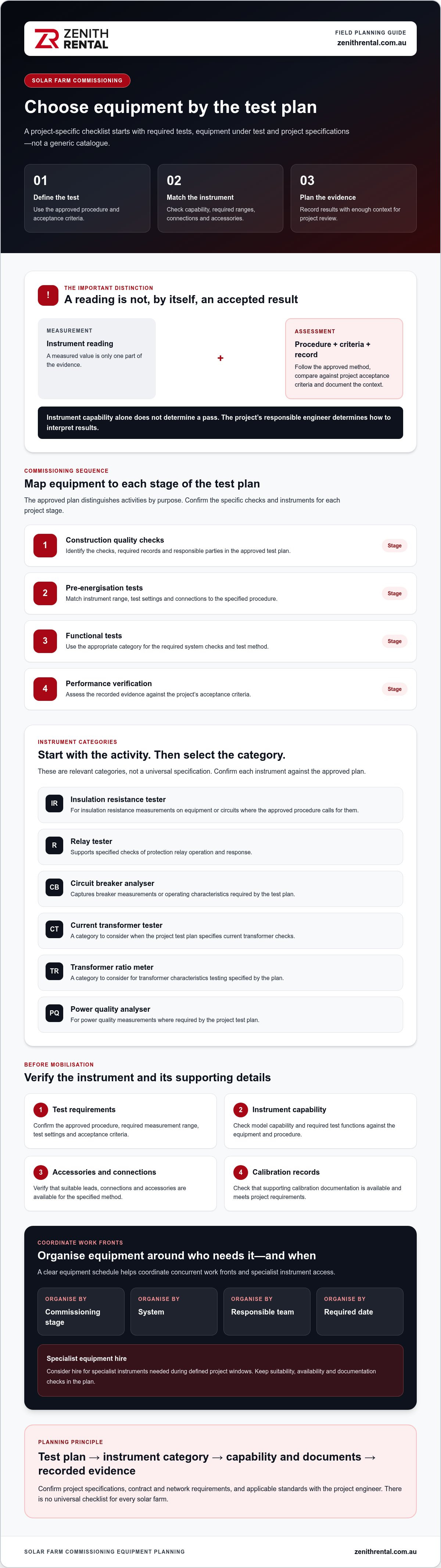
- Assess solar farm commissioning test equipment against the required procedure and project acceptance criteria. Instrument capability alone doesn’t determine a pass.
- Organise equipment by commissioning stage, system, responsible team and required date to coordinate concurrent work fronts.
- Consider hire for specialist instruments needed during defined project windows, while keeping suitability and documentation checks part of your planning.
What solar farm commissioning test equipment needs to prove
Commissioning tests create documented evidence that installed systems meet approved project requirements and are ready for their intended operation. A meter display is only part of that evidence. Teams must follow the specified procedure, record relevant conditions and compare results with the project’s acceptance criteria.
An instrument reading is a measurement. An accepted commissioning result is that measurement, taken under the approved procedure, assessed against the project’s acceptance criteria and recorded with enough context to be reviewed. This distinction matters. A reading outside the required range may point to a defect, an unsuitable test setup or a mismatch between the instrument and procedure. The project’s responsible engineer determines how to interpret it.
How the commissioning test plan shapes equipment selection
Start with the approved test procedures and acceptance criteria. Identify the voltage levels, measurement tasks, required records and responsible parties for each activity. The test plan should establish which work occurs during construction quality checks, before energisation, during functional testing and as part of performance verification. These stages have different purposes and may need different instrument categories.
There’s no universal checklist for every solar farm. Contract documents, network requirements and applicable Australian or international standards, including the relevant editions, can affect the scope. Ask the project engineer to confirm which requirements apply before selecting equipment or deciding whether a result is acceptable.
Which systems may require test evidence
Evidence may be required for PV strings, inverters, transformers, protection systems, switchgear and power quality. The test plan defines the specific checks. For example, insulation resistance testing, protection relay operation, circuit breaker performance, transformer characteristics and power quality measurements may each require a suitable instrument category and procedure.
Separate solar-specific checks from broader electrical balance-of-plant testing. PV array and inverter requirements relate to the generation system, while switchgear, transformers and protection equipment form part of the wider electrical infrastructure. A foundational overview of a photovoltaic (PV) system can help clarify its components, but it doesn’t replace project-specific test documents or engineering direction.
For broader guidance on assessing equipment access and suitability, see the Australian test equipment hire guide. The same principle applies to solar farm commissioning test equipment: match each instrument to a defined test, then verify its capability and documentation against the approved plan.
Match solar farm commissioning tests to the right instrument categories
Build the equipment schedule from the test procedure, not from a catalogue. Each instrument should support a defined activity and produce evidence the project team can assess. The categories below are starting points, not a universal specification. Confirm requirements, ranges, accessories and documentation against the approved test plan before arranging hire.
| Test activity | Instrument category | Purpose | Pre-hire checks |
|---|---|---|---|
| Insulation resistance | Insulation resistance tester | Measures insulation resistance on equipment or circuits where the approved procedure calls for it. | Confirm the procedure’s required range and test settings, suitable leads and accessories, and supporting calibration documentation. |
| Protection relay checks | Relay tester | Supports specified checks of protection relay operation and response. | Check the required test functions, connections, accessories and compatibility with the relay test procedure. |
| Circuit breaker checks | Circuit breaker analyser | Captures the breaker measurements or operating characteristics required by the test plan. | Verify the functions and connection accessories required for the breaker and test method. |
| Transformer and current transformer tests | Transformer ratio meter or current transformer tester | Supports specified ratio checks for transformers or characteristic tests for current transformers. | Confirm the test method, required measurement capability, connection arrangement and documentation. |
| Power quality assessment | Power quality analyser | Records electrical power quality parameters specified for the relevant commissioning activity. | Check measurement functions, ranges, leads or probes, and the procedure’s recording requirements. |
| PV array or inverter checks | Instrument specified by the PV test procedure | Supports the measurements required by the project’s PV string or inverter commissioning scope. | Confirm the exact instrument type, ratings and accessories. Check availability of irradiance, temperature or I-V curve instruments rather than assuming they are included. |
Electrical balance-of-plant tests and relevant equipment
For balance-of-plant work, select an instrument category for each defined test. An insulation resistance tester may suit a specified insulation check, while relay testers and circuit breaker analysers support different protection and switching tasks. Transformer ratio meters and current transformer testing equipment apply only where the approved procedure calls for those measurements. These are relevant categories for Zenith Rental to confirm, subject to current availability and capability.
PV array and inverter tests need scope-specific instruments
PV commissioning procedures may call for string, inverter or performance-related measurements, but the required instruments depend on the procedure and equipment ratings. Don’t assume a general electrical tester covers PV-specific tests. Confirm whether dedicated PV string, I-V curve, irradiance or temperature instruments are needed, and check their availability separately before finalising the equipment plan.
For a defined commissioning window, explore test equipment hire options and confirm the relevant category, specifications, accessories and documentation against your test schedule.
How to assess test equipment capability before accepting results
A suitable instrument must be capable of performing the specified test under the conditions set out in the approved procedure. Check its measurement range, accuracy, resolution and safety rating, then confirm that its functions align with the test method and the equipment being assessed.
Instrument selection is valid only when the instrument’s capability matches the approved test method. Capability is separate from acceptance criteria: instrument specifications describe what it can measure, while project documents define the limits a result must meet. A reading within an instrument’s range isn’t automatically a pass.
Check ranges, ratings, leads and accessories
Before dispatch, compare the expected values and tolerances in the procedure with the instrument’s stated ranges, accuracy and resolution. Consider whether it can measure with suitable precision around the values the team expects to assess. If the procedure, asset details or required limits are unclear, ask the responsible engineer to resolve them before selecting equipment.
Check the complete test setup, not just the instrument. Confirm whether the planned work requires particular probes, leads, clamps, adapters or software, and verify that these items are included and suitable for the procedure. For electrical testing, have the responsible engineer confirm applicable CAT ratings, voltage limits and safe-use requirements for the work conditions. Don’t assume accessories are interchangeable between instruments.
Review calibration and traceability records
Request current calibration documentation and check that it meets the project’s requirements. Match the instrument’s identifying details, such as its make, model or serial number where recorded, to the equipment supplied. If the records don’t clearly correspond to the instrument, or their status isn’t suitable for the project, resolve the discrepancy before testing.
Keep the supporting documentation with the commissioning records as required by the project process. Don’t assume a calibration document proves the instrument suits the test, or that a particular accreditation or traceability status applies. Confirm both directly from the records and project requirements.
A pre-test review of solar farm commissioning test equipment can be captured as a short sign-off checklist:
- Does the instrument cover the required measurement range with appropriate accuracy and resolution?
- Are its safety ratings and voltage limits suitable for the test conditions?
- Are all required accessories and software available and compatible?
- Do instrument identification and calibration records match, and do they satisfy project requirements?
- Has the responsible engineer confirmed the procedure and acceptance criteria?
Resolve gaps before work starts. This helps teams distinguish an instrument limitation or setup issue from a result that needs technical review.
Build a commissioning equipment checklist before mobilisation
A reliable mobilisation plan connects every test to the right instrument, team and date. Organise the solar farm commissioning test equipment register by commissioning stage and system, then assign an owner to confirm each requirement. This makes dependencies easier to see when several work fronts are active at once.
Five checks to complete before equipment dispatch
- Start with the approved test plan. List procedures, expected measurement ranges and acceptance criteria for each activity. Record the system or asset, commissioning stage, responsible team and required-on-site date.
- Match tests to instrument categories. Identify the category needed for each task, then confirm model-level suitability against the procedure. Don’t assume a general electrical tester covers a specialist test.
- Confirm the hire and delivery details. Check current availability, the required hire period, delivery arrangements and the date equipment must reach site. Note dependencies, such as access to an asset or completion of preceding work.
- Verify the complete kit and paperwork. Confirm instrument identification, required leads, probes, clamps or adapters, software where applicable, and any batteries or charging needs. Check that calibration documentation is available and matches the instrument supplied.
- Check site readiness and the return plan. Confirm the work area, access, safe-use requirements and any project arrangements needed before testing. Document a contingency for equipment or work-front delays, including who will approve changes and arrange the instrument’s return.
Use one checklist record per instrument or clearly defined kit. Include the activity, system identifier, instrument category, model details once confirmed, accessories, documents, responsible person, delivery window, contingency and return date. This creates a practical handover between the test planner, site team and equipment coordinator.
Coordinate test records with handover requirements
Agree on system identifiers before testing begins. Use the same naming across test sheets, instrument records and handover files so results can be traced to the correct asset. Capture instrument details and results in the project-approved format, and confirm which supporting records must accompany each completed test.
For further context on documentation, see this guide to calibration accuracy and instrumentation guidance. Clear records support review, but they don’t replace the project’s own acceptance requirements.
Need equipment for a defined commissioning window? Explore test equipment hire options, and confirm availability, accessories and documentation against your checklist before mobilisation.
Plan solar farm commissioning equipment hire with confidence
Choose between ownership and hire by considering how often each instrument will be used, how specialised its capability is, how long the project needs it and whether your team can store and maintain it appropriately. Equipment used continuously across projects may suit ownership, provided you can manage its lifecycle, calibration requirements and supporting records. A specialist instrument needed only for a defined commissioning window may be more practical to hire than to retain between projects.
Make the decision instrument by instrument. A project might regularly use some electrical test equipment but need a relay tester, circuit breaker analyser or transformer ratio meter only for particular test stages. Compare expected use and operational requirements rather than assuming one approach suits every item. Hire can provide access to specialist categories for a project period, but it doesn’t remove your team’s responsibility to confirm technical suitability, accessories, calibration documentation and alignment with the approved test plan.
When hiring specialist commissioning instruments may make sense
Hire is worth considering when a test activity is infrequent, its equipment is highly specialised or the instrument is needed for a defined stage rather than ongoing work. Ownership may be appropriate where regular use justifies maintaining the equipment in-house. Either way, assign responsibility for checking instrument condition, calibration records, storage and readiness before the next test. For solar farm commissioning test equipment, base the decision on actual project tasks and expected use, not a generic equipment list.
What to share when requesting equipment availability
Provide enough detail for the equipment category and requirements to be checked against your work plan. Include:
- Test activities, relevant systems and the procedures or project documents that define the work.
- Required dates, hire period and delivery timing, including any dependencies that could affect mobilisation.
- Expected measurement ranges and other capability requirements confirmed by the responsible engineer.
- Required accessories, quantities and any calibration or supporting records the project needs.
- A project contact who can clarify technical requirements and confirm changes to dates or scope.
Zenith Rental is an Australian-owned, nationwide hire provider for test and measurement equipment, including electrical and power testing categories such as relay testers, insulation meters, power quality analysers, circuit breaker analysers, current transformer testers and transformer ratio meters. Confirm availability, model specifications, accessories and documentation for the intended test and dates. Check dedicated PV-specific instruments separately.
Share your test requirements and discuss test equipment hire with Zenith Rental to confirm whether suitable equipment is available for your commissioning window.
Prepare your commissioning plan for a confident start
Strong commissioning begins with equipment choices tied to approved test procedures, not a generic list. Match each activity to an appropriate instrument category, then confirm its range, accuracy, safety rating, accessories and calibration documentation against project requirements. Keep acceptance criteria distinct from instrument capability, and organise access around the systems, teams and dates in your test plan.
A considered approach to solar farm commissioning test equipment can help project teams coordinate specialist instruments for defined commissioning windows without overlooking technical suitability or handover records. Zenith Rental provides nationwide Australian test equipment hire, with categories including relay testers, insulation meters, power quality analysers and transformer test equipment. Confirm current availability, specifications, accessories and supporting documentation for the equipment your project requires.
To discuss your project requirements and equipment availability, discuss your solar commissioning test equipment requirements. With clear planning and the right checks in place, your team can approach commissioning with greater confidence and keep each test aligned with the project’s requirements.
Frequently Asked Questions
What test equipment is needed to commission a solar farm?
The required equipment depends on the approved test plan, project specifications and systems being commissioned. Solar farm commissioning test equipment may include insulation resistance testers, relay testers, circuit breaker analysers, transformer ratio meters, current transformer testers and power quality analysers. PV array or inverter procedures may call for other instruments. Confirm measurement ranges, accuracy, safety ratings, accessories and calibration documentation against each test before arranging equipment.
Which tests are carried out during solar farm commissioning?
Commissioning may include construction quality checks, pre-energisation tests, functional checks and performance verification. The approved project scope could call for insulation resistance testing, protection relay and circuit breaker checks, transformer tests, inverter checks or power quality measurements. Not every project uses the same procedures or acceptance criteria. The project engineer should confirm the required tests, applicable standards and network requirements, then define how results will be recorded and assessed.
Do solar farms need insulation resistance testing before energisation?
Insulation resistance testing may be required before energisation, but the approved project procedure must determine whether it applies, which circuits or equipment it covers, and how to perform it. Don’t assume one test method or instrument setting suits every asset. Confirm the required tester range, accessories, safe-use requirements and acceptance criteria with the responsible engineer. Record results using the project’s specified format and asset identifiers.
Can I hire solar farm commissioning test equipment in Australia?
Yes, specialist electrical and power testing equipment can be hired in Australia. Zenith Rental provides nationwide test equipment hire, with categories including relay testers, insulation meters, power quality analysers, circuit breaker analysers, current transformer testers and transformer ratio meters. Confirm current availability, model capability, accessories and calibration documentation against your test plan. Dedicated PV-specific instruments, such as I-V curve or irradiance equipment, should be checked separately.
What should I check on test equipment calibration records before commissioning?
Check that the documentation’s instrument identification matches the equipment supplied, then review the recorded calibration status and dates against project requirements. Confirm that the records are current and suitable for the intended test, and retain them with commissioning documents as required. If identification is unclear, records are missing or the status doesn’t meet project criteria, resolve the issue before testing. Don’t assume a document establishes accreditation or traceability unless it specifically confirms this.
Are PV-specific testers included in general electrical test equipment hire?
Not necessarily. General electrical test equipment hire may cover categories such as insulation, relay, transformer and power quality testing, but this doesn’t confirm availability of dedicated PV string, I-V curve, irradiance or temperature instruments. Identify the instruments required by the PV test procedure, then confirm their availability, specifications and included accessories with the equipment provider. Don’t substitute a general electrical instrument unless the procedure and responsible engineer allow it.
How early should commissioning test equipment be arranged?
Arrange equipment as soon as the test plan and commissioning schedule identify the required categories and dates. No single lead time suits every project, so allow time to confirm availability, model suitability, measurement ranges, accessories, calibration records and delivery arrangements. Share schedule dependencies and likely changes with the equipment provider. For specialist instruments or concurrent work fronts, early coordination can help the team plan access and reduce the risk of equipment clashes.