


Selecting a Calibrator for Hazardous Areas: 2026 Guide
The most dangerous oversight in volatile process facilities isn't missing an accuracy tolerance; it's miscalculating how surface thermal limits interact with explosive vapors. Flawless plant execution dictates that selecting a calibrator for hazardous areas must begin with rigorous temperature classifications and gas group boundaries long before you evaluate measurement spans or digital bus capabilities.
You already appreciate the exacting standards demanded by zero-incident operations. Reconciling overlapping IECEx and ATEX frameworks, verifying complex field-loop entity parameters, and guarding against the catastrophic risks of non-rated electronics can challenge even the most experienced instrumentation teams, especially when specialized devices spend months sitting idle between turnarounds.
This guide delivers the clarity you need to master the technical, safety, and operational criteria required for fully compliant calibration assets in classified spaces. You'll learn how to pinpoint exact zone and temperature ratings for your field instruments, choose between dedicated standards and multi-function communicator platforms, and implement an audit-ready verification protocol for absolute operational confidence.
Key Takeaways
- Match intrinsic safety protection concepts and surface thermal codes to specific atmospheric hazards to ensure uncompromising site integrity.
- Master the technical criteria for selecting a calibrator for hazardous areas by balancing field loop entity parameters against strict test uncertainty ratios.
- Evaluate the operational efficiency of unified communicator platforms against the dedicated resilience of single-parameter standards for field teams.
- Establish rigorous pre-entry inspection routines and documented traceability to ensure immediate audit readiness in classified environments.
- Leverage flexible test equipment hire to deploy premier, fully verified instruments during major shutdowns without tying up capital in idle assets.
De-Coding Hazardous Zone Classifications & Intrinsic Safety Standards
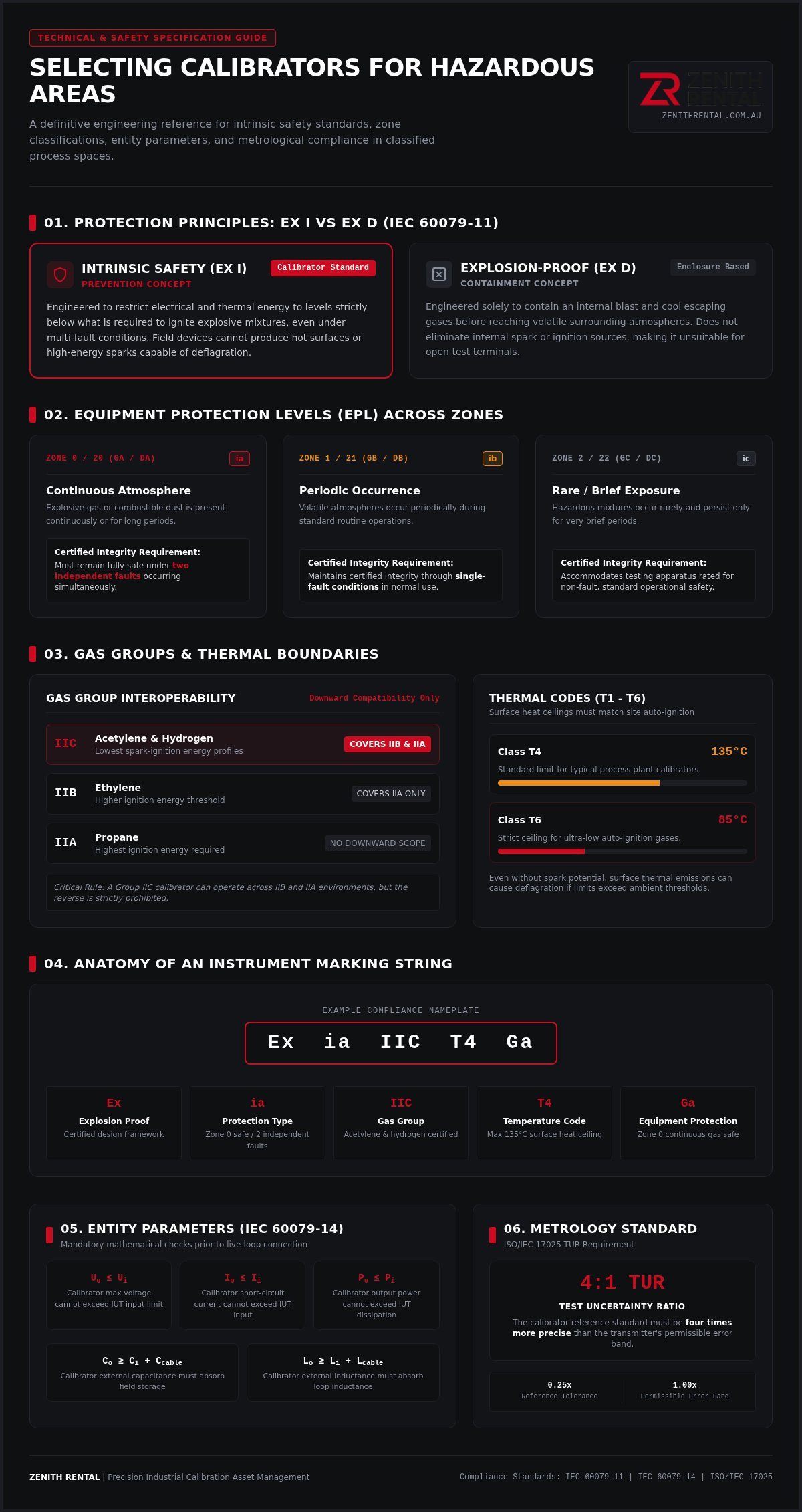
Precision calibration in potentially explosive atmospheres requires a zero-tolerance approach to ignition risks. While explosion-proof (Ex d) enclosures are engineered to contain an internal blast and cool escaping gases, intrinsic safety (Ex i) prevents ignition entirely. An intrinsically safe instrument is an electrical device engineered to restrict electrical and thermal energy to levels below what is required to ignite a specific hazardous atmospheric mixture, even under multi-fault conditions. Under global intrinsic safety standards governed by IEC 60079-11, this energy limitation ensures that field devices cannot produce hot surfaces or high-energy sparks capable of deflagration.
Thermal boundaries represent a non-negotiable parameter. Even if an electrical circuit lacks spark-ignition potential, surface temperature codes (T1 through T6) dictate compliance. A T4 rating caps device surface heat at 135°C, whereas a T6 rating imposes a strict 85°C ceiling. When selecting a calibrator for hazardous areas, matching these thermal limitations to site auto-ignition thresholds is essential to safeguarding critical process assets.
Understanding IECEx and ATEX Protection Levels
Operating across international jurisdictions means interpreting both the global IECEx system and regional directives like ATEX. Flawless execution requires identifying the appropriate Equipment Protection Level (EPL) across specific process environments:
- Zone 0 / Zone 20 (Ga / Da): Explosive gas or combustible dust is present continuously or for long periods. These zones demand "ia" level protection, which remains entirely safe with two independent faults occurring simultaneously.
- Zone 1 / Zone 21 (Gb / Db): Volatile atmospheres occur periodically during normal operations. Instruments rated "ib" provide certified integrity through single-fault conditions.
- Zone 2 / Zone 22 (Gc / Dc): Hazardous mixtures occur rarely and persist only briefly, accommodating "ic" level testing apparatus.
Interpreting Nameplate Markings and Entity Parameters
Nameplate strings encode essential operational boundaries. A rating such as Ex ia IIC T4 Ga identifies an intrinsically safe unit safe for Zone 0, certified for Gas Group IIC (acetylene and hydrogen hazards, representing the lowest spark-ignition energy profiles), with a 135°C thermal ceiling. Gas Groups IIA (propane) and IIB (ethylene) require higher ignition energies, meaning a IIC calibrator can operate across IIB and IIA, but the reverse is never permitted.
Connecting test equipment directly to live process loops introduces the entity concept. Under IEC 60079-14, calibrator output parameters must never exceed the safety boundaries of the instrument under test (IUT):
- $U_o \le U_i$ (Calibrator maximum open-circuit voltage cannot exceed IUT input limit)
- $I_o \le I_i$ (Calibrator short-circuit current cannot exceed IUT input limit)
- $P_o \le P_i$ (Calibrator output power cannot exceed IUT dissipation limit)
- $C_o \ge C_i + C_{cable}$ (Calibrator external capacitance must safely absorb field storage)
- $L_o \ge L_i + L_{cable}$ (Calibrator external inductance must absorb loop inductance)
Validating intrinsically safe entity parameters requires mathematically confirming that the source device's open-circuit energy limits remain lower than the receiving asset's breakdown thresholds while absorbing total cable reactance. Thorough verification ensures selecting a calibrator for hazardous areas translates into safe, seamless field execution.
Essential Technical Parameters for Selecting Hazardous Area Calibrators
Rigorous metrological performance must align seamlessly with physical safety when selecting a calibrator for hazardous areas. Process engineers often begin with measurement accuracy, applying the established 4:1 Test Uncertainty Ratio (TUR) specified by ISO/IEC 17025. This ratio ensures that your calibrator reference standard is four times more precise than the transmitter's permissible error band. Meeting this accuracy threshold in classified environments is uniquely challenging because internal loop power supplies must operate under severe energy constraints to maintain compliance with the OSHA hazardous classified locations standard.
Supplying 24 V DC to an unpowered transmitter while simultaneously reading 4–20 mA feedback requires substantial current, yet intrinsically safe circuitry must strictly cap available output wattage to prevent thermal ignition. When assessing high-performance assets, teams frequently turn to premier solutions such as an intrinsically safe multifunction calibrator hire to ensure uncompromised loop drive capability alongside certified field compliance.
Measurement Capabilities: Electrical, Pressure, and Temperature
Comprehensive field testing demands versatile parameter simulation across severe process conditions:
- Electrical Loops: High-precision mA sourcing, step testing, and frequency tracking to calibrate flow totalizers and safety interlocks accurately.
- Pressure Calibration: Isolated stainless steel piezoresistive sensors handling ranges from delicate draft vacuum levels up to high-pressure regimes, backed by internal pneumatic pumps or dedicated external generation controllers.
- Temperature Testing: Multi-channel simulation for standard resistance temperature detectors (RTDs like Pt100) and specialized thermocouples, factoring in precise cold junction compensation without exceeding barrier current caps.
Physical Ergonomics, Battery Safety, and Field Ingress
Field practicality defines how safely an instrument performs during extended shifts. Enclosure protection should meet at least IP65 standards, guarding internal electronics against fine particulates, driving rain, and corrosive atmospheres. High-contrast transflective displays are crucial for full sunlight legibility, allowing technicians to read critical parameters without disabling backlight power conservation schemes.
Battery safety requires uncompromising discipline. Hazardous area certifications strictly prohibit opening battery compartments or recharging cells within classified spaces; technicians must either obtain a hot-work gas permit or relocate the asset to an unclassified workshop to perform battery swaps. Battery chemistry, typically certified lithium-ion or sealed NiMH packs, undergoes rigorous thermal short-circuit testing to prevent runaway heat generation. Balancing these physical boundaries with advanced metrology guarantees that selecting a calibrator for hazardous areas delivers superior field productivity without compromising plant safety.
Evaluating Multi-Function vs. Dedicated Calibrators in Classified Environments
Every field campaign involves balancing equipment capability with technician agility. When selecting a calibrator for hazardous areas, instrument teams face a core strategic dilemma: consolidate tasks into a single comprehensive multi-function communicator, or deploy targeted, single-parameter calibrators across specific workfronts. The right choice dictates physical efficiency on elevated cat-tracks and defines site exposure under the statutory guidelines outlined in the HSE ATEX equipment and explosive atmospheres guidance.
All-in-one architectures drastically reduce trips into classified process zones. However, relying on a unified platform introduces single-point operational vulnerabilities; if an all-in-one instrument suffers damage or requires annual recertification, your team loses pressure, mA, thermal, and digital bus capabilities all at once.
The Case for Multi-Function Calibrators with Protocol Communicators
Modern field execution prioritizes speed and seamless data collection. An intrinsically safe multi-function calibrator paired with HART and Foundation Fieldbus communicators enables technicians to power transmitters, measure loop currents, verify sensor responses, and adjust digital zero/span configurations simultaneously. Dual-channel logging records both input stimulation and output feedback in real time, eliminating manual note-taking errors in challenging plant settings.
Industry-standard architectures from manufacturers like Druck and Fluke combine precision sourcing with intuitive digital bus navigation. This convergence eliminates the need to haul multiple handheld meters, separate power barriers, and standalone communication modems through hazardous boundaries.
When Dedicated Single-Parameter Instruments Deliver Superior Value
Specialized tools preserve operational resilience when broad versatility isn't necessary. Dedicated loop calibrators or specialized pressure calibrators provide distinct advantages during complex campaigns:
- Targeted Diagnostics: Fast, dedicated 4–20 mA loop checks require no menu navigation or complex device configuration, allowing technicians to verify loops within seconds.
- Superior Physical Ergonomics: Dedicated tools weigh significantly less than modular communicator stations, reducing physical fatigue during multi-story ladder climbs.
- Multi-Front Deployment: Distributing individual pressure, temperature, and electrical calibrators allows multiple technicians to work concurrently across separate processing modules rather than queueing for a single multi-function asset.
- Benchtop Pressure Control: High-precision pneumatic controllers provide stable, fine-tuned pressure generation during intensive transmitter overhauls, surpassing the capabilities of compact, hand-pumped field units.
Carefully evaluating operational scope ensures that selecting a calibrator for hazardous areas equips technicians with the ideal balance of functional versatility and focused field performance.
Operational Compliance: Traceability, Proof Testing, and Inspection Protocols
A certified nameplate is only the first line of defense. Selecting a calibrator for hazardous areas requires equal diligence in establishing ongoing verification protocols to ensure that physical wear or documentation gaps don't compromise site safety. Under IEC 60079-17, electrical installations in classified zones face regular visual, close, and detailed inspections at intervals not exceeding three years. Portable test assets crossing those boundaries must prove immaculate physical integrity before every single entry.
Automated data logging has replaced handwritten calibration logs, reinforcing data integrity across high-stakes industries. Modern calibrators transfer tamper-proof "As-Found" and "As-Left" records directly into Calibration Management Software, satisfying rigorous safety audit frameworks like OSHA 1910.119 Process Safety Management without leaving room for manual transcription errors.
The Pre-Work Inspection Checklist for Certified Tools
Permit-to-work issuance hinges on systematic verification. Before an instrument crosses a battery boundary into classified process areas, technicians must execute three essential checks:
- Certification Currency: Confirm calibration validity dates remain active, ensuring the asset operates within valid metrological tolerance limits.
- Mechanical Integrity: Inspect the non-metallic housing for micro-fractures, verify that display windows are intact, and check that ingress seals remain pliable without dry rot.
- Approved Accessories: Ensure test leads, shrouded clips, and external sensor cables carry specific Ex ratings matching the host instrument. Uncertified leads invalidate the entire loop certification.
- Battery Hardware: Verify that proprietary casing fasteners are fully torqued, ensuring the compartment cannot open accidentally in the field.
Ensuring Traceability and Mitigating Safety Audit Non-Compliance
Auditors look past the physical casing to scrutinize metrological provenance. True compliance demands an unbroken chain of comparisons traced directly to national metrological institutes via ISO/IEC 17025 accredited calibration facilities. If an incident occurs or an auditor requests verification, a missing certificate serial number can trigger immediate stop-work notices or invalidate weeks of maintenance records.
An unbroken, accredited metrological audit trail paired with verified physical integrity is the sole acceptable proof that a field instrument remains compliant within an explosive atmosphere.
To ensure your facility remains audit-ready without administrative bottlenecks, consider securing a pre-verified multi-function calibrator with HART/Foundation Fieldbus communicator hire backed by full NATA-traceable paperwork.
Adhering to these strict verification standards ensures that selecting a calibrator for hazardous areas delivers lasting operational safety and total regulatory confidence.
Strategic Procurement: Hire vs Capital Acquisition for Industrial Turnarounds
Ownership of specialized intrinsically safe instrumentation carries an extensive lifecycle commitment. When selecting a calibrator for hazardous areas, plant leadership must weigh capital expenditure against ongoing maintenance overheads. High-precision instruments stored in tool cribs between scheduled shutdown windows continue to depreciate while requiring mandatory annual recalibration in accredited laboratories. If specialized assets sit idle for long stretches of the operational calendar, direct purchasing ties up valuable capital while exposing the facility to technology obsolescence.
Adopting an agile equipment strategy allows facilities to scale testing capacity precisely when project demands peak, bypassing the burdens of long-term ownership.
Navigating Peak Demand During Major Plant Outages
Major plant turnarounds concentrate months of critical loop testing and transmitter verification into intense, multi-week windows. During these peak campaigns, the sheer volume of field checks quickly outstrips normal crib inventory. Attempting to purchase sufficient permanent instruments to satisfy peak turnaround staffing creates an unsustainable fleet of dormant assets once the facility returns to steady-state operations.
Securing specialized instruments through flexible hire solves acute shortages instantly. Technicians receive fully verified, freshly certified devices ready for immediate site integration. This eliminates the frantic pre-turnaround rush to coordinate third-party laboratory recertifications for internal tools. Once the outage concludes, the rented fleet returns to the provider, freeing your team from long-term storage, shelf drift, and ongoing maintenance logistics.
Partnering with an Elite Equipment Rental Specialist
Collaborating with a premier equipment provider transforms testing logistics into a refined competitive advantage. Zenith Rental maintains a comprehensive nationwide fleet of precision test and measurement instruments, delivering access to premier industry marques including Druck pressure pneumatic controllers, Fluke multi-product calibrators, and advanced multi-parameter process devices.
Securing an intrinsically safe multifunction calibrator hire through a dedicated partner guarantees that every deployed unit arrives with complete NATA-traceable calibration paperwork. Rigorous pre-dispatch testing ensures flawless out-of-the-box reliability, allowing engineering leads to meet tight shutdown schedules with total regulatory assurance. Transitioning heavy equipment acquisition into predictable operational expenditure protects balance sheets while delivering world-class instrumentation to every field technician. Ultimately, selecting a calibrator for hazardous areas through a trusted hire partner delivers uncompromising safety, audit compliance, and peak operational agility.
Master Compliance and Precision in Classified Environments
Flawless plant safety demands complete harmony between metrological precision and rigorous explosion protection. From calculating loop entity parameters to honoring strict thermal envelopes and maintaining continuous inspection logs, every detail safeguards your workforce and critical process assets. Navigating these requirements ensures your operations uphold the highest standards of industrial excellence without operational compromise.
Selecting a calibrator for hazardous areas shouldn't require balancing metrological capability against restrictive capital budgets. Partnering with Zenith Rental delivers immediate nationwide access to an elite fleet of instruments from premier marques like Druck, Fluke, Megger, and Transmille. Every precision asset arrives fully verified with complete NATA-traceable calibration paperwork, backed by specialized guidance from dedicated Australian instrumentation hire specialists.
Equip your field technicians with superior testing tools while maintaining total audit readiness across every campaign. Secure precision intrinsically safe calibrator hire for your next project and lead your upcoming shutdown with unmatched efficiency and peace of mind.
Frequently Asked Questions
What makes a calibrator intrinsically safe for use in hazardous areas?
An intrinsically safe calibrator limits internal electrical energy and surface thermal output so electrical arcs or hot components cannot ignite surrounding flammable gases or dust. Certified under IEC 60079-11 standards, these instruments incorporate specialized energy-limiting resistors, zener diodes, and protective galvanic isolation. This construction guarantees that even under multiple simultaneous component faults, the tool's maximum energy release remains well below the minimum ignition threshold of volatile process atmospheres.
Can I use a standard industrial calibrator inside a Zone 2 hazardous area?
No, you can't introduce standard unrated test equipment into a Zone 2 location without obtaining a formal hot-work permit and maintaining continuous atmospheric gas monitoring. Even though explosive mixtures occur only infrequently or briefly in Zone 2, standard electronics risk producing incendive sparks or uncontrolled surface heat during normal operation. Routine plant protocols demand certified Ex ic, Ex ib, or Ex ia instruments to preserve safety without work stoppages.
What is the practical difference between IECEx and ATEX certification marks?
ATEX is a mandatory European Union directive based on manufacturer declarations and notified body assessments, whereas IECEx is a voluntary international system accepted across global jurisdictions. While both share harmonized testing standards under the IEC 60079 series, IECEx enforces continuous factory surveillance audits and publishes public online certificates. Operating in international process sectors requires recognizing both marks to guarantee seamless cross-border asset deployment.
How do temperature class ratings (T4 vs T6) impact field calibrator selection?
Temperature class ratings establish the maximum surface temperature an instrument can reach, defining where the device can safely operate. A T4 rating caps external surface heat at 135°C, which is suitable for diesel or ethylene vapors. A stricter T6 rating limits heat to 85°C, required for volatile compounds like carbon disulfide. When selecting a calibrator for hazardous areas, the tool's thermal class must remain well below the auto-ignition temperature of site gases.
Why must calibrator battery compartments never be opened in hazardous zones?
Opening battery compartments inside classified spaces exposes unsealed electrical terminals that can produce an incendive arc when separated or reconnected. Even if the instrument is powered down, internal chemical cells store active energy capable of immediate discharge. Hazardous area operating procedures mandate that technicians leave the classified area and return to a safe workshop before swapping battery packs or connecting external charging cables.
What calibration documentation must accompany instruments onto hazardous sites?
Instruments entering classified process boundaries require a current, accredited calibration certificate demonstrating unbroken traceability to national metrology standards alongside the manufacturer's hazardous area declaration of conformity. Site auditors review these documents to verify serial numbers, test uncertainty ratios, and recalibration due dates. Maintaining complete, verified documentation prevents work stoppages and ensures that all field measurements hold up during rigorous regulatory compliance reviews.
Why is hiring specialized calibrators advantageous for annual turnaround maintenance?
Equipment rental gives facilities immediate access to high-tier instruments from premier manufacturers without tying up capital in specialized gear that sits idle for months. Major turnaround campaigns create brief surges in testing requirements that exceed standard tool crib inventories. Securing an intrinsically safe multifunction calibrator hire ensures you deploy pre-verified, NATA-traceable devices right when work peaks. Selecting a calibrator for hazardous areas through a flexible hire arrangement eliminates long-term shelf maintenance and annual recertification costs.