


Scaling Operations with Rental Equipment: A Practical Guide
The smartest way to expand project capacity isn’t always to buy more equipment. Scaling operations with rental equipment lets teams respond to changing workloads and specialist testing requirements without committing to assets that may sit idle after a project ends. It can also help prevent equipment shortages from delaying work or adding pressure to internal teams.
Dependable access to the right instruments matters, particularly when your existing fleet doesn’t cover a specialist measurement or calibration task. The challenge is matching equipment to real project needs while keeping your permanent fleet practical and well utilised.
This guide explains how to make rental equipment part of a repeatable operating process. You’ll learn how to identify what to hire, plan equipment selection and preparation, coordinate use on site, and manage returns consistently. We’ll also cover how specialist test and measurement equipment, from power quality instruments to circuit breaker analysers, can support varied scopes of work. With a considered approach and a specialist Australian hire partner such as Zenith Rental, you can scale capability while matching commitments to demand.
Key Takeaways
- Identify whether an equipment gap is temporary or reflects a stable, ongoing requirement.
- Build a rental plan around the project’s measurement tasks, operating conditions, interfaces and timing.
- Compare rental and ownership based on utilisation, changing project needs and the capability your team requires.
- Assign clear responsibility for instrument coordination, handover and project close-out.
- Use specialist test and measurement equipment hire to address changing scopes without unnecessarily expanding your permanent fleet.
Scaling Operations with Rental Equipment: Identify the Capacity Gap First
Scaling operations with rental equipment starts with a clear view of what your current fleet can support, not an assumption that growth means buying more assets. Operational scaling means meeting higher or more varied project demand by adjusting access to equipment instead of automatically expanding what you own. This reflects the broader idea of Scalability: increasing a system’s capacity to handle growth while maintaining effective performance.
First, establish whether the equipment gap is temporary or persistent. A defined project may require an instrument your team rarely uses, while a steady stream of similar work may signal a recurring capacity need. Look for practical indicators:
- Work is delayed because a required instrument is already assigned elsewhere.
- Specialist testing or calibration tasks cannot proceed with the equipment on hand.
- Project backlogs grow while staff and other resources are ready to work.
- Owned instruments sit idle while teams compete for a different, more frequently needed item.
- Project scopes include measurements your existing fleet doesn’t cover.
These signs can point to different problems. An unavailable instrument may reflect a scheduling issue or a genuine shortage. Idle assets alongside bottlenecks may indicate that the fleet’s mix no longer matches demand.
Which signs show your operation needs additional equipment capacity?
Connect each delay to the equipment constraint behind it. Record when work waits for an instrument, how often that instrument is in use, whether downtime affects delivery, and whether demand recurs across projects. A one-off requirement for a defined job may call for temporary access. Repeated shortages across planned work merit a closer review of longer-term capacity. This evidence helps your team choose a response based on actual utilisation and demand, rather than reacting to a busy period alone.
How can rental equipment support changing project demand?
Hire can provide access for a project, specialist task or temporary workload increase without making every instrument a permanent asset. For example, one electrical testing project may require insulation resistance testing, while another calls for power quality measurement or calibration. The right equipment depends on the scope. Rental complements an owned fleet: retain equipment used consistently, then add specialist instruments when project needs change instead of replacing assets that remain useful.
How to Build a Rental Equipment Strategy That Scales
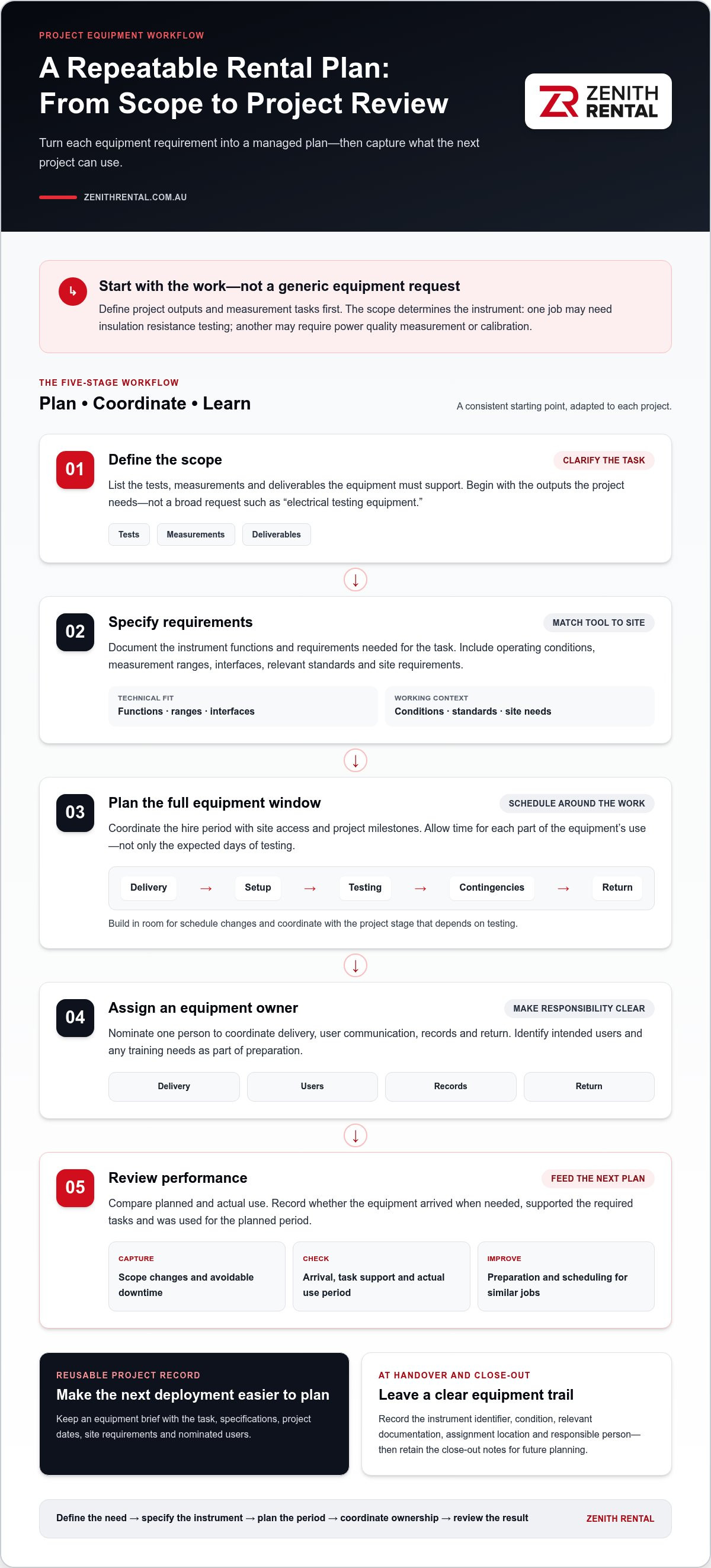
A repeatable rental strategy turns a project requirement into a managed equipment plan, from defining the scope to reviewing performance after use. Define the task, specify the instrument, coordinate its use, document the handover, and review the result. This workflow gives project teams a consistent starting point while leaving room to adapt to each job.
What should teams define before arranging equipment hire?
Start with the project outputs, then identify the measurement tasks and instrument functions needed to produce them. A request for “electrical testing equipment” is too broad to guide a precise selection. Specify the required measurement ranges, operating conditions and interfaces, along with relevant standards and site requirements. Identify intended users and any training needs as well.
Then work through a practical sequence:
- Define the scope: List the tests, measurements and deliverables the equipment must support.
- Specify requirements: Document operating conditions, required ranges, interfaces and relevant standards.
- Plan the schedule: Allow for delivery, setup, testing, contingencies and return, not just the expected days of use.
- Assign an equipment owner: Give one person responsibility for coordinating delivery, user communication, records and return.
- Review performance: Compare planned and actual use, then record issues and lessons for the next project.
Plan around the full sequence of work. If testing depends on site access or a particular project stage, coordinate the equipment period with that milestone and allow for schedule changes. A clear plan reduces last-minute coordination and helps the team make purposeful use of each instrument.
How can teams make rental equipment repeatable across projects?
Create a reusable equipment brief that records the task, specifications, project dates, site requirements and nominated users. At handover, note the instrument identifier, its condition and relevant documentation. Record where the equipment is assigned and who is responsible for it. This provides a clear close-out record and helps teams spot recurring requirements without relying on memory.
After the job, review whether the equipment arrived when needed, supported the required tasks and was used for the planned period. Note scope changes, avoidable downtime and any preparation that would make the next deployment smoother. Over time, these records can help refine equipment specifications and scheduling across similar projects.
For broader decisions about equipment ownership, weigh expected utilisation, project forecasts and the work involved in managing each asset over its lifecycle. For project-specific test and measurement requirements, include specialist test equipment hire in your equipment plan.
Renting vs Buying Equipment: Compare Capability, Control, and Commitment
Scaling operations with rental equipment doesn’t mean renting everything, just as owning more instruments doesn’t automatically create more capacity. The right balance depends on how often equipment is needed, how predictable project demand is, and whether your team can manage the instrument throughout its lifecycle. Compare the full operational requirements rather than assuming either option will always cost less.
| Criterion | Rental implications | Ownership implications | Question for the project team |
|---|---|---|---|
| Utilisation | Can suit intermittent use and defined project periods. | May suit instruments used regularly across steady workloads. | How often is this instrument genuinely required? |
| Project variability | Provides flexibility to match equipment access to changing scopes. | Offers ongoing access, but the asset may be underused between projects. | Are future requirements consistent or still changing? |
| Specialist capability | Can provide access to instruments for less common measurement tasks. | Builds an in-house capability for recurring specialist work. | Will this function be needed often enough to maintain internally? |
| Maintenance and calibration | Requires clear checks at handover and coordination of use and return. | Requires internal planning for maintenance, calibration and readiness. | Who will ensure the instrument is suitable and ready for the task? |
| Lifecycle and control | Access is planned around a project and its equipment period. | The organisation manages storage, records and readiness over time. | Does the team have the capacity to manage the full lifecycle? |
When does renting specialist test equipment make operational sense?
Rental can suit intermittent testing, an uncommon measurement task or a temporary increase in project work. A scope might call for a calibrator, circuit breaker analyser or power quality instrument that the team doesn’t need for every job. Hiring provides access to that specialist capability for the relevant work, while frequently used core assets can remain in the owned fleet.
When might owning frequently used equipment be more practical?
Regular, predictable demand may justify assessing ownership, particularly when an instrument supports ongoing work across projects. Include more than purchase and access in that review: account for storage, maintenance coordination, calibration planning and keeping users ready to operate the equipment. Base the decision on recorded utilisation and realistic project forecasts, not an assumption that current demand will continue unchanged.
Reliability depends on a disciplined process whichever route you choose. Match the instrument to the task and required measurement conditions, plan access around the project schedule, and assign responsibility for handover checks, documentation and return or ongoing care. A frequently used owned instrument may provide dependable access, while a planned rental can support a specialist requirement without expanding the permanent fleet. Choose the approach your team can manage from project planning through equipment close-out.
How to Scale Project Delivery Without Losing Equipment Control
As equipment moves between projects, visibility and clear responsibility help keep delivery organised. A consistent control process makes scaling operations with rental equipment easier to manage, even when several teams share instruments. Use a defined sequence: confirm the scope, specify each instrument, coordinate users, manage handover, then close out and review.
Maintain a central equipment register as the project’s single reference point. For each instrument, record:
- Project and task: Where it’s assigned and what work it supports.
- Responsible user: Who coordinates receipt, inspection, use and return.
- Location and dates: Where the instrument is needed and the planned period of use.
- Status and records: Whether it’s planned, received, in use or returned, with relevant handover details and project documentation.
Build contingencies into the plan instead of assuming schedules will hold exactly. Consider how changes to site access or project timing could affect delivery, setup and return. Give users time to become familiar with the instrument and its task-specific requirements before work begins. If a schedule shifts, update the register and notify affected users so responsibilities and equipment status stay clear.
What controls help multiple teams use rental equipment consistently?
Name a responsible person for each instrument, even when several authorised users will operate it. At handover, record the instrument identifier and condition, and make relevant setup instructions and requirements available before testing starts. Keep usage records and relevant test results with the project documentation. These controls help teams trace an instrument’s use and maintain a clear record as it passes between users or locations.
A concise project checklist can connect equipment to the work and its records:
- Instrument: What equipment is required for the task?
- Owner: Who receives, coordinates and returns it?
- Timing and location: When and where is it needed?
- Record: What handover details, usage notes and test results belong in the project file?
How should teams review equipment performance after a project?
At close-out, compare planned and actual use, delays, task coverage and operational issues. Record whether the instrument suited the measurement task and site conditions, and whether users had the information they needed. Use those findings to refine future specifications and scheduling, and to inform rental or ownership decisions for recurring work.
For project teams planning specialist test and measurement equipment hire, explore Zenith Rental equipment hire as part of a controlled delivery process.
Scale Technical Capability with Zenith Rental Equipment Hire
Once you’ve identified the project gap and set a clear equipment process, specialist hire can extend your team’s technical capability without making every instrument a permanent asset. Zenith Rental provides test and measurement equipment hire for industrial and power testing projects across Australia. Its range supports changing scopes, from electrical testing and calibration to pressure and transformer testing.
Which specialist equipment categories can support technical projects?
Choose equipment based on the measurement task, operating conditions and required range. Calibrators support calibration-related work, with the appropriate instrument depending on the measurements and interfaces involved. Circuit breaker analysers and power quality instruments can suit specific electrical testing scopes, while pressure controllers and transformer oil breakdown testers support relevant industrial and power projects. Each category serves a distinct purpose, so let the project brief guide selection rather than assuming every team needs the same instruments.
For a wider overview of planning equipment hire in Australia, explore the Australian test equipment hire guide. If a project involves gas measurement, the gas measurement instruments guide provides context for that specialist category.
How can a specialist hire partner support a scaling plan?
A specialist partner can help teams align instrument access with project requirements, particularly when work calls for equipment beyond the core fleet. Zenith Rental’s range includes calibrated electrical and industrial instruments, multi-product calibrators, circuit breaker analysers, pressure controllers and transformer oil breakdown testers, with equipment from brands including Fluke, Megger and Transmille. This range can support varied technical scopes without suggesting that a single project needs every instrument.
As you plan upcoming work, define the measurements, conditions, interfaces and timing that matter, then map them to the appropriate equipment category. Scaling operations with rental equipment connects specialist capability to actual demand while keeping project coordination deliberate. Explore Zenith Rental’s test equipment range as you prepare for your next project.
Build Your Next Project Around the Capability You Need
Strong operational scaling starts with a clear view of project demand, not an automatic increase in owned assets. Identify where equipment constraints affect delivery, then match access to the task, schedule and level of specialist capability required. A repeatable process for specifying instruments, coordinating users and reviewing each project helps teams adapt while keeping equipment under control.
That’s the practical value of scaling operations with rental equipment: your team can respond to changing scopes without committing to a permanent fleet for every specialist requirement. Zenith Rental is an Australian-owned specialist provider serving customers nationally, with calibrated electrical and industrial testing instruments and equipment from Fluke, Megger and Transmille.
For upcoming testing and calibration work, explore specialist test equipment hire with Zenith Rental. Plan around the measurements and schedule your project requires, then find suitable equipment in Zenith Rental’s range.
Frequently Asked Questions
Can rental equipment help a business scale without buying more assets?
Yes. Rental equipment can provide access to additional or specialist capability as project demand changes, without automatically expanding your owned fleet. It may suit instruments that aren’t used consistently, while frequently needed assets remain in-house. To decide whether hire fits, review utilisation, project frequency, equipment requirements and the internal capacity needed to coordinate and support the equipment. Base the choice on your workload rather than assuming rental or ownership is always preferable.
How do I decide whether to rent or buy test equipment?
Compare how often the equipment is needed, how predictable demand is and whether the task requires specialist capability. Include the practical responsibilities of ownership, such as storage, maintenance coordination, calibration planning and keeping users ready to operate the instrument. Rental may suit intermittent or specialist requirements, while stable, frequent use may warrant assessing ownership. Document your assumptions and revisit them as project forecasts and operational requirements change.
Is renting equipment reliable for critical projects?
Rental can support critical project work when the equipment and workflow are planned carefully. Define the measurement task and operating conditions, select an instrument suited to those requirements, and coordinate its use with the project schedule. Assign responsibility for handover and ensure users understand the equipment’s intended task. Keep relevant instrument and project records together. Reliability depends on the full process, including selection, scheduling and clear responsibilities, whether equipment is rented or owned.
What equipment can industrial teams rent to expand testing capability?
Industrial teams can hire instruments to match specific project tasks. Examples include calibrators for calibration-related work, circuit breaker analysers and power quality instruments for relevant electrical testing, and pressure controllers or transformer oil breakdown testers for suitable industrial scopes. These categories aren’t a universal checklist. First define the required measurements, ranges, site conditions and project outputs, then match the instrument’s functions to the task and the team’s operating requirements.
How can multiple teams manage rental equipment across projects?
Give each instrument a named project owner and use a shared register to track its assigned user, location, planned dates and status. Set consistent steps for receipt, inspection, use, handover and return, and keep relevant usage details and test results with the project documentation. After each job, review utilisation and coordination issues. This creates a clearer record across teams and helps improve equipment scheduling and planning for future projects.
What happens if project requirements change after equipment is selected?
Reassess the equipment plan before proceeding if the task, site conditions or schedule changes materially. Review the measurement requirements, operating environment, instrument functions and users, then update the equipment brief and project records so everyone follows the current scope. Coordinate adjustments through the established rental workflow. Don’t assume the original selection remains suitable simply because it matched the earlier plan.
How should a business measure whether rental equipment helped it scale?
Assess whether the equipment supported planned tasks, addressed capacity bottlenecks and fitted the project schedule. Record actual utilisation, delays, task coverage and any setup or coordination issues, then compare the results with the assumptions behind the hire decision. Scaling operations with rental equipment works when access matches real project needs and the process remains manageable. Use each review to refine future rental plans and ownership decisions.