


Pressure Controller Setup Guide: Achieving Industrial Precision in 2026
Precision setup is a disciplined ritual of preparation; it is never just a simple sequence of button presses. You likely recognize that in high-stakes industrial environments, a single misaligned port or a minor calibration drift represents more than a technical delay. It is a direct threat to your equipment's integrity and your professional standing. This pressure controller setup guide provides the elite expertise needed to master the sophisticated configuration of high-precision assets, ensuring your results meet the most rigorous NATA-traceable standards with absolute confidence.
By following this expert-led framework, you'll achieve a seamless, error-free process that eliminates the frustration of time-consuming on-site troubleshooting. We will detail the essential steps for configuring your controllers to meet the new ISO 9001:2026 quality requirements while maintaining the prestige and reliability your clients expect. From port connection safety to proactive compliance with the latest OSHA standards, you're about to transform a complex technical necessity into a hallmark of your operational excellence. This guide ensures your performance remains at the peak of the industry.
Key Takeaways
- Elevate your technical standards by understanding why automated controllers are essential for meeting the rigorous accuracy requirements of 2026 industrial benchmarks.
- Master the meticulous pre-installation protocols required to safeguard high-performance assets and maintain the absolute purity of your pressure media.
- Confidently navigate the selection between pneumatic and hydraulic configurations to ensure peak stability across your entire required pressure range.
- Implement a seamless configuration workflow using our expert pressure controller setup guide to align every measurement with global project specifications.
- Discover the strategic advantage of utilizing elite, NATA-calibrated instruments to guarantee immediate compliance and professional prestige in high-stakes environments.
The Critical Role of Precision in Pressure Controller Setup
In the high-stakes world of industrial calibration, the modern pressure controller has evolved into something far more significant than a mere tool. It's an active, automated calibration asset that orchestrates the entire measurement process. While a standard Pressure regulator might suffice for basic flow maintenance, a high-precision controller manages the delicate balance of pneumatic or hydraulic pressure with surgical accuracy. This distinction is critical because 2026 industrial standards, specifically the updated ISO 9001:2026 requirements, demand a level of precision that traditional manual gauges or legacy systems simply cannot sustain.
Achieving impeccable results begins with a disciplined configuration. This setup is the bedrock of your NATA-traceable audit trail, ensuring every data point is defensible and accurate. When your documentation reflects this level of perfection, it reinforces your reputation for absolute reliability and success. To reach this standard, you must master the relationship between the three core components: the controller itself, the stable pressure source, and the Device Under Test (DUT). This pressure controller setup guide provides the roadmap to integrate these elements into a high-performance ecosystem.
Automated vs. Manual Pressure Control
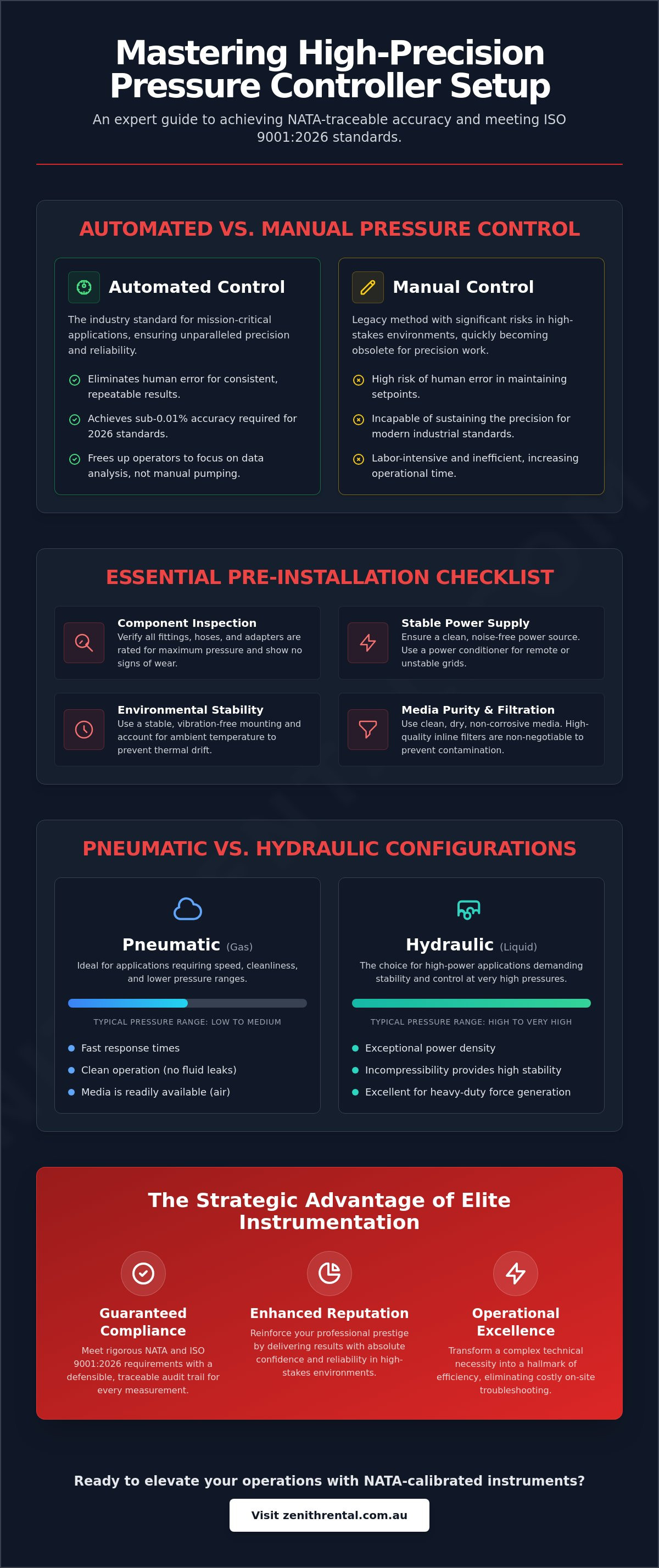
Elite B2B operations are rapidly moving away from manual hand pumps for critical measurement paths. The risk of human error in setpoint maintenance is simply too high when your project's success depends on sub-0.01% accuracy. Automated controllers utilize sophisticated internal transducers that constantly monitor and adjust the environment to maintain a perfect equilibrium. This transition isn't just about speed; it's about the confidence that comes from using assets designed for the most refined technical requirements. It allows the operator to step away from the labor of pumping and focus on the qualitative analysis of the data.
Standard Operating Environments in Australia
Australian industrial environments often test the limits of sensitive equipment. Ambient temperature fluctuations on-site can introduce thermal drift, which compromises the integrity of your calibration results. A professional setup requires a stable, vibration-free mounting to prevent measurement noise from nearby heavy machinery or industrial activity. By accounting for these regional nuances during the initial installation, you ensure your instrumentation operates at its peak performance. This attention to detail separates standard service providers from those who have truly mastered the art of high-end industrial precision.
Essential Pre-Installation Requirements and Safety Protocols
Before you engage the power on a high-precision instrument, your focus must lie on the environment and the integrity of your peripheral hardware. A successful execution depends on a meticulous inspection of every component, from the controller chassis to the high-pressure hoses. Any degradation in these assets doesn't just risk a failed calibration; it poses a significant safety hazard. You must verify that every fitting and adaptor is rated for the maximum expected pressure of your project. This level of scrutiny is what ensures your setup can protect devices from overpressure and maintain the prestige of your operations.
Stability extends to your electrical supply as well. Sensitive digital electronics require a consistent, noise-free power source to prevent erratic readings or internal damage. Following a comprehensive pressure controller setup guide means treating the power cable with as much respect as the pneumatic lines. If you're operating in remote Australian sites, consider using a dedicated power conditioner to buffer against the fluctuations common in field generators. This proactive approach minimizes friction and mirrors the ease of a truly professional engagement process.
Media Purity and Filtration
Moisture and oil contamination are the primary culprits behind premature controller failure. Your media must be clean, dry, and non-corrosive to preserve the delicate internal manifold system. Implementing high-quality inline filters is a non-negotiable step for any elite technician. These filters act as a final line of defense against particulates that could compromise your NATA-traceable results. When transitioning between pneumatic and hydraulic applications, ensure your media separation protocols are absolute to prevent cross-contamination. For those requiring the highest standard of hardware, choosing to hire premium calibration equipment ensures you start with an instrument that has been professionally maintained and verified.
Connection Integrity and Port Identification
Success is found in the finer details of port identification. Elite controllers clearly distinguish between Supply, Test, and Vent ports; misidentifying these can lead to immediate equipment damage. While it's tempting to apply excessive force, over-tightening NPT connections often leads to cracked manifolds or stripped threads. Parallel thread connections require a different touch, relying on high-quality seals or bonded washers rather than thread deformation to achieve a leak-free performance. This disciplined approach to connectivity mirrors the high performance of the assets you provide to your clients, ensuring every detail of their needs has been accounted for.
Navigating Pneumatic vs. Hydraulic Pressure Configurations
Selecting the appropriate medium for your calibration task is a decision that defines the technical trajectory of your project. For ranges below 7,000 kPa, pneumatic systems offer a clean, efficient, and highly responsive environment. However, as you move into extreme high-pressure applications, the stability of hydraulic fluids becomes indispensable. This choice isn't merely about the numbers on a display; it's about understanding the physical behavior of the media under stress. While air is highly compressible and stores significant elastic energy, hydraulic fluids are nearly incompressible, providing a rock-solid foundation for measurements that require absolute stillness.
Efficiency in any pressure controller setup guide depends on managing 'dead volume.' This is the internal space within the hoses and fittings between the controller and the Device Under Test (DUT). Large dead volumes lead to sluggish response times and increased media consumption, which can be particularly costly when using high-purity nitrogen. By utilizing short, small-bore tubing and minimizing the number of adaptors, you ensure a crisp, immediate response from the controller manifold. This meticulous approach to volume management mirrors the high performance of the assets provided to discerning industrial professionals.
Safety is paramount when handling high-pressure nitrogen cylinders as a supply source. These vessels contain immense stored energy and require a dedicated, high-quality supply regulator to step the pressure down to a manageable level for the controller inlet. For a broader perspective on how these principles integrate into complex industrial environments, the U.S. Department of Energy's Guide to Process Heating Systems offers valuable insights into the systemic importance of pressure regulation. Adhering to these rigorous standards ensures your setup remains a hallmark of reliability and professional success.
Pneumatic Setup Considerations
A refined pneumatic configuration requires precise control over the external supply. Your supply regulator should be set approximately 10% above your maximum required test point to allow the internal valves to operate within their optimal range. In sensitive or confined Australian workshops, managing the exhaust and vent lines is critical. Routing these vents to a safe area prevents sudden noise or gas displacement from disturbing the pristine nature of the laboratory environment. Always integrate a pressure relief valve as a final safeguard to protect the DUT from accidental over-ranging.
Hydraulic System Priming
The secret to hydraulic precision lies in the total elimination of trapped air. Even a tiny bubble can cause pressure oscillations and measurement drift, compromising your NATA-traceable results. Meticulous priming techniques, such as using a vacuum priming station or carefully bleeding the system at the highest point, are essential. Whether you select distilled water for oxygen-clean applications or specialized sebacate oil for high-end metrology, maintaining the pristine condition of your hydraulic reservoir is a non-negotiable requirement. This focus on the finer details ensures a seamless engagement process and results that reflect your success.
A Step-by-Step Guide to Configuring Your Pressure Controller
Initiating the configuration of a high-precision instrument is a ritual of technical discipline. When you first engage the power, the controller performs a sophisticated self-test diagnostic sequence. This internal audit verifies the integrity of the transducers and control valves before you proceed. Once the system is ready, your first task is to define the units of measure, such as kPa, bar, or psi, to match your specific project requirements. This alignment ensures that every reading is immediately actionable and eliminates the risk of manual conversion errors during high-stakes operations.
Safety remains the cornerstone of any professional pressure controller setup guide. You must set upper and lower pressure limits within the software immediately after unit selection. These digital safeguards act as a final barrier to prevent accidental over-pressurisation, protecting the Device Under Test (DUT) from mechanical stress. Before starting your calibration, execute a zeroing procedure. You'll need to choose between absolute pressure mode, which references a vacuum, or gauge pressure mode, which references local atmospheric conditions. This choice is fundamental to the accuracy of your results and must be made with absolute clarity.
The final step before formal measurement is the system leak test. By reaching a setpoint and then isolating the system, the controller monitors for any pressure decay over a defined period. This verifies that the seals and fittings discussed in previous sections are performing at their peak. To ensure your next project benefits from this level of precision, you can rent high-precision pressure controllers that arrive fully calibrated and ready for immediate deployment.
Menu Navigation and Parameter Entry
Mastering the interface requires a clear understanding of 'Control' versus 'Measure' modes. Control mode actively regulates the pressure to your desired setpoint, while Measure mode allows the instrument to act as a high-accuracy reference gauge. You should configure the slew rates to manage the speed of pressure changes, which prevents thermal shock to sensitive sensors. For applications requiring extreme setpoint maintenance, utilise the 'Fine Tune' features to eliminate even the smallest oscillations in the pressure circuit.
Data Logging and Remote Communication
Modern industrial standards require a robust, time-stamped audit trail for every calibration event. Configuring RS232, IEEE-488, or USB interfaces allows for automated data capture and integration into your laboratory management software. HART or Foundation Fieldbus integration enhances field calibration by allowing the controller to communicate directly with smart transmitters for seamless configuration and verification. Ensuring your data logging parameters meet your organisation's quality record requirements is the final hallmark of a successful, professional setup.
Elevating Your Project with Elite Pressure Instrumentation
Achieving the highest standard of industrial precision requires more than just technical knowledge. It demands access to the most refined assets available in the modern market. While this pressure controller setup guide provides the framework for success, the strategic advantage of utilizing the latest Druck pressure controllers cannot be overstated. These instruments represent the peak of measurement technology, offering the stability and automated control necessary to meet 2026's rigorous quality benchmarks. By choosing to hire rather than purchase, you ensure your project utilizes current, high-performance technology without the burden of capital depreciation.
Success in high-stakes environments is built on trust and absolute reliability. Integrating this pressure controller setup guide with NATA-certified hardware ensures your audit trail remains impeccable from the moment of power-on. Every instrument provided for your project arrives ready for immediate deployment. When you encounter complex setup scenarios that fall outside standard protocols, having access to expert technical support provides the professional confidence needed to proceed. Zenith Rental has mastered the art of premium service, ensuring that Australian industry professionals have the tools they need to reach the zenith of their field.
The Benefits of Test Equipment Hire
The hidden costs of instrument ownership often compromise the efficiency of a project. Annual calibration cycles, storage requirements, and the inevitable march of obsolescence can drain resources. Scaling your equipment fleet to match specific project demands allows for a more agile and responsive operation. For a deeper look into these strategic advantages, consult The Definitive Guide to Test Equipment Hire in Australia. This resource illustrates how elite firms maintain their competitive edge by prioritizing access over ownership.
Why Discerning Professionals Choose Zenith Rental
Our commitment to excellence extends beyond the hardware we provide. We view every engagement as a partnership, offering a level of premium hospitality that is rare in the industrial sector. Our nationwide service ensures that your project remains on schedule, regardless of your location within Australia. We understand that your time is a high-value asset; our processes are designed to minimize friction at every touchpoint. Whether you are conducting a single calibration or managing a large-scale facility upgrade, our team ensures every detail is accounted for. Experience the difference that professional authority and elite assets can make for your next project. Explore our elite range of pressure controllers and calibrators today to secure your operational success.
Mastering the Peak of Calibration Excellence
Mastering industrial precision is a journey that begins with a disciplined ritual of preparation and ends with the absolute confidence of a defensible audit trail. You've explored how meticulous media purity and rigorous safety protocols form the bedrock of successful operations. By implementing the strategies in this pressure controller setup guide, you transform a complex technical requirement into a hallmark of your professional success. The transition from manual processes to automated, high-performance control isn't just a technical upgrade; it's a commitment to the highest possible standard of service and quality.
Your next project deserves the prestige of elite instrumentation without the burden of ownership. Zenith Rental provides a seamless experience for the Australian industry, offering the latest technology from world-class brands like Druck and Fluke. Every asset includes NATA-certified calibration as standard, backed by expert technical support to ensure your success in even the most high-stakes environments. It's time to elevate your operational standards and achieve the results your discerning clients expect. Secure Your Precision Pressure Controller for Your Next Project and experience the ease of a truly refined partnership. We look forward to supporting your pursuit of excellence.
Frequently Asked Questions
What is the primary difference between a pressure calibrator and a pressure controller?
A pressure controller actively maintains a specific setpoint using automated internal valves, whereas a traditional calibrator often requires manual intervention to reach and hold a pressure value. The controller provides a hands-off, highly stable environment that eliminates human error. This automation is a central theme in any modern pressure controller setup guide, allowing you to focus on the qualitative results of your calibration rather than the mechanics of the pump.
Can I use shop air as a supply source for a high-precision pressure controller?
You should avoid using standard shop air because it typically contains moisture, oil, and particulates that will damage the controller's internal manifold. High-precision instruments require clean, dry, non-corrosive media, such as high-purity nitrogen or instrument-grade air. Using contaminated air risks immediate equipment failure and compromises the integrity of your NATA-traceable results, which can lead to costly delays and compliance issues on-site.
How often should a pressure controller undergo a formal NATA calibration?
A pressure controller should generally undergo a formal NATA calibration every 12 months to ensure continued accuracy and compliance. In high-stakes environments or where the instrument is used heavily on-site, a six-month interval might be more appropriate. Regular calibration is the only way to verify that the internal transducers haven't drifted, maintaining the prestige and absolute reliability associated with your professional services and high-end project results.
What happens if I accidentally apply pressure to the vent port of the controller?
Applying pressure to the vent port can cause significant internal damage to the controller's exhaust valves and sensitive sensors. The vent port is designed solely to release pressure safely into the atmosphere; it's not built to receive supply pressure. If this occurs, you should immediately cease operations and perform a full diagnostic self-test to check for manifold leaks or transducer errors before attempting any further precision measurements.
Is it possible to control hydraulic pressure using a pneumatic controller?
You can only control hydraulic pressure with a pneumatic controller if you utilize a specialized media separator or dirt trap. This physical barrier prevents hydraulic fluid from entering the pneumatic manifold while still allowing the pressure to be transmitted to the Device Under Test. Without this protection, liquid ingress will cause catastrophic failure of the pneumatic valves, necessitating expensive repairs and potentially compromising your project timeline and professional reputation.
How do I calculate the total uncertainty of my pressure setup?
You calculate total uncertainty by combining the controller's base accuracy with environmental variables, the resolution of the DUT, and the stability of your connections. This is typically done using the Root Sum Square (RSS) method to ensure a statistically sound confidence interval. Professional metrologists prioritize this calculation to guarantee that their results meet the highest possible standards of industrial precision and international compliance requirements.
What are the most common causes of pressure leaks in a new setup?
The most common causes of leaks include worn O-rings, incompatible thread types, such as mixing NPT and parallel BSP, and the practice of over-tightening fittings. A leak-free performance depends on selecting the correct seals and ensuring that all adaptors are rated for the project's maximum pressure. Following a disciplined pressure controller setup guide helps you identify these vulnerabilities during the initial system leak test before formal calibration begins.
Can I operate these controllers in intrinsically safe or hazardous areas?
Most high-precision benchtop controllers aren't designed for hazardous areas and should only be operated in safe zones. If your project requires measurements in potentially explosive atmospheres, you must select an instrument specifically rated as intrinsically safe, such as those with ATEX or IECEx certifications. Always verify the safety rating on the manufacturer's data plate before bringing any electronic test equipment into a restricted or high-stakes industrial environment.