


Peace of Mind with Calibrated Rental Gear: What to Check Before Your Next Test
What if a current calibration record still isn’t enough to trust a test result? Peace of mind with calibrated rental gear depends on more than a certificate: the instrument must suit the measurement, range and conditions you’ll encounter on site.
It’s sensible to want confidence before readings inform maintenance, commissioning or safety decisions. Calibration evidence describes how an instrument performed under defined conditions, but it can’t guarantee every field result or compensate for the wrong instrument, poor setup or changing conditions. Understanding that distinction helps you avoid misplaced confidence and unnecessary doubt.
This guide explains what to look for in calibration records, how to match rental equipment to your measurement task and working environment, and how careful use and clear documentation can support your results. You’ll also learn where calibration’s assurance ends, so you can make a considered choice for your project. Zenith Rental hires calibrated electrical, industrial and power testing equipment across Australia to support a focused testing workflow.
Key Takeaways
- Build peace of mind with calibrated rental gear by matching the instrument to the measurement and conditions, not relying on calibration status alone.
- Review relevant calibration record details, such as instrument identification, dates and results, and understand what the evidence can’t guarantee.
- Compare hiring with owning in light of project duration, equipment utilisation and the need for specialist capability.
- Use a pre-test checklist to assess measurement range, functions, accessories, instrument condition and calibration information.
- Explore specialist hire options, including calibrators, relay testers, insulation resistance testers and power quality measurement equipment, to support your testing workflow.
Why Calibrated Rental Gear Matters for Confident Testing
Calibrated rental gear is hired test equipment with calibration information relevant to the measurement task. That context matters: evidence about an instrument’s performance is useful only when the instrument suits the value, range and function your project needs to assess. A well-matched instrument can help your team make informed decisions, avoid preventable repeat tests and keep a clearer record of how results were obtained.
Calibration involves comparing an instrument with a reference under defined conditions. For a foundation on the term and its general purpose, see What is Calibration? The practical value is evidence about the instrument, not a blanket promise about every reading it produces. Setup, method, environmental conditions and handling still shape the result.
Calibration supports confidence in an instrument; confidence in a measurement depends on the instrument, method, setup and operator working together.
That distinction is central to peace of mind with calibrated rental gear. Calibration information can inform your decision, but it can’t correct an unsuitable range, a loose connection or an incorrectly applied test procedure. Treat calibration as one part of disciplined measurement, then capture enough context to understand the result later.
What does calibrated equipment help a project team trust?
Calibration evidence helps a project team assess whether an instrument’s performance has been checked in a way relevant to the intended measurement. It supports confidence in the tool, while the test method and the person using it require separate attention. For example, an electrician measuring insulation resistance needs an appropriate insulation resistance tester and must connect and operate it according to the test procedure. Calibration status alone doesn’t validate that procedure or the recorded reading.
When results guide maintenance or commissioning decisions, recording the instrument used and the test performed makes later review more straightforward. That context helps teams distinguish an instrument concern from a method or setup issue, rather than treating every unexpected result as proof that the equipment has failed.
Why hire calibrated instruments instead of relying on assumptions?
Hiring can give a team access to a specialist instrument for a defined project, without assuming that a general-purpose device already on hand can do the job. The right choice depends on the measurement range, required function and conditions in which testing will take place. A mismatch can leave a measurement unsupported even if the instrument has calibration evidence.
Before selecting equipment, define what you need to measure and how the result will be used. Then match the instrument’s capability to that task, rather than choosing by familiarity alone. For a broader view of planning equipment around project requirements, the test equipment hire guide offers useful context. This deliberate approach helps turn access to specialist gear into a considered, well-documented testing workflow.
How Calibration Records Support Confidence in Rental Measurements
A calibration record gives context for an instrument’s measurement performance. Calibration compares an instrument with a reference under defined conditions, then documents the results. It is evidence, not a blanket promise that every reading will be accurate in every setting. To use that evidence well, connect it to the measurement you need to make and the requirements your project sets.
Which calibration details matter when reviewing rental equipment?
Start by matching the instrument’s identifying details on the record to the equipment in your hands. A mismatch can make the record irrelevant to that instrument. Review the calibration date, results and measurement points covered, then consider whether they suit your project’s requirements. A date alone can’t show whether the instrument was assessed across the range or function your task relies on.
Results need interpretation, too. They describe performance under the stated calibration conditions, so compare them with the tolerances and measurement needs that apply to your work. A record is useful when its details fit the task, not simply because a document is available.
Calibration evidence supports task-specific checks; it doesn’t replace them. For peace of mind with calibrated rental gear, verify the instrument’s identity, relate the recorded results to the required measurement and keep relevant evidence with your test records. Read the documentation for what it establishes about the instrument, and don’t treat it as a guarantee of every field result.
What calibration can, and can’t, tell you
Traceability describes a documented chain of comparisons linking a measurement to recognised references, with each link contributing to the measurement’s uncertainty. Uncertainty expresses the range of doubt associated with a result; it isn’t simply a declaration that a reading is wrong. The calibration services and traceability reference provides further context on these concepts, but it doesn’t establish the status of a particular rental instrument.
Calibration status informs whether an instrument may be suitable, but it can’t validate a field result by itself. Range and resolution affect whether the instrument can meaningfully measure the value in question. Temperature, moisture or electrical interference can influence conditions; setup and operator technique matter as well. Interpret accreditation references, including NATA or ISO/IEC 17025, only in relation to the specific evidence and claim being considered.
For a useful project record, note which instrument was used, the measurement task, the reading and any relevant conditions or method details. That context makes results easier to review and helps distinguish a calibration question from an issue with setup or procedure. Teams planning a defined test task can explore Zenith Rental’s specialist test equipment hire as part of selecting instruments for their workflow.
Calibrated Rental Gear Compared with Owned or Unverified Equipment
The right equipment strategy depends on how often you’ll use an instrument, how specialised the task is and what evidence your project needs. Hiring can suit a defined job that calls for a particular capability; an owned instrument may be more practical for frequent, familiar testing. Equipment with unclear calibration status presents a different consideration: its current measurement performance is uncertain until the relevant information is established.
There’s no universal winner. Compare the options against the whole project, including instrument suitability, team workflow, access when testing begins and the effort involved in maintaining equipment. This framework makes peace of mind with calibrated rental gear a considered choice, rather than an assumption that hire or ownership is always preferable.
When can hiring calibrated test equipment make sense?
Hire may suit short projects, intermittent testing or specialist instruments used too infrequently to justify keeping one in-house. It can also let a team select equipment around changing technical requirements, such as using a relay tester for one work package and a power quality instrument for another. The rental benefits for precision testing can include access to a focused instrument choice without adding it to the permanent equipment pool.
Plan around the actual test schedule, however. Consider how long the instrument is required, whether its functions and measurement range suit the task, and how access aligns with the work. Hire is most useful when it supports the workflow without introducing avoidable scheduling or familiarisation challenges.
When might an existing instrument remain the practical choice?
An owned instrument can make sense for frequent use, established procedures and teams already confident with its operation. Familiarity may support a smooth workflow, particularly when the same measurements recur. Ownership still brings responsibility for suitable upkeep and calibration controls; a familiar device with unclear current status shouldn’t be treated as equivalent to one with relevant, current evidence.
Compare the overall project needs, not just the method of access. A hybrid approach may suit a team that keeps routinely used equipment and hires specialist instruments for occasional tasks.
| Decision factor | Potential benefits | Limitations to weigh | Planning question |
|---|---|---|---|
| Hire for a defined project | Access to specialist capability for a specific task or period. | Timing, delivery coordination and user familiarisation need planning. | Does the instrument’s range and function match the work? |
| Use owned equipment | Ready access and team familiarity for recurring tests. | Calibration, maintenance and storage remain ongoing responsibilities. | Is its current status suitable for this measurement? |
| Use equipment with unclear status | It may already be available to the team. | Uncertainty about current performance can weaken confidence in results. | Can its calibration status be established before relying on readings? |
Use the answers to select equipment that fits the measurement, project duration and team’s working practice. That keeps the decision grounded in evidence and practical needs, rather than familiarity or access alone.
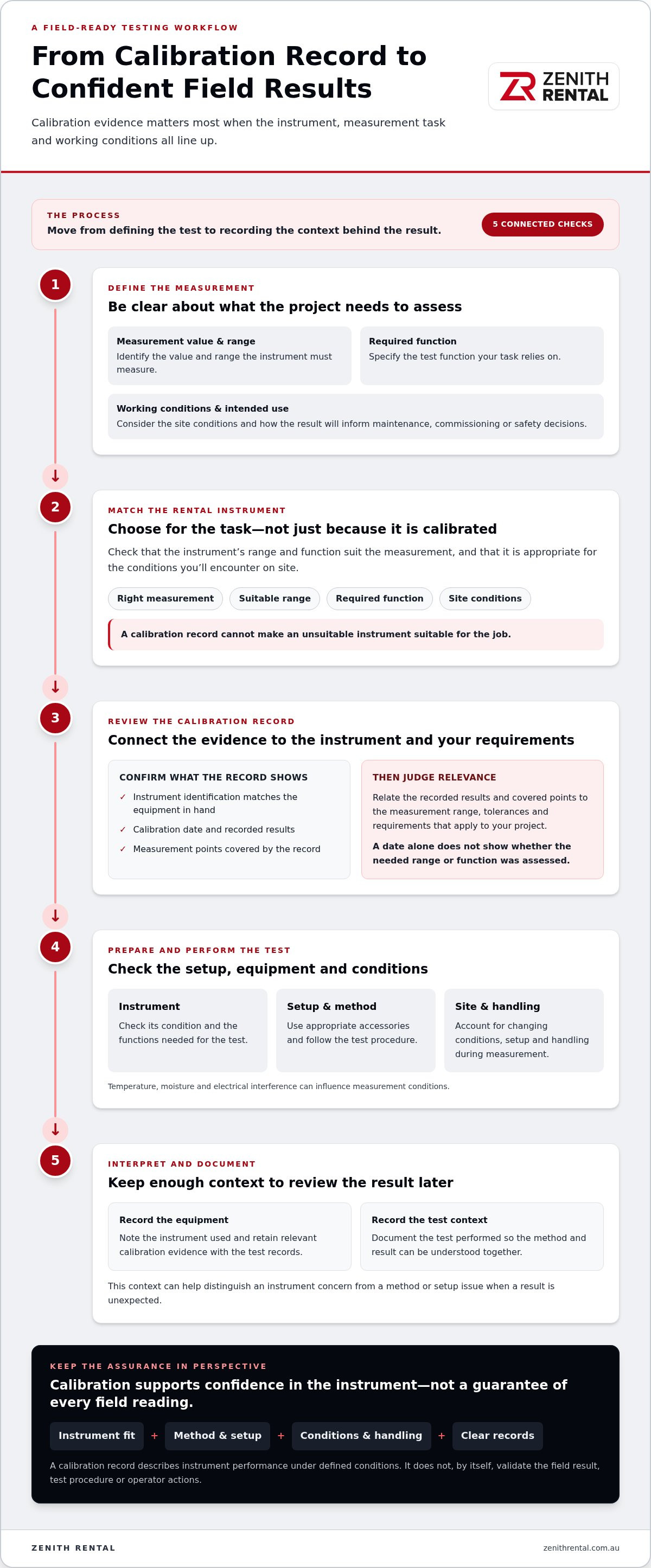
A Practical Checklist for Using Calibrated Rental Equipment
A consistent workflow helps your team move from equipment selection to defensible results without overlooking practical details. Plan the measurement first, then check the instrument and its setup before testing. These steps won’t remove every source of uncertainty, but they make it easier to identify gaps early and preserve useful context for reviewing readings.
Before the equipment arrives: define the test
Write down what must be measured, the expected range, the conditions on site and the functions the instrument needs. The task determines the instrument category: power quality measurement, insulation resistance testing and pressure testing call for different capabilities. A guide to choosing equipment for projects can help structure that selection around the job rather than familiarity alone.
- 1. Define the measurement. Specify what you’ll test, the expected range and how the result will inform a decision.
- 2. Match instrument capability. Check that the measurement range, resolution and required functions suit the task and working conditions.
- 3. Plan the complete setup. Identify the leads, probes, adapters or other accessories required, and consider environmental conditions that could influence readings.
- 4. Check the equipment on receipt. Match its identifying details to the applicable calibration information. Inspect the instrument, leads and accessories for visible damage, and review the relevant operating and safety instructions before use.
- 5. Set up consistently. Follow the defined method, use suitable connections and settings, and keep the setup repeatable across comparable tests. If conditions change, record the change rather than assuming readings remain directly comparable.
- 6. Record and review. Log the instrument identity, setup, relevant conditions, readings and any anomalies using your project’s normal recordkeeping process. Review results against the task requirements and follow up unexpected readings before relying on them.
On receipt and during testing: preserve measurement confidence
Calibration information is only one part of the pre-test review. Confirm that the record relates to the instrument received, then consider whether its stated information is relevant to the planned measurement. Don’t treat a document or date as a substitute for checking function, condition and fit for purpose. If identification, accessories or the instrument’s condition create uncertainty, resolve the issue before proceeding with the test.
Setup and environment deserve attention throughout the work. Temperature, moisture, vibration or electrical interference may affect measurement conditions, depending on the task and instrument. Keep connections, settings and operator steps consistent when comparing readings, and note any departure from the intended method.
Documented test conditions give others the context they need to interpret results, not just read the numbers. This is a practical foundation for peace of mind with calibrated rental gear: clear preparation, consistent execution and records that support review. Choose test equipment hire for your project with the measurement task and workflow in mind.
How Zenith Rental Helps You Approach Calibrated Equipment Hire with Confidence
Once you’ve defined the measurement and considered what calibration evidence can tell you, the next step is selecting equipment that fits the work. Zenith Rental is an Australian-owned specialist providing short- and long-term hire of electrical, industrial and power testing instruments across Australia. A focused equipment choice can support a smoother workflow, whether your team is completing a defined test programme or needs specialist capability for a longer project.
Peace of mind with calibrated rental gear comes from making a considered selection and using the instrument within the requirements of the task. Describe the measurement clearly, account for site conditions and treat calibration information as one part of your decision, not as a guarantee of every result.
A specialist range for electrical and industrial testing
Zenith Rental’s equipment range includes calibrators, three-phase relay testers, insulation resistance testers and power quality measurement equipment. Each category serves different project needs: a calibrator may support instrument testing, a relay tester suits relay testing work, and an insulation resistance tester addresses insulation measurements. Power quality equipment is relevant when a project calls for analysis of electrical supply conditions. The appropriate choice depends on the test method, required functions and measurement range.
Available brands include Fluke, Megger and Transmille. Brand familiarity can help a team work within established practices, but the specific instrument’s capabilities still need to match the measurement. For additional context on how calibration relates to instrumentation, explore calibration accuracy and instrumentation.
Plan your next test with a clear equipment brief
A concise project brief makes equipment selection more purposeful. Outline the task, expected measurement range, functions required, working conditions and intended hire duration. Include how the reading will be used and whether the team needs particular accessories to complete the planned setup. These details help align the equipment choice with the technical requirements and the way your team will carry out the work.
Zenith Rental supports short- and long-term hire needs across Australia, with equipment spanning electrical, industrial, pressure and power testing. A well-defined brief keeps selection connected to the project rather than relying on general assumptions about what an instrument can do. It also gives your team a useful reference when preparing for the test and documenting results.
For your next project, bring the measurement task and working conditions into focus, then explore Zenith Rental equipment hire for a considered match to your testing requirements.
Make Your Next Test a More Confident One
Carry your equipment decisions into the next project as a repeatable practice. A clear measurement brief, thoughtful instrument selection and consistent recordkeeping help your team make results easier to understand and act on. Over time, that discipline can also sharpen future test planning: note what worked, where setup took extra care and what capabilities the next job may require.
That’s the practical foundation of peace of mind with calibrated rental gear. Calibration evidence matters, but confidence grows when the instrument, method and project requirements align. Give your next test the same considered attention before work begins, and you’ll be better placed to use each reading responsibly.
For your upcoming electrical, industrial or power testing task, explore Zenith Rental’s specialist test equipment hire and take the next step towards a well-matched setup. A little preparation can make your testing workflow clearer from the outset.
Frequently Asked Questions
Does a calibration certificate guarantee every test result is accurate?
No. A calibration certificate records information about an instrument’s performance under specified conditions; it can’t guarantee every reading taken in the field. For example, a certificate won’t account for a damaged lead, a poor connection or an unsuitable test point. Treat it as one input to your decision, then follow the approved method and assess whether the measurement makes sense for the equipment and system being tested.
Can calibrated test equipment still produce an incorrect reading?
Yes. Even equipment with relevant calibration evidence can produce a misleading reading if it’s set incorrectly, used outside its intended range or connected improperly. A loose lead, wrong function selection or changing site conditions may affect the result. If a reading conflicts with expected behaviour, pause and inspect the setup before acting on it. Peace of mind with calibrated rental gear should never mean skipping a reasonableness check.
Is equipment verification the same as calibration?
No, the terms usually describe different checks, though their precise use can depend on an organisation’s procedure. Calibration establishes a relationship between an instrument’s indications and reference values under stated conditions. Verification is generally a check that the equipment meets defined requirements for its intended use. A functional check before testing may reveal an obvious issue, but it doesn’t automatically replace calibration or establish its status.
What information should I keep with my test results?
Keep enough detail for someone else to understand how each result was obtained. Alongside readings, record the instrument’s make or identifier, test date, operator, equipment or asset tested, selected function and relevant settings. Note the test location or point, unusual conditions, deviations from the usual method and any repeat measurements. Where your project process requires it, retain the applicable calibration documentation with the job record.
How should I protect rental test equipment while it is in use?
Use the instrument’s case for transport and storage, and keep it away from impact, dust, moisture and conditions outside the manufacturer’s stated operating limits. Handle probes and leads carefully; don’t pull equipment by its cables or leave connectors exposed to damage. Keep accessories together so they aren’t mixed with unrelated items. Before each use, look for visible damage, contamination or loose connections and set aside anything that appears compromised.
When should a project team review an instrument’s calibration status?
Review the status before relying on the instrument for a project measurement, ideally during planning or equipment receipt rather than at the test point. Check again if the instrument is damaged, behaves unexpectedly or has been exposed to conditions that may affect it. Your organisation’s procedure and project requirements should guide any further review. If the work is delayed, confirm the status still meets the requirements at the time of testing.
Can hiring calibrated equipment replace a documented test procedure?
No. Hiring equipment with relevant calibration information doesn’t define what to test, how to connect the instrument or how to judge the result. A documented procedure gives the team a consistent method, including required checks and recordkeeping. For example, two technicians following the same approved sequence can make their results easier to compare. Use equipment evidence and the project procedure together, not as substitutes for one another.