


Micro Milliohm Meter Hire: The Discerning Professional’s Guide to Precision Resistance Testing
Relying on a standard multimeter for sub-ohm circuit testing isn't just a minor oversight; it's a significant risk that can jeopardize the integrity of your entire commissioning process. You already know that in high-stakes industrial environments, the margin for error is non-existent. Securing a premium Micro Milliohm Meter hire is often the difference between a project that stalls and one that excels. The constant burden of NATA calibration schedules and the substantial capital investment required for high-precision instrumentation often feel like an unnecessary weight on your project's momentum. It's a challenge to balance the need for exacting accuracy with the reality of a disciplined budget.
This guide will show you how a strategic approach to equipment acquisition empowers you to bypass these logistical hurdles while securing absolute measurement reliability. We'll explore the technical advantages of the 4-wire Kelvin method and the financial wisdom of the rental model in 2026. You'll learn how to maintain full compliance with Australian safety standards and ensure your site commissioning is both seamless and successful. By the end, you'll understand why the most successful professionals view elite instrument hire as a hallmark of sophisticated project management.
Key Takeaways
- Understand how precise low-resistance testing acts as a critical safeguard against catastrophic electrical faults and equipment failure.
- Discover how the 4-wire Kelvin probe method eliminates lead resistance to provide absolute accuracy in sub-ohm circuits.
- Explore why a Micro Milliohm Meter hire offers a superior financial strategy by removing the burden of NATA calibration and capital expenditure.
- Master essential field techniques, including surface de-oxidation and lead placement, to ensure repeatable and valid test results.
- Learn how accessing world-class instrumentation ensures your project remains in full compliance with Australian safety standards in 2026.
The Strategic Importance of Micro Milliohm Meter Hire
In the high-stakes world of industrial electrical systems, precision isn't merely a preference; it's a fundamental requirement for safety and operational longevity. While a standard multimeter is a staple in any technician's toolkit, it lacks the sophistication required to measure the minute resistance levels found in high-current paths. A micro-milliohm meter is a specialized instrument engineered to detect resistance in the sub-ohm range with exacting accuracy. For professionals managing large-scale infrastructure, a Micro Milliohm Meter hire provides access to this elite level of diagnostic power without the logistical burden of asset ownership.
The necessity of this precision becomes clear when you consider the physics of high-current systems. In these environments, even a fraction of a milliohm of unintended resistance can lead to catastrophic failure. Standard multimeters fail here because they don't provide the necessary test current to "see" through surface oxides or overcome the internal resistance of their own leads. By utilizing a dedicated low-resistance tester, you ensure that every connection, from massive busbars to delicate relay contacts, meets the rigorous standards required for safe power distribution.
Detecting Contact Resistance in High-Stakes Environments
Contact resistance is often an invisible threat. It occurs at the physical interface of two conductors, such as the bolted joints of a busbar or the internal contacts of a high-voltage circuit breaker. When high current flows through these points, the $I^2R$ effect dictates that any resistance generates heat. If left undetected, this heat leads to thermal runaway. The connection oxidizes, resistance increases further, and the temperature climbs until the component fails or ignites. Professional Ducter testing, facilitated by a high-quality Micro Milliohm Meter hire, allows you to identify these anomalies long before they escalate into expensive downtime or hazardous site conditions.
Applications Across the Australian Energy and Mining Sectors
Australia's industrial landscape presents unique challenges, particularly in remote mining sites and evolving energy hubs. Precision resistance testing is vital for several key applications:
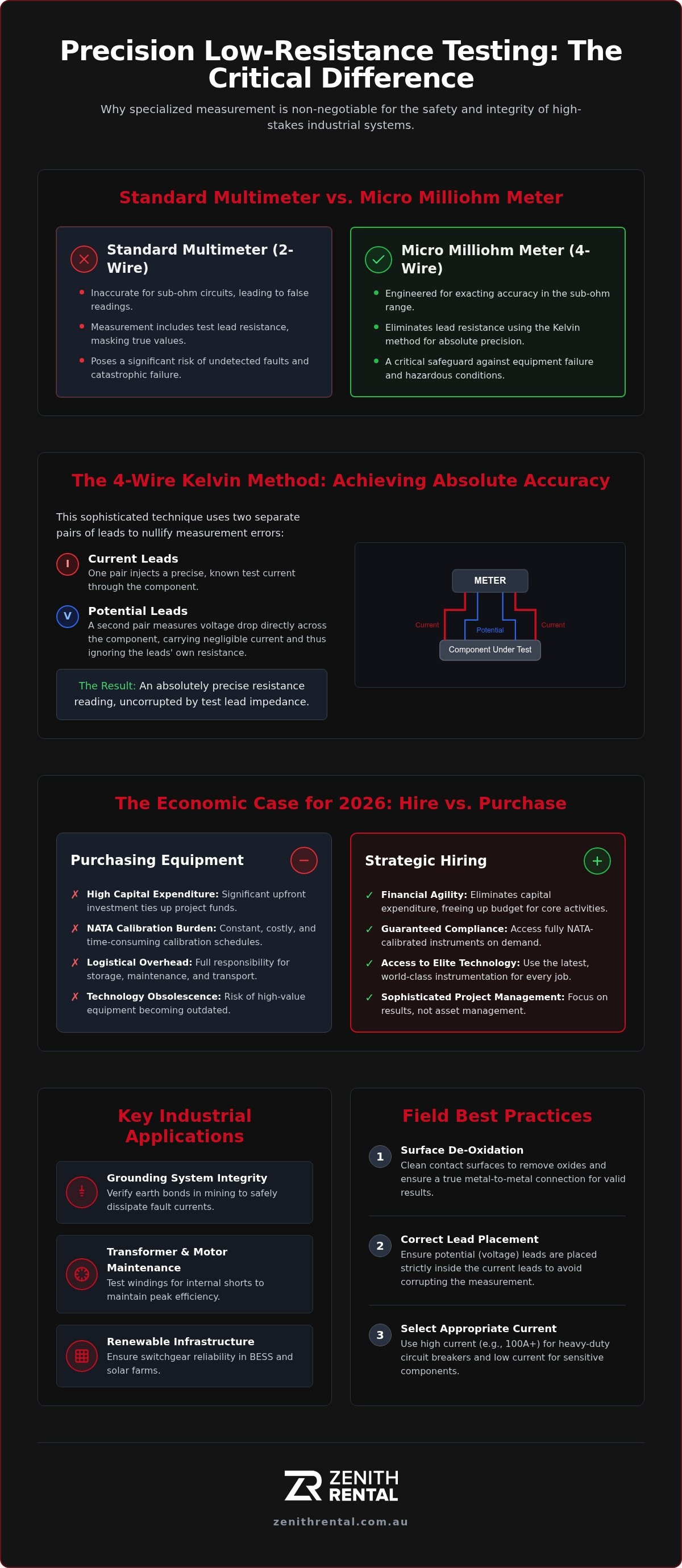
- Grounding System Integrity: Verifying that earth bonds in remote mining facilities are robust enough to dissipate fault currents safely into the soil.
- Transformer and Motor Maintenance: Testing windings for internal shorts or degradation to maintain peak efficiency in heavy machinery.
- Renewable Infrastructure: Ensuring the reliability of switchgear within battery energy storage systems (BESS) and solar farms, where high-frequency cycling demands perfect connectivity.
By integrating these precision measurements into your commissioning and maintenance schedules, you elevate your project from basic compliance to a standard of excellence that protects both personnel and high-value assets.
Technical Sophistication: The 4-Wire Kelvin Method
Standard two-wire testing is fundamentally limited by the resistance of the test leads themselves. This lead resistance is added to your measurement, creating a significant error that masks the true state of your equipment. The 4-wire Kelvin method solves this by using two separate pairs of leads. One pair carries the test current, while the second pair measures the potential drop directly across the test object. Because the potential leads carry almost no current, the voltage drop across them is negligible. This allows the meter to calculate the resistance of the component with absolute precision, unencumbered by the leads' own impedance.
Selecting the appropriate current injection level is equally critical. Low-current settings are ideal for testing small relays or sensitive electronic components where high current might cause damage. Conversely, high-current injection, often reaching 100A or more, is necessary to overcome contact films and oxides in heavy-duty circuit breakers. A sophisticated Micro Milliohm Meter hire provides the flexibility to toggle between these modes, ensuring your diagnostic approach is as refined as the infrastructure you're testing.
Milli vs. Micro: Matching Instrumentation to the Task
Milliohm meters are the workhorses for general diagnostics, such as checking motor windings or verifying cable integrity across large facilities. However, high-voltage switchgear and transformer bushings require micro-ohm resolution to detect the earliest signs of degradation. In 2026, the established resolution threshold for micro-ohm meters requires the ability to resolve measurements to 0.1 micro-ohms with a base accuracy of at least 0.2%.
Instrument Features for Discerning Professionals
Elite instrumentation must withstand the rigors of the field. Look for units with high IP ratings, typically IP65, to ensure dust and moisture don't compromise your data in harsh Australian environments. Modern digital reporting is also essential; instruments that offer seamless data logging and Bluetooth connectivity allow you to generate NATA-compliant reports directly from the site. Reliability also extends to power management. Long battery life and rapid charging capabilities ensure your schedule remains uninterrupted during intensive testing windows. When precision is your priority, choosing a high-tier Micro Milliohm Meter hire ensures you have a tool that matches your professional standards.
The Economic Case: Why Hire Trumps Purchase in 2026
Strategic asset management in 2026 requires more than just technical proficiency; it demands a sophisticated approach to capital allocation. While owning a high-precision tester might once have been seen as a badge of professional readiness, the rapid pace of technological advancement has shifted the paradigm. Choosing a Micro Milliohm Meter hire transforms a heavy capital investment into a streamlined operational expense. This shift allows you to preserve your budget for core project activities while ensuring you always have access to the absolute peak of measurement technology.
Ownership often carries a hidden tax of rapid depreciation and escalating maintenance costs. High-end diagnostic tools, particularly those featuring the latest digital interfaces and high-current capabilities, can become legacy hardware within a few short years. By opting for a rental model, you bypass the risk of asset obsolescence. You gain the agility to scale your capabilities according to the specific demands of each contract, whether you require a lightweight handheld unit for site inspections or a high-current station for transformer testing.
NATA Traceability: The Gold Standard of Compliance
The administrative burden of maintaining NATA traceability is often the most significant "calibration trap" for any professional organization. Missing a calibration window doesn't just compromise your data; it creates a legal and safety liability that can derail site audits and invalidate commissioning reports. Zenith Rental eliminates this friction entirely. We manage the rigorous calibration cycles for every instrument in our curated inventory. When you secure a Micro Milliohm Meter hire through our service, the asset arrives with a current, NATA-traceable certificate, ensuring your project remains in full compliance with Australian safety standards without you ever having to track a schedule.
Optimising Project Budgets with Elite Hire
When you calculate the total cost of ownership, the numbers clearly favor the hire model for most industrial projects. Beyond the initial purchase price, you must account for insurance, secure storage, and the inevitable repairs that high-stakes field use requires. Our service offers a more refined financial path:
- Project-Specific OPEX: Align your equipment costs directly with project revenue for cleaner balance sheets.
- National Support: Benefit from our national coverage, ensuring that high-tier instrumentation is available wherever your project takes you across Australia.
- Zero Downtime: Access immediate replacements or backups if your project scope changes, keeping your team productive and your timeline intact.
This logistical ease, combined with the prestige of using world-class brands like Megger and Fluke, positions your firm as a high-tier partner that values both precision and efficiency.
Field Best Practices for Accurate Resistance Testing
Executing precise measurements in the field requires a disciplined approach that extends beyond simply pressing a button. While a Micro Milliohm Meter hire provides the high-fidelity hardware required for sub-ohm diagnostics, the validity of your data rests on your preparation and technique. A single oversight in surface preparation or probe placement can introduce errors that dwarf the actual resistance of the component under test. Mastering these variables is what separates a routine check from a professional certification.
Surface integrity is your first priority. Atmospheric oxidation and industrial contaminants create resistive films that interfere with current flow. Before attaching your Kelvin clips or probes, ensure the contact points are cleaned to a bright metal finish using non-abrasive techniques. This step is particularly vital in coastal or high-humidity Australian environments where corrosion cycles are accelerated. Once the surface is prepared, lead placement must be consistent. Small variations in where you seat your potential probes can lead to significant fluctuations in readings, especially on large busbars or complex switchgear assemblies.
Step-by-Step Guide to a Successful Resistance Test
Begin with a rigorous visual inspection of both the asset and your test leads. Check for frayed insulation or oxidized probe tips that could compromise the circuit. When you're ready to test, select a current injection level that is high enough to provide a stable reading but remains well within the thermal limits of the asset. Injecting 100A into a small relay, for instance, could cause permanent damage. After the meter stabilizes, record the result alongside the ambient temperature. Since resistance is temperature-dependent, normalizing your data to a standard reference allows for accurate historical comparisons and trend analysis.
Common Pitfalls and How to Avoid Them
Electromagnetic interference (EMI) is a persistent challenge in active substations and industrial plants. High-voltage lines can induce noise into your test leads, leading to erratic displays. To mitigate this, keep your leads as short as possible and avoid coiling excess cable. Another common pitfall is accepting "close enough" results. In 2026, safety standards leave no room for ambiguity; a measurement that is marginally outside of specifications is a liability, not a pass. Always ensure your leads are mechanically secure before testing to prevent the measurement fluctuations that occur with loose connections.
To ensure your next project meets these exacting standards, secure your equipment through a professional Micro Milliohm Meter hire and experience the reliability of world-class instrumentation.
Zenith Rental: Your Partner in Precision Instrumentation
Selecting a partner for high-precision testing is a decision that reflects your own commitment to excellence. At Zenith Rental, we understand that our instruments are a critical component of your professional reputation. We don't just provide equipment; we offer a sophisticated service model built on absolute reliability and professional authority. By securing a Micro Milliohm Meter hire through our curated inventory, you're choosing a partner that prioritizes the success of your project as much as you do. Our team focuses on the finer details, ensuring that every asset we provide contributes to the seamless nature of your site operations.
Our national support network is tailored specifically for the Australian market. We ensure that distance never compromises your access to elite-tier instrumentation. Whether you're operating in a remote mining hub or an urban energy center, our logistics team manages every detail to ensure your equipment arrives calibrated, compliant, and ready for immediate deployment. This commitment to efficiency and high performance mirrors the standards of the discerning professionals we serve.
Elite Brands and Proven Reliability
We believe that premium results require premium tools. This is why we trust Megger for the most demanding low-resistance tasks. Their hardware is the industry benchmark for durability and precision in the field. There is also a natural synergy between Fluke reliability and the high-end service Zenith provides. We maintain a continuous investment cycle in 2026-spec testing technology, ensuring that our clients are never held back by legacy equipment or outdated interfaces. Our inventory is a testament to our status as a high-tier partner for professional requirements.
Seamless Integration into Your Workflow
The Zenith experience is designed to be frictionless. Our deeply knowledgeable staff provides expert technical advice, helping you navigate the nuances of current injection levels and resolution requirements to select the perfect meter. We've mastered the art of luxury service in the industrial sector, moving you from a quote to on-site implementation with impeccable organization. Our engagement process typically follows a smooth, logical rhythm:
- Expert Consultation: We help you match instrument specifications to the unique demands of your project.
- Rapid National Dispatch: Your NATA-certified asset is dispatched quickly to maintain your project momentum.
- Professional Support: You gain access to ongoing technical assistance from elite service professionals.
Every detail of our service is considered. We provide NATA-traceable calibration certificates as a standard, removing the administrative burden of compliance from your team. This focus on the finer details allows you to concentrate on the technical complexities of your project, secure in the knowledge that your measurement integrity is absolute. Secure your project’s integrity with a Micro Milliohm Meter hire from Zenith Rental today.
Elevating Your Project Standards with Precision
Mastering low-resistance testing is a fundamental investment in the long-term integrity of your infrastructure. By prioritizing technical sophistication and rigorous field protocols, you protect your assets from the invisible risks of contact resistance. A strategic Micro Milliohm Meter hire ensures that you always work with the most advanced instrumentation, allowing you to bypass the administrative burden of NATA calibration while maintaining full compliance with Australian safety standards. It's about more than just equipment; it's about the peace of mind that comes from absolute measurement reliability.
Zenith Rental supports your commitment to excellence with a curated inventory from world-class brands like Megger and Fluke. Every instrument in our fleet includes NATA-traceable calibration as standard, backed by a national Australian support and delivery network designed for the most demanding environments. This seamless integration of high-tier hardware and expert support allows your team to focus on successful site commissioning without logistical friction.
Explore our elite range of Micro Milliohm Meters for hire to secure the reliability your next project demands. We look forward to supporting your success with the highest standard of service in the industry.
Frequently Asked Questions
What is the difference between a micro-ohm meter and a standard multimeter?
Standard multimeters are designed for general electrical work and lack the sensitivity to measure resistance below one ohm with any meaningful accuracy. A micro-ohm meter utilizes a high test current and specialized circuitry to resolve measurements in the micro-ohm range. This precision is necessary for detecting contact degradation in high-current components like busbars. A Micro Milliohm Meter hire ensures you have the technical capacity to detect faults that a standard multimeter would simply overlook.
Why is NATA calibration essential for micro-milliohm meter hire in Australia?
NATA-traceable calibration is the industry benchmark for measurement accuracy and legal compliance across Australia. It provides a documented chain of evidence that your instrument performs to national standards. Using uncalibrated equipment during site commissioning creates significant liability and can lead to failed safety audits. Zenith Rental includes current NATA-traceable certificates with every hire, ensuring your project meets the highest professional standards of reliability and site safety.
Can I use a micro-milliohm meter for testing grounding systems?
Yes, these meters are essential for verifying the integrity of grounding systems, particularly the low-resistance bonds between earth electrodes and structural steel. While a dedicated earth tester measures soil resistivity, a micro-milliohm meter confirms that the physical connections are robust enough to carry fault currents. This testing is critical for infrastructure projects where grounding reliability is a non-negotiable safety requirement for protecting both personnel and high-value equipment.
How much current is typically used during a low-resistance test?
Test currents typically range from 10mA for sensitive electronic components up to 100A or higher for industrial circuit breakers. The choice depends on the asset's thermal limits and the need to break through surface oxidation. Using a high-current injection provides a more stable reading on heavy-duty connections. Our technical team can assist you in selecting a meter with the appropriate current range for your specific industrial or energy application.
What is the 4-wire Kelvin method and why is it used?
The 4-wire Kelvin method uses two leads to inject current and two separate leads to measure the voltage drop. This configuration is used because it completely eliminates the resistance of the test leads from the measurement calculation. It's the only reliable way to achieve sub-ohm accuracy. By separating the current and potential paths, the meter provides a true reading of the component's resistance, which is vital for high-stakes precision testing.
Are the meters provided by Zenith Rental suitable for harsh field environments?
Every instrument in our inventory is selected for its ability to perform in demanding Australian field conditions. We feature elite brands like Megger and Fluke, known for their ruggedized chassis and high IP ratings, often reaching IP65 for dust and water protection. These professional-grade tools are designed to withstand the rigors of remote mining sites and industrial hubs, ensuring you maintain measurement integrity regardless of the environmental challenges on-site.
How quickly can Zenith Rental deliver equipment to a national project site?
Zenith Rental operates with a national support and logistics framework designed to meet the urgent timelines of critical industrial projects. We prioritize rapid dispatch to ensure your equipment arrives exactly when needed, regardless of your project's location across the country. Our streamlined engagement process, from initial quote to site delivery, is engineered to minimize friction and keep your commissioning schedule on track without any unnecessary delays.
What documentation is provided with a Micro Milliohm Meter hire?
A Micro Milliohm Meter hire from Zenith Rental includes a comprehensive documentation package to support your site compliance. You'll receive a current NATA-traceable calibration certificate, detailed user manuals, and relevant safety documentation. This ensures your team has the information required for safe operation and that your project files contain the verified data needed to prove compliance with Australian safety standards and the highest industry best practices.