


Mastering the Transformer Oil Sampling Procedure: A Professional’s Guide to Precision
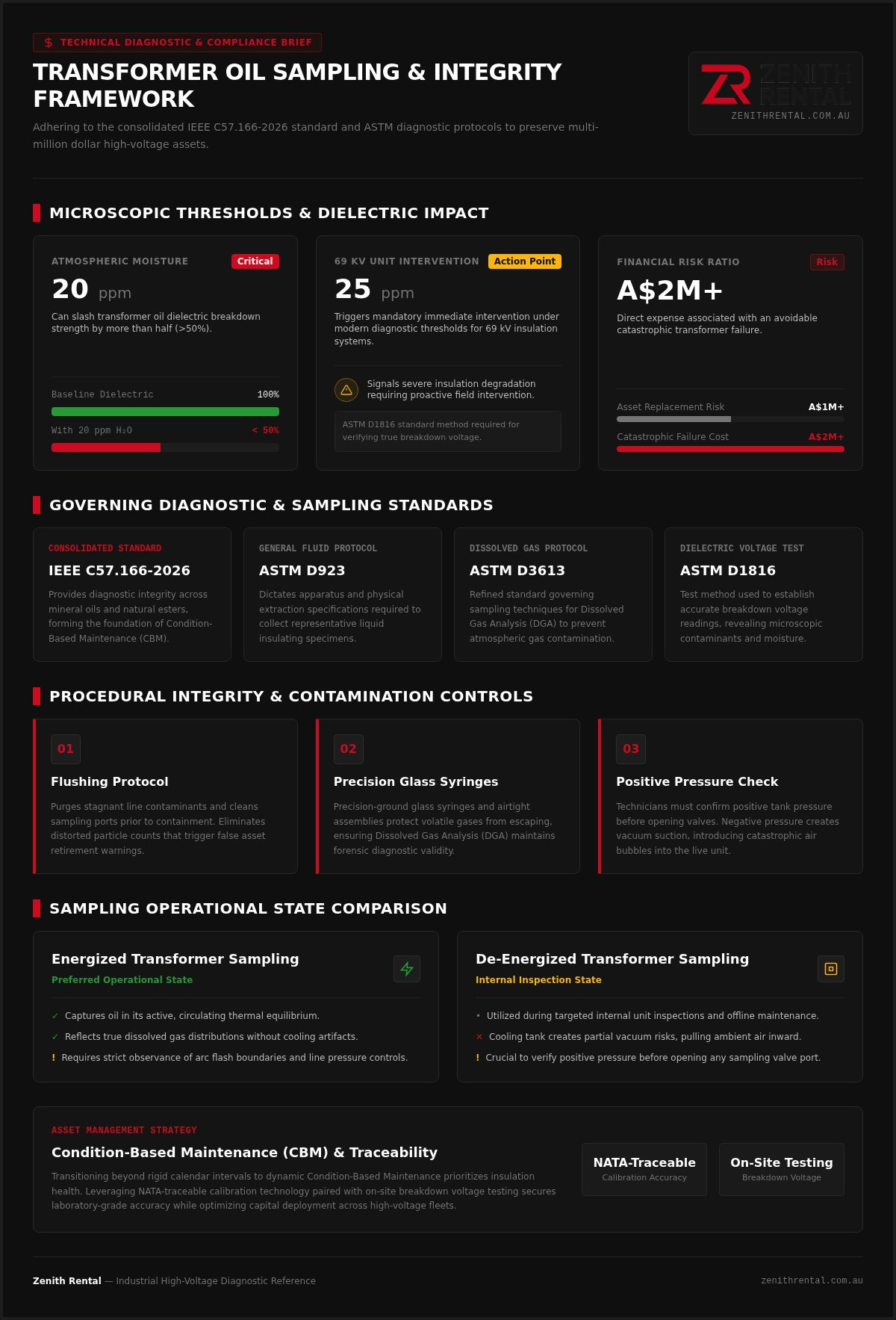
Did you know that as little as 20 parts per million of atmospheric moisture can slash your transformer oil's dielectric strength by more than half? It's a sobering reality for high-voltage professionals who understand that the integrity of a multi-million dollar asset rests on a single, perfectly executed extraction. You've likely experienced the frustration of chasing a false DGA reading or the anxiety of sampling a live unit when the stakes for safety and environmental compliance are at their peak.
This guide provides a rigorous, standard-compliant transformer oil sampling procedure designed to eliminate air intrusion and ensure your laboratory results are beyond reproach. We'll explore the critical transition to the IEEE C57.166-2026 standard, the necessity of ASTM D1816 testing, and the precise steps required to maintain an audit-ready protocol for every high-voltage asset in your fleet. By mastering these refined techniques, you'll secure the repeatable, contamination-free samples necessary for accurate diagnostics and absolute reliability. We'll also examine the essential equipment needed to maintain NATA-traceable accuracy across the Australian landscape, ensuring your maintenance program reflects the highest tier of professional excellence.
Key Takeaways
- Align your maintenance protocols with the latest IEEE C57.166-2026 standards to ensure every diagnostic report meets the most rigorous international benchmarks for excellence.
- Master a flawless transformer oil sampling procedure by implementing a disciplined flushing protocol that effectively eliminates stagnant contaminants and the risk of air intrusion.
- Utilise precision-ground glass syringes and airtight sampling assemblies to preserve the integrity of your Dissolved Gas Analysis (DGA) and prevent the loss of volatile gases.
- Pair your sampling regime with high-performance on-site breakdown voltage testing to gain an immediate, reliable perspective on the dielectric health of your assets.
- Leverage NATA-traceable rental equipment to access elite-tier calibration and measurement technology without the burden of significant capital expenditure.
The Critical Role of Precision in Transformer Oil Sampling
A meticulously executed transformer oil sampling procedure is the baseline of elite asset management. It's a controlled extraction designed to capture a representative snapshot of the fluid's chemical and physical state. Much like a medical professional relies on a blood test to diagnose internal ailments, electrical engineers use Dissolved Gas Analysis (DGA) to peer inside the hermetic seal of a transformer. This diagnostic clarity is vital. It transforms invisible thermal or electrical stresses into actionable data, allowing for the proactive management of high-voltage assets across the Australian grid with absolute reliability.
The financial implications of a single procedural error are staggering. A sample contaminated by external particulates or moisture can trigger a false positive, potentially leading to the unnecessary decommissioning of an asset valued at over A$1 million. By adopting Condition-Based Maintenance (CBM) and adhering to the consolidated IEEE C57.166-2026 standard, professionals move beyond rigid schedules, opting instead for a strategy that prioritises the actual health of the insulation system. This transition to CBM represents the industry gold standard, ensuring that every maintenance dollar is spent where it provides the most value and prestige.
Microscopic Indicators of Transformer Health
Precision sampling allows technicians to detect dissolved gases, moisture, and metallic traces long before a catastrophic failure occurs. These microscopic elements serve as forensic evidence of insulation degradation. For instance, moisture levels as low as 25 ppm in a 69 kV unit can signal the need for immediate intervention according to modern diagnostic thresholds. Air intrusion during the extraction process can also artificially lower dielectric breakdown voltage readings, masking the true performance of the oil. Comprehensive transformer oil testing, utilising the ASTM D1816 method, provides the necessary insight to predict and prevent faults, ensuring the longevity of critical infrastructure through data-driven decisions.
The Consequences of Compromised Samples
Poorly maintained valves or substandard containers don't just provide "bad data"; they actively obscure developing faults. If a sample is drawn through a dirty port without proper flushing, the resulting particle count may suggest premature asset retirement for a perfectly healthy unit. This lack of precision creates unnecessary friction in the audit process and undermines the reliability of the entire electrical network. Accuracy is not a luxury; it's a requirement for operational success. In 2026, the cost of a precision transformer oil sampling procedure remains a negligible fraction of the A$2 million-plus expense associated with an avoidable catastrophic transformer failure.
Industry Standards and Preparation for Extraction
Achieving a flawless result begins with an unwavering commitment to international benchmarks. The transformer oil sampling procedure must align with ASTM D923 sampling standards, which dictate the specific apparatus and techniques required to secure a representative specimen. While ASTM D923 governs the general extraction of insulating liquids, ASTM D3613 provides the refined protocol necessary for Dissolved Gas Analysis (DGA). These standards work in tandem with IEEE C57.166-2026, the newly consolidated guide that ensures diagnostic integrity across various insulating fluids, including mineral oils and natural esters.
Safety protocols differ significantly depending on whether the unit's energized or de-energized. Sampling from an energized transformer is often preferred to capture the oil in its active, circulating state, yet it requires rigorous adherence to arc flash boundaries and pressure management. Conversely, de-energized sampling may be necessary for specific internal inspections but carries the risk of air ingress if the tank cools and creates a partial vacuum. Technicians must verify positive pressure before opening any valves to prevent air bubbles from entering the active tank, which could cause catastrophic dielectric failure during operation.
Navigating ASTM and IEEE Compliance
Compliance isn't merely about the extraction; it's about the precision of the diagnostic intent. Sampling for moisture requires different vessel preparation than sampling for gas, where even a microbubble can invalidate a Status 3 concern under IEEE C57.104-2019. For Australian professionals, these procedures form the backbone of NATA-traceable reporting. Precise documentation and impeccable labelling ensure that every sample contributes to an audit-ready history of asset performance. Maintaining this level of detail is seamless when you hire calibrated testing equipment designed for high-stakes industrial environments.
Site Conditions and Environmental Hazards
Environmental controls are your primary defence against contamination. You shouldn't initiate a sample when relative humidity exceeds 70% or during inclement weather without a controlled enclosure. Atmospheric water can contaminate a sample instantly, leading to a false dielectric failure. Before extraction, the sampling valve must be cleaned and flushed with at least two litres of oil to remove stagnant debris. Personal Protective Equipment (PPE) is non-negotiable. Handling hot insulating fluids requires thermal-resistant gloves and face shields to ensure the technician's safety matches the rigour of the procedure itself.
Selecting High-Performance Sampling Equipment and Containers
The selection of extraction hardware is where theoretical knowledge meets physical precision. A rigorous transformer oil sampling procedure requires more than just a clean vessel; it's a process that demands instrumentation designed to preserve the chemical integrity of the fluid under varied environmental stressors. For Dissolved Gas Analysis (DGA), the industry standard remains the precision-ground glass syringe. Unlike plastic alternatives, glass is non-permeable to volatile gases like hydrogen and acetylene, ensuring the sample reaching the lab is an exact reflection of the transformer's internal state. For bulk samples intended for particle counting, clean-room certified containers are non-negotiable, as they prevent ambient dust from creating false-positive reports of insulation distress.
The DGA Syringe vs. Bulk Bottle Debate
Preserving the "fingerprint" of the oil requires a nuanced understanding of storage. Glass syringes with Luer-lock three-way valves allow for a hermetic seal, effectively eliminating the risk of gas partitioning into air bubbles. For broader diagnostic suites, including moisture and acidity tests, amber glass bottles provide a shield against photo-oxidation. Adhering to the Bureau of Reclamation FIST guidelines ensures that your choice of container aligns with global best practices for high-voltage maintenance. To source the necessary precision tools for your next audit, consider the benefits of test equipment hire Australia, which provides immediate access to professional-grade sampling kits.
Leveraging Rental for Elite Instrumentation
Capital expenditure on niche diagnostic tools can often be difficult to justify for periodic maintenance cycles. Leveraging a rental model allows Australian firms to deploy the latest Megger or Fluke instrumentation, such as high-accuracy oil breakdown testers, without the long-term burden of ownership and calibration management. Every asset provided through a premium hire service is NATA-calibrated and site-ready, ensuring your transformer oil sampling procedure is supported by equipment at the peak of its performance. This approach not only reduces maintenance overhead but also guarantees that your team is working with the most refined technology available, reflecting a commitment to absolute reliability and professional prestige.
The Step-by-Step Transformer Oil Sampling Procedure
Executing a flawless transformer oil sampling procedure requires a disciplined, rhythmic approach to field operations. This protocol serves as the definitive checklist for technicians who demand absolute accuracy and compliance with Australian industrial standards. By following a structured sequence, you eliminate the variables that lead to costly diagnostic errors. Every movement must be deliberate, ensuring the fluid reaches the laboratory in the exact condition it existed within the transformer tank.
- Step 1: Flush the sampling valve. Open the valve and allow at least two litres of oil to flow into a waste container. This step is vital to remove stagnant oil and any accumulated debris from the valve body and sampling port.
- Step 2: Secure the sampling assembly. Connect your high-quality tubing and adapters to the valve. Ensure every connection is airtight to prevent the ingress of atmospheric moisture or oxygen during the extraction.
- Step 3: Regulate the flow. Adjust the valve to maintain a steady, laminar stream. You must avoid high-velocity turbulence, as cavitation can introduce microscopic air bubbles that compromise both DGA and dielectric breakdown results.
- Step 4: Fill the container. When using glass syringes for DGA, ensure there's zero headspace. For bulk samples, fill the bottle to the shoulder, leaving minimal air gap while allowing for slight thermal expansion.
- Step 5: Seal and label immediately. Clean the exterior of the container, apply a secure seal, and attach a detailed label. Documentation should include the asset ID, oil temperature, and ambient conditions at the time of the sample.
Execution Protocol for DGA Samples
Managing the three-way stopcock is the most critical movement during DGA extraction. This valve allows you to vent the initial oil flow and any trapped air pockets before the fluid enters the syringe, maintaining a hermetic seal throughout the process. The flush-and-fill technique ensures the syringe is rinsed with the source oil at least twice before the final analytical volume is captured. A standard Dissolved Gas Analysis typically requires a minimum volume of 30 to 50 millilitres of oil collected in a gas-tight glass syringe.
Post-Sampling Quality Control
The integrity of your data depends on a secure chain of custody that begins the moment the valve is closed. You should verify the seal's integrity and pack the samples in a padded, light-shielded transport case to prevent UV degradation or physical damage. Australian environmental regulations are strict regarding the handling of insulating fluids; all flush oil must be collected in dedicated containers for proper disposal and never discarded on-site. To ensure your field team is equipped with the precision required for this protocol, you can hire NATA-calibrated sampling equipment for your next project.
Beyond the Sample: Analysis and Breakdown Voltage Testing
While the laboratory provides the definitive chemical breakdown, on-site diagnostics offer the immediate clarity required for high-stakes decision-making. The transformer oil sampling procedure isn't merely a logistical step; it's the gateway to a comprehensive health profile. By performing an immediate dielectric breakdown test, technicians can identify critical failures before the sample even reaches the lab. This "first-look" diagnostic is essential for justifying emergency shutdowns or confirming that an asset is safe for continued operation under peak load conditions across the Australian grid.
Interpreting these results requires a sophisticated understanding of how fluid properties interact. Acidity levels and interfacial tension (IFT) provide a window into the oxidation state of the oil, while furanic compound analysis offers a forensic look at the degradation of the paper insulation. If on-site data reveals a sharp decline in dielectric strength, it often signals the presence of moisture or conductive particulates that demand immediate filtration. This real-time intelligence ensures that maintenance teams aren't waiting days for a lab report when an asset's integrity is at risk.
Utilising Transformer Oil Breakdown Voltage Testers
The primary benefit of on-site verification is the speed of assessment. Utilising a transformer oil breakdown voltage tester hire allows your team to perform ASTM D1816 compliant tests in the field, providing a reliable measure of the oil's ability to withstand electrical stress. This immediate feedback complements the more granular laboratory DGA, creating a multi-layered diagnostic approach. When a sample shows a breakdown voltage below the established IEEE thresholds, it provides the empirical evidence needed to initiate proactive oil processing or replacement, safeguarding assets valued at millions of dollars.
Advanced Diagnostics with TTR and Insulation Testing
A truly elite maintenance program integrates fluid analysis with core electrical testing. Combining your transformer oil sampling procedure data with digital transformer turns ratio meter results allows you to verify that internal physical displacements haven't occurred. Simultaneously, using insulation resistance testers helps confirm that the winding integrity remains intact despite any detected oil contamination. For professionals who demand the highest standards of accuracy and prestige, partnering with Zenith Rental provides an elite, end-to-end testing fleet. Accessing NATA-calibrated, industrial-grade instrumentation ensures that every diagnostic conclusion is backed by absolute reliability and technical excellence.
Securing the Future of Your High-Voltage Assets
Mastering a refined transformer oil sampling procedure is more than a technical requirement; it's a commitment to the longevity and prestige of your electrical infrastructure. By adhering to the consolidated IEEE C57.166-2026 standards and using precision-ground glass syringes, you ensure every diagnostic report is an absolute reflection of asset health. This disciplined approach eliminates the friction of false readings and provides the empirical evidence needed for confident, data-driven decision-making.
Success in the field depends on the quality of your instrumentation. Accessing elite technology shouldn't require significant capital expenditure when reliability is at stake. Zenith Rental provides the sophisticated tools necessary for these critical audits, ensuring your team performs at the peak of industry standards with total peace of mind.
Explore Our Elite Range of Transformer Testing Equipment for Hire and benefit from NATA-calibrated instrumentation, nationwide Australian delivery, and specialised technical support tailored for industrial excellence. Let's ensure your next maintenance cycle reflects the highest tier of professional reliability.
Frequently Asked Questions
Can you take an oil sample from a live transformer safely?
Sampling from a live transformer is safe and often preferred, provided technicians verify positive pressure before opening the valve. This prevents the unit from drawing in air bubbles, which could lead to an immediate dielectric failure. It's essential to follow strict arc flash boundaries and ensure the oil is circulating to capture a representative specimen of the asset's current health and performance.
How often should transformer oil be sampled for testing?
The frequency of your transformer oil sampling procedure depends on the asset's condition as defined by IEEE C57.104-2019. Status 1 units typically require annual testing, while Status 2 or 3 units demand more frequent monitoring to track gas generation rates. Critical infrastructure or high-load transformers often benefit from biannual checks to ensure any insulation degradation is identified before it reaches a catastrophic threshold.
What is the most common cause of a contaminated oil sample?
Atmospheric moisture is the most frequent cause of contaminated samples. even a minor exposure to humid air can introduce 20 to 30 ppm of water, which is enough to reduce the oil's dielectric breakdown voltage by more than half. Other common culprits include dirty sampling valves that haven't been properly flushed and the use of non-certified containers that introduce ambient dust into the fluid.
Why is zero headspace required for DGA oil samples?
Zero headspace is required to prevent volatile gases from partitioning out of the oil and into the air bubble. If a headspace exists, critical diagnostic gases like hydrogen and acetylene will escape the liquid phase, leading to skewed laboratory results. Using a precision-ground glass syringe with a three-way stopcock allows technicians to eliminate all air, ensuring the sample remains a true reflection of the transformer's internal chemistry.
What are the main differences between ASTM D923 and ASTM D3613?
ASTM D923 provides the general standard for sampling insulating liquids using bottles or cylinders for physical and chemical analysis. In contrast, ASTM D3613 focuses specifically on the refined techniques required for Dissolved Gas Analysis (DGA). While D923 is suitable for monitoring moisture and acidity, D3613 mandates the use of gas-tight syringes to prevent the loss of light hydrocarbons and hydrogen during transport to the laboratory.
How much oil needs to be flushed before taking a representative sample?
You must flush a minimum of 1 to 2 litres of oil before drawing the analytical sample. According to ASTM D923 and IEC 60475, the flush volume should also be at least 2 to 4 times the internal volume of the sampling line and valve assembly. This rigorous step ensures that stagnant oil, moisture, and debris are removed from the port, allowing for a truly representative extraction.
What safety PPE is required for transformer oil sampling?
Safety PPE for transformer oil sampling includes thermal-resistant gloves, a full face shield, and an oil-resistant apron to protect against hot insulating fluids. If sampling from an energized unit, technicians must also wear appropriate arc flash-rated clothing as determined by the site's safety audit. Ensuring your team has the correct gear is just as vital as using NATA-calibrated instrumentation for maintaining a professional and safe work environment.
How does temperature affect the transformer oil sampling procedure?
Temperature is a critical factor because it influences moisture solubility and the risk of condensation. You should ideally perform the transformer oil sampling procedure when the oil is warmer than the ambient air. If cold oil is sampled in warm, humid conditions, moisture will condense on the equipment surfaces and contaminate the specimen, leading to a false-positive reading for water content and a lower dielectric strength result.