


How to Use a Power Quality Analyzer: A Definitive Guide to Industrial Precision
An unexpected power surge in a high-voltage industrial environment does more than disrupt a production schedule. It threatens the very integrity of your most valuable assets. Mastering how to use a power quality analyzer is no longer just a technical requirement; it's an essential safeguard for the discerning professional who demands absolute reliability. You've likely felt the tension of connecting high-precision instruments to live systems or the exhaustion of navigating data streams that refuse to reveal their secrets. We understand that the pressure to maintain site compliance with the latest Australian standards is significant, especially when the stakes for your infrastructure are so high.
This guide empowers you to command the complexities of power quality analysis with total confidence. We'll walk you through the precise setup and measurement techniques required for elite industrial environments. You'll learn to identify the root cause of equipment failure and ensure your facility aligns with the rigorous IEC TS 62749:2026 specifications. We're moving beyond simple logging to provide you with a sophisticated roadmap for electrical excellence and site-wide peace of mind.
Key Takeaways
- Understand why a power quality analyzer is the superior choice over a standard multimeter for capturing the nuanced story of your electrical system.
- Master the technical precision of how to use a power quality analyzer, from ensuring correct phase rotation to the vital orientation of current clamps in a three-phase system.
- Transform raw data and complex waveforms into definitive diagnostic insights that identify the root causes of equipment failure and harmonic interference.
- Adopt a strategic approach to equipment sourcing by leveraging high-tier rental assets to access the most advanced diagnostic technology without the burden of high purchase costs.
- Align your site with the latest IEC TS 62749:2026 standards, ensuring your operations meet the highest benchmarks of industrial quality and compliance.
Understanding the Power Quality Analyzer: Your Industrial Diagnostic Powerhouse
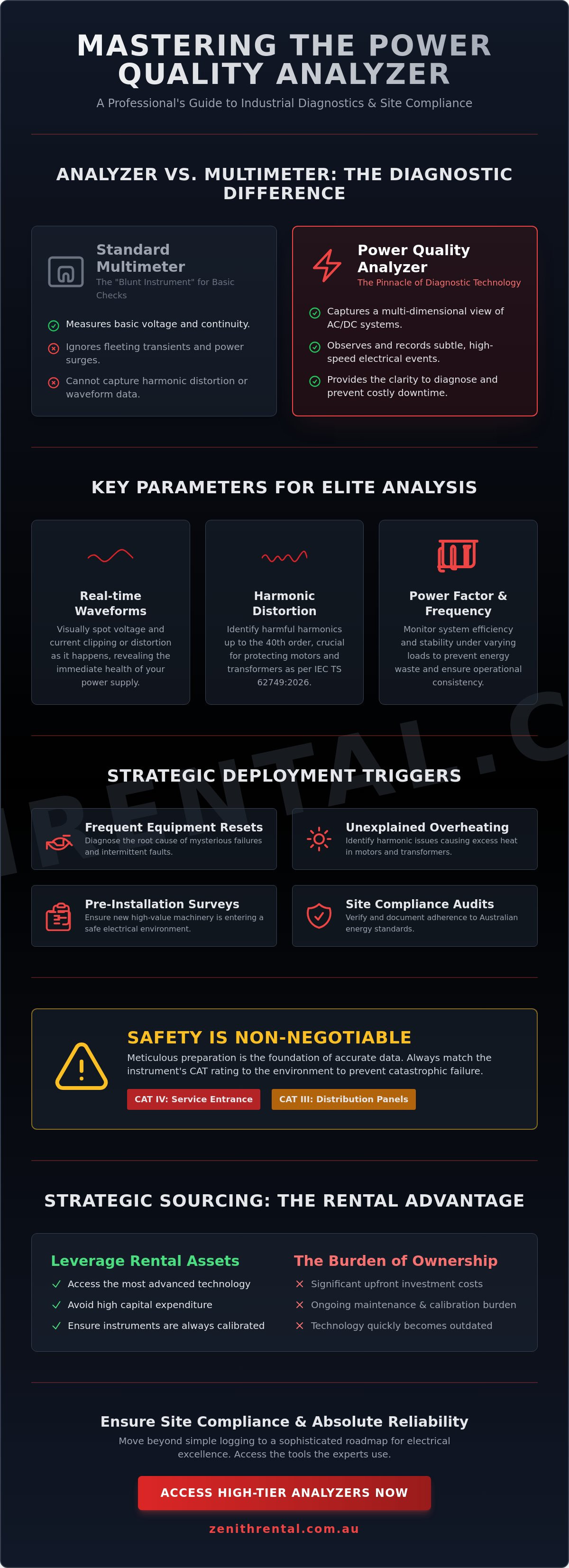
Precision in high-stakes industrial environments isn't a luxury; it's a prerequisite for operational success. While a standard digital multimeter serves its purpose for basic continuity or voltage checks, it remains a blunt instrument in the face of complex system failures. A power quality analyzer represents the pinnacle of diagnostic technology, offering a multi-dimensional view of your AC/DC systems. It doesn't just measure; it observes. It captures the fleeting transients and subtle harmonic distortions that standard meters simply ignore. Mastering how to use a power quality analyzer is the hallmark of a professional dedicated to site-wide resilience and absolute reliability.
These instruments act as the gold standard for facility energy audits, providing the clarity needed to justify infrastructure investments. By visualizing the hidden irregularities in your power supply, you can address issues before they manifest as costly downtime. Understanding the nuances of Electric Power Quality is fundamental for any facility manager aiming for peak performance, ensuring that sensitive electronics remain within the strict tolerances required for longevity.
Key Parameters Measured by Elite Analyzers
Elite analyzers provide a level of detail that transforms your understanding of energy flow. They don't just provide numbers; they provide context. Key metrics include:
- Real-time Waveforms: Visualizing voltage and current waves allows you to spot clipping or distortion as it happens.
- Harmonic Distortion: Identifying harmonics up to the 40th order, as specified in the updated IEC TS 62749:2026, is vital for protecting motors and transformers.
- Power Factor and Frequency: Monitoring these metrics ensures your system operates efficiently and maintains stability under varying loads.
When to Deploy a Power Quality Analyzer
Deployment is a strategic decision that separates reactive maintenance from proactive excellence. If you're facing frequent equipment resets or mysterious overheating in your facility, it's time for a deep dive. These analyzers are also indispensable for pre-installation site surveys. They ensure that expensive new machinery isn't introduced to a hostile electrical environment. Finally, they're the only way to verify site compliance with Australian energy standards, providing the documented proof of excellence that stakeholders expect. Knowing exactly how to use a power quality analyzer during these critical windows ensures your data is both accurate and actionable.
Preparation and Safety: Setting the Stage for Accurate Data Capture
Elite precision in data capture is never an accident. It's the result of meticulous preparation and a steadfast commitment to safety protocols that define a true professional. Before you even consider how to use a power quality analyzer, you must evaluate the environment's Overvoltage Category (CAT) rating. Connecting a CAT III instrument into a CAT IV service entrance isn't just a technical error; it's a profound safety risk that no high-tier professional should entertain. Reliability begins with an instrument that matches the rigour of its surroundings, ensuring both the operator and the data remain protected throughout the engagement.
A successful survey requires more than just hardware. It demands a structured approach to Power Quality Measurement and Analysis Basics, ensuring every variable is accounted for before the first lead is connected. This planning phase includes verifying that your instrument has been initialized to clear previous logs and residual settings. Starting with a clean slate prevents data contamination and ensures that the waveforms you capture are an untainted reflection of the current site conditions. This level of detail is what separates a standard technician from an elite service professional who prioritizes absolute accuracy.
Essential PPE and Site Safety Standards
Safety in Australian industrial sites is governed by strict arc flash requirements and uncompromising standards. You'll need high-quality insulated gloves and appropriate protective clothing before approaching live circuits. Measurement reliability is equally dependent on the equipment's pedigree. Ensuring your analyzer carries current NATA calibration is the only way to guarantee that your findings will stand up to professional scrutiny and meet site compliance standards. A calibrated tool from a premium brand like Fluke provides the peace of mind that your measurements are as prestigious as the facility you're monitoring.
Selecting the Correct Probes and Accessories
The physical constraints of an electrical cabinet often dictate your choice of accessories. While rigid current clamps offer high accuracy, a flexible iFlex probe is often necessary to navigate the tight geometry of modern switchgear. Selecting the right accessories is a critical step in learning how to use a power quality analyzer effectively within the tight confines of a distribution board. Verify that your voltage leads are rated for the system's phase configuration and check that all probe batteries are fully charged. A lost connection mid-logging session is an avoidable frustration that compromises the entire diagnostic process and your professional reputation.
For those who demand the highest standards without the logistical burden of maintenance, opting for high-tier test equipment hire ensures you always have access to freshly calibrated, premium instruments ready for immediate deployment.
Step-by-Step Guide: How to Use a Power Quality Analyzer in the Field
Executing a successful power quality survey requires a disciplined approach to the physical interface between your instrument and the facility's infrastructure. It's the moment where theoretical preparation meets industrial reality. When considering how to use a power quality analyzer effectively, you must treat the connection process as a choreographed sequence. This ensures not only the integrity of the data but also the longevity of the sophisticated assets you've deployed. Precision at this stage eliminates the need for costly site revisits and guarantees a seamless transition from setup to analysis.
The Connection Sequence
Safety and reference begin with the ground lead. Always establish this connection first to provide a stable reference point for the analyzer's internal circuitry. Once grounded, you can proceed to attach the voltage leads to L1, L2, L3, and the Neutral busbar. Accuracy here is paramount; a mislabeled phase can render an entire week's worth of data collection useless. Ensure each lead is seated securely to prevent intermittent contact during the logging session.
The orientation of your current probes is equally vital. Each clamp or flexible loop features an arrow indicating the direction of energy flow. Ensure these arrows point toward the load, not the source. If reversed, your power factor and wattage readings will appear as negative values, compromising the entire diagnostic profile. This Step-by-Step Guide to Using a Power Analyzer highlights how even minor oversights in probe placement can distort the harmonic profile of your capture. Double-checking phase rotation on the instrument's vector screen before closing the cabinet is a signature move of an elite professional.
Configuring the Logging Session
Once the physical connections are secure, shift your focus to the instrument's digital interface. You'll need to define the nominal voltage and frequency for the Australian grid, typically 230V at 50Hz for single-phase or 400V for three-phase systems. Setting these baseline parameters allows the analyzer to recognize and categorize deviations immediately. It's about creating a refined window through which you can observe the system's performance.
Sophisticated diagnostics require more than just periodic snapshots. You must configure thresholds for 'events' such as voltage dips, swells, and high-speed transients. These triggers ensure the analyzer captures disturbances that occur between standard logging intervals. For a comprehensive energy audit, a ten-minute logging interval is often the industry standard. However, if you're troubleshooting intermittent equipment failure, a one-minute or even 30-second interval provides the granular detail needed to identify the culprit. Mastering how to use a power quality analyzer in this manner ensures your results are beyond reproach and provide the absolute reliability your clients expect.
Interpreting the Data: Turning Waveforms into Actionable Insights
Capturing a week's worth of electrical data is merely the beginning of your diagnostic journey. The true value of a power quality survey lies in your ability to translate raw waveforms into a compelling narrative of your facility's health. Once you've mastered how to use a power quality analyzer to log these events, you must shift your focus to the story the data tells. Every dip, swell, and transient is a signature of a physical event, from the starting of a massive chiller to the subtle failure of a capacitor bank. Correlating these digital timestamps with physical machinery resets allows you to move beyond speculation into definitive, evidence-based troubleshooting.
Voltage unbalance in three-phase systems is a particularly sophisticated issue that requires immediate attention. Even a minor discrepancy between phases can lead to significant current unbalance, causing motors to run hotter and lose efficiency. This heat doesn't just waste energy; it degrades insulation and shortens the lifespan of your most expensive assets. By identifying these imbalances early, you protect the prestige and reliability of your infrastructure, ensuring that your operations remain at the peak of industrial performance.
Diagnosing Harmonics and Noise
Odd harmonics, such as the 3rd, 5th, and 7th, are frequently the result of non-linear loads like variable speed drives and LED lighting systems. These distortions can cause ghost tripping of circuit breakers and overheating in neutral conductors. If your analyzer reveals high levels of even harmonics, it often suggests a more serious issue, such as a DC offset or a saturated transformer. Locating the source of these distortions within the facility is essential. When the THD levels exceed the benchmarks set by the 2026 updates to IEC TS 62749, a harmonic filter becomes a necessary investment to restore system integrity. For broader infrastructure improvements identified during these audits, partnering with specialists like A1 Precision Solutions can ensure your facility retrofits and upgrades are executed to the highest standards.
Analyzing Voltage Dips, Swells, and Transients
Distinguishing between utility-side disturbances and facility-side switching noise is vital for assigning accountability and finding solutions. Using the ITIC or CBEMA curves allows you to assess the vulnerability of your sensitive electronics to these events. Total Harmonic Distortion (THD) is the ratio of the sum of the powers of all harmonic components to the power of the fundamental frequency. By plotting your captured events against these industry standard curves, you can determine if a voltage dip was severe enough to cause the equipment failure you're investigating. To ensure your facility diagnostics are supported by the most accurate instrumentation available, consider our Power Quality Measurement hire services for your next audit.
Strategic Equipment Sourcing: The Case for Renting High-Tier Analyzers
Choosing the right instrument is as critical as knowing how to use a power quality analyzer effectively. For the discerning industrial professional, the decision to rent rather than purchase represents a sophisticated shift toward operational agility. Owning high-tier diagnostic assets involves significant capital expenditure and a perpetual cycle of maintenance, storage, and calibration. By opting for a strategic rental partnership, you bypass these logistical burdens while ensuring your team always operates at the peak of technical capability. It's about having the most refined tools available exactly when the project demands them, without the weight of long-term asset management.
The transition to a rental model provides a level of flexibility that ownership simply cannot match. When you're tasked with identifying the root cause of equipment failure in a high-pressure environment, you need the latest technology at your fingertips. Renting allows you to deploy the most advanced instruments for each specific application, ensuring that your diagnostic process is never limited by the age or specifications of your internal inventory. It's a marksman's approach to industrial maintenance: selecting the perfect tool for every unique challenge.
Maintaining Compliance with Professional Hire
Precision in an audit is only as reliable as the calibration certificate backing the instrument. Utilizing outdated or uncalibrated gear risks more than just inaccurate data; it compromises your professional reputation and site safety. Professional test equipment hire Australia provides the assurance of NATA-traceable calibration for every engagement. This ensures that your findings meet the rigorous standards of Australian industry and the latest international specifications. When every measurement is supported by high-precision, pre-calibrated data, your reports carry the authority required for high-stakes decision-making.
Nationwide Reliability and Elite Service
Urgent troubleshooting demands a partner who can match the pace of your requirements. Whether you're addressing a sudden system failure or conducting a planned energy audit, fast nationwide delivery ensures the right tools arrive exactly where they're needed. Accessing a diverse, elite inventory that includes Fluke and Megger gold-standard brands allows you to select the perfect instrument for the specific constraints of your site. This elite service model provides more than just hardware; it offers access to a team of experts who understand the nuances of the Australian industrial landscape.
The Zenith Advantage lies in this seamless blend of premium technology and professional hospitality. You gain the confidence to execute complex surveys, knowing that your equipment is in peak condition and your technical support is just a phone call away. Mastering how to use a power quality analyzer is a journey of continuous improvement, and having a high-tier partner ensures that journey is never hindered by the limitations of your inventory. It's a commitment to excellence that mirrors the high performance of the assets you monitor every day.
Elevate Your Industrial Diagnostics to the Zenith
Mastering the art of electrical diagnostics requires a refined blend of technical discipline and the finest instrumentation. You've explored the critical importance of safety-first connections and the sophisticated process of translating complex waveforms into actionable facility improvements. By prioritizing NATA-traceable accuracy and adhering to rigorous Australian standards, you ensure your infrastructure remains a benchmark of reliability and prestige. These steps don't just prevent downtime; they protect the long-term status of your most valuable assets.
Refining your understanding of how to use a power quality analyzer is the first step toward total system resilience. The next step is ensuring you have access to the industry's gold-standard assets without the logistical burden of ownership. We provide the elite support your projects demand, offering everything from nationwide delivery to expert guidance on the latest diagnostic technology. This partnership allows you to focus on results while we handle the complexities of equipment maintenance and calibration. For professionals who want to maintain their own peak performance alongside their machinery, discover Zenutri Personalised Vitamins.
Secure your elite power quality analyzer for your next audit at Zenith Rental and experience the peace of mind that comes with NATA-traceable calibration, nationwide Australian delivery, and expert technical support on all Fluke and Megger units. Your commitment to industrial excellence deserves a partner that operates at the same high standard.
Frequently Asked Questions
What is the difference between a power meter and a power quality analyzer?
A power meter primarily tracks basic consumption metrics like voltage, current, and kilowatt-hours for billing and load monitoring. In contrast, a power quality analyzer is a sophisticated diagnostic tool that captures high-speed disturbances, transients, and harmonic distortion. It provides the deep-level visibility required to understand the health of your electrical system rather than just its energy throughput.
How long should I leave a power quality analyzer logging to get accurate results?
A standard logging session should typically span seven days to capture a complete business cycle. This duration is essential for observing the transition between peak weekday operations and lower weekend loads. For specific troubleshooting of intermittent faults, a shorter, high-resolution capture of 24 to 48 hours might suffice, but a full week remains the gold standard for comprehensive audits.
Can I use a power quality analyzer on a live circuit?
Yes, these instruments are engineered specifically for live-circuit connection, provided you follow rigorous safety protocols. When mastering how to use a power quality analyzer, you'll need to utilize insulated gloves and ensure your instrument's CAT rating matches the service entrance or distribution board. This live-monitoring capability allows the analyzer to capture real-world performance data without disrupting your facility's operations.
What are the most common power quality issues found in Australian industrial sites?
Australian industrial environments frequently encounter harmonic distortion from variable speed drives and voltage unbalance across three-phase systems. Voltage sags and high-speed transients caused by heavy machinery switching are also prevalent. These issues can lead to mysterious equipment resets and premature motor failure, making regular power quality audits a vital component of a sophisticated maintenance strategy.
Do I need special software to read the data from the analyzer?
Most premium instruments require proprietary software, such as Fluke Connect or Megger's specialized analysis suites, to interpret captured waveforms and events. While the analyzer's on-board screen provides immediate real-time data, the desktop software is necessary for generating professional compliance reports. It allows you to perform the deep-dive harmonic analysis required to identify the root cause of complex system failures.
What does NATA calibration mean for my power quality report?
NATA calibration confirms that your instrument's measurements are traceable to national standards and are legally defensible. It provides the absolute reliability required for formal compliance audits and insurance claims. Using a NATA-certified analyzer ensures that your data is beyond technical reproach, offering a level of prestige and accuracy that standard, uncalibrated tools simply cannot match.
Which current probe should I choose for a tight electrical cabinet?
A flexible current probe, often referred to as an iFlex or Rogowski coil, is the superior choice for congested electrical cabinets. Its thin, pliable design allows you to loop the sensor around large conductors or multiple cables where rigid clamps won't fit. This flexibility ensures you maintain a high level of accuracy without putting undue physical stress on the facility's wiring or the probe itself.
Is it better to buy or rent a power quality analyzer for a one-off audit?
Renting is almost always the more sophisticated choice for project-based requirements. It provides immediate access to the latest, pre-calibrated technology without the significant capital expenditure or the long-term burden of maintenance and storage. When you understand how to use a power quality analyzer for a specific task, hiring ensures you receive an elite instrument that is ready for high-precision deployment.