


How to Test a Circuit Breaker Trip Unit: The Professional’s Guide to Precision Calibration in 2026
In the high-stakes world of industrial infrastructure, a circuit breaker that simply appears functional is often a liability in disguise. You recognize that the margin for error has vanished now that NFPA 70B 2026 is a mandatory standard, yet the complexity of modern electronic trip units remains a daunting challenge for many facility managers. It's a heavy responsibility to ensure that a single fault doesn't escalate into a catastrophic system failure, especially when Australian safety audits demand such rigorous, documented proof of performance.
This professional guide provides the clarity you need to master how to test a circuit breaker trip unit with absolute precision, ensuring your critical assets operate with the reliability your reputation demands. We will examine the sophisticated nuances between primary and secondary injection testing, validate your trip curves against the latest ANSI/NETA ATS-2025 requirements, and establish a seamless path toward documented audit compliance. By utilizing elite-tier instrumentation, such as the latest Megger SPI series or professional circuit breaker analyzer hire, you transform a technical necessity into a hallmark of superior operational safety and prestige.
Key Takeaways
- Gain a definitive understanding of how to test a circuit breaker trip unit by distinguishing between the electronic logic validation of secondary injection and the robust stress testing of primary injection.
- Learn to decode complex LSI and LSIG parameters to ensure your trip curves align precisely with manufacturer specifications and the latest industry standards.
- Master the technical nuances required to verify the entire protection chain during new installations, ensuring your high-value assets meet the most stringent safety benchmarks.
- Discover how to achieve documented compliance for Australian safety audits through precise calibration and the meticulous plotting of time-current curves.
- Elevate your testing capabilities by leveraging elite circuit breaker analyzer hire and Megger equipment hire Australia, providing seamless access to the industry's most advanced instrumentation.
The Critical Role of Trip Unit Testing in Industrial Infrastructure
The circuit breaker is far more than a mechanical switch; it's the sophisticated guardian of your facility’s operational heartbeat. Within this assembly, the trip unit functions as the "brain," a command center tasked with sensing anomalies and executing a disconnect before damage occurs. While legacy thermal-magnetic units rely on physical heat and magnetic flux, modern Electronic Trip Units (ETUs) utilize microprocessors to offer surgical precision. Understanding how to test a circuit breaker trip unit is no longer a luxury for the meticulous; it's a fundamental requirement for maintaining the integrity of high-value industrial assets.
Performance vs. Presence: Why Mere Continuity Fails
A common misconception in the field is that a simple continuity test confirms a breaker's health. This is a dangerous oversimplification. A breaker might conduct current perfectly well under normal loads, yet possess a "frozen" mechanism or a degraded microprocessor that fails to act during a genuine fault. Harsh industrial environments, characterized by dust, vibration, and thermal cycling, can silently erode the sensitivity of electronic components over time. Trip unit calibration is the formal validation of time-current curves to ensure the device responds within its engineered parameters. Without this validation, you risk catastrophic equipment damage or an arc flash event that compromises personnel safety. Relying on "presence" rather than "performance" is a gamble that discerning professionals simply don't take.
The Australian Regulatory Landscape for Electrical Protection
In the Australian market, compliance isn't just about ticking boxes; it's about demonstrating a commitment to excellence and reliability. AS/NZS 3000 mandates the verification of protective devices to ensure they operate as intended under fault conditions. For facility managers, periodic testing serves as a vital shield against liability. Insurance providers increasingly scrutinize maintenance records, and a lack of documented calibration can lead to denied claims or increased premiums following a system failure. By investing in professional testing, you secure a seamless audit trail that satisfies both regulatory bodies and internal safety mandates. This proactive approach transforms maintenance from a logistical burden into a strategic advantage, reflecting the high-tier standards of your operation.
Secondary Injection Testing: Validating Electronic Logic
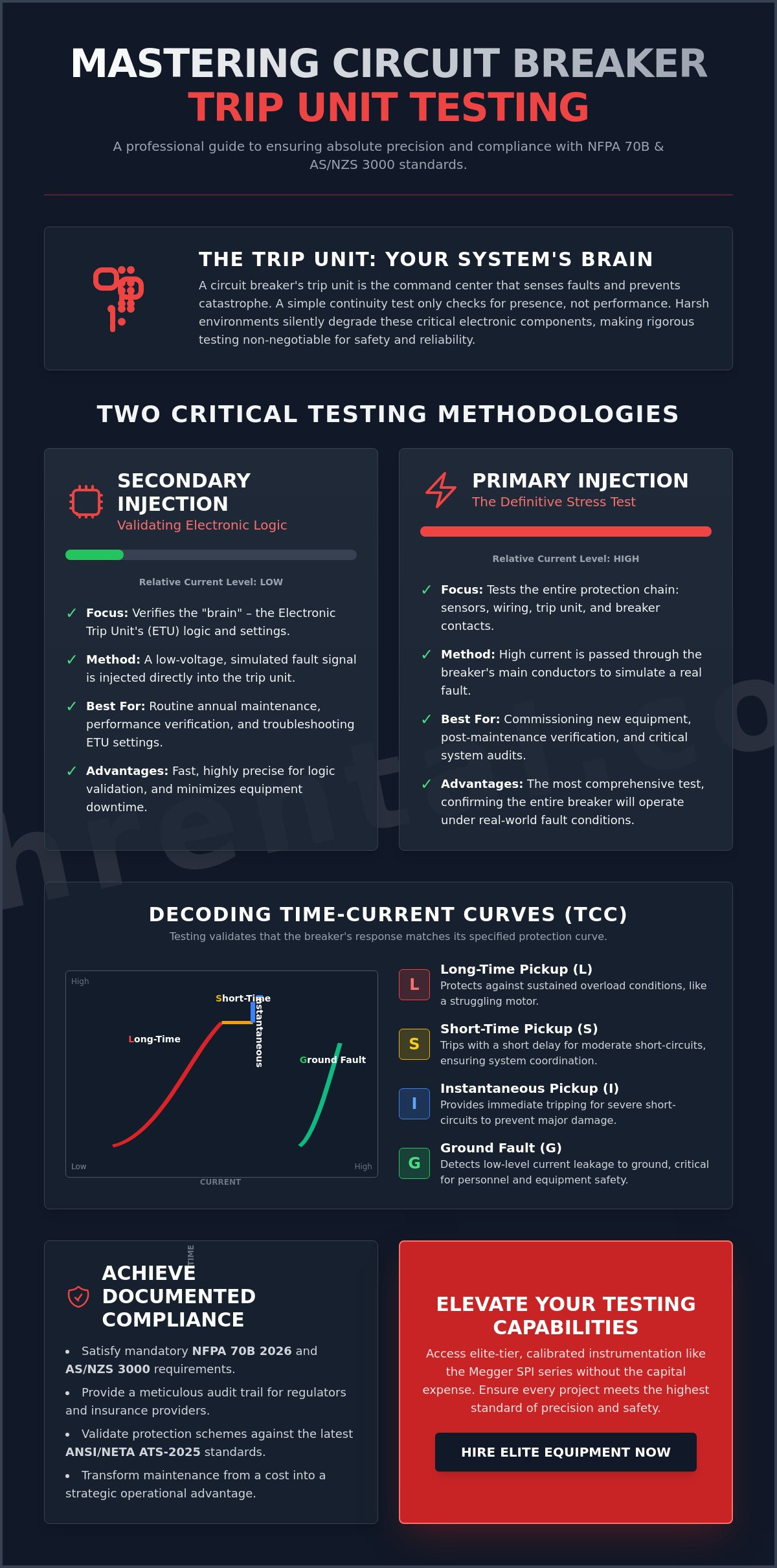
Secondary injection testing represents a surgical approach to modern electrical maintenance. It focuses on the Electronic Trip Unit (ETU) logic without the requirement for high-current injection through the primary poles. This method is the preferred choice for annual routine maintenance where the physical integrity of the contacts and current transformers has already been established. When considering how to test a circuit breaker trip unit efficiently, secondary injection offers a sophisticated path to validation that minimizes facility downtime while ensuring the "brain" of the system remains sharp. By injecting a simulated signal directly into the ETU, you verify that the logic processor interprets fault conditions with absolute precision. This process aligns perfectly with the NETA Acceptance and Maintenance testing standards, which distinguish between verifying electronic settings and full-path integrity.
Accessing these advanced features requires specialized secondary injection test sets, typically specific to the breaker's manufacturer. Connecting to the dedicated test port allows for a seamless interface between the tester and the breaker’s internal circuitry. For those who demand the highest standard of precision without the capital burden of ownership, opting for electrical test equipment rental Australia ensures you have access to the latest calibrated technology for every project. It's a choice that reflects a commitment to quality and operational excellence.
The Secondary Injection Procedure
The process begins by safely isolating the trip unit from the power circuit to prevent accidental upstream interruptions. Once the test set is interfaced with the breaker's port, it simulates specific overcurrent, short-time, and ground fault signals. You are essentially "tricking" the breaker into believing a fault exists. This verifies that the logic response is instantaneous and that the trip signal generation is functioning exactly as the manufacturer engineered. It's a clean, controlled environment for high-stakes validation.
Interpreting Electronic Trip Unit (ETU) Feedback
During the test, observe the digital display and LED status indicators with a discerning eye. You must compare the measured trip times against the manufacturer’s published tolerances. If the breaker trips outside these bounds, it may indicate "nuisance tripping" caused by faulty internal logic or environmental degradation of the microprocessor. Identifying these nuances early prevents unexpected outages. Accurate documentation of these results is essential for maintaining a prestige-level safety audit trail and ensuring long-term industrial resilience.
Primary Injection Testing: The Definitive Stress Test
Primary injection testing stands as the definitive stress test for any industrial power system. Unlike secondary methods that focus solely on the electronic logic, primary injection validates the entire protection chain. This includes the current transformers, the internal wiring, and the mechanical tripping mechanism itself. It's the most rigorous way to confirm that your safety systems will perform exactly as engineered during a real-world fault. For new installations or major overhauls, this level of scrutiny is non-negotiable. It provides the absolute peace of mind that comes with knowing every physical and electronic component is in perfect harmony. With the 2026 mandate of NFPA 70B making these procedures legally enforceable, primary injection has transitioned from a best practice to a regulatory necessity.
When mastering how to test a circuit breaker trip unit via primary injection, you're essentially simulating a true fault by passing high current through the breaker's poles. This process reveals hidden flaws that secondary testing cannot detect, such as high-resistance connections or mechanical binding that might prevent the breaker from physically opening. Because modern circuit breaker trip units are highly sensitive, this comprehensive approach ensures the entire system responds with the required speed and precision.
Verifying the Entire Protection Loop
Primary injection is uniquely capable of testing the current transformers (CTs) and the secondary wiring simultaneously with the trip unit logic. This holistic view is critical for detecting saturation issues or incorrect CT ratios that could lead to a protection failure. Professionals often utilize "Cold Start" testing to establish a baseline before moving to "Hot Start" parameters, which simulate the breaker's response when it's already at operating temperature. This level of detail is what separates a routine check from a prestige-level safety validation. It ensures that every link in the protection chain is robust enough to handle the immense thermal and magnetic stresses of a fault.
High-Current Instrumentation Requirements
Executing these tests requires formidable power. High-output primary injection test sets must often deliver currents exceeding 10,000A to accurately trip larger industrial breakers. Managing the thermal limits of the equipment is a delicate art; repeated test cycles can quickly overheat the breaker under test if not managed with professional care. Accessing this level of specialized gear is made effortless through The Definitive Guide to Test Equipment Hire in Australia, which outlines how to source the industry's most advanced instrumentation. By choosing the right tools, you ensure your testing process is as seamless and reliable as the assets you protect.
Interpreting Results and Time-Current Curves
Executing the test is only the first step; the true hallmark of an elite professional is the sophisticated interpretation of the resulting data. When you evaluate how to test a circuit breaker trip unit, you're looking for a perfect alignment between the measured trip times and the manufacturer’s Time-Current Curve (TCC). This log-log graph serves as the definitive blueprint for your asset's protection. You must meticulously plot your results across the LSI/LSIG spectrum: Long-time for sustained overloads, Short-time for intentional fault delays, Instantaneous for immediate arc suppression, and Ground Fault for leakage protection. A discrepancy of even a few milliseconds can be the difference between a seamless operation and a catastrophic system failure.
Defining a "Pass" or "Fail" requires a deep understanding of industry-standard tolerances, typically aligned with ANSI/NETA ATS-2025 or specific manufacturer data. Beyond the numbers, you must record the ambient temperature and humidity during the testing window. These environmental variables are not mere footnotes; they directly influence the thermal characteristics of the trip unit's sensors and can explain minor deviations in the data. For those who demand absolute precision, utilizing industrial test equipment rental Australia provides access to NATA-traceable instrumentation, ensuring your results are beyond reproach during high-stakes safety audits.
Common Failure Modes in Trip Units
Identifying "out of tolerance" delays often reveals the early stages of component aging or microprocessor drift. You must distinguish between a mechanical latch failure, where the breaker physically refuses to move, and an electronic logic failure, where the "brain" incorrectly calculates the fault. If a unit fails to meet its TCC parameters, you face a critical decision. While some modern units allow for minor recalibration, a significant deviation usually necessitates a full replacement to maintain the prestige and safety of your electrical infrastructure. It's a choice that prioritizes long-term reliability over temporary fixes.
Compliance Documentation and Reporting
A professional test report is more than just a record; it's a component of your facility's legacy of safety. In the Australian industrial landscape, your documentation must meet stringent record-keeping standards to satisfy insurance requirements and AS/NZS 3000 verification mandates. Every report should include the serial number of the NATA-traceable tester used, the specific trip settings, and the environmental conditions at the time of the test. This level of detail creates an unbreakable audit trail, reflecting the organized and refined nature of your maintenance program. It ensures that every detail of your compliance needs has been accounted for with professional grace.
The Zenith Advantage: Elite Instrumentation for Discerning Professionals
Mastering the technical landscape of 2026 requires more than just expertise; it demands access to the absolute peak of instrumentation technology. When you're determining how to test a circuit breaker trip unit for critical infrastructure, the precision of your hardware is the silent arbiter of your professional success. Owning a fleet of specialized testers often introduces unnecessary friction, including capital depreciation, specialized storage, and the relentless cycle of annual recalibration. Opting for a strategic partnership through equipment hire allows you to bypass these logistical burdens entirely. It ensures you always work with the most refined versions of the industry’s gold-standard assets, such as the latest Megger SPI series or Fluke’s advanced multi-product calibrators.
Every instrument provided through our service arrives with the absolute assurance of NATA-traceable calibration. This commitment to excellence means you can focus on the technical nuances of your task, confident that your data is beyond reproach during any safety audit. Whether you're conducting high-current primary injection or delicate secondary logic validation, the right tool transforms a complex requirement into a seamless, high-performance event. Zenith Rental facilitates this transition across Australia, supporting intricate maintenance schedules with a level of organization and prestige that mirrors your own high-tier standards.
Curating the Perfect Testing Suite
Achieving the highest standard of safety requires a tailored approach to your testing suite. You must select the specific secondary injection set that matches your breaker’s brand architecture to ensure perfect communication with the electronic trip unit. We recommend combining your trip unit testers with high-performance insulation resistance and contact resistance kits for a truly comprehensive validation of the protection chain. This holistic approach captures the finer details of the breaker’s health that single-function tests might overlook. To understand why certain brands continue to define the industry, explore Megger Equipment Rentals: Advantages and why they remain the preferred choice for discerning Australian engineers.
Seamless Service and Technical Support
Partnering with an Australian-owned specialist in instrumentation brings a level of prestige and reliability that budget-tier providers simply cannot replicate. We understand that in industrial maintenance, time is the most precious commodity you possess. Our team ensures that every piece of gear is meticulously inspected and ready for immediate deployment, minimizing project downtime and allowing you to maintain the momentum of your successful operations. This high-tier support is designed to feel like a natural, sophisticated extension of your own team, providing the absolute reliability you need for high-stakes environments. Enquire about our elite circuit breaker analyzers and trip unit testers today.
Securing Industrial Excellence Through Calibrated Precision
Transitioning from basic maintenance to a sophisticated protection strategy ensures your infrastructure remains a testament to reliability and success. You've seen how the distinction between primary and secondary injection testing provides a comprehensive shield for your assets, and how interpreting Time-Current Curves with surgical accuracy satisfies the most stringent Australian safety audits. Mastering how to test a circuit breaker trip unit isn't merely a technical requirement; it's a commitment to the highest standards of industrial prestige. By validating every link in the protection chain, you eliminate the fear of catastrophic failure and replace it with absolute operational confidence.
Every detail of your maintenance schedule deserves the assurance of NATA-traceable calibration and the support of elite instrumentation. We provide Australia-wide delivery for mission-critical projects, backed by specialist technical support that mirrors the complexity of your requirements. It's time to transform your safety protocols into a seamless, high-performance experience. Explore Our Elite Range of Circuit Breaker Analyzers and secure the future of your facility with the grace and precision it deserves today.
Frequently Asked Questions
How often should circuit breaker trip units be tested in an industrial environment?
Industry reports indicate that implementing a testing regimen every 1 to 3 years can reduce electrical failures by 40%. The 2026 edition of NFPA 70B now mandates specific maintenance intervals based on the criticality and condition of your assets. Regular validation ensures your protection system remains at the peak of its engineered performance and meets all regulatory requirements.
Can I perform secondary injection testing while the breaker is energized?
You shouldn't perform secondary injection testing while the breaker is energized. Safety protocols require the breaker to be isolated from the primary power source to prevent accidental tripping of upstream devices or hazardous arc flash events. This isolation ensures a controlled environment where the logic of the trip unit can be validated with absolute precision.
What is the difference between an electronic trip unit and a thermal-magnetic breaker?
An electronic trip unit (ETU) utilizes microprocessors to provide a sophisticated range of adjustable settings, such as LSI and LSIG parameters. In contrast, thermal-magnetic breakers rely on physical heat and magnetic flux to trigger a trip. When you learn how to test a circuit breaker trip unit of the electronic variety, you're engaging with a microprocessor "brain" that offers far greater accuracy than its mechanical predecessors.
Are secondary injection test sets universal across all breaker manufacturers?
Secondary injection test sets are almost never universal. Most manufacturers design their testers to interface with specific proprietary ports and communication protocols unique to their breaker lines. Using the incorrect test set can lead to inaccurate data or potential damage to the trip unit's sensitive logic board, which is why sourcing the correct manufacturer-specific kit is essential.
What Australian standards govern the testing of protective devices?
In Australia, the primary standard is AS/NZS 3000, which outlines the requirements for the verification of protective devices in electrical installations. Discerning professionals also adhere to international benchmarks like the ANSI/NETA MTS-2023 for maintenance testing. These standards ensure that your facility meets the highest benchmarks for safety, insurance compliance, and operational prestige.
Why is NATA traceability important for my circuit breaker test results?
NATA traceability provides an unbreakable audit trail that confirms your test equipment meets national standards for accuracy. For high-stakes industrial projects, this level of documentation is essential to satisfy safety auditors and insurance providers. It transforms a routine technical check into a prestige-level validation of your facility's integrity and your commitment to excellence.
What are the risks of using uncalibrated equipment for trip unit verification?
Using uncalibrated equipment introduces the risk of "false passes," where a faulty breaker is incorrectly deemed safe. This can lead to catastrophic system failures or arc flash incidents during a real fault condition. It also compromises your legal standing, as uncalibrated data is often inadmissible during a safety audit or liability investigation following an incident.
Is primary injection testing always required for routine maintenance?
Primary injection testing is typically reserved for new installations or major overhauls rather than routine annual maintenance. Secondary injection is usually sufficient for periodic logic validation because it's more efficient and less thermally stressful for the breaker. However, understanding how to test a circuit breaker trip unit via primary injection remains vital for those occasions when the entire protection chain, including current transformers, must be verified.