


How to Perform an Insulation Resistance Test: An Elite Industrial Guide (2026)
Is your current testing protocol a mere compliance hurdle, or is it a refined diagnostic art that safeguards your most prestigious industrial investments? You likely recognize the mounting pressure to meet strict Australian safety audit requirements, particularly as the transition period for the new AS/NZS 3000 standard concludes on November 12, 2026. Mastering how to perform insulation resistance test sequences is no longer just a technical necessity; it's a hallmark of elite asset management that ensures the longevity of your high-value electrical infrastructure.
This guide empowers you to execute the procedure with absolute poise and technical precision. It's natural to feel a sense of hesitation when faced with ambiguous readings or the risk of stressing sensitive components, but our sophisticated methodology eliminates that uncertainty. You'll gain the confidence to interpret fluctuating data and secure the defensible, NATA-traceable logs required for your compliance records. We provide a clear roadmap for your next audit, from selecting the correct 500V DC nominal voltage to verifying that your XLPE or PVC insulated cables exceed the rigorous benchmarks established by AS/NZS 3760:2022.
Key Takeaways
- Discover how Ohm’s Law serves as the foundation for identifying leakage and maintaining the peak performance of your electrical infrastructure.
- Learn why utilizing NATA-traceable calibration from elite brands like Megger and Fluke is essential for producing defensible data during rigorous safety audits.
- Master the sophisticated sequence of how to perform insulation resistance test protocols, including the vital isolation of assets and the precise configuration of Line, Earth, and Guard leads.
- Understand the nuances of data interpretation, such as applying temperature compensation and analyzing historical trends to predict insulation health before failure occurs.
- Streamline your workflow by accessing a meticulously maintained fleet of industrial test equipment, ensuring your testing process is as seamless as it is reliable.
Understanding the Critical Role of Insulation Resistance (IR) Testing
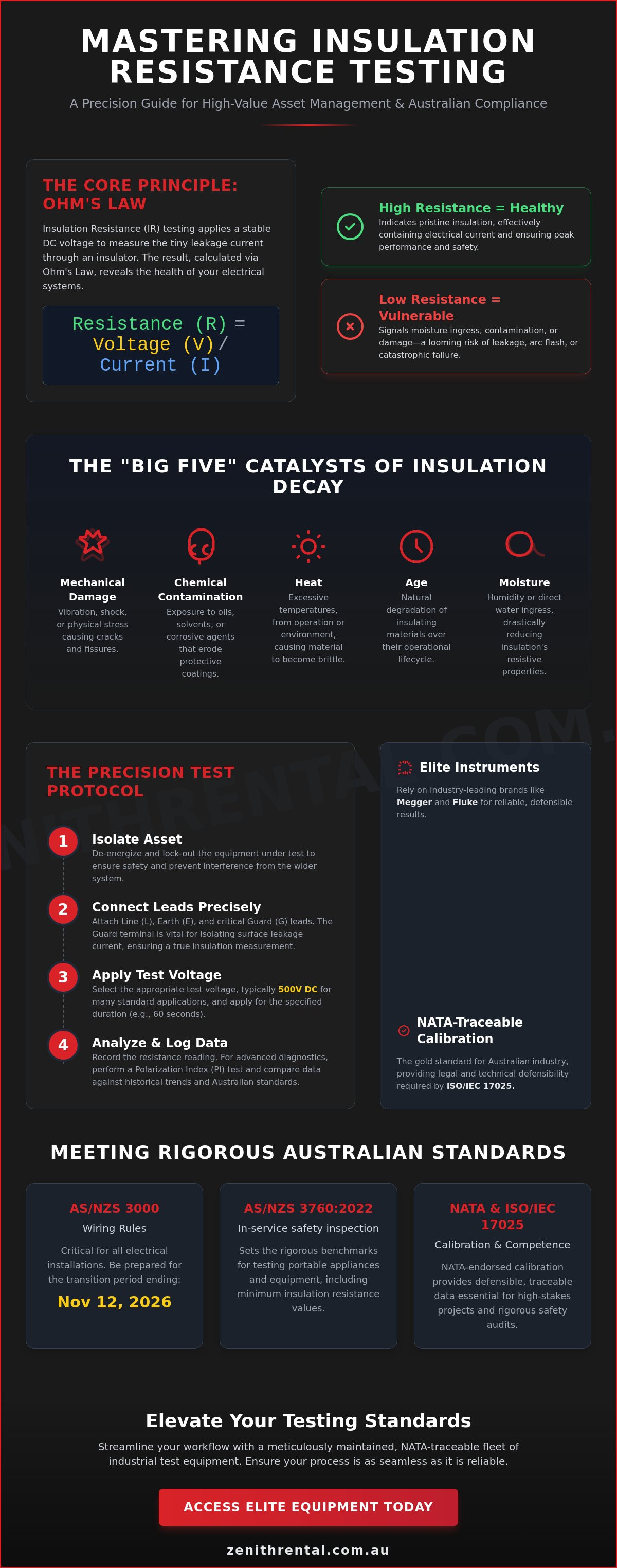
Insulation resistance serves as the definitive measure of an insulator's integrity, acting as a silent guardian for your most sophisticated electrical systems. At its core, IR testing is the application of DC voltage to measure current flow through insulation. This process relies on the elegant simplicity of Ohm’s Law. By applying a controlled voltage and measuring the resulting minute leakage current, we can calculate the resistance that prevents energy from escaping its intended path. High resistance indicates a pristine environment; low resistance signals a looming vulnerability.
Mastering the nuances of how to perform insulation resistance test procedures is a proactive investment in your facility's operational continuity. Rather than waiting for a catastrophic failure that triggers expensive downtime, regular IR testing allows you to monitor the health of your assets over their entire lifecycle. This data-driven approach ensures that your high-value transformers, motors, and cables remain at peak performance, maximizing their total value and safety for your personnel.
The Mechanics of Insulation Degradation
Even the most robust insulation is subject to the "Big Five" catalysts of decay: mechanical damage, chemical contamination, heat, age, and moisture. In the demanding Australian industrial landscape, these factors are often amplified. High humidity in tropical regions or the extreme thermal cycles of the outback can accelerate the breakdown of polymeric and PVC coatings. Choosing a periodic testing schedule over a "fix-on-fail" mentality is the hallmark of an elite maintenance strategy. It allows you to identify microscopic fissures or moisture ingress before they evolve into an uncontained arc flash or a total system blackout.
Why Precision Matters in High-Voltage Environments
While a basic continuity check might confirm a simple connection, high-voltage insulation resistance tests provide a much deeper level of diagnostic insight. These tests require specialized instrumentation, such as a Megohmmeter or insulation resistance tester, which provides the necessary pressure to reveal weaknesses that lower voltages simply cannot detect. Precision is paramount when dealing with high-value assets.
- Spot Reading: A single measurement that provides a snapshot of insulation health at a specific moment.
- Time-Resistance Methods: Sophisticated diagnostic tests, such as Polarization Index (PI), that monitor how insulation behaves under prolonged stress.
Relying on elite-tier equipment ensures that your data is not only accurate but also defensible. When you understand the subtle differences between these methods, you gain the ability to predict asset failure with remarkable accuracy. This level of foresight is what separates standard maintenance from a truly refined industrial operation.
Selecting the Instrument: Why Precision Calibration Defines Your Results
Excellence in diagnostic testing begins with the instrument in your hands. When determining how to perform insulation resistance test procedures on high-value assets, the choice of instrument isn't merely a logistical detail; it's a statement of quality. Elite manufacturers such as Megger and Fluke have spent decades refining the technology required to deliver absolute reliability. These instruments don't just provide numbers; they provide the peace of mind that your data is accurate and your assets are secure.
A critical feature that separates professional grade equipment from entry level tools is the guard terminal. This third lead is essential for eliminating the interference caused by surface leakage current. Without it, moisture or dust on the surface of an insulator can skew your results, leading to a false sense of concern or, worse, a missed vulnerability. NATA-traceable calibration remains the gold standard in the Australian industrial sector. For those operating within mining, government, or high-stakes infrastructure projects, a NATA-endorsed certificate provides the legal and technical defensibility required by ISO/IEC 17025.
Key Features of Professional Insulation Testers
Modern industrial environments demand versatility. Professional testers offer variable test voltages ranging from 250V for sensitive electronics to 10kV or even 15kV for medium-voltage assets. This range allows for a Step-by-step insulation resistance test that includes specialized diagnostics like Polarization Index (PI) and Dielectric Absorption Ratio (DAR). Internal data logging has also become a standard requirement. It enables you to store thousands of readings for historical trend analysis, which is vital for predicting insulation failure before it occurs. Furthermore, ensuring your device carries a CAT III/IV safety rating is non-negotiable for protection against transient overvoltages in Australian industrial settings.
Accessing Elite Technology via Rental
The strategic advantage of hiring calibrated instruments is significant for discerning project managers. By opting for high-tier rental, you gain immediate access to the latest measurement technology without the burden of ownership. You eliminate the hidden costs of annual NATA calibration, storage, and eventual obsolescence. This approach ensures that you always have the most sophisticated tools for your specific project duration, whether you need a specialized insulation resistance tester hire for a week or a comprehensive suite of equipment for a major shutdown.
Positioning your team with the right tools is a hallmark of success. For a deeper look at the logistical benefits of this model, explore our insights on test equipment hire australia. Choosing to hire ensures that your focus remains on the flawless execution of the test rather than the maintenance of the tester itself.
Step-by-Step: How to Perform an Insulation Resistance Test with Precision
Executing an IR test requires more than just a high-quality instrument; it demands a disciplined, methodical approach that reflects the value of the assets under your care. Precision in execution ensures that your data is both accurate and defensible for future safety audits. When you understand exactly how to perform insulation resistance test sequences, you transform a routine check into a sophisticated diagnostic event. The process begins with absolute isolation, ensuring the asset is completely de-energised and disconnected from the grid to prevent any back-feed or interference.
Connection is where technical knowledge meets physical execution. You'll utilize three primary leads: 'Line', 'Earth', and 'Guard'. The Earth lead secures the connection to the grounded frame or casing, while the Line lead attaches to the conductor being tested. For complex industrial assets, the Guard lead is your secret to accuracy; it bypasses surface leakage paths that might otherwise corrupt your readings. Once connected, you must select the appropriate test voltage. While a 500V DC output is standard for general circuits, sensitive equipment with surge protection may require a more delicate 250V DC approach to avoid unintended damage.
Observation is the final pillar of a successful test. You shouldn't simply record the first number that appears on the display. Instead, allow the reading to stabilize as the insulation reaches its full capacitive charge. This patience ensures you're measuring true resistance rather than transient charging currents. After the test concludes, safety remains the priority. Modern testers often handle this automatically, but you must verify that the stored capacitive charge is safely discharged before you disconnect your leads.
Safety Protocols and Pre-Test Verification
Before you begin, confirm the 'Dead Test' status using a secondary, calibrated voltage detector. This redundancy is a hallmark of elite safety standards. Inspect your test leads for any signs of wear or cracking, as compromised leads can introduce erroneous resistance values that mask underlying issues. Finally, check your instrument's battery levels. Consistent voltage output is vital for reliable data, and a weak battery can lead to subtle fluctuations that undermine the integrity of your results.
The 5-Minute Testing Procedure
- Step 1: Isolate the circuit entirely and disconnect any voltage-sensitive electronics that could be damaged by the test voltage.
- Step 2: Connect the Earth lead to the grounded frame and the Line lead to the primary conductor.
- Step 3: Apply the selected test voltage for 60 seconds. This duration allows the insulation to reach a stable state, providing a more accurate reflection of its health.
- Step 4: Record the final resistance value in Megohms (MΩ) or Gigohms (GΩ) to ensure a clear historical record for your compliance logs.
By following these precise steps, you ensure that how to perform insulation resistance test protocols in your facility meets the highest Australian standards, protecting both your equipment and your reputation for excellence.
Interpreting Results: Temperature Compensation and Australian Standards
Recording a single resistance value is a start, but it's the historical trend that reveals the true narrative of your asset's health. While basic guides suggest that a 1 MΩ reading is a universal pass, elite professionals understand that context is everything. When you master how to perform insulation resistance test protocols, you realize that environmental variables significantly dictate your data's validity. Temperature is a formidable variable; for every 10°C rise in temperature, the measured resistance of your insulation typically halves. Without adjusting for this, a perfectly healthy motor might appear to be failing simply because it's operating in the heat of a Western Australian summer.
Compliance in the Australian industrial sector requires adherence to rigorous benchmarks. The current standard for in-service safety inspection is AS/NZS 3760:2022, but the industry is currently focused on the approaching November 12, 2026, deadline. This date marks the end of the transition period for the new AS/NZS 3000 standard, after which all new construction must comply with updated benchmarks. For those managing high-value assets like XLPE insulated cables, expectations are significantly higher than the bare minimums; you should look for resistance greater than 1500 MΩ for a 50m run at 20°C to ensure absolute integrity.
For large rotating machinery, the Polarization Index (PI) provides a more sophisticated diagnostic than a simple spot test. By comparing the resistance after ten minutes to the resistance after one minute, you can determine if the insulation is brittle or contaminated. This ratio offers a clear, defensible data point that transcends the limitations of a single snapshot, allowing you to make informed decisions about the lifecycle of your most prestigious equipment.
Normalizing Data for Accurate Comparison
To maintain a reliable audit trail, you must normalize your readings to a common baseline. This allows you to compare current results with data captured months or years ago under different conditions. In particularly moist or humid environments, the Dielectric Absorption Ratio (DAR) becomes essential for identifying moisture ingress that a standard test might overlook. As a standard rule for industrial excellence, insulation resistance should be corrected to a 20°C or 40°C base to provide a true reflection of the material's state.
When to Flag a 'Fail' and Take Action
Recognizing a 'Stepped Voltage' failure is critical; if resistance drops sharply as you increase the test voltage, it indicates an impending breakdown that requires immediate attention. Discerning operators often establish internal thresholds that exceed minimum regulatory requirements, providing an extra layer of security for critical infrastructure. If you encounter complex diagnostic readings that defy simple interpretation, consulting with fluke specialists can provide the clarity needed to protect your investments.
Securing accurate, audit-ready data starts with the right equipment. To ensure your next compliance check is flawless, explore our range of meticulously calibrated insulation resistance tester hire options and experience the precision your project deserves.
Elevating Your Testing Standards with Zenith Rental
Mastering the technical nuances of how to perform insulation resistance test procedures is only half of the equation for industrial excellence. The other half lies in the quality of the instrumentation you bring to the site. At Zenith Rental, we provide more than just tools; we offer a gateway to the world's most sophisticated measurement technology. Our meticulously maintained fleet features the latest models from Megger and Fluke, ensuring that your diagnostic capabilities match the prestige of the assets you're protecting. When you choose an elite instrument, you're not just measuring resistance; you're securing the future of your infrastructure.
Every tester in our collection arrives pre-calibrated and accompanied by NATA-traceable documentation. This provides the absolute peace of mind required for high-stakes Australian industrial, mining, and government projects. In an era where audit requirements are becoming increasingly stringent, having defensible data backed by a NATA-endorsed certificate is a non-negotiable standard. We understand that your time is a luxury. Our nationwide delivery capability ensures that whether your project is in a metropolitan hub or a remote industrial site, the precision you require is always within reach, exactly when you need it.
We position ourselves as your technical partners rather than mere equipment providers. Our team possesses the deep industry knowledge necessary to help you navigate the complexities of modern testing standards. We're here to ensure that your engagement process is as seamless and refined as the performance of the assets we provide. By aligning with Zenith, you're choosing a partner that values reliability and industrial excellence as much as you do.
The Discerning Professional’s Choice
Top-tier Australian contractors consistently rely on Zenith for safety-critical missions because we provide an "Expert-to-Expert" support model. We don't just hand over a device; we offer the insights needed to solve complex measurement challenges in the field. Our inventory includes specialized accessories that standard rental houses often overlook, such as heavy-duty clips for secure connections on large busbars and long-range leads for expansive industrial footprints. These finer details ensure that your execution of how to perform insulation resistance test protocols remains flawless and efficient.
Secure Your Next Project with Zenith
The transition to the new AS/NZS 3000 standard by November 2026 leaves no room for compromise in electrical safety. Our rental engagement process is designed to minimize friction, allowing you to focus on the high-level diagnostic work that defines your professional reputation. We remain committed to absolute reliability, providing the instruments that turn data into confidence. Experience the difference that elite instrumentation makes on your next project. Explore our premium range of insulation resistance testers for hire and elevate your testing standards to the zenith of industry excellence.
Securing the Future of Your Industrial Legacy
Mastering the sophisticated nuances of how to perform insulation resistance test protocols is more than a technical requirement; it's a commitment to the enduring health of your high-value infrastructure. By integrating precise temperature compensation and adhering to the rigorous benchmarks of AS/NZS 3000, you transcend basic maintenance. You establish a standard of excellence that protects both your personnel and your significant capital investments. This proactive approach ensures your operations remain resilient as we approach the mandatory compliance deadlines of late 2026.
Your success in the field depends on the absolute reliability of your data. Zenith Rental provides the gold-standard instrumentation required for these safety-critical missions, featuring an elite inventory of Fluke and Megger testers. With NATA-traceable calibration on all instruments and dedicated nationwide industrial support, we ensure your testing is as seamless as it is accurate. We invite you to Secure a NATA-Calibrated Insulation Tester for Your Next Project and experience the confidence that comes with elite-tier equipment. Your assets deserve the highest standard of care, and we're here to help you deliver it.
Frequently Asked Questions
What voltage should I use for an insulation resistance test?
For standard 415V or 1000V industrial motors, a 5kV or 10kV test voltage is generally preferred to reveal deep-seated vulnerabilities. When determining how to perform insulation resistance test sequences on general low-voltage circuits, a nominal 500V DC is the standard requirement under AS/NZS 3000. However, if the equipment contains sensitive surge protection devices, you should reduce the nominal testing voltage to 250V DC to ensure the integrity of those delicate components is maintained.
How long should an insulation resistance test be performed?
A standard spot reading should be performed for at least 60 seconds to allow the capacitive charging current to decay fully. This duration ensures that the instrument is measuring the true leakage current through the insulation rather than transient charging effects. For more sophisticated diagnostics on large rotating machinery, you might extend the test to 10 minutes to calculate the Polarization Index, providing a much deeper insight into the long-term health of the insulation system.
What is a good insulation resistance reading for industrial motors?
While the absolute minimum regulatory requirement is 1 MΩ, high-performance industrial motors typically exhibit much higher values for absolute reliability. For polymeric insulated cables, you should expect readings greater than 50 MΩ at a 20°C baseline. A healthy motor will often display values in the hundreds of Megohms or even Gigohms. If you are assessing larger assets, look for a Polarization Index greater than 2.0, which indicates that the insulation is dry and free from contamination.
Can I perform an IR test on a live circuit?
No, you must never perform an insulation resistance test on a live circuit. The asset must be completely de-energized, isolated from the grid, and verified as 'dead' using a secondary voltage detector before you connect your leads. Applying an IR test to a live system is a severe safety hazard for the operator and will likely cause catastrophic damage to your sophisticated testing instrument, rendering it useless for future diagnostics.
Why do insulation resistance readings change with temperature?
Insulation resistance is inversely proportional to temperature because thermal energy increases the mobility of electrons and ions within the material. As a general rule, the resistance value halves for every 10°C increase in temperature. This physical property is why elite professionals always normalize their data to a 20°C or 40°C baseline. This ensures that historical trends remain accurate and aren't skewed by seasonal variations or operational heat generated by the equipment itself.
What is the difference between a Megger and an insulation tester?
There is no functional difference between a Megger and a professional insulation tester; Megger is simply the prestigious brand that pioneered this technology. Much like other industry-leading names, the brand has become synonymous with the category itself. Whether you refer to it as a Megohmmeter or a tester, the instrument's role remains the same: applying a precise DC voltage to measure the integrity and safety of your high-value electrical insulation.
How often should industrial equipment undergo IR testing?
The standard interval for testing industrial equipment is typically 12 months, often aligning with the standard calibration cycle for professional instruments. However, assets operating in harsh Australian environments exposed to extreme heat or chemical contaminants may require more frequent assessments. Establishing a regular testing schedule is a hallmark of elite asset management, allowing you to identify degradation well before it leads to a costly system failure or an unscheduled shutdown.
What happens if I apply too much voltage during an IR test?
Applying excessive voltage can lead to dielectric breakdown, potentially puncturing the insulation and causing permanent, irreparable damage to your assets. It's vital to match the test voltage to the specific rating of the equipment. Understanding how to perform insulation resistance test protocols with precision means selecting a voltage high enough to reveal weaknesses but low enough to remain within the safe operating parameters of the material's dielectric strength.