


How to Avoid Electrical Measurement Errors: A Practical Guide
What if a calibrated meter still gives you a reading you can’t rely on? The instrument matters, but so do its settings, leads, connection points and the conditions around the test. Knowing how to avoid electrical measurement errors means controlling the whole process, not simply trusting the device in your hand.
If readings differ between instruments or repeat tests, it’s reasonable to question which result is accurate. Small oversights, such as selecting the wrong range or testing a live circuit for resistance, can affect both the reading and the decisions that follow. A consistent method helps you identify these risks before relying on a measurement.
This guide sets out a practical approach to choosing suitable test equipment, checking its condition and configuration, making connections carefully and reviewing results. You’ll also learn when a reading needs further verification and when your instrument may not suit the measurement or working conditions. For Australian teams, hiring calibrated equipment can be an option when the right instrument isn’t available or appropriate.
Key Takeaways
- Learn how to avoid electrical measurement errors by checking the instrument, settings, leads and connection points before testing.
- Distinguish measurement error from uncertainty, and consider how the task and working conditions can affect a reading.
- Assess whether a result is trustworthy by comparing repeat readings with equipment documentation and the task’s acceptance criteria.
- Use a structured pre-test, measurement and post-test workflow to catch common issues before relying on results.
- When your existing equipment isn’t suitable for the task, consider whether hiring calibrated test equipment is a practical option.
How to Avoid Electrical Measurement Errors: Start with the Measurement
A dependable result begins before you connect a test instrument. First, define what you need to measure and how the result will be used. A voltage reading used to investigate a fault, for example, needs to relate to the right point in the circuit and the conditions present during the test. Without that context, even a clear display may not answer the question that matters.
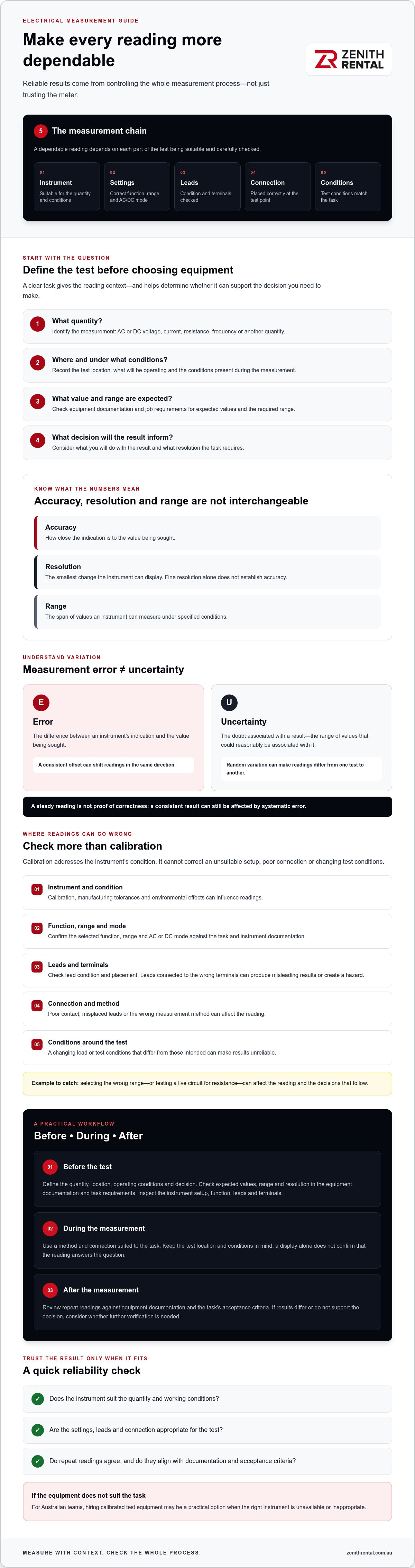
Measurement error is the difference between an instrument’s indication and the value being sought. Accuracy describes how close that indication is to the value, while uncertainty expresses the doubt associated with the result. Error and uncertainty aren’t interchangeable. A measurement has an error even when its exact value is unknown, while uncertainty describes the range of values that could reasonably be associated with the result.
What counts as an electrical measurement error?
Errors can arise in different ways. A systematic effect, such as a consistent offset, can shift readings in the same direction. Random variation causes readings to differ from one test to another. Instrument-related issues, including calibration, manufacturing tolerances and environmental effects, are among the factors described in Instrument error.
Consider checking voltage at a connection point. If the instrument is set to the wrong function, the leads are placed incorrectly or the test conditions differ from those intended, the display may mislead. A steady reading isn’t proof of correctness: an instrument can repeatedly show a consistent value that is still affected by a systematic error. Reliable readings support better troubleshooting, maintenance decisions and judgements about electrical equipment.
Define the test before choosing the instrument
Write down the measurement task before selecting equipment. Record the quantity, test location, operating conditions and the decision the result will inform. Then check the equipment documentation and job requirements for the expected values, required range and resolution. Resolution is the smallest change the instrument can display. It doesn’t, by itself, establish the reading’s accuracy.
Be specific about the signal. Are you measuring AC or DC voltage, current, resistance, frequency or another quantity? Note relevant conditions, such as whether the equipment is operating and where the measurement must be taken. These details help you choose an instrument suited to the quantity and working environment, rather than relying on a general-purpose meter by default.
- Quantity: What exactly must be measured?
- Location and conditions: Where will the test take place, and what will be operating?
- Expected value: What range does the equipment documentation or task specify?
- Decision: What will you do with the result, and what resolution does that require?
Defining the task gives the measurement a clear purpose. It also provides a practical basis for choosing suitable test equipment and judging whether the result can support the decision at hand.
Common Electrical Measurement Errors and What Causes Them
A reading can be distorted at several points, from choosing an unsuitable instrument to making poor contact at the test point. Calibration matters, but it addresses only the instrument’s condition. It can’t correct the wrong function, misplaced leads, a changing load or an unsuitable measurement method. To understand how to avoid electrical measurement errors, consider the whole chain: instrument, setup, connection, technique and environment.
Instrument, range and configuration mistakes
Before connecting, confirm the selected function, range and AC or DC mode against the task and instrument documentation. A meter set to measure current won’t provide a meaningful voltage reading, and leads connected to the wrong terminals can produce misleading results or create a hazard. Don’t assume that two meters, or two functions on the same meter, are interchangeable for every measurement.
Specifications describe different things. Range is the span of values an instrument can measure under specified conditions. Resolution is the smallest change it can display. Accuracy indicates how close a result is to the value sought. A display with fine resolution doesn’t necessarily provide high accuracy. Check the instrument’s stated limits and instructions, then select a range suited to the expected value and task.
Connections, environment and measurement method
Even a suitable, calibrated instrument can give an unreliable result if the connection is poor. Inspect leads, probes and connectors for damage, looseness or contamination. Confirm that probes make firm contact at the intended points. Weak or intermittent contact may cause readings to fluctuate or fail to represent the circuit properly.
Conditions can change the result, too. Electrical noise may disturb a reading; temperature or vibration may affect equipment or connections; and a changing load can make successive measurements differ because the circuit itself is not in the same state. Note these conditions, and don’t treat a single observation as representative if readings vary or operating conditions are shifting. Consider whether the measurement method could influence the circuit or miss the behaviour you need to observe.
- Instrument: Is the function and range suitable, and are you within the stated limits?
- Setup: Are the leads in the correct terminals and the mode appropriate?
- Connection: Are probes and contact points clean, intact and secure?
- Conditions: Could noise, vibration, temperature or load changes affect the result?
For hazardous or high-energy work, follow the applicable workplace procedures and use competent personnel. Don’t proceed if the instrument, leads or method aren’t appropriate for the task. If existing equipment is unsuitable or unavailable, calibrated test equipment hire may help you access an instrument suited to the measurement and working conditions.
How to Check Whether an Electrical Reading Is Trustworthy
A reading deserves confidence only when it makes sense in context. Compare it with the expected behaviour of the equipment, relevant documentation and the task’s acceptance criteria. A result outside expectations isn’t automatically wrong, but it does call for investigation before you use it to guide maintenance or troubleshooting.
To assess how to avoid electrical measurement errors, review the evidence behind the number, not just the display. Use this comparison to identify what may need checking:
| Check | What to consider |
|---|---|
| Repeatability | Do measurements agree when repeated under similar conditions? |
| Instrument specification | Does the instrument’s range and stated performance suit the task? |
| Connection quality | Were leads and probes connected securely at the intended points? |
| Environmental conditions | Could noise, temperature, vibration or a changing load have affected the result? |
Repeatability, accuracy and measurement uncertainty
Repeatability is the agreement between measurements taken under similar conditions using the same method. If repeated voltage readings vary, check whether the circuit’s operating state or the test connections changed. If they remain consistent, that supports repeatability, but it doesn’t establish accuracy: an instrument or method can produce a stable, systematically shifted result.
Measurement uncertainty describes the doubt associated with a result, rather than simply naming a mistake. It can reflect limitations in the instrument, method and test conditions.
Interpret every reading alongside its uncertainty, the instrument’s limitations and the conditions under which you took it.
When should you repeat or independently verify a reading?
Repeat the measurement if it’s unstable, unexpected or inconsistent with how the equipment behaves. First review the setup: confirm the function and range, inspect the leads, check the contact points and note whether operating conditions have changed. Repeating the same flawed setup may reproduce the problem rather than resolve it.
If the result has important consequences or the available evidence doesn’t resolve a discrepancy, consider verification with a suitably specified independent instrument. Check that its measurement function, range and limitations suit the same task. Two instruments agreeing doesn’t prove the result is correct if both are unsuitable, affected by the same conditions or used with the same connection error.
Document the readings, instrument details, test points and relevant conditions. If results differ, record the difference and investigate it rather than selecting only the value that fits an expectation. This creates a clearer basis for deciding whether the result meets the task’s criteria or needs further review.
A Step-by-Step Process to Prevent Electrical Measurement Errors
A repeatable workflow makes it easier to catch problems before they affect a result. Adapt these checks to your workplace procedures and the instrument’s instructions. If you can’t establish a safe setup, stop and seek suitable guidance rather than proceeding with an uncertain method.
- 1. Define the task. Record what you need to measure, where the measurement will be taken and what decision it will inform. Note the circuit’s expected state and relevant site procedures.
- 2. Confirm the expected range and conditions. Check the job requirements and equipment documentation for the expected value, quantity and required resolution. Identify whether the measurement involves AC, DC, frequency or another function, and note conditions that could affect the test.
- 3. Check the instrument and accessories. Inspect the instrument, leads, probes and connectors for damage or wear. Review the instrument’s identification and calibration status or supporting documentation where relevant. Confirm that the equipment is suitable for the task and working conditions.
- 4. Set up before connecting. Select the correct function and an appropriate range. Check that the leads are in the correct terminals, then make connections in line with the instrument instructions and applicable safe-work procedures.
- 5. Take the reading consistently. Follow the same method and use the same test points each time. Allow the display to stabilise if the instrument and measurement method require it, and observe whether the circuit’s operating state changes during the test.
- 6. Review unexpected results. If a reading is unstable or surprising, check the settings, connections and surrounding conditions before repeating it. Investigate differences rather than choosing the value that best matches an expectation.
- 7. Record and close out. Log the result with its units, instrument identification, test location, relevant operating conditions and any limitations or unusual observations. Follow the applicable procedure for disconnecting and securing the equipment.
Good records let another person understand how a result was obtained and whether it applies to the decision being made. A bare value without units, test conditions or instrument details is difficult to assess later. This disciplined sequence is a practical way to approach how to avoid electrical measurement errors without assuming that a calibrated instrument alone assures a reliable result.
If your instrument isn’t suitable for the task, test equipment hire guidance can help you consider equipment options for a defined project.
When Suitable Test Equipment Helps Prevent Measurement Errors
The right instrument is the one that suits the measurement, not simply the one already on the bench. Its function, range, accessories and documented capabilities need to match the task and operating conditions. Equipment that can’t measure the required quantity or perform within the needed range may produce a reading that looks precise but isn’t suitable for the decision.
When to review or replace your current measurement setup
Review your setup if a reading exceeds the instrument’s range, the task’s requirements or the capabilities described in its documentation. Calibration records matter, too. If they’re overdue, unclear or unavailable, follow your organisation’s procedures to establish whether the instrument is acceptable for the work.
A project may also call for a function your existing equipment doesn’t provide. For example, a task involving insulation resistance or power quality may require a different instrument category from a general meter. Check the measurement requirement first, then determine whether your current equipment is appropriate or specialist equipment is needed.
Choose equipment around the measurement, not the brand
Compare the instrument’s function, range and accessories with the job specification and conditions at the test location. A familiar brand name alone can’t establish suitability. Before relying on equipment, review its instructions and relevant calibration information, and confirm that the supplied instrument matches the intended task. Apply the same principles when reviewing equipment selection for projects.
Hiring may be useful when a project requires specialised or calibrated equipment that isn’t available in your usual instrument set. It can provide access for a defined task without changing the checks that make a measurement dependable. You still need to use the equipment correctly, follow safe-work procedures, make sound connections and assess unexpected results. Hire alone doesn’t guarantee a correct reading.
A considered next step for Australian testing teams
Before exploring equipment options, summarise the quantity to measure, expected range, operating conditions and documentation the task requires. This gives you a clear basis for confirming whether a particular instrument is appropriate. Zenith Rental provides a national Australian test-equipment hire service, with calibrated electrical, industrial and power testing equipment in its hire inventory. Check the relevant equipment information against your project needs.
Explore calibrated test equipment hire for an instrument that may suit your measurement task.
Make Reliable Measurements Part of Every Test
Reliable electrical readings come from a disciplined process, not a single instrument check. Define the measurement and its purpose, confirm that the equipment suits the task and conditions, then review unexpected results before acting on them. Clear records preserve that context, so readings can be assessed thoughtfully rather than treated as isolated numbers.
Knowing how to avoid electrical measurement errors also means recognising when your existing equipment may not meet the task’s requirements. Zenith Rental provides Australian-wide hire of electrical and industrial testing equipment, including calibrated instruments and equipment from established brands such as Fluke, Megger and Transmille. Instrument suitability and documentation still need to be checked against the work at hand.
If a project calls for equipment beyond your current instrument set, explore calibrated test equipment hire as one option. With a clear measurement objective and a repeatable approach, you can make informed decisions and approach each test with confidence.
Frequently Asked Questions
What is the most common cause of electrical measurement errors?
There isn’t one cause that applies to every test. Common contributors include selecting the wrong function or range, poor probe contact, damaged leads, an unsuitable instrument or changing circuit conditions. To understand how to avoid electrical measurement errors, compare the setup with the task before testing. If a result seems unexpected, check the connections and settings, then repeat the measurement using the correct procedure and record the conditions.
Can a calibrated meter still give an incorrect reading?
Yes. Calibration information describes an instrument’s performance under specified conditions, but it doesn’t guarantee that every measurement is correct. Incorrect settings, an unsuitable range, poor connections, environmental effects or use outside documented limits can still affect a result. Review the instrument instructions and test setup, and consider measurement uncertainty when interpreting the display. Calibration status is one part of assessing a reading, not a substitute for correct technique.
How do I know whether a multimeter reading is accurate?
A display alone can’t establish accuracy. Check that the selected function, range and measurement points suit the task, then inspect the leads and contact points. Compare the result with expected equipment behaviour and the meter’s documented specifications. If conditions allow, repeat the measurement consistently and review the calibration status. Interpret the result alongside the method and its uncertainty, rather than assuming a stable or familiar-looking value is correct.
Why do electrical readings change when I repeat a test?
Readings may vary because the load changes, contact is unstable, electrical noise is present or the instrument’s resolution affects the displayed value. The measurement process can also produce variation. Keep the setup and operating conditions as consistent as practical, inspect connections and confirm the instrument settings. Record repeated results rather than relying on a single value. If the variation persists and could affect a decision, investigate before drawing conclusions.
What should I check before measuring voltage?
Start by confirming the test objective, then check that the instrument function and range are suitable for the circuit and conditions. Inspect the meter and leads, identify the intended measurement points, and follow the equipment instructions and applicable site safety procedures. If you’re uncertain about a safe method, stop and seek guidance from a competent person. Treat an unexpected reading as unverified until you’ve assessed it properly.
How often should electrical test equipment be calibrated?
There’s no single interval that suits every instrument and use. Follow the equipment documentation, your organisation’s calibration programme and any procedures that apply to the task. Check the calibration record before relying on results, particularly where the work requires documented evidence. If the status, interval or traceability is unclear, ask the responsible technical authority how to proceed rather than assuming the instrument is suitable.
Does using a second meter prove that a reading is correct?
No. Two meters can agree and still share limitations, unsuitable settings or the same connection error. A second measurement is more useful when the independent instrument is appropriate for the task and its specifications and calibration information are understood. Compare the instruments’ methods and test conditions, investigate any discrepancy, and document the evidence supporting your conclusion. Agreement is a useful check, not proof on its own.