


Hipot Tester Hire: The Professional Guide to High-Voltage Safety Testing 2026
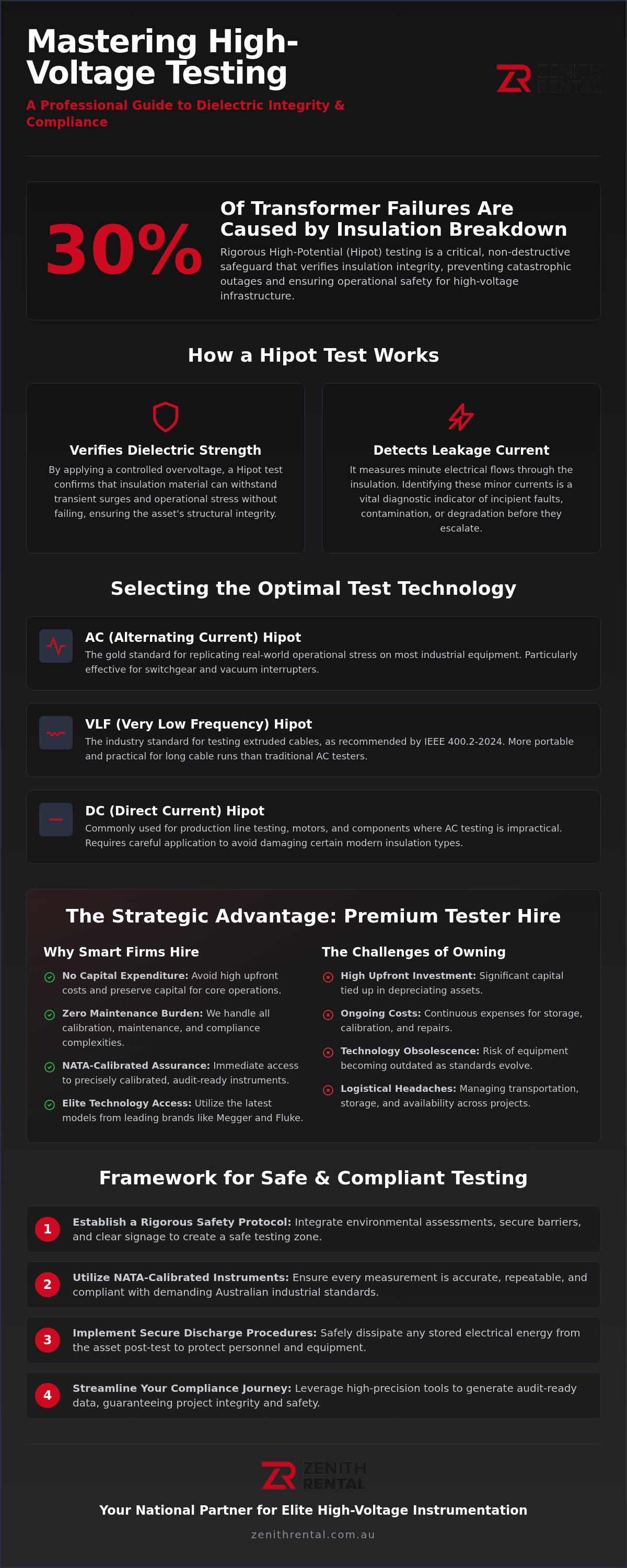
Insulation breakdowns cause 30% of all transformer failures, a statistic that underscores the absolute necessity of rigorous dielectric strength testing. In a professional environment where a single oversight can lead to catastrophic outages or failed safety audits, the precision of your equipment is non-negotiable. For many discerning firms, maintaining a permanent, NATA-certified fleet is a logistical burden that distracts from core operations. This is why a premium Hipot tester hire has become the strategic choice for those who demand excellence without the high capital expenditure and maintenance requirements of ownership.
You likely understand the intense pressure of ensuring every component meets the stringent AS/NZS safety standards under the scrutiny of a critical audit. We're here to ensure that process is seamless and successful. This professional guide will help you master the complexities of high-voltage testing by selecting the most advanced instruments for your specific industrial needs. We'll examine the recent updates to IEEE 400.2-2024, the industry's shift toward VLF testing for extruded cables, and how to utilize elite technology to guarantee your project's integrity and your team's absolute safety.
Key Takeaways
- Gain a sophisticated understanding of how high-potential stress testing serves as a non-destructive safeguard for critical electrical infrastructure.
- Navigate the technical nuances between AC, DC, and VLF technologies to ensure your testing methodology aligns perfectly with your asset's insulation characteristics.
- Discover the strategic advantages of Hipot tester hire, including immediate access to NATA-calibrated instruments from elite brands like Megger and Fluke.
- Establish a rigorous safety protocol that integrates environmental assessments and secure discharge procedures to maintain an uncompromising standard of site safety.
- Streamline your compliance journey by leveraging high-precision tools designed to meet the most demanding industrial safety audits and standards.
Hipot Tester Hire: Ensuring Dielectric Integrity in Critical Infrastructure
High-voltage infrastructure requires a level of vigilance that transcends basic maintenance. A Hipot test, formally known as a Dielectric withstand test, represents the definitive non-destructive method for verifying insulation integrity. By subjecting an asset to a controlled overvoltage, engineers can confirm that the dielectric material remains robust enough to handle transient surges without failing. This process is essential for preventing catastrophic equipment failure and ensuring the safety of personnel operating near high-energy systems. It's the standard for validating that electrical pathways are sufficiently isolated from ground and adjacent phases.
Dielectric strength serves as the primary health metric for your most valuable assets. Whether you're managing sprawling cable networks, industrial motors, or power transformers, the ability of insulation to resist electrical breakdown is what separates a reliable grid from an unplanned outage. Since insulation breakdowns cause 30% of transformer failures, the precision offered by a professional Hipot tester hire becomes a critical component of any risk mitigation strategy. It provides the empirical data needed to make informed decisions about asset retirement or continued service life.
The Mechanics of Dielectric Strength Testing
Hipot testers function by applying a voltage significantly higher than the equipment's normal operating range to monitor for insulation breakdown. While insulation resistance testing measures the total resistance of the dielectric, the Hipot test specifically checks for the material's ability to withstand high stress without a physical rupture. Leakage current is the minute flow of electricity that passes through or over the surface of insulation during a test; it serves as a vital diagnostic indicator of incipient faults or contamination. Identifying these minor current flows before they escalate into a full arc-over is the hallmark of a sophisticated testing program.
Why National Compliance Standards Demand Precision
The Australian regulatory landscape for high-voltage safety audits is uncompromising. Relying on unverified or aging equipment introduces the unacceptable risk of a "false pass," where degraded insulation appears healthy but fails under real-world load. Utilizing NATA-calibrated instruments ensures your results meet the rigorous benchmarks set by Australian industrial standards. For large-scale infrastructure projects, securing premium test equipment hire Australia provides the certainty that every measurement is accurate and audit-ready. A strategic Hipot tester hire allows your team to focus on technical execution while we handle the complexities of calibration and compliance. This approach mirrors the high standards expected in Australia's most demanding industrial sectors.
Selecting the Optimal Technology: AC, DC, and VLF Hipot Testers
The selection of your testing platform is a strategic decision that directly influences the reliability of your electrical infrastructure. Whether you're validating new switchgear or assessing the health of aging distribution networks, the choice between AC, DC, and Very Low Frequency (VLF) technology requires a deep understanding of the asset’s physical properties. An informed Hipot tester hire ensures that your diagnostic methodology aligns with the latest technical standards, including the updated IEEE 400.2-2024 guidelines published on January 9, 2026. This standard provides critical guidance on diagnostic measurements for shielded power cables up to 69 kV, emphasizing the industry's move toward more sophisticated waveforms.
AC Hipot testing remains the gold standard for replicating real-world operational stresses. Since most industrial equipment operates on alternating current, applying an AC overvoltage stresses the insulation in a manner that mirrors its daily service life. This approach is particularly effective for switchgear and vacuum interrupters. However, the high reactive current required for long cable runs often necessitates massive, less portable equipment. Adhering to OSHA safety standards during these high-voltage procedures is paramount, as the energy levels involved demand impeccable site management and operator expertise.
AC vs. DC Hipot Testing: A Technical Comparison
DC Hipot testing offers a smaller equipment footprint, making it a traditional favorite for field maintenance on high-capacitance loads. By applying a steady voltage, the tester avoids the reactive current issues inherent in AC systems. Despite this portability, a significant shift occurred on May 3, 2026, when updated IEEE 400 guidance formally discouraged DC testing for extruded, shielded power cables. Research indicates that DC testing can be ineffective at detecting certain defects and may even cause latent damage to modern XLPE insulation. Consequently, DC methods are now primarily reserved for manufacturing quality control or specific legacy assets where its characteristics remain beneficial.
Understanding VLF (Very Low Frequency) Applications
VLF technology has emerged as the premier solution for modern high-voltage cable systems. By operating at a frequency of 0.1Hz, VLF testers provide the benefits of AC testing without the enormous power requirements. This allows for high-precision diagnostics on long cable runs using portable units. It's the current industry standard for testing XLPE and EPR insulation, providing a clear path to compliance with 2026 safety benchmarks. If you're managing complex distribution networks, a Hipot tester hire featuring VLF capabilities is essential. Our specialists at Zenith Rental invite you to review our curated selection of elite instrumentation to ensure your next project meets these exacting standards.
The Strategic Advantage of Premium Hipot Tester Hire
High-stakes electrical testing demands more than just a functional tool; it requires a strategic partnership that prioritizes precision and fiscal intelligence. While purchasing high-voltage equipment might seem like a permanent solution, the hidden costs of ownership often erode the perceived value. Depreciation, specialized storage, and the relentless cycle of NATA-traceable calibration create a significant logistical burden. Choosing a premium Hipot tester hire transforms these capital liabilities into agile operational advantages, allowing your firm to maintain a lean profile while accessing the world's most sophisticated diagnostic technology.
Success in the field depends on the absolute reliability of your instrumentation. When you opt for a professional rental, you eliminate the risk of technological obsolescence. You're no longer tethered to aging assets that may not support the latest diagnostic waveforms or safety features. Instead, you gain the flexibility to scale your fleet based on specific project phases, ensuring you have the exact quantity and type of testers required for a short-term shutdown or a multi-year infrastructure rollout. This level of scalability is essential for maintaining momentum in Australia's fast-paced industrial sector.
Calibration and Reliability: The Zenith Standard
In a landscape where safety audits are rigorous, a documented trail of measurement certainty is your greatest asset. Every unit in a premium hire fleet arrives site-ready, accompanied by a current NATA-traceable calibration certificate. This eliminates the weeks of downtime typically lost when sending owned equipment for annual servicing. Adhering to the NFPA 70E Standard for electrical safety in the workplace becomes a seamless process when your gear is guaranteed to perform within exacting tolerances. These certificates aren't just paperwork; they're your primary defense against the measurement errors that lead to "false passes" in critical infrastructure.
Operational Flexibility for National Projects
National industrial projects require a partner with the reach and inventory to support diverse site conditions. A strategic Hipot tester hire provides immediate access to elite brands like Megger and Fluke, which remain the gold standard for reliability in harsh Australian environments. Whether you need a compact DC unit for a remote mine site or a high-capacity VLF set for a metropolitan grid expansion, the ability to source specialized tools on demand reduces your logistical overhead. You benefit from expert technical guidance during the selection process, ensuring the instrumentation you deploy is perfectly matched to the insulation characteristics of your specific assets.
A Professional Framework for Safe and Compliant Hipot Testing
Execution is where technical knowledge meets operational discipline. While a premium Hipot tester hire provides the necessary precision, the integrity of the test depends on a rigorous framework of pre-test protocols. Begin with a meticulous visual inspection of the asset; look for surface contamination, moisture, or mechanical damage that could skew results. Environmental factors like high humidity can increase leakage current, potentially leading to a false failure. Assessing these variables before energizing the system ensures that your data reflects the true state of the insulation rather than external interference.
Establishing a secure test zone is a non-negotiable requirement for industrial compliance. This involves more than just physical barriers; it requires a coordinated effort to isolate the asset from all other power sources and grounded surfaces. Clearly mark the perimeter with high-visibility tape and ensure all non-essential personnel remain outside the boundary. This disciplined approach mirrors the high standards of luxury service, where every detail is accounted for to provide a sense of absolute security and professional ease.
Safety Protocols and Hazard Mitigation
Safety in high-voltage environments relies on the "two-person rule," where a second qualified operator monitors the test to provide an emergency stop if required. Proper grounding is the cornerstone of this process. Always maintain contact with the grounding point before approaching the test object with the high-voltage discharge rod to ensure a controlled path for residual energy. Post-test, managing residual charge is critical; modern cables can retain significant energy long after the tester is deactivated. Utilize the discharge rod to bleed off this energy until the voltage reaches zero, preventing accidental shocks during reconnection.
Interpreting Hipot Test Results
Distinguishing between normal charging current and actual insulation failure requires a discerning eye. When the voltage first ramps up, a spike in current is expected as the asset's capacitance charges. A steady, low leakage current thereafter indicates a healthy dielectric. However, erratic fluctuations or a sudden "trip" suggest an impending breakdown or partial discharge. If a failure occurs, don't immediately re-test. Investigate the root cause, looking for tracking, carbonization, or puncture points in the insulation material. Documenting these findings is essential for long-term asset health monitoring and future safety audits.
If you're preparing for a critical safety audit and require the highest caliber of instrumentation, explore our range of NATA-calibrated high-voltage tools to ensure your site remains compliant and secure.
Zenith Rental: Your National Partner for Elite High-Voltage Instrumentation
Choosing Zenith Rental for your Hipot tester hire connects your project to a legacy of technical excellence and absolute reliability. Our fleet encompasses the full spectrum of high-voltage diagnostics, featuring advanced AC, DC, and VLF solutions tailored for Australia's most demanding infrastructure. We curate our inventory with a focus on uncompromising quality, stocking only the most respected names like Megger and Fluke. This commitment ensures that your team has access to the same high-performance assets used by the world's leading energy and industrial firms.
National delivery capabilities ensure that whether you're working on a metropolitan grid expansion or a remote mining operation, your equipment arrives precisely when needed. We understand the high stakes of maintenance shutdowns and safety audits, where every hour of downtime carries significant weight. Our technical expertise bridges the gap between selection and execution, providing your team with the confidence to manage complex dielectric strength tests with ease. It's a partnership designed to elevate your operational standards while maintaining the lean efficiency of a hired fleet.
The Zenith Advantage in Australian Industry
Our commitment to professional authority stems from a deep understanding of the Australian industrial landscape. We recognize that test and measurement equipment hire is more than a transaction; it's a critical component of your safety and compliance strategy. By providing NATA-calibrated units that are ready for immediate site deployment, we streamline your engagement process and minimize the friction often associated with high-voltage testing. This seamless integration allows you to focus on the technical nuances of your project while we manage the logistics of quality assurance. We take pride in being a high-tier partner that speaks to success and discerning technical taste.
Contact Our Specialists for Your Next Project
Selecting the correct instrument for a specific high-voltage application requires nuanced knowledge of insulation characteristics and regulatory requirements. Our specialists offer tailored advice to help you navigate these technical challenges, ensuring the equipment you receive is perfectly suited to your asset's needs. Every unit is dispatched fully calibrated and site-ready, reinforcing our position as an elite service provider. We invite you to Consult with Zenith Rental for your Hipot testing requirements and experience a service that prioritizes your success, safety, and professional peace of mind. Let us help you reach the highest possible standard of quality for your next high-voltage project.
Mastering High-Voltage Safety with Absolute Precision
Insulation integrity is the foundation of a resilient power grid. By mastering the technical nuances between AC, DC, and VLF technologies, you ensure that your assets are tested under the most accurate conditions possible. A strategic Hipot tester hire provides the agility to meet rigorous Australian safety standards without the logistical burden of fleet maintenance or annual calibration management. You've seen how precision isn't just about the numerical measurement; it's about the reliability of the instrument and the disciplined safety protocols that protect your team.
Zenith Rental stands ready to support your most critical industrial projects with an elite fleet that defines the peak of the industry. Our commitment to excellence is reflected in every NATA-calibrated unit we provide, ensuring your site remains audit-ready and secure. With national reach across Australia and a curated selection of premium Fluke and Megger instrumentation, we bridge the gap between complex technical requirements and seamless site execution. We invite you to experience a service where every detail of your high-voltage needs has been meticulously considered.
Secure Your High-Voltage Hipot Tester Hire from Zenith Rental
We look forward to helping you achieve an uncompromising standard of quality and safety on your next project.
Frequently Asked Questions
What is the primary difference between a Hipot test and an insulation resistance test?
A Hipot test applies a high overvoltage to verify that insulation won't rupture under extreme stress; it's a "pass or fail" dielectric withstand test. In contrast, an insulation resistance test measures the actual resistance value in megohms to detect moisture or contamination at lower voltages. While insulation resistance testing monitors gradual degradation, the Hipot test ensures the asset can survive transient surges without a catastrophic breakdown.
Is it better to use AC or DC for Hipot testing on industrial motors?
AC Hipot testing is generally the preferred choice for industrial motors because it replicates the alternating stress the insulation experiences during its normal service life. This method provides a more authentic assessment of the motor's dielectric health. While DC testing is more portable and requires less power, AC testing is often mandatory for new equipment to ensure it meets original manufacturing quality standards under real-world conditions.
How often should a Hipot tester be calibrated to remain compliant with Australian standards?
To maintain compliance with Australian industrial benchmarks and safety audits, a Hipot tester typically requires NATA-traceable calibration every twelve months. This annual cycle ensures that the instrument's measurement certainty remains within the exacting tolerances required for high-voltage diagnostics. For projects in particularly harsh or remote environments, some firms opt for more frequent verification to guarantee the absolute reliability of their safety data.
What are the safety requirements for personnel performing high-voltage Hipot tests?
Personnel must adhere to the "two-person rule," which ensures a second qualified operator is always present to manage emergency procedures and monitor the test zone. Safety requirements also include the use of high-voltage discharge rods to bleed off residual energy and the establishment of physical barriers to prevent unauthorized access. This disciplined approach reflects a commitment to elite safety standards, protecting both the technical team and the critical infrastructure.
Can VLF testing be used on all types of high-voltage cables?
VLF testing is the premier solution for modern extruded cables such as XLPE and EPR, providing a highly effective diagnostic waveform without the power requirements of standard AC sets. While it's exceptionally versatile, its application on older paper-insulated lead-covered (PILC) systems requires specific technical protocols to avoid damaging the legacy dielectric. For most contemporary projects, a VLF Hipot tester hire offers the most sophisticated path to verifying cable integrity.
What factors influence the leakage current during a Hipot test?
Leakage current is significantly influenced by environmental factors such as humidity, temperature, and surface contamination, all of which can create conductive paths over the insulation. The asset's inherent capacitance also creates an initial charging current that must be carefully distinguished from the steady-state leakage current. Discerning these variables is essential for an accurate diagnosis, ensuring that minor environmental fluctuations aren't mistaken for a genuine insulation failure.
Why is NATA-traceable calibration essential for rental test equipment?
NATA-traceable calibration is the cornerstone of professional authority, providing the documented proof of accuracy required to pass rigorous safety audits. When you secure a Hipot tester hire with this certification, you're guaranteed that the instrument has been verified against national standards of excellence. This measurement certainty is vital for making high-stakes decisions about asset health and for maintaining a defensible record of compliance for your clients.
How do I determine the correct test voltage for my specific asset?
The correct test voltage is dictated by the specific Australian or international standards, such as AS/NZS or IEEE, that govern your particular asset class. A common industry formula for new equipment is twice the rated operating voltage plus 1,000 volts, though this value is typically reduced for maintenance testing on aged infrastructure. Our specialists can provide tailored advice to ensure your testing parameters provide a robust safety margin without causing unnecessary dielectric stress.