


Dielectric Strength Test Explained: A Comprehensive Guide to Industrial Insulation Integrity
What if the only thing standing between your facility's peak operational performance and a catastrophic failure is a layer of insulation no thicker than a few sheets of paper? It's a sobering thought for any professional managing high-value assets where the margin for error is non-existent. Having the dielectric strength test explained with absolute precision is essential for those who refuse to settle for anything less than total reliability. You're likely aware that maintaining insulation integrity is a critical priority, yet the fine line between a successful diagnostic and damaging an expensive transformer often feels incredibly thin.
This guide empowers you to master these technical complexities, ensuring you achieve absolute site safety and asset longevity. We'll demystify the confusion between strength and withstand testing while addressing the latest regulatory requirements, such as the ASTM D149-20 and IEC 61010-1 standards. You'll gain the confidence to select the right high-end instrumentation for your requirements, ensuring your facility remains a benchmark of industrial excellence and prestige.
Key Takeaways
- Discover the critical mechanisms of dielectric breakdown and learn to distinguish between internal punctures and surface flashovers.
- Gain a sophisticated understanding of the dielectric strength test explained through the lens of ultimate material failure versus non-destructive withstand protocols.
- Ensure your facility meets prestigious international standards by mastering the nuances of ASTM D149 and IEC 60243 compliance.
- Learn how precision instruments, such as specialized transformer oil breakdown voltage tester hire, safeguard your most valuable industrial assets.
- Elevate your maintenance strategy by leveraging the latest measurement technology through elite hire services that prioritize both accuracy and efficiency.
What is Dielectric Strength? The Core Principles Explained
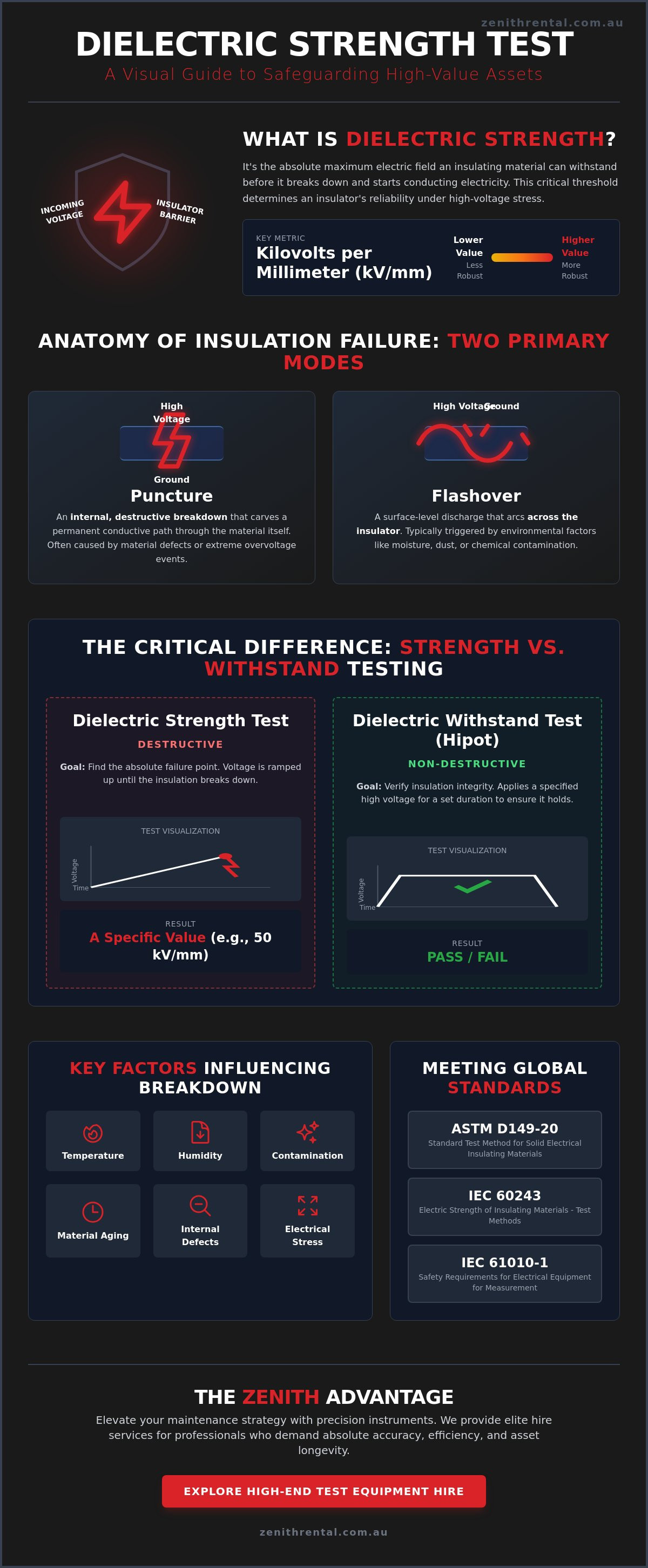
At its most fundamental level, dielectric strength represents the absolute threshold of an insulating material's endurance. It is the maximum electric field intensity a substance can support before its molecular structure yields to the pressure of high voltage. Having the dielectric strength test explained with clarity is the first step toward safeguarding your facility's most prestigious assets. When this limit is exceeded, we witness Dielectric Strength breakdown; a transformative moment where an elite insulator loses its integrity and begins to conduct electricity like a wire.
Engineers recognize this metric as the gold standard for evaluating insulation quality because it provides a definitive numerical value for reliability. We typically express this value in Volts per unit thickness, such as Volts per meter (V/m) or the more common industrial unit, kilovolts per millimeter (kV/mm). A higher value signifies a more robust material, capable of maintaining its composure under the most demanding electrical stresses. This precision allows for the selection of materials that don't just meet requirements but exceed them, ensuring a seamless experience for your onsite team. Understanding the dielectric strength test explained in this context provides the technical confidence required to manage high-stakes industrial environments.
The Role of Insulators in Industrial Power Systems
In high-voltage environments, insulators serve as the silent guardians of your infrastructure. They prevent catastrophic short circuits that could otherwise lead to expensive asset damage or total system failure. However, even the most refined materials are susceptible to their environment. Factors like rising humidity or extreme temperature fluctuations can degrade performance over time. Maintaining peak performance requires tools that mirror the high standards of your operation. This is why many professionals rely on the legacy of Fluke to provide the sophisticated measurement accuracy needed to detect these subtle shifts before they escalate.
Why Regular Testing is Non-Negotiable
Proactive insulation monitoring is the hallmark of an impeccably organized maintenance strategy. By committing to regular assessment, you effectively eliminate the risk of unplanned downtime that disrupts your project's momentum. Safety remains the ultimate priority. Identifying potential flashover risks before they occur protects your personnel and ensures your site remains a benchmark of professional excellence. Consistent testing also ensures your facility remains in absolute alignment with Australian regulatory standards for high-voltage installations. It's about more than just utility; it's about the peace of mind that comes from knowing every detail of your asset's health has been considered and accounted for.
The Science of Dielectric Breakdown: How and Why It Happens
Understanding the physical mechanics of insulation failure is essential for any professional seeking to have the dielectric strength test explained with total technical authority. A breakdown event isn't usually a single, isolated moment; it's a sophisticated cascade of microscopic failures. When an electric field reaches a critical intensity, it initiates an ionization process. Electrons are violently stripped from their atomic orbits, accelerating and colliding with other atoms to create a conductive path through what was once a secure barrier. This sudden transformation from an elite insulator to a conductor represents the definitive point of failure.
In high-value industrial assets, we distinguish between two primary failure modes: puncture and flashover. A puncture is an internal failure where the electrical discharge carves a permanent, destructive path through the material's bulk. In contrast, a flashover occurs across the surface of the insulator, often visible as a luminous arc. Both signify a loss of absolute reliability, but their causes often differ. While punctures frequently stem from material defects or extreme overvoltage, flashovers are usually triggered by environmental factors. Moisture, chemical contamination, and the natural fatigue of aging accelerate this dielectric fatigue. These impurities lower the energy threshold required for ionization. Standardized protocols, such as ASTM D149 Testing, provide the structured framework needed to evaluate solid materials and identify these vulnerabilities before they compromise site safety.
Thermal vs. Electrical Breakdown
Thermal breakdown occurs when a dielectric material generates more localized heat than it can safely dissipate. This rise in temperature increases conductivity, leading to a runaway cycle that eventually melts or chars the insulation. Pure electrical breakdown is different; it's the result of intense field intensity alone, often occurring in microseconds. Distinguishing between these two during post-test analysis is vital for long-term asset health. Identifying charred, carbonized paths usually points to thermal issues, whereas clean, sudden fractures suggest a pure electrical failure event.
The Impact of Material Thickness and Geometry
It's a common misconception that dielectric strength is a linear function of thickness. In reality, doubling the material thickness rarely doubles the breakdown voltage. The 'edge effect' also plays a significant role; sharp electrode geometries concentrate the electric field, often triggering premature failure at the points of highest stress. When interpreting results in kV/mm across different asset scales, one must account for these geometric nuances. Achieving this level of diagnostic precision is simplified when you utilize sophisticated test equipment hire, ensuring your data remains as refined as your facility's operational standards.
Dielectric Strength vs. Dielectric Withstand: Understanding the Nuance
Precision in terminology is the hallmark of a discerning professional. While many industry sources use Hipot and dielectric strength as interchangeable labels, they represent distinct philosophies of measurement. Having the dielectric strength test explained involves recognizing that one method seeks the material's absolute limit, while the other confirms its operational safety. This distinction is vital for those managing high-value infrastructure where the margin for error is non-existent. One is a quest for the breaking point; the other is a validation of integrity.
The primary pass/fail metric for a withstand test isn't a spectacular arc or a physical rupture. Instead, engineers monitor the leakage current threshold. This subtle flow of electricity provides a sophisticated diagnostic of the insulation's health. If the current remains below a predetermined milliampere limit during the test duration, the asset is deemed safe for service. It's a refined approach that ensures your equipment operates at peak performance without being pushed to the point of no return.
Dielectric Strength: The 'Destructive' Limit
Strength testing is inherently destructive. It requires increasing the voltage until the insulation fails completely, providing the definitive data needed for material selection and R&D. Because this process permanently damages the asset, it's typically reserved for material samples or end-of-life analysis rather than routine maintenance. Selecting the right tools for these high-stakes assessments is simplified when you consult the definitive guide to test equipment hire. This ensures you have access to the elite diagnostic technology required to capture these precise failure points with absolute accuracy.
Dielectric Withstand (Hipot): The Safety Benchmark
The Dielectric Withstand test, or Hipot test, serves as the ultimate safety benchmark for assembled products and new installations. It's a non-destructive procedure designed to stress the insulation at a voltage significantly higher than its normal operating level, usually twice the rated voltage plus 1000V. In Australian industrial settings, following strict standards for ramp-up and dwell time is essential. You must gradually increase the voltage to avoid transient spikes that could cause unnecessary stress. Once the target is reached, the dwell time allows the insulation to prove its composure under sustained pressure, ensuring every detail of your site's safety has been verified.
Industrial Field Testing: Standards, Methods, and Equipment
Executing a high-voltage assessment requires more than technical skill; it demands adherence to the world’s most rigorous standards. When we have the dielectric strength test explained for field applications, we look to governing bodies like ASTM and IEC to provide the necessary structure. The ASTM D149-20 standard remains the definitive framework for evaluating solid insulators, while IEC 60243-1:2013 governs the electric strength of insulating materials. Adhering to these protocols ensures your diagnostics aren't just accurate but also internationally recognized for their precision. It’s this level of detail that separates an elite maintenance program from a standard one.
Professionals typically choose between two primary voltage application strategies: the Short-Time Method and the Step-by-Step Method. In the Short-Time Method, the voltage rises at a constant, rapid rate until breakdown occurs, providing a quick snapshot of material endurance. The Step-by-Step Method is more nuanced, applying an initial voltage and increasing it in specific increments with defined dwell times. This gradual approach allows for the detection of thermal influences that a faster test might overlook. This methodical discipline ensures every diagnostic is as reliable as the high-value assets you protect.
Safety remains the cornerstone of every prestigious operation. High-voltage testing is a high-stakes endeavor that requires absolute focus. You must implement robust grounding systems, physical barriers, and the disciplined use of discharge rods to manage residual energy after the test concludes. These protocols aren't merely logistical necessities; they’re the signature of a site that values the safety of its personnel and the absolute integrity of its infrastructure. Every detail must be accounted for to maintain the seamless nature of your facility’s performance.
Testing Transformer Oil and Liquid Dielectrics
For those managing oil-filled assets, the health of the insulating liquid is a primary indicator of transformer longevity. Moisture, acidity, and carbon particles can drastically reduce breakdown voltage, leading to catastrophic failure if left unmonitored. Utilizing a transformer oil breakdown voltage tester hire allows for the precise measurement of liquid dielectric strength in accordance with Australian utility standards. This process ensures that your cooling and insulating mediums maintain their elite performance levels over decades of service, reflecting a commitment to long-term asset health.
Field Equipment for Professional Insulation Validation
Selecting the right instrumentation is the difference between a routine check and a sophisticated validation. In the field, combining Hipot testing with insulation resistance tester hire provides a comprehensive view of insulation health. For Australian industrial audits, NATA calibration is essential for compliance; it proves your measurement tools meet the highest possible standards of accuracy. Whether you require AC Hipot testers for high-capacitance loads or DC alternatives for cable validation, your choice of equipment reflects your discerning taste for quality. Secure the most refined industrial test equipment rental Australia offers to ensure your next project reaches the peak of industry standards.
The Zenith Advantage: Precision Hire for Elite Industrial Standards
Zenith Rental stands as the premier partner for organizations that demand absolute reliability in their diagnostic processes. When you've had the dielectric strength test explained, it becomes clear that the quality of your results is inextricably linked to the quality of your instrumentation. Opting for a rental solution offers a sophisticated path to project success; it allows you to bypass significant capital outlay while maintaining immediate access to the latest technological advancements. This is a strategic choice that ensures your facility operates at the peak of industry standards without the burden of long-term asset depreciation or complex maintenance schedules.
Every instrument within our curated inventory arrives project-ready, having been impeccably maintained and meticulously calibrated to ensure total accuracy. This commitment to excellence provides the necessary assurance for your most critical high-voltage assessments. Using project-ready tools from a high-tier partner minimizes operational risk and reflects a discerning taste for quality that standard budget-tier services simply cannot match. We support national Australian industries with a level of expert-tier reliability that treats your logistical requirements as a memorable component of a successful project rather than a mere necessity.
Accessing Top-Tier Brands Like Megger and Fluke
The prestige of world-leading brands like Megger and Fluke isn't just about status; it's about the absolute reliability they bring to the industrial field. Utilizing Megger equipment hire allows your team to work with the global standard for insulation testing, providing a superior user experience that translates into actionable data. These industry-validated tools reduce project risk and provide the technical confidence required for high-stakes, high-voltage environments. Having the dielectric strength test explained by an elite professional is the foundation, but executing that test with the world's most refined measurement technology is what truly ensures the longevity of your most valuable assets.
Seamless Logistics for National Australian Projects
Our commitment to your success extends across the continent, providing reliable access to specialized measurement equipment for projects in every corner of Australia. The hire process is designed to be smooth and logical, mirroring the high performance and efficiency of the assets themselves. We prioritize a communication rhythm that minimizes friction, ensuring that every detail of your equipment needs is considered and accounted for well before you arrive on site. This seamless engagement allows you to focus on the finer details of site compliance and absolute safety. Consult with the elite service professionals at Zenith Rental for your next critical testing phase and reach the highest possible standard of quality.
Elevating Your Asset Integrity Strategy
Mastering industrial insulation integrity is a journey of precision and technical discipline. Having the dielectric strength test explained in such detail provides you with the clarity needed to navigate complex regulatory landscapes while safeguarding your facility's most prestigious assets. You've seen how distinguishing between ultimate material failure and non-destructive validation protects your infrastructure from unnecessary stress. By aligning your maintenance protocols with international standards, you ensure your site remains a benchmark of absolute reliability.
True operational excellence is achieved when your expertise is matched with the world's most refined measurement technology. Zenith Rental provides seamless access to elite brands like Fluke, Megger, and Transmille; ensuring your team has the tools required for success. Every instrument features NATA traceable calibrations, offering the peace of mind that comes from total accuracy. With national Australian support, we ensure your next critical testing phase is executed with the sophistication your project deserves.
Secure Precision Testing Instrumentation for Your Next Project
We look forward to supporting your commitment to reaching the highest possible standard of industrial quality.
Frequently Asked Questions
What is the difference between dielectric strength and insulation resistance?
Insulation resistance measures the quality of the insulator at a specific voltage, typically using a Megger, to identify moisture or contamination. In contrast, having the dielectric strength test explained involves identifying the absolute voltage limit where the material physically fails. While resistance tests are routine health checks, strength tests determine the material's ultimate endurance threshold under extreme electrical pressure.
Is a dielectric strength test destructive to the equipment being tested?
Pure dielectric strength testing is inherently destructive because it increases voltage until the insulation ruptures. However, most field professionals perform a dielectric withstand test, often called a Hipot test, which is non-destructive. This validation confirms the asset can handle its rated voltage plus a safety margin without causing permanent damage to the molecular structure or service life.
How often should industrial transformers undergo dielectric strength testing?
Industrial transformers generally undergo insulation health checks annually, though the specific frequency depends on the asset's criticality and operational environment. High-load units or those in harsh coastal conditions benefit from more frequent oil analysis and breakdown testing. You should always consult the manufacturer's maintenance schedule and relevant Australian standards to ensure your testing regime maintains absolute site safety and asset longevity.
Can I perform a dielectric strength test with a standard multimeter?
No, a standard multimeter cannot perform this assessment because it lacks the high-voltage output required to stress the insulation. These tests involve kilovolts, far exceeding the 600V or 1000V limit of a typical handheld meter. For accurate results, you must use specialized instrumentation like a Hipot tester or a dedicated insulation resistance meter designed specifically for high-voltage industrial environments.
What are the safety requirements for performing a Hipot test on-site?
On-site safety requires a combination of physical barriers, clear warning signage, and impeccable grounding protocols. You must establish a controlled test area to prevent unauthorized access during the high-voltage application to protect personnel. Utilizing discharge rods to bleed off residual capacitive charge after the test is a critical step that ensures the safety of your elite technical team before they handle the equipment.
Why is transformer oil breakdown voltage testing important for maintenance?
Testing the breakdown voltage of transformer oil is vital because the liquid serves as both a coolant and a primary insulator. Over time, moisture and carbon particles accumulate, significantly lowering the oil's ability to resist electrical stress. Regular monitoring identifies these impurities early, allowing for oil filtration or replacement before a catastrophic internal flashover occurs within your high-value transformer assets.
Does the thickness of insulation directly determine its dielectric strength?
Thickness does not determine strength in a strictly linear fashion. While a thicker material generally withstands more voltage, the dielectric strength test explained in a laboratory setting shows that strength often decreases per unit of thickness as the material gets thicker. This occurs because larger volumes of insulation are more likely to contain microscopic defects or voids that facilitate an earlier breakdown event.
What Australian standards govern dielectric testing for industrial switchgear?
The primary standards for industrial switchgear in Australia include the AS/NZS 62271 series, which aligns with international IEC standards. These documents outline the specific voltage levels and durations required for both type testing and routine field validation. Adhering to these prestigious benchmarks ensures your installation meets the highest possible standards for reliability and regulatory compliance across the national power grid.