


Circuit Breaker Timing Test Procedure: The Professional's Guide to Switchgear Reliability (2026)
A single millisecond of deviance in a high-voltage interrupter is often the only warning you'll receive before a catastrophic failure compromises your entire facility. You recognize that in the high-stakes world of power distribution, switchgear reliability is the ultimate hallmark of professional excellence. It's a standard that demands more than just routine checks; it requires an uncompromising commitment to precision. This guide empowers you to master the circuit breaker timing test procedure with the technical mastery of an elite professional, ensuring every mechanical nuance is captured and analyzed with absolute clarity.
By following our expert-led methodology, you'll learn to identify subtle mechanical degradation long before it escalates into a liability. We'll examine the critical 2026 NEC updates regarding arc flash hazards and the latest IEEE PC37.09™ draft standards that define modern compliance. From leveraging AI-driven diagnostics to utilizing premium circuit breaker analyzer hire for infrequent yet vital assessments, we provide the roadmap to an impeccable execution. You'll discover how to navigate the complexities of modern multi-break interrupters while maintaining the highest safety standards for your team and your most valuable assets.
Key Takeaways
- Master the art of millisecond precision to prevent catastrophic arcing and ensure the absolute reliability of your high-voltage assets.
- Implement a rigorous circuit breaker timing test procedure that integrates the latest 2026 NEC safety standards with meticulous site isolation protocols.
- Identify subtle mechanical discrepancies, from coil fatigue to lubricant degradation, by expertly contrasting field results with manufacturer nameplate specifications.
- Secure the most sophisticated measurement technology through premium circuit breaker analyzer hire, allowing you to maintain an elite standard of performance.
- Enhance your professional standing by utilizing AI-enhanced diagnostics and modular hardware to future-proof your switchgear maintenance strategy.
Understanding the Criticality of Circuit Breaker Timing
In the high-stakes landscape of electrical infrastructure, timing isn't merely a technical metric; it's the heartbeat of system integrity. At its core, a timing test measures the precise interval between the initiation of a command and the physical movement of the contacts. To truly appreciate the gravity of these measurements, one must first understand What is a circuit breaker? beyond its basic role as a switch. It's a sophisticated guardian of stability. When you perform a circuit breaker timing test procedure, you're verifying that the device can extinguish a lethal arc within a fraction of a second. This rapid response prevents the violent energy of a fault from compromising your most valuable assets.
System stability relies on the predictable, lightning-fast clearing of faults. If a breaker operates even slightly outside its specified window, the result is often uncoordinated tripping. This leads to wider network blackouts and expensive, unnecessary downtime for critical facilities. Adhering to Australian Standards (AS/NZS) and international NETA requirements isn't just a matter of regulatory compliance. It's an uncompromising commitment to a standard of excellence that reflects your discerning taste for reliability and prestige. Achieving this level of accuracy often necessitates the use of high-tier instrumentation, making specialized circuit breaker analyzer hire a preferred choice for those who demand the latest diagnostic technology.
The Anatomy of a Timing Cycle
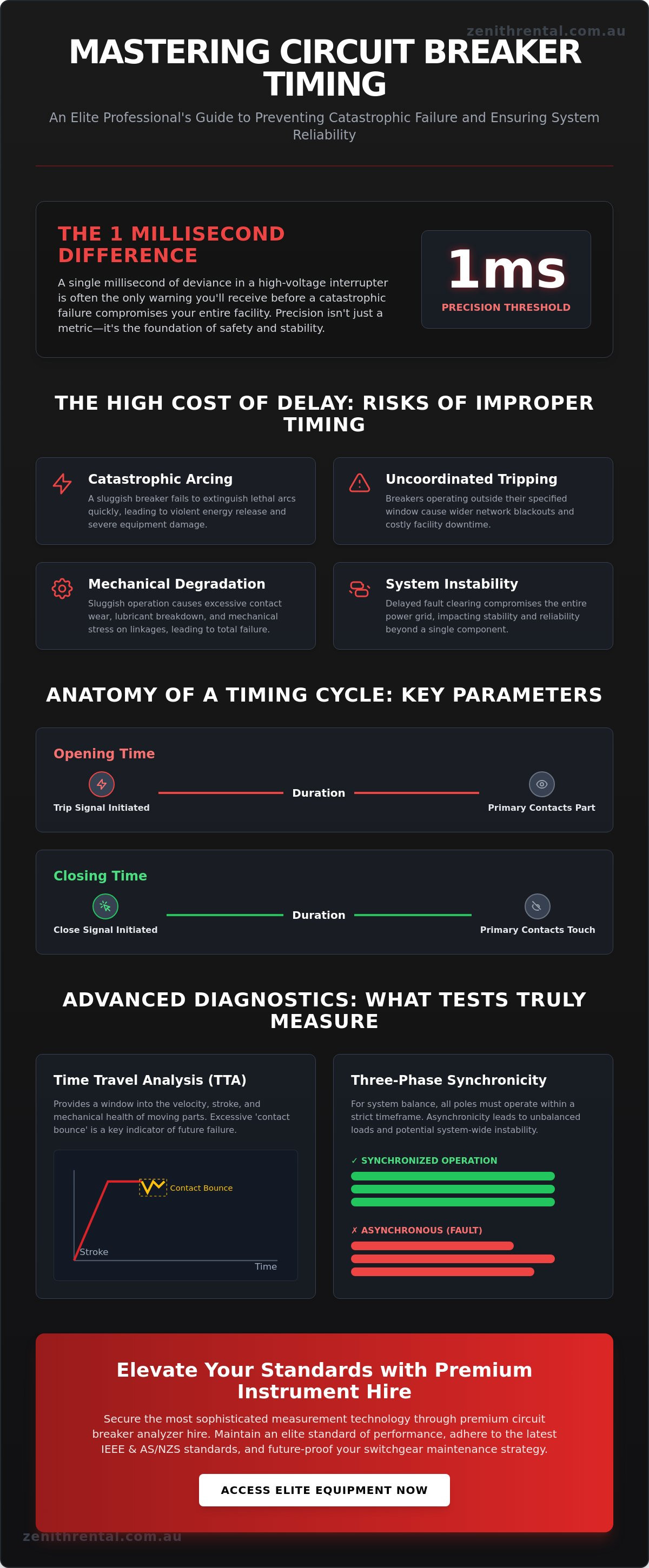
Achieving mastery over your switchgear requires a deep understanding of the operating cycle's distinct phases. Opening time represents the duration from the trip signal to the moment the primary contacts part. Conversely, closing time spans the interval from the close signal to the instant the contacts touch. For those managing modern, high-performance networks, the complexity of reclose operations, such as the O-0.3s-CO sequence, adds another layer of scrutiny. These rapid-fire sequences test the breaker's ability to handle successive faults with absolute precision, ensuring the system remains resilient under pressure.
Risks of Improperly Timed Breakers
Neglecting these timing parameters invites risks that no professional can afford. A sluggish breaker causes excessive contact wear and the rapid carbonisation of insulating oil, which severely degrades the equipment's dielectric strength. Over time, the mechanical stress on linkages and operating mechanisms leads to total failure. By prioritizing a rigorous circuit breaker timing test procedure, you ensure your assets remain at the peak of their industry performance. This proactive approach safeguards your reputation and ensures that every component of your power system operates with the seamless efficiency that success demands.
Essential Parameters: What Timing Tests Actually Measure
Precision is the hallmark of an elite electrical professional. When you execute a circuit breaker timing test procedure, you're looking for more than a simple binary result. You're seeking a detailed portrait of mechanical health. This involves comparing main contact timing with auxiliary contact signals to ensure the protection logic aligns perfectly with physical movement. Main contacts handle the primary load, while auxiliary contacts signal the status to control systems. Any discrepancy between these two can lead to false alarms or, worse, a failure to report a successful trip during a fault event.
Time Travel Analysis (TTA) provides a window into the velocity and stroke of the moving parts. If a breaker closes too slowly, it risks pre-arcing; too fast, and the mechanical impact causes contact bounce. Excessive bounce is a precursor to pitted contacts and eventual dielectric failure. High-precision instruments, available through professional circuit breaker analyzer hire, allow you to capture these transients with microsecond accuracy. For those adhering to the NETA standards for circuit breaker testing, these metrics are non-negotiable for proving site reliability and ensuring the longevity of expensive switchgear.
Synchronicity Across Three Phases
Mechanical harmony is vital for system balance. You must ensure all poles operate within a strict timeframe; typically, the maximum allowable deviation between poles is less than 1/6 of a cycle. Asynchronous operation creates damaging neutral currents and places immense torsional stress on the breaker's main shaft. By analyzing pole discrepancy data, you can identify early signs of linkage wear or drive rod misalignment before they manifest as a total mechanism jam.
Coil Current Analysis
The electrical signature of the trip and close coils tells a story of its own. By monitoring the coil current curve, you can identify plunger friction, failing insulation, or low battery voltage issues within the DC control circuit. We recommend the "first trip" testing concept. This captures the breaker's performance in its true operational state, before repeated operations "warm up" the lubricant or clear away oxidation. This data is the most authentic representation of how your equipment will perform when a real-world fault occurs, providing the ultimate peace of mind for site managers and stakeholders alike.
Step-by-Step Circuit Breaker Timing Test Procedure
Executing a flawless circuit breaker timing test procedure is an exercise in professional discipline. It begins long before the first signal is sent to the trip coil. You start with an impeccable preparation phase, verifying the permit-to-work and ensuring the asset is fully isolated from the grid. This isn't merely a safety requirement; it's the foundation of data integrity. Any residual energy or improper grounding can introduce electrical noise, masking the subtle mechanical signatures you're attempting to capture. By treating the preparation with the same care as the test itself, you ensure a seamless transition from setup to analysis.
Selecting the appropriate instrumentation is your next critical decision. A vacuum interrupter demands different sensitivity settings compared to a large SF6 or bulk oil unit. Modern digital analyzers have revolutionized this process with intuitive interfaces, yet they still require a nuanced touch to configure correctly. You'll connect your primary leads to the main contacts and your control leads to the trip and close coils. Ensuring these connections are secure and low-resistance is paramount for capturing high-fidelity traces that reflect the true state of the mechanism. For many elite professionals, choosing circuit breaker analyzer hire provides the flexibility to match the specific tester to the breaker's unique architecture.
Safety Protocols and Isolation
Confirm the breaker is in a strictly de-energised state before any leads are attached. Apply local earths and verify the "test" position within the cubicle to provide a physical break from the primary bus. You must also ensure that secondary control circuits are correctly isolated from the protection bus. This prevents accidental operations of adjacent equipment, maintaining the sanctuary of your testing environment. This level of meticulousness mirrors the standards of a high-end service provider, where every detail is managed to eliminate friction and risk.
Executing the Test Sequence
Your first operation should always be an "As-Found" test. This captures the breaker's performance exactly as it has sat in service, which is the most authentic representation of its reliability. Following this, perform the standard sequences: Close, Open, and the rapid Close-Open (CO) cycle. We recommend executing multiple operations to ensure the data is consistent and repeatable. For those who demand the gold standard in measurement, The Legacy of Fluke and Megger instruments remain the preferred choice for Australian industry. These tools provide the high-resolution traces necessary for identifying the slightest mechanical hesitation. Before clearing the site, verify the trace integrity on the digital display to ensure every millisecond of the operation is accounted for.
Interpreting Results and Identifying Mechanical Discrepancies
The true value of a circuit breaker timing test procedure lies in the translation of raw data into actionable intelligence. Once the traces are captured, your role shifts from technician to diagnostician. You'll begin by holding your field results against the manufacturer’s nameplate specifications, which serve as the definitive benchmark for your asset's performance. Deviations of just a few milliseconds can signal the onset of mechanical fatigue. Identifying a 'slow' breaker requires a nuanced approach. You must determine if the delay originates in a sluggish trip coil, hardened lubricant within the mechanism, or a latch that has lost its precision edge. These distinctions are the hallmark of a professional who values switchgear reliability above all else.
Environmental factors play a significant role in your analysis, particularly within the challenging Australian climate. Extreme ambient temperatures can fluctuate significantly during a single shift, subtly altering the viscosity of lubricants and the resistance of coils. Because of this, a single-point test is merely a snapshot in time. Elite asset managers rely on trending data, comparing today's results with historical records to detect gradual degradation that might otherwise remain hidden. This longitudinal view allows you to predict failure long before it occurs, maintaining the prestige and safety of your facility. When you require the most advanced tools to capture these nuances, our circuit breaker analyzer hire service provides the precision you need.
Common Trace Abnormalities
Analyzing the Time Travel Analysis (TTA) graph reveals the inner workings of the interrupter. Contact chatter, visible as rapid oscillations on the trace, often points to weakened springs or misaligned contacts that fail to seat properly. If the trace shows excessive damping, you're likely looking at a problem with the hydraulic dashpot or a blockage in the SF6 gas flow. Staggered pole operation, where one phase lags behind the others, usually indicates wear in the common drive shaft or the associated linkages. Addressing these anomalies early ensures your equipment remains at the peak of its industry standard.
Reporting and Documentation
A NATA-compliant test report is more than a regulatory hurdle; it's a critical component of your asset management lifecycle. Your documentation should include every essential data point, from coil current signatures to contact synchronicity. Providing this level of detail offers stakeholders a sense of security and ease, knowing that every detail of their power system has been accounted for. To ensure your reporting tools are always of the highest calibre, consult The Definitive Guide to Test Equipment Hire in Australia. This resource helps you select the latest instrumentation, ensuring your data is as polished and professional as the service you provide.
Elevating Your Testing Standards with Premium Instrument Hire
Maintaining an internal fleet of high-precision analyzers is a logistical burden that often distracts from the core mission of system reliability. For the discerning professional, the circuit breaker timing test procedure is only as credible as the instrument used to perform it. By opting for premium instrument hire, you bypass the cycle of depreciation and the constant demand for NATA-certified calibration. Instead, you gain immediate access to the latest technology from industry leaders like Megger and Doble. This ensures that every trace captured is a masterpiece of accuracy, providing the absolute reliability your high-tier projects demand.
The logistical ease of national equipment delivery is a vital asset during critical outages where every hour of downtime carries significant weight. You shouldn't have to worry about the maintenance history or calibration status of your tools when the pressure is on. Elite rental services ensure that every piece of equipment arrives in pristine condition, backed by current certification and ready for immediate deployment. This seamless process mirrors the high performance of the assets you protect, allowing you to execute your testing schedule with total confidence and professional prestige.
The Strategic Advantage of Hire
Choosing to rent provides a clear strategic advantage by eliminating the hidden "Cost of Ownership." You avoid the ongoing expenses of storage, software updates, and the inevitable obsolescence of sensitive electronics. When your workload scales for large-scale substation commissioning, hire allows you to deploy multiple NATA-calibrated units without a massive capital outlay. You'll also benefit from expert technical support, ensuring that even the most complex analyzer configurations are handled with ease. This flexibility ensures your team is always equipped with the most refined tools for any circuit breaker timing test procedure.
Selecting Your Partner in Excellence
True success in switchgear maintenance requires a partner that understands the unique rigours of the Australian electrical landscape. You deserve a service that prioritizes technical mastery and provides a level of hospitality that makes the engagement process effortless. By utilizing only the most sophisticated instrumentation, you reinforce your reputation as an elite service professional who settles for nothing less than the industry's peak standards. Discover the Zenith range of Circuit Breaker Analyzers for hire.
Securing the Future of Your High-Voltage Infrastructure
Mastering the circuit breaker timing test procedure is more than a technical requirement; it's a commitment to the highest standards of electrical safety and operational excellence. By integrating rigorous site protocols with advanced Time Travel Analysis, you ensure that your switchgear remains a reliable pillar of your facility's success. You've seen how identifying subtle mechanical discrepancies and tracking historical trends can prevent catastrophic failures before they occur, safeguarding both your assets and your reputation.
Achieving this level of precision requires instrumentation that matches your professional ambition. Our elite inventory features the latest Megger and Fluke technology, providing the high-fidelity traces necessary for definitive analysis. Every asset in our fleet comes with NATA-traceable calibration, ensuring your results meet the most stringent regulatory requirements. With nationwide delivery for your most critical industrial projects, we provide the logistical ease and technical support you need to maintain an impeccable standard of service.
Secure Your Precision Circuit Breaker Analyzer Today and experience the confidence that comes with absolute reliability. Your dedication to detail is what defines your success, and we're here to ensure your testing is always at its zenith.
Expert Insights: Frequently Asked Questions
How often should a circuit breaker timing test be performed?
Routine maintenance cycles generally dictate a test every three to six years, though high-duty breakers may require more frequent attention. You should always consult the manufacturer's specific maintenance manual for your asset to ensure compliance. Adhering to these intervals ensures your switchgear remains at the peak of its industry standard, providing the absolute reliability that a premium facility demands for its long-term success.
What is the difference between a timing test and a travel analysis?
A timing test focuses exclusively on the temporal interval between a command signal and the physical contact change. Travel analysis, or Time Travel Analysis, provides a more sophisticated view by measuring the velocity, acceleration, and total stroke of the mechanism. While the circuit breaker timing test procedure identifies if a breaker is slow, travel analysis explains why it's failing by revealing mechanical friction or damping issues.
Can I perform a timing test while the breaker is online?
Standard timing procedures require the breaker to be fully isolated and de-energised to ensure technician safety and data precision. While some advanced monitoring systems provide basic online data, they can't replicate the high-resolution traces of a dedicated analyzer. Maintaining the sanctuary of an isolated test environment is the only way to achieve the NATA-compliant results expected of an elite service professional.
What are the typical tolerance limits for pole discrepancy?
Typical tolerance limits for pole discrepancy are restricted to less than 1/6 of a cycle, which equates to roughly 3.33 milliseconds in a 50Hz system. This ensures all three phases operate in harmony, preventing the damaging neutral currents that arise from asynchronous switching. Precision at this level is a hallmark of switchgear reliability, reflecting a commitment to the finer details of asset management.
Do I need NATA-calibrated equipment for routine maintenance?
Utilizing NATA-calibrated equipment is essential for ensuring the integrity of your results and maintaining regulatory compliance. Routine maintenance demands the same level of accuracy as commissioning to detect subtle mechanical degradation accurately. By choosing a partner that provides NATA-traceable rental assets, you ensure your project uses only the most refined instrumentation, reinforcing your image as a high-tier professional.
What happens if a circuit breaker fails its timing test?
If a breaker fails its timing requirements, it must be immediately investigated and removed from service consideration until rectified. The failure often points to hardened lubricants, weakened springs, or electrical issues within the trip coil. Addressing these discrepancies promptly preserves the prestige of your network and prevents the catastrophic equipment failures that occur when protection timing is compromised.
How does temperature affect circuit breaker operation times?
Extreme temperatures in the Australian climate significantly impact the viscosity of lubricants and the electrical resistance of operating coils. Heat can thin grease, leading to faster but less damped operations, while cold can cause sluggish movement. Professionals account for these variations by recording ambient conditions during the circuit breaker timing test procedure, ensuring that field data is interpreted with a sophisticated understanding of environmental context.
Is a 'first trip' test necessary for every maintenance cycle?
Executing a 'first trip' test is highly recommended during every maintenance cycle to capture the breaker's true operational state. This 'as-found' data reveals how the mechanism would have performed during a real fault after months or years of inactivity. It provides the most authentic insight into reliability, ensuring that every detail of your customer's safety needs has been considered and accounted for.