


Circuit Breaker Analyzer Hire: The 2026 Professional’s Guide to HV Testing
What makes a circuit breaker analyzer the right choice: a long feature list, or reliable timing and motion data that suit your switchgear? For high-voltage testing, results depend on more than the instrument. Calibration, correct setup and clear interpretation all matter when assessing breaker condition and planning maintenance. Circuit breaker analyzer hire gives Australian professionals access to specialist equipment for the work at hand.
Hiring can provide access to precision test equipment without the ongoing work of owning, maintaining and calibrating a specialised fleet. The key is to match the analyzer and accessories to the breaker and planned tests, reducing the risk of incomplete or unreliable data that could complicate maintenance planning.
This guide explains what timing and motion analysis can reveal, how to match analyzer capabilities to your requirements, and what to prepare before a hire. It also covers how NATA-traceable equipment supports test records and audit preparation. Zenith Rental hires specialist electrical test equipment, including circuit breaker analyzers, for projects across Australia.
Key Takeaways
- Timing and motion analysis can reveal mechanical issues that a basic trip test may not show.
- Contact resistance measurements can help identify deterioration at breaker contacts.
- Circuit breaker analyzer hire gives teams access to specialist instruments without maintaining a dedicated fleet.
- Match analyzer channel requirements to the switchgear’s number of breaks per phase and the tests required.
- Calibrated, NATA-traceable test equipment supports dependable results and well-documented maintenance records.
Understanding Circuit Breaker Analysis in High-Voltage Maintenance
Circuit breaker analysis measures a breaker’s mechanical operation and electrical timing to assess switchgear condition. In high-voltage maintenance, this goes beyond confirming that a breaker trips. Measurements can help reveal wear, slow operation, phase discrepancies or contact degradation before they contribute to equipment failure. This supports informed maintenance planning and helps manage the risk of faults that can lead to arc-flash hazards. Testing must always take place within an appropriately controlled safety programme.
An analyzer records operating behaviour so technicians can compare results with manufacturer guidance, previous tests and the maintenance programme. The Circuit breaker analyzer overview provides background on the instrument and its measurement types. The practical value is in using those measurements to build a clearer picture of mechanical condition, rather than treating the test as a simple pass-or-fail trip.
The Anatomy of a Modern Circuit Breaker Analyzer
Depending on the instrument and setup, an analyzer may combine timing channels to record operation across phases, a motion transducer to track contact travel, and a resistance module to measure contact resistance. Digital controls can coordinate test sequences and capture results, giving technicians a consistent record to interpret and retain. Portable units also make detailed measurements possible at the asset, beyond a basic functional check.
Why Industrial Reliability Starts with Precision
Small timing differences can be significant. A phase deviation or a change from the breaker’s established baseline may point to a developing mechanical issue. In a protection system, inconsistent operation can affect how reliably equipment responds to a fault. Motion and resistance measurements provide additional context, helping maintenance teams decide whether to investigate, adjust or schedule further work.
Sound decisions depend on dependable measurements. Instruments with calibration records traceable to the National Association of Testing Authorities (NATA) support confidence in test data used for maintenance documentation. Those records can help prepare for safety audits and inform discussions with insurers, but they don’t guarantee lower premiums. For guidance on selecting and using calibrated instruments, explore the definitive guide to test equipment hire in Australia.
For periodic breaker testing, circuit breaker analyzer hire provides access to specialist instrumentation without the ongoing demands of maintaining a private fleet. Prioritise an instrument that suits the breaker and test plan, verify its calibration documentation, and follow a disciplined procedure. These steps help ensure results can inform maintenance planning and asset condition assessments.
Key Testing Parameters: From Timing Analysis to Contact Resistance
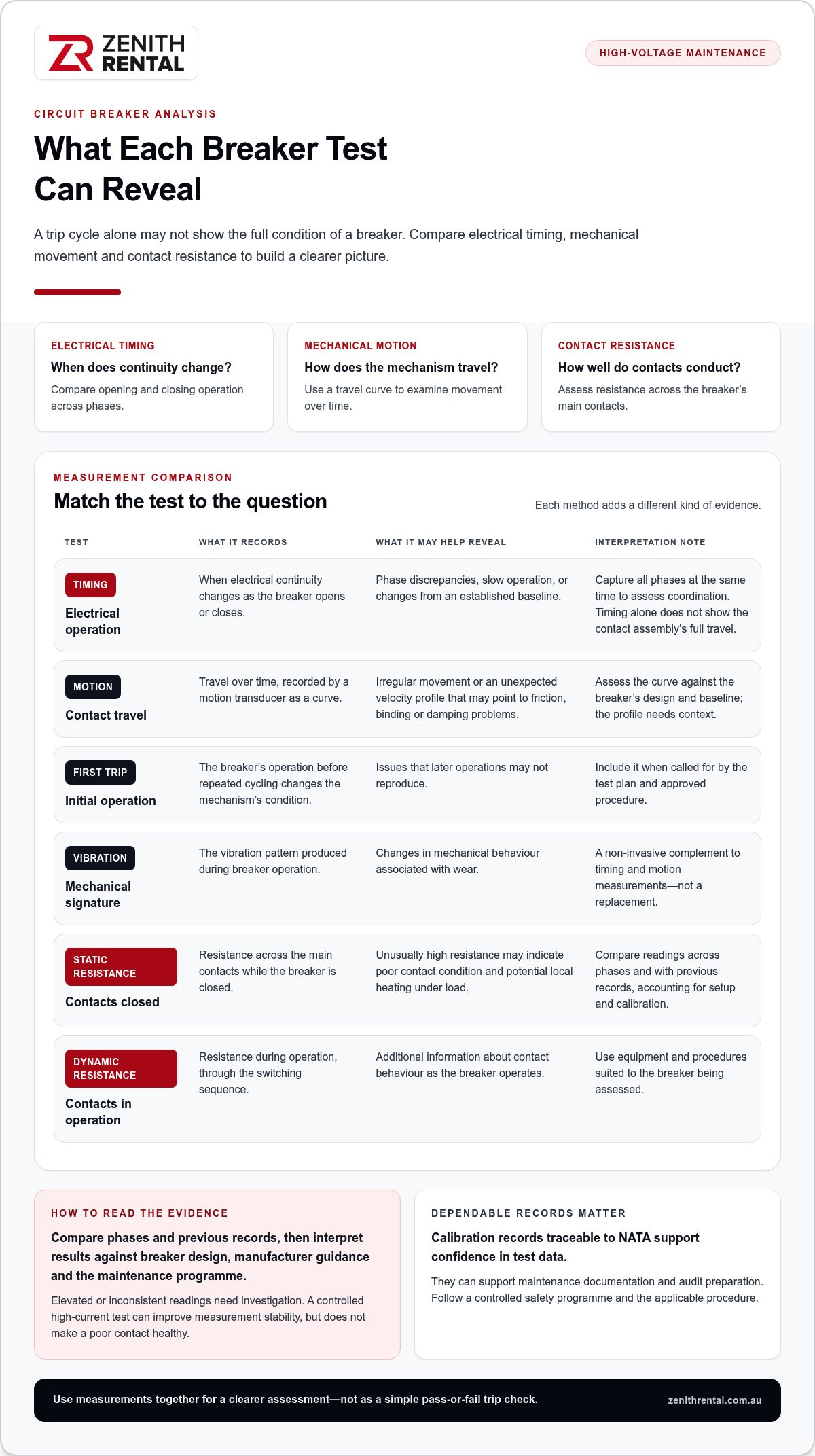
A breaker may complete a trip cycle and still show signs of deterioration. A useful assessment combines electrical timing with evidence of how the mechanism moves and how the contacts conduct. Where appropriate, vibration measurements can add another view of mechanical behaviour. Each test answers a different question, so select measurements according to the breaker design, maintenance history and approved procedure. The IEEE C37.09 standard test procedures provide a reference for circuit-breaker testing, alongside applicable Australian requirements and manufacturer guidance.
Electrical Timing vs. Mechanical Motion
Timing channels record when electrical continuity changes as the breaker opens or closes. Capturing all phases at the same time helps show whether they operate in coordination. Timing alone, however, doesn’t show the full travel of the contact assembly or explain why a phase operates slowly. A motion transducer records travel over time, producing a curve that can reveal irregular movement. An unexpected velocity profile may indicate friction, binding or damping problems, but it must be assessed against the breaker’s design and baseline.
First-trip testing can be informative because it records operation before repeated cycling changes the mechanism’s condition. When the test plan calls for it, the result can help identify issues that later operations may not reproduce. Vibration analysis provides another non-invasive view: sensors capture the mechanical signature of operation, which can help flag changes associated with wear. It complements timing and motion measurements rather than replacing them.
Advanced Micro-Ohm Measurement Techniques
Contact resistance testing measures resistance across the main contacts. Unusually high resistance can indicate poor contact condition and potential local heating under load. Static testing measures resistance with the breaker closed. Dynamic resistance measurement (DRM) records resistance during operation, providing additional information about contact behaviour through the switching sequence. Use equipment and procedures suited to the breaker being assessed.
A controlled high-current test current can improve measurement stability by reducing the influence of surface films and connection resistance. It doesn’t make a poor contact healthy, so elevated or inconsistent readings still need investigation. A Micro Milliohm Meter can provide supplementary low-resistance measurements when a separate instrument is required for contact assessment.
For a reliable diagnosis, compare readings across phases and with previous records, while accounting for test setup and instrument calibration. Circuit breaker analyzer hire gives maintenance teams access to specialist measurement equipment for planned testing without the burden of owning a dedicated instrument fleet.
The Economic Logic of Circuit Breaker Analyzer Hire vs. Capital Expenditure
Owning a specialised high-voltage test instrument can make sense when it has frequent, predictable use across a substantial asset base. For occasional maintenance campaigns or a large substation audit, circuit breaker analyzer hire provides access to the required instrumentation while leaving capital available for other infrastructure priorities. The decision is not simply about choosing the lowest immediate cost. Compare the full cost of ownership with the cost of hiring for the defined work.
Start with a total cost of ownership (TCO) comparison. Alongside the purchase price, include calibration, maintenance, storage, insurance, staff familiarity and the possibility that the instrument sits idle between testing programmes. Compare those costs with the hire period, logistics and equipment required for the scope. A clear test plan, informed by applicable procedures such as the IEEE C37.09 testing procedures, helps avoid investing in capabilities the team rarely uses.
Optimising Your Maintenance Budget
Hiring turns a substantial equipment purchase into a project-related operating expense, which can align spending with planned work and keep capital available for core assets. The tax treatment of hire and ownership depends on the business and its circumstances, so model cashflow with your finance team or tax adviser rather than assuming a universal tax advantage. For a one-off audit, compare the full hire cost with the ownership costs over the period the instrument would realistically serve.
Technology also evolves. Hiring lets a maintenance team select equipment for a particular test scope rather than relying indefinitely on an ageing instrument. For broad audits, planned hires can support work across multiple fronts without requiring a permanently expanded fleet.
NATA Calibration and Site Compliance
Calibration status matters when testing is due and instrument records need to be current. Ownership puts the scheduling and record-keeping burden on the organisation; hiring can reduce that internal workload. Zenith Rental hires specialised electrical testing equipment with NATA-traceable calibration, supporting dependable measurement and audit preparation. Retain the calibration documentation supplied with the instrument alongside test results, asset details and the maintenance record.
This documentation can make evidence easier to organise within a safety management system, but it doesn’t replace the organisation’s procedures or prove compliance by itself. Hiring also doesn’t automatically increase project capacity. Plan the instrument requirements, test sequence and crew capacity together. This helps align procurement with the work and keeps calibration evidence connected to the site record.
Selecting the Optimal Analyzer for Your Switchgear Portfolio
The right analyzer matches the breaker design and the tests required by the maintenance programme. Start by identifying whether the assets are medium-voltage distribution breakers or high-voltage transmission breakers, then review the manufacturer’s procedures and planned test scope. Check channel capacity against the number of breaks per phase so the instrument can capture the required measurements together and produce a complete test record.
Consider the connection method too. Dual-ground testing can suit workflows where the breaker remains grounded on both sides, but use it only with compatible equipment and procedures. It does not replace isolation, permits, risk assessment or other site safety controls. Finally, decide how results will be recorded. Software should support the test sequence, clear reporting and, where useful, comparison with historical data.
Matching Instrument to Breaker Type
Breaker technology shapes the test setup. GIS and SF6-insulated equipment may have restricted access and specific connection arrangements, so the analyzer and leads must suit the manufacturer’s procedure. Vacuum interrupters need particular attention to contact wear. Travel or wipe measurements, where specified, can help assess contact erosion and remaining service condition. For legacy air-blast and oil breakers, confirm the test method, connections and interpretation criteria against the equipment documentation. An analyzer can capture useful data, but technicians still need to understand the breaker’s operating design.
Technical Features for Field Efficiency
Field conditions also shape the practical choice. Battery-powered equipment may simplify work at substations without convenient power, while mains operation can suit sites with reliable power. Wireless transducers can reduce lead clutter and setup effort when their operation fits the site’s safety and test requirements. For reporting, a built-in printer provides a hard copy, while digital software can make it easier to store and trend results across maintenance cycles. Choose the format that fits how your team reviews, retains and shares test results.
Before arranging circuit breaker analyzer hire, prepare a concise equipment profile: breaker type, voltage class, breaks per phase, required timing, motion or resistance tests, connection constraints and reporting format. This makes it easier to match the instrument to the switchgear instead of choosing by brand or feature count alone. Zenith Rental hires high-precision circuit breaker analyzers as part of its specialist electrical test equipment range. Explore circuit breaker analyzer hire for your switchgear testing requirements.
Zenith Rental: Elevating Australian Industry Through Precision Instrumentation
Zenith Rental is an Australian-owned and operated specialist in electrical test equipment. For teams planning circuit breaker analyzer hire, a well-matched instrument and its calibration documentation are important parts of a considered testing programme.
Zenith Rental serves customers nationally with specialist testing equipment. Its range includes high-precision circuit breaker analyzers and equipment from brands such as Megger, Fluke and Transmille. NATA-traceable electrical test equipment supports confidence in measurement records, while calibration documentation contributes to site and audit preparation.
A considered hire plan starts with the switchgear, required measurements, test schedule and reporting needs. Sharing those details helps align instrument selection and the hire period with the project scope, whether the work involves a planned maintenance window or a broader audit. This is more effective than treating a specialist instrument as a generic item.
Unrivalled Technical Expertise
Successful HV testing depends on matching the instrument to the task and following applicable procedures. Zenith Rental specialises in high-value calibration and measurement equipment. The project team remains responsible for safe work planning and interpreting test results. For programmes with other measurement requirements, the equipment range also includes pressure and dielectric testing instruments, such as Druck pressure controllers and Hipot testers.
For a multi-stage project, coordinating related equipment can simplify planning and support consistent test records. Align the requested instruments and hire dates with the work sequence, then retain the supplied calibration documentation with the relevant site records.
Secure Your Next Project with Zenith
Before arranging equipment, prepare a concise brief with the breaker types, tests required, site conditions, schedule and documentation needs. These details create a clear starting point for circuit breaker analyzer hire and help match the instrument to the planned work. Zenith Rental serves industrial projects across Australia with specialist test equipment.
Explore test equipment hire at Zenith Rental and plan your next project around instrumentation suited to the task.
Put Precision at the Centre of Your Next Test Programme
Dependable breaker assessment starts with an analyzer suited to the switchgear and a test plan that combines timing, motion and resistance measurements where required. Hiring provides access to specialist equipment for planned work without the ongoing demands of maintaining a private fleet. Keep calibration records and test results together to support maintenance decisions and audit preparation.
Zenith Rental provides specialist electrical test equipment to projects across Australia. NATA-traceable calibration supports measurement confidence, and the instrument’s documentation can form part of the testing record.
Choose circuit breaker analyzer hire with care: match the instrument to the breaker, prepare the required connections and define how results will be recorded. Explore circuit breaker analyzer hire at Zenith Rental and plan your next test programme with equipment suited to the work.
Frequently Asked Questions
What is the difference between primary and secondary injection testing?
Primary injection passes test current through the primary circuit, including the breaker’s current path, while secondary injection applies signals to the protection relay’s secondary inputs. Primary testing can assess more of the installed current path and connected components; secondary testing focuses on relay and trip-circuit response. They serve different purposes, so specify which functions need verification in the test plan rather than treating one method as a substitute for the other.
Why is NATA calibration essential for circuit breaker analyzers in Australia?
NATA-traceable calibration provides documented evidence that an instrument’s measurements relate to recognised measurement standards through a traceability chain. This supports confidence in timing, motion and resistance results used for maintenance decisions and audit records. It doesn’t certify a test, establish compliance or replace site procedures. For circuit breaker analyzer hire, review the instrument’s calibration documentation and ensure it is appropriate to the measurements being recorded.
Can circuit breaker analyzers be used on both MV and HV switchgear?
Yes, analyzers can be used for both medium-voltage and high-voltage switchgear when the instrument, connections and test method suit the breaker and its operating mechanism. Voltage class alone doesn’t determine compatibility. Breaker design, number of breaks per phase, required test channels and the manufacturer’s procedure all matter. Check the test plan and instrument configuration against the equipment documentation before starting work.
What are the safety benefits of Dual Ground testing during analysis?
Dual Ground testing is designed to allow certain breaker tests while earth connections remain applied on both sides, reducing the need to remove grounds for the test when the method and equipment support it. This can reduce exposure to hazards associated with changing grounding arrangements. It doesn’t make testing inherently safe or replace isolation, permits, risk assessment, approved procedures or instrument-specific instructions. Only trained personnel should perform the test.
How do I interpret a motion curve on my analyzer report?
A motion curve plots contact travel against time during breaker operation, often alongside velocity information. Review its shape, travel and velocity against the manufacturer’s criteria and the asset’s historical baseline. Irregular movement, an unexpected pause or a changed velocity profile may indicate friction, damping or mechanism concerns, but no single curve feature proves a fault. Check the test setup and transducer placement, then interpret the findings alongside timing and other inspection results.
What is the typical lead time for national delivery of a circuit breaker analyzer?
Plan delivery and setup as part of the project schedule, particularly when testing must take place within a defined outage or maintenance window. Include the required analyzer, accessories and calibration documentation in the equipment plan, and allow time for the instrument to be ready before testing begins. Zenith Rental serves customers nationally with specialist test equipment.
Does hired equipment include all necessary transducers and cables?
The accessories required depend on the analyzer configuration and breaker tests. A complete setup may need timing leads, motion transducers, resistance connections and suitable cables, but not every test uses the same combination. Prepare an equipment list based on breaker type, test sequence, channel requirements and connection points. This helps assemble a compatible setup and avoid arriving on site without a required component.
What happens if I need technical support while on-site with a hired analyzer?
If a setup or reading is unclear, pause the test and follow site safety procedures before making changes. Review the instrument instructions, connection diagram and approved test procedure, then document the issue and test conditions. Include technical support planning in the project preparation. Don’t improvise connections or treat an unfamiliar result as acceptable; follow the project’s established technical and safety channels.